
" We don't sell the wine without touching the vine "
| BUY MORE! SAVE MORE! | ||||||||||||||||||||
|
| Country: | France |
| Regions: | Rhone Cote Rotie |
| Winery: | Saint Cosme |
| Grape Types: | Grenache Syrah |
| Organic: | Yes |
| Vintage: | 2023 |
| Bottle Size: | 750 ml |
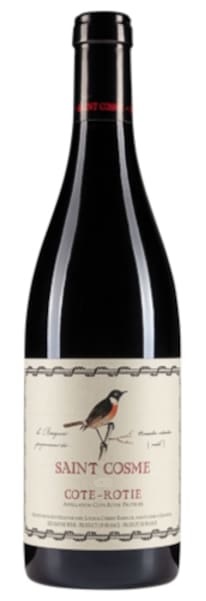
On the palate, it reveals a fresh attack followed by an ample, structured, long-lasting finish. The wine unfurls in successive stages and ends with top-quality tannins produced by whole cluster fermentation. It features aromas and flavors of smoked ham, violet, graphite, graphite, and licorice.
Syrah, with its deep flavors and firm tannins, is a natural match for grilled or smoked meat and dishes featuring herbs, roasted mushrooms, and onions. Seared venison or beef with black pepper and thyme or a Moroccan tagine of pigeon or chicken are complimented by the spicy characteristic of Syrah.
Review:
This refined, graceful version is winey, offering steeped currant flecked with bacon fat, dried leaves, white pepper and mocha. Streaming and fluid in feel, with salty, mineral intensity building toward the long, elegant finish, which shows polished tannins. Though drinking beautifully now, this will benefit from time in bottle. Best from 2026 through 2038.
-Wine Spectator 94 Points
Château de Saint Cosme is the leading estate of Gigondas and produces the appellation’s benchmark wines. Wine has been produced on the site of Saint Cosme since Roman times, evident by the ancient Gallo-Roman vats carved into the limestone below the château. The property has been in the hands of Louis Barruol’s family since 1490. Henri and Claude Barruol took over in 1957 and gradually moved Saint Cosme away from the bulk wine business. Henri was one of the first in the region to work organically beginning in the 1970s. Louis Barruol took over from his father in 1992, making a dramatic shift to quality, adding a négociant arm to the business in 1997, and converting to biodynamics in 2010.
The estate is in the heart of Gigondas where 15 hectares of vineyard grow in the shade of the Dentelles de Montmirail. The limestone that distinguishes Gigondas from other southern Rhône appellations is visible on the jagged cliffs of the Dentelles. In addition to Gigondas and the old-vine selection Gigondas Valbelle, three single-vineyard Gigondas are produced: Hominis Fides, Le Claux, and Le Poste. Louis Barruol owns an additional 10 hectares of vineyard in Violès outside of Gigondas to produce Les Deux Albions Blanc IGP. Côtes-du-Rhône Les Deux Albions Rouge and Le Poste Côtes-du-Rhône Blanc round out the estate offerings and are labeled as “Château de Saint Cosme.” Little James’ Basket Press, Châteauneuf-du-Pape, and northern Rhône appellations are from contracted growers and are labeled “Saint Cosme.”
Louis Barruol’s style combines the region’s typical ripeness with freshness, an elusive quality in the warm climate of the southern Rhône. One of the keys to freshness is the use of stems for their red wines. The stems absorb alcohol during fermentation and help retain acidity and tannin. Red wines are made by spontaneous fermentation. Louis prefers cement tanks or mostly used 228-liter Burgundian pièce for élevage with just a few traditional demi-muid for his whites. The négociant wines are transported to Gigondas in casks to avoid racking and unnecessary exposure to oxygen. Reds are bottled unfined and unfiltered. “I want to make wines which express their terroir with purity and personality. I want balanced wines with a great ability to age,” says Louis Barruol.

Ridge's Geyserville is one of California's iconic field-blend reds, drawn from century-old vines in Sonoma's Alexander Valley. Zinfandel-led, with Carignane and Petite Sirah, it is made in Ridge's signature natural-yeast, American-oak style — vivid, spicy and built to age.
Review:
Tasted from tank just prior to bottling, the 2024 Geyserville is one of the very best Geyservilles I've ever tasted. It's weightless and elegant but supremely concentrated and packed to the gills with intense flavor. Rich blue fruit, incense, crushed rocks and deeply pitched spice tones march with gravitas from open to close. What a sensational edition of this wine.
Vinous (Billy Norris) 97 Points

All older vintage wines have been purchased from a single collectors cellar. Pictures can be requested before shipment.
All older vintage wines have been purchased from a single collectors cellar. Pictures can be requested before shipment.

Chateau de Saint Cosme Gigondas Le Claux is made from 95% Grenache, 5% Syrah.
Château de Saint Cosme is the leading estate of Gigondas and produces the benchmark wines of the appellation. The property has been in the hands of the Barruol family since 1490. Louis Barruol took over from his father in 1992 making a dramatic shift to quality and converting to biodynamics in 2010.
Château de Saint Cosme Gigondas Le Claux is the estate’s oldest vineyard and sits near the entrance to the winery. “It was first planted in 1870 following phylloxera. My uncles thought it wasn’t producing enough fruit and planned to uproot it in 1914,” says Louis Barruol, but “World War I interrupted that plan.”
The 1.8-hectare Le Claux—meaning “Clos” in old French—is a field blend of predominately Grenache. Louis Barruol believes 10% of the vineyard is from the original 1870 planting. Vines are replaced by massal selection and the average vine age is 60-years. The wine is made with whole cluster fermentation from indigenous yeasts, is aged in 20% new 228-liter barrels, and bottled without fining or filtration.
Tasting Notes
Brilliant violet color. Displays pungent, mineral- and spice-accented cherry, black raspberry, potpourri and licorice aromas, along with hints of savory herbs, vanillo and incense. Chewy and tightly focused on the palate, offering bitter cherry, dark berry and Moroccan spice flavors that unfurl slowly through the back half. It closes with firm tension, chewy tannins and excellent tenacity, leaving resonating cherry and floral notes behind. All barriques, a third of them new.
-Vinous 95-97 Points
Review:
-Josh Raynolds (Vinous) 97 Points
-Yohan Castaing (Robert Parker) 95 Points
-Nicolas Greinacher (Vinous) 94 Points
-Jeb Dunnuck 94 Points

Chateau de Saint Cosme Gigondas is made from 70% Grenache, 15% Mourvèdre, 14% Syrah, 1% Cinsaut.
The wine shows intense blackberry and fig fruit with licorice, violets, and charcoal on the finish. It is remarkably fresh and finessed given the sun and warmth of the southern Rhône. The unique micro-climate combined with 60-year-old vines and traditional winemaking make Château de Saint Cosme Gigondas the benchmark wine of the appellation.
Review:
-Josh Raynolds (Vinous) 94 Points
-Jeb Dunnuck 93 Points
-Wine Enthusiast 92 Points

Hominis Fides is typically the most elegant of Château de Saint Cosme’s three single-vineyard Gigondas. “Grenache grown in the sandy soil produces marvelously textured wines as well as extremely refined tannins; a very special and stylish wine,” says Louis Barruol. The wine features aromas and flavors of pepper, truffle, graphite, and smoke.
Grenache is the pale-colored, red-fruited, and potpourri-scented red grape variety of the southern Rhône and can be paired with both rustic and sophisticated dishes. Full-bodied Grenache-based wines are ideal with stews, braises, and grilled meats, while lighter versions can work well with dark fish and tomato-based dishes such as ratatouille.
Review:
-Josh Raynolds (Vinous) 97 Points
-Yohan Castaing (Robert Parker) 95 Points
-Nicolas Greinacher (Vinous) 94 Points

Le Poste’s cool microclimate and limestone soil make it one of Saint Cosme’s most structured, aromatic, and mineral intense wines of the estate. This wine always walks a knife's edge of power and finesse thanks to its deep fruit and precise structure. The wine features aromas and flavors of iodine, violet, pepper, and ash.
Grenache is the pale-colored, red-fruited, and potpourri-scented red grape variety of the southern Rhône and can be paired with both rustic and sophisticated dishes. Full-bodied Grenache-based wines are ideal with stews, braises, and grilled meats, while lighter versions can work well with dark fish and tomato-based dishes such as ratatouille.
Review:
-Josh Raynolds (Vinous) 97 Points
-Yohan Castaing (Robert Parker) 96 Points
-Nicolas Greinacher (Vinous) 95 Points

On the palate, it reveals a fresh attack followed by an ample, structured, long-lasting finish. The wine unfurls in successive stages and ends with top-quality tannins produced by whole cluster fermentation. It features aromas and flavors of smoked ham, violet, graphite, graphite, and licorice.
Review:
A refined, fine-textured and precise Cote-Rotie with aromas of cherries, wild berries, wild herbs, bark and baking spices. Medium-bodied with finely grained tannins. There is a vibrant and spicy character at the center, with a succulent, precise and lively expression toward the long finish. Try after 2026.
-James Suckling 95 Points

At Saint Cosme, their white wine traditions are as important and time-honored as the reds. The Clairette grape variety has found the ideal place to express itself in the cool, limestone valley of Saint Cosme. Produced by massal selection from the Le Poste vinevard, the Clairette for Hominis Fides thrives in Miocene limestone sand. Its aromas of fennel and grapefruit usher in its finely textured palate, imparting it with substantial agability.
Review:
-Joe Czerwinski (Robert Parker) 93 Points

Beatus began with a dream and a friendship. Our dream was to make wine in Châteauneuf du Pape, one of the first regions to inspire the desire to pursue winemaking in general, and of working with Grenache in particular.
We developed a long-standing friendship with Anne-Charlotte Melia-Bachas, Proprietor of Chateau de la Font du Loup, who approached us with the idea to craft a wine together a number of years ago.
This has all come to fruition with Beatus, a wine that we have decided to make ongoing, every year — since tasting the exciting results of the first vintage in barrel.
The vineyard parcel selected for this wine is a single plot of 80-year old Grenache at the top of La Crau in Châteauneuf du Pape, the highest location in the AOC. It sits on a north-facing slope that helps guard against the sometimes intense summer heat that can affect the surrounding areas.
This plot is called “Le Poteau” and has been generously granted to us by Anne-Charlotte as the core of this wine, with supplementation of Syrah and Mourvèdre from surrounding parcels also grown on the Chateau de la Font du Loup estate, to round out the blend.
The winemaking is directed by myself and carried out by Anne-Charlotte, Stéphane Dupuy d’Angeac and their team. It is our hope to bring you one of the finest expressions of Grenache from this special region each and every vintage.
Yields from this block are very small due to the age of the vines, therefore only up to 100 cases of Beatus will be produced each year, depending on the conditions of the vintage.
Our first release was in November of 2022.
– Winemaker Todd Alexander
Review:
Made in collaboration with Chateau de la Font Du Loup, the 2020 Beatus is an extraordinary bottling that rivals some of the top wines of this region. The nose is hugely perfumed with red rose petals, potpourri, sage and shades of red currants. The palate displays the same level of concentration as it does on the bouquet. Beautiful guava and ripe strawberry fruits parade with copious minerals and a sinfully good texture on the palate. Fresh and vibrant, this is just sensational stuff to enjoy in its heady youth.
Owen Bargreen 97 Points

Collemattoni Rosso di Montalcino is made from 100% Sangiovese.
Color: intense ruby red. Bouquet: violet flowers, black cherry and wild black fruits. Taste: warm, dry and with good balance. The fruit comes from a parcel of 8-13 year old vines planted in sandy clay and marl soils; harvest is 100% destemmed with a soft pressing, fermented in temperature-controlled stainless steel at 28-30°C, with 20-25 days of skin-contact maceration using the rack-and-return (delestage) technique. Malolactic complete; lightly filtered before bottling.
Pairs with steak, pheasant and strong cheese.
Review:
-James Suckling 92 Points



