" We don't sell the wine without touching the vine "
| BUY MORE! SAVE MORE! | ||||||||||||||||||||
|
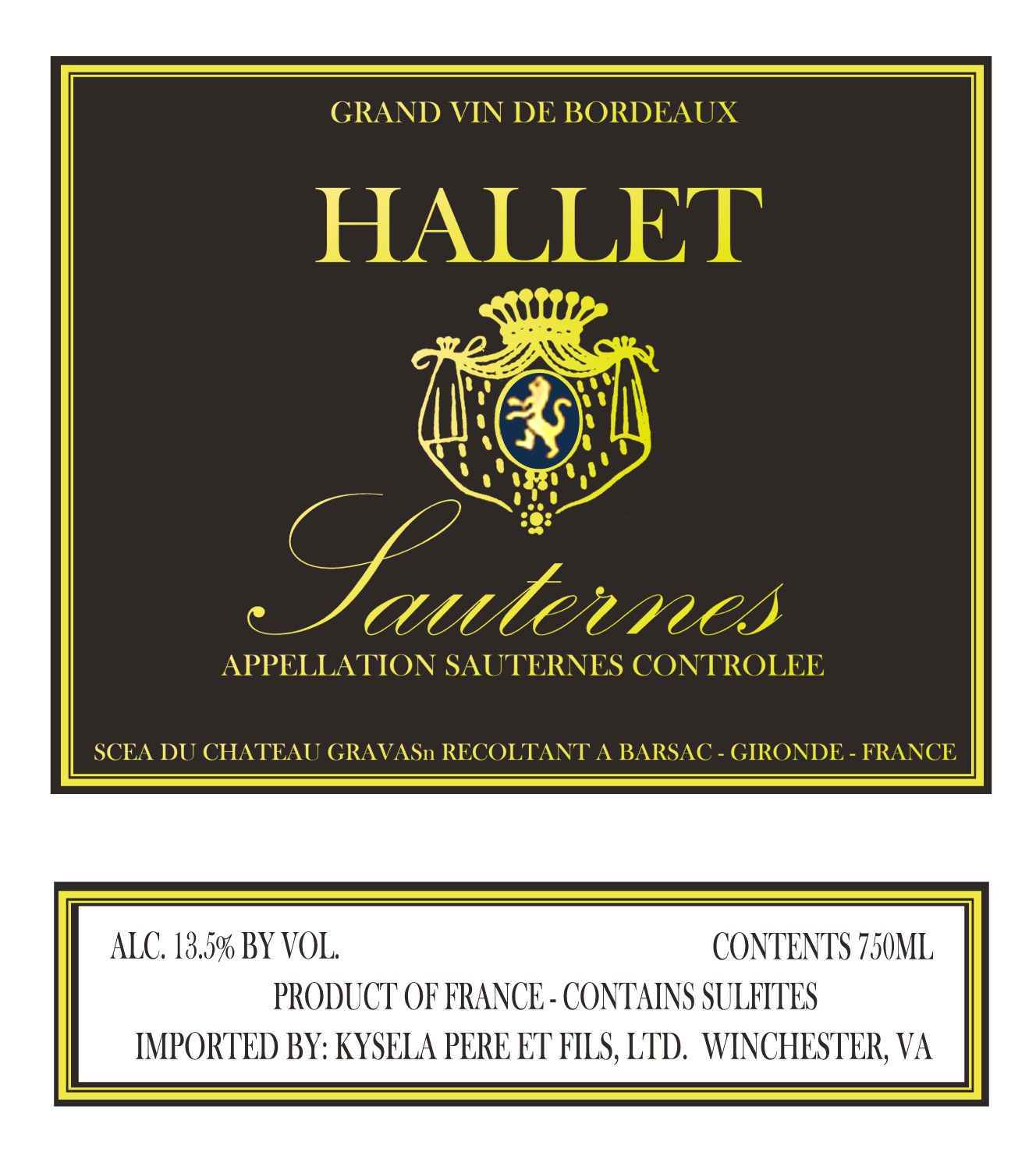
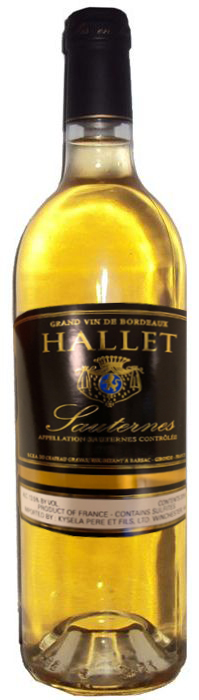
Chateau Hallet Sauternes 2022 is made from 100% Sémillon.
This classic Sauternes shows delicate aromas of honey, citrus, candied fruit and acacia. The 375ml half bottle is an ideal pour for two — a match not only for desserts but also for foie gras, roast meats and blue cheeses, and a delicious aperitif served well chilled.
The Hallet Estate
Chateau Hallet is located in Sauternes, and is a Michel Bernard family rental system vineyard. This family also owns Chateau Gravas, Sauternes.
The Hallet Vineyard
The vineyard is 5 hectares (13 acres) total. The soil is a mix of clay and limestone. The 30 year-old vines are harvested by hand: the grapes are picked in successive passes. The wine matures in stainless steel tank and no oak is used.
The production is 1,250 cases / year on average.

Chateau Hallet Sauternes is made from 100% Sémillon.
Golden in the glass, it offers delicate aromas of honey, citrus, candied fruit and acacia blossom. Lusciously sweet yet beautifully balanced, it is a natural match for foie gras, roasted meats and blue cheeses — and makes a gorgeous aperitif served well chilled.

Chateau Pitray Castillon Cotes de Bordeaux Le Grand Vin is made from 90% Merlot and 10% Cabernet Franc.
Notes of candied fruit, dried figs, currants marked by their delicacy despite the sensation of great maturity. On the palate, we find this aromatic range with present but very velvety tannins.
Ageing: partially in new oak barrels, partially 1 and 2 years old barrels and stainless steel tanks.Vinification: thermo-regulated concrete tank.
2 other grape selection including one handed, before filling the tanks.
Harvest: last generation harvesting machine with on-board grape selection.
Review:
-James Suckling 92 Points
-Jeff Leve, The Wine Cellar Insider 92 Points
-Jeb Dunnuck 91 Points
-Andreas Larsson - Tasted 91 Points

Chateau Pitray Castillon Cotes de Bordeaux Les Prairies is made from 75% Merlot, 23 % Cabernet Franc and 2 % Malbec.
Notes of ripe fruit and black tea leaves, it is a young but accomplished wine, ready to drink, whose tannins are already very well integrated.
Review:
-James Suckling 93 Points
-Jeb Dunnuck 90 Points
-Vinum Wine Magazine 90 Points

Chateau Lascombes Margaux is made from 67% Cabernet Sauvignon, 30% Merlot, 3% Petit Verdot and Cabernet Franc.
An Earth Mother, with velvet-lined blackberry, Bay leaf, graphite, and roasted coffee bean. Chalky tannins grip the teeth, with a dusty grip. From its backbone and vibrant acidity, to its notes of dried violets on the finish, we bow to its elegant nature.
- The Somm Journal, Apr/May 2025 97 Points
Precise, brilliant and engaging, a three-dimensional wine that shows itself in all its splendor. Notes of black cherries, mixed plums, mixed flowers and bergamot describe the secondary scene. Lemon peel and ginger the secondary one. Full body, perfectly extracted tannins and a vertical finish of infinite presence. Better from 2029.
-WineCritics.com 97 Points
Based on 67% Cabernet Sauvignon, 30% Merlot and the rest Petit Verdot and Cabernet Franc, the 2022 Château Lascombes pulls from 40% of the total production and was aged 18 months mostly in barrels (60% new) with a small portion in foudre. This inky hued beauty boasts a rich, concentrated, full-bodied, well-oaked style as well as pure cassis and darker berry fruits, some graphite, scorched earth, and licorice nuances, terrific overall balance, and a great finish.
-Jeb Dunnuck 96+ Points

Clos Saint-Jean is a 41-hectare estate in Châteauneuf-du-Pape run by brothers Vincent and Pascal Maurel. Considered by many critics and wine-writers as the preeminent estate espousing the modern style of winemaking in Châteauneuf, this cellar is one of the oldest in the region, having been founded in 1900 by the greatgreat-grandfather of Vincent and Pascal, Edmund Tacussel. A short time after its founding and well before the AOP of Chateauneuf-du-Pape was created in 1923, Edmund began bottling estate wines in 1910.
The farming at Clos Saint-Jean is fully sustainable due to the warm and dry climate, which prevents the need for chemical inputs. Instead, Vincent and Pascal employ organic methods for pest control, mainly pheromones, to prevent pests from taking up residence in their vines, a process called amusingly enough in French, confusion sexuelle. The vines tended manually, and harvest is conducted in several passes entirely by hand.
Deus ex Machina is a literary and dramatic term for a miraculous intervention that interrupts a logical course of events in a plot or play. A suitable name for a cuvée that had it’s start in the torrid vintage of 2003 when Philippe Cambie and Vincent Maurel made the decision to harvest at the end of September, weeks after their neighbors. Deus ex Machina is a blend of old vine Grenache from La Crau, aged in tank with equally ancient Mourvedre from the sandy soils of BoisDauphin aged in demi-muid. Deus ex Machina is only made in the best vintages.
Review:
Lastly, the 2022 Châteauneuf Du Pape Deus-Ex Machina shows a similar profile to the Combes des Fous, yet it brings another level of tannins and concentration. Kirsch liqueur, white flowers, sandalwood, cured meats, and graphite notes all shine here, and it's full-bodied, has a deep, layered, powerful, yet weightless profile, lots of ripe tannins, and a blockbuster of a finish. This ripe, sexy, seamless, incredibly impressive beauty will compete with anything in the vintage. As usual, this cuvée is 60% Grenache and 40% Mourvedre, which is brought up in roughly 40% new demi-muids.
Review: Jeb Dunnuck 97 Points

Grand Veneur Chateauneuf du Pape Rouge Le Miocene is made from 70% Grenache, 20% Syrah, 10% Mourvèdre .
An intense dark-ruby color. The nose develop aromas of ripe black fruit (such as blackberry), cherry and spice box. The palate reveals the presence of tannins, in high quantity and elegant. The finish is long and luxurious. This is the Châteauneuf du Pape expression, displaying all the characteristics of the terroir.
Soil type: Plots are located northern part of Châteauneuf du Pape and the vines are grown under organic process.The soil is marked by the violence wrought by the Rhone river. It consists of a layer of marine molasses of the Miocene period covered by alpine alluvium. The presence of a great number of rounded stones known as "galets" in the earth is evidence of the time when the Rhone, then a torrent, tore fragments of rock from the Alps and deposited them on the plain. The GRAND VENEUR cuvee will express year after year a great power and aromatic complexity.
Winemaking & ageing: Harvest is sorted by hand, destemmed and crushed. Fermentation temperature is controlled at 30°C. Vatting period of 18 to 20 days. Matured in vats and oak casks.
Review:
-Yohan Castaing (Robert Parker) 94 Points
-Jeb Dunnuck 93 Points
-Decanter World Wine Awards 93 Points
-James Suckling 92 Points

Ferren Chardonnay Sonoma Coast is made from 100 percent Chardonnay.
The Sonoma Coast bottling is a blend of barrels from Ferren's single vineyard offerings; Lancel Creek, Silver Eagle, Volpert, and Frei Road Vineyards. The wine is always somewhat more approachable early in its life as less new oak is used in the blend. Pure and translucent fruit is the hallmark of this cuvée. Citrus, quince, sea spray, and minerals are buoyed by refreshing acidity and a seamless finish.
Review:
-James Suckling 97 Points
-Jeb Dunnuck 94 Points
-Wine Spectator 94 Points

Double Diamond by Schrader Napa Valley Sauvignon Blanc is made from Sauvignon Blanc.
Schrader Cellars, founded by Fred Schrader, is one of Napa Valley's most sought-after names, famed for its cult Cabernets from the Beckstoffer To Kalon Vineyard. Double Diamond is Schrader's more approachable label, and this Napa Valley Sauvignon Blanc carries that same attention to detail into a bright, aromatic white. Expect vivid citrus, white peach and melon, a crisp line of acidity, and a clean, mineral finish. Vinted and bottled by Schrader Cellars.