
" We don't sell the wine without touching the vine "
| BUY MORE! SAVE MORE! | ||||||||||||||||||||
|
| Country: | France |
| Region: | Chateauneuf du Pape |
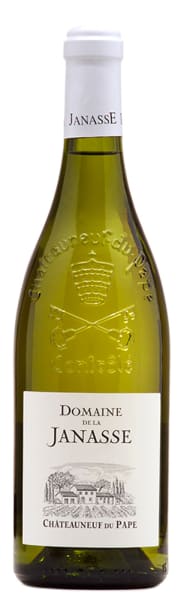
| Winery: | La Janasse |
| Grape Type: | Roussanne |
| Vintage: | 2024 |
| Bottle Size: | 750 ml |
Domaine de la Janasse has been in the Sabon family since 1967, today run by siblings Christophe and Isabelle. Their Châteauneuf-du-Pape Blanc — Roussanne-led, with Grenache Blanc and Clairette — is consistently one of the finest whites in the appellation, combining richness with purity and the ability to age for two decades.
Review:
Based on 70% Roussanne and 15% each Grenache Blanc and Clairette and aged 12 months in 20% new French oak with the balance in used barrels and concrete. It has a medium gold hue and delivers remarkable intensity in its ripe stone fruits, fresh croissant, honeyed flowers, and orange blossom nuances. It's medium to full-bodied, has a pure, seamless, layered mouthfeel, beautiful balance, and a fabulous finish that will evolve for 20+ years if well stored. Drink 2025-2045.
Jeb Dunnuck 98 Points
-Jeb Dunnuck 91 Points
Aimé, the founder
In 1967, Aimé Sabon came back from his military service. He took over his father’s vines, who used to take his grapes to the wine cooperative. In 1973, Aimé built his own cellar. Domaine de la Janasse was born and named after the family farm that was in Courthézon, in the locality of “La Janasse”. Aimé was ambitious. He knew he had fabulous soil and he wanted to expand the estate by acquiring new plots. From 15 hectares at the very beginning, La Janasse has now reached more than 90 hectares.
From father to children
In 1991, after a technical diploma in viticulture and oenology in Beaune, and another one in marketing in Mâcon, Christophe Sabon –Aimé’s eldest son– came back to La Janasse where he was given the keys to the cellar. From then different cuvees were developed, new markets conquered. In 2001, Isabelle –Aimé’s daughter– graduated as an oenologist from the University of Toulouse, and joined the team. With Hélène, Aimé’s wife, the family was reunited again in La Janasse.

I feel this wine expresses the greatness of California and its hidden pockets where Cabernet can excel. The cold Pacific Ocean running the entire length of the state presents maritime influences – and with each small distance eastward the climate warms. Stony soils, south facing slopes and moderately warm conditions are the keys to producing dark, rich and good tasting Cabernet.
A small release from Caymus Vineyards, this wine is a California-appellation Cabernet Sauvignon – supple, dark and rich, bearing the signature hallmarks of Caymus. It is sourced from sites throughout the state which feature climatic conditions, soils and topography that are ideally suited to Cabernet. This project stems from excitement over California's diverse vineyard land, often in lesser-known areas, with the potential to produce exceptional Cabernet.

Bachelet Bertrand Chassagne Montrachet Blanc is made from 100 percent Chardonnay.
The Chassagne-Montrachet appellation is located in the southern part of the Côte de Beaune and produces mainly white wines. The vineyard faces east, with varied soil types, characterized by the presence of iron oxide, which gives a red-brown color to the soil.
Bachelet Bertrand Chassagne-Montrachet is produced from two villages, La Canière and Les Lombardes.
The wine offers a golden color, a soft, floral nose with spicy notes. On the palate, the wine is ample and harmonious, combining freshness and tension.
Pairs well with fish (especially salmon) or white meat in sauce (poultry, veal).

Louis M. Martini The Gryphon Napa Valley Cabernet Sauvignon 2023 is made from Cabernet Sauvignon.
The Gryphon takes its name and its crest from the mythical creature that is the traditional symbol of Genoa, the Italian port city where Louis M. Martini was born and from which he set sail for America in 1899 at just twelve years old. The three sections of the gryphon's tail stand for the three generations of Martinis — Louis M., Louis P. and Mike — who built the family's legacy across more than ninety years in Napa Valley.
Six years in the making, The Gryphon is a deliberate return to the classic Napa Cabernet of the 1960s and 1970s: varietal, energetic and alive. Fruit is drawn from premier vineyards across the valley — among them William Hill, Monte Rosso and Stagecoach — and the wine is crafted in the same small-lot cellar used for the winery's flagship Lot No. 1. A blend led by 82% Cabernet Sauvignon, rounded out with Cabernet Franc, Merlot and Malbec, it is layered, structured and built for the table. Boysenberry and blackberry open the glass, lifted by dried mint, fennel and a whisper of jasmine, over a core of cool mineral and cocoa from fresh French oak.
Review:
"This is super-classic Napa Valley Cabernet Sauvignon: inky black-fruited yet bright, layered with sagebrush, tobacco, violets and loamy earth."
Decanter, 97 points

Grand Veneur Chateauneuf du Pape Blanc Le Miocene is made from 60% Clairette, 40% Roussanne
Pale yellow colour with hints of green, aromas of white flowers (may blossom, honeysuckle).
The palate is pleasantly balanced between liveliness and roundness, which brings out characteristics of dried apricot, honey and elderberry. A Châteauneuf du Pape white displaying a great finesse.
Best between 1 and 8 years.
Soil type Coming from the single vineyard named “La Fontaine”, the plot is facing north.It is made of clay-sand and limestone. Thanks to the northern orientation, it is always very well aired. This sector allow the Roussane and Clairette to mature in great conditions without losing freshness, which we believe is key point. Winemaking & ageing Whole-bunch pressing. Vinification in stainless-steel tanks. Fermentation temperature controlled at 15°C.
Review:
-Nicolas Greinacher (Vinous) 92 Points

Fragrant aromas of yellow peach and ripe melon are found on the nose, interspersed with bright citrus notes. These continue on the palate with notes of creamy vanilla and buttery nuances on the long finish. Rombauer's signature bright acidity is evident throughout each sip, balancing the softness of the midpalate.
Pairings for this wine include crab cakes, barley risotto, and strawberry shortcake.
Review:
"Layers of citrus, yellow apples, pastry and stone fruit with an underlying smoky, saline edge, showing freshness underneath the power. The rich palate offers a rounded mouthfeel and a bright line of acidity that cuts through the generous texture. Full-throttle with weight and depth, but very enjoyable old-vine character from 1982. Drink or hold."-James Suckling 93 Points

Mordoree Lirac Blanc Reine des Bois is made from 30% Grenache, 20% Clairette, and 15% each Viognier, Roussanne, and Marsanne, as well as splashes of Picpoul and Bourboulenc.
Color : green gold
Aromas : white fruits, peach, apricot, pear, violet.
Palate : rounded, long finish, highly flavoured.
Ageing Potential : 4-5 years.
Surface : 4 Ha. Yield : 35 Hl./Ha. Vineyard age : 30 years Terroir : Clay / chalk with pebble stones. Harvest : by hand Vinification : skin maceration and direct pressing with temperature control. Fermentation : oak barrel fermentation for 25% of the total volume
Pairs well with appetizers, fish, seafood.
Review:
-Yohan Castaing (Robert Parker) 92 Points

Domaine de la Janasse Chateauneuf-du-Pape Cuvee Chaupin is made from 100 percent Grenache.
Chaupin is Domaine de la Janasse's single-parcel expression of old-vine Grenache, drawn mostly from the sandy-soiled Chapouin lieu-dit with smaller parts from La Crau and Janasse, some of the oldest vines planted in the early twentieth century. The Sabon family has run the estate near Courthezon since 1967 - today the brother-and-sister team of Christophe and Isabelle - and Janasse stands among Chateauneuf-du-Pape's benchmark producers. Partially destemmed and aged twelve months in foudre and demi-muids, Chaupin is the purest, most perfumed side of Grenache in its homeland.
Review:
All Grenache sourced mostly from the Chapouin lieu-dit with a splash from Janasse, the 2023 Châteauneuf Du Pape Cuvée Chaupin shows a medium ruby hue followed by a pretty, perfumed, remarkably elegant profile. It has a core of sweet red and black berry fruits, absolutely heavenly Provençal aromatics of herbes de Provence, black olive, pepper, and flowers, plus ripe, velvety tannins, flawless balance, and a great finish. Partially destemmed and aged 12 months in 70% foudre and 30% demi-muids, this heavenly 2023 will drink beautifully over the coming two decades. There are roughly 1,500 cases produced. Drink 2025-2045.
-Jeb Dunnuck 99 Points

Domaine de la Janasse Chateauneuf-du-Pape Cuvee Vieilles Vignes is made from 65% Grenache, 20% Mourvèdre, 10% Syrah, 5% divers.
In contrast to Chaupin, which is made from old-vine Grenache on sandy soils, the cuvée Vieilles Vignes is from old vines of Grenache, Mourvedre, Syrah along with smaller percentages of other permitted varieties that are grown in these old vineyards. The wine is sourced from 4 terroirs: pebbly clay, sand, gravelly red clay and sandy limestone. Vieilles Vignes is always the most powerful and concentrated Châteauneuf-du-Pape cuvée made at Domaine de la Janasse.
Review:
-Wine Advocate 96 Points

Color : pale gold
Aromas : subtle with notes of white fruit and flowers
Mouth : balanced, fresh and mineral
TA: 3.0 g/L
RS: 1.5 g/L

All older vintage wines have been purchased from a single collectors cellar. Pictures can be requested before shipment.

Mordoree Cotes du Rhone Dame Rousse Rose is made from 40% Grenache, 35% Syrah, 15% Cinsault, 5% Carignan, 5% Mourvèdre
Domaine de La Mordoree Cotes du Rhone Rosé is produced from organically and biodynamically farmed vineyards. This dry, crisp, light, salmon-colored offering exhibits fruity aromas of strawberry and raspberry, citrus fruits and floral notes. It is round, fresh and well-balanced in the mouth, with a long finish.
Food pairing: cold meats and delicatessen, fowl, white meats, grilled lamb with Provence herbs, fish soup, fried fish, pastas, pizzas and all Asian dishes.

Delas Hermitage Domaine des Tourettes is made from Syrah.
Sourced from Delas' holdings on the Hermitage hill, this 2021 has a deep, brilliant red hue. The nose is powerful and complex, expressing blackberries, spices and leather. On the palate the wine is firm but silky, with the tightly-knit tannic structure that is the hallmark of wines with a long future.
Pair this wine with rare or medium-cooked game, marinated meats and spicy stews. We recommend opening this bottle between one and three hours before drinking.
Reviews:
Some weight of fruit here underneath the measured clove oak. Smooth, ripe, with well-balanced acidity, this has a good sense of balance and elegance. Fresh, with plentiful cinnamon spice and forest berry fruit that's just-ripe, neither over nor under. A fairly compact, early-drinking Hermitage, not a powerful one, but one that has some natural class.
-Decanter 93 Points
Very complex nose with notes of candied orange, cocoa powder and spice. Remarkably harmonious for the vintage with almost silky tannins, then comes an intense flinty character that gives the slightly sweet finish so much excitement. Matured entirely in oak barrels with about one quarter new, but only for 12 months.
-James Suckling 93 Points
"In der Nase verhalten aber vielversprechend. Mit herbalen und waldig anmutenden Noten, auch Bohnerwachs und Pfeffer, ein Hauch von Waldbeeren. Im Gaumen vielschichtig ausgewogen, auch zupackend, mit feinkörnigem Tannin und einer angepassten saftigen Säure. Gute Länge. sehr gehaltvoll."
-Vinum Wine Magazine 95 Points

Pulled from a Gentleman's cellar, all wines from this cellar have been purchased by the owner either from the importer or direct from winery. They stayed in his cellar until being moved to the Timeless Wines warehouse.

Merryvale Sonoma Coast Chardonnay is made from Chardonnay.
Merryvale Vineyards works out of a historic 1933 stone cellar in St. Helena — the first winery built in Napa Valley after Prohibition, and where the Mondavi brothers made their earliest wines. Owned by the Swiss Schlatter family since 1996, Merryvale draws on prized vineyard sites across Napa and Sonoma. This Sonoma Coast Chardonnay — barrel fermented and aged roughly ten months in about 30% new French oak — is the first Merryvale has sourced across cool-climate Sonoma Coast sites. It is bright and energetic, with layers of lemon and lime zest, apricot and white peach leading to a long, mineral-driven finish.
Review:
"This marks the first Chardonnay Merryvale has sourced from excellent sites across the Sonoma Coast. The wine is barrel fermented and aged for 10 months in approximately 30% new French oak. It is expressive and energetic and showcases elegant layers that build on its medium-bodied richness and refined minerality. Bright notes of lemon and lime zest are complemented by apricot, crunchy white peach, and grapefruit zest, leading to a long, mineral-rich finish. This beautifully balanced and vibrant Chardonnay offers complexity and freshness with every sip."
- Jonathan Cristaldi, Wine Enthusiast, 93 Points



