
" We don't sell the wine without touching the vine "
| BUY MORE! SAVE MORE! | ||||||||||||||||||||
|
| Country: | France |
| Regions: | Rhone Chateauneuf du Pape |
| Winery: | La Janasse |
| Grape Type: | Grenache |
| Vintage: | 2023 |
| Bottle Size: | 750 ml |
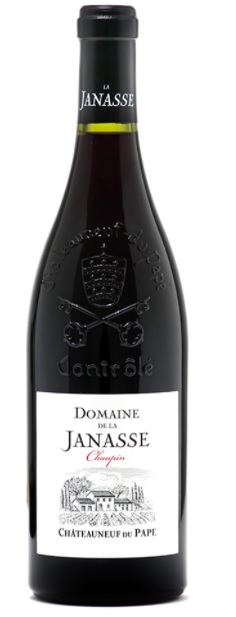
Domaine de la Janasse Chateauneuf-du-Pape Cuvee Chaupin is made from 100 percent Grenache.
Chaupin is Domaine de la Janasse's single-parcel expression of old-vine Grenache, drawn mostly from the sandy-soiled Chapouin lieu-dit with smaller parts from La Crau and Janasse, some of the oldest vines planted in the early twentieth century. The Sabon family has run the estate near Courthezon since 1967 - today the brother-and-sister team of Christophe and Isabelle - and Janasse stands among Chateauneuf-du-Pape's benchmark producers. Partially destemmed and aged twelve months in foudre and demi-muids, Chaupin is the purest, most perfumed side of Grenache in its homeland.
Review:
All Grenache sourced mostly from the Chapouin lieu-dit with a splash from Janasse, the 2023 Châteauneuf Du Pape Cuvée Chaupin shows a medium ruby hue followed by a pretty, perfumed, remarkably elegant profile. It has a core of sweet red and black berry fruits, absolutely heavenly Provençal aromatics of herbes de Provence, black olive, pepper, and flowers, plus ripe, velvety tannins, flawless balance, and a great finish. Partially destemmed and aged 12 months in 70% foudre and 30% demi-muids, this heavenly 2023 will drink beautifully over the coming two decades. There are roughly 1,500 cases produced. Drink 2025-2045.
-Jeb Dunnuck 99 Points
Aimé, the founder
In 1967, Aimé Sabon came back from his military service. He took over his father’s vines, who used to take his grapes to the wine cooperative. In 1973, Aimé built his own cellar. Domaine de la Janasse was born and named after the family farm that was in Courthézon, in the locality of “La Janasse”. Aimé was ambitious. He knew he had fabulous soil and he wanted to expand the estate by acquiring new plots. From 15 hectares at the very beginning, La Janasse has now reached more than 90 hectares.
From father to children
In 1991, after a technical diploma in viticulture and oenology in Beaune, and another one in marketing in Mâcon, Christophe Sabon –Aimé’s eldest son– came back to La Janasse where he was given the keys to the cellar. From then different cuvees were developed, new markets conquered. In 2001, Isabelle –Aimé’s daughter– graduated as an oenologist from the University of Toulouse, and joined the team. With Hélène, Aimé’s wife, the family was reunited again in La Janasse.

Lismore Estate Syrah is made from 100 percent Syrah.
A careful selection of the best of the vintage that exemplifies the extraordinary terroir of Lismore.
An exotic experience which shifts your mind to another place. Cassis, brambles and succulent cherry. White pepper, classic garrigue and the strong floral perfume of crushed violets. Light and elegant, but structured with a fresh acidity. To experience the best this wine has to offer, decanting is suggested.
The grapes were fermented 40% whole bunch in a 5000 litre wooden fermenter with gentle pigeage throughout. The process allowed for a long extraction period which lends to the fruit expression of this wine. The wine was left for a 30 day extended maceration on the skins and then pressed in a traditional baskets press. Matured in 500 litre barrels for 10 months (35% new). Time in the bottle will allow integration, the deepening of layers and full expression of the fruit.
Review:
The 2022 Syrah Estate Reserve was dry-farmed on steep shale slopes with long hang-time on the vine. This vintage includes 50% whole bunch and aged in 500- and 700-liter barrels. It has an intense nose with black cherry, raspberry, Provençal herbs and wild thyme. The harmonious palate has a slightly powdery texture and wonderful backbone, reminiscent of a Côte-Rôtie, with white pepper and subtle fennel notes toward the nish. It feels quite linear at the moment, perhaps holding something back for later? Fabulous. - Neal Martin" - Antonio Galloni's Vinous (August 2024), 95 pts "Dominated by grapes from Elgin, with a smaller Stanford component, this is the sort of Syrah that you want to drink by the bottle. Fifty per cent whole bunches add some perfume and texture to a palate of subtle vanilla spice from 15% new oak and layers of white pepper, bramble, liquorice and red cherry. 2025-30" - Tim Atkin (SA Special Report 2024), 93 pts "In a tricky stage when I tasted it twice in the Cape, this needs more time in bottle to show at its best. Aromas of earth, beetroot, fynbos and blood usher you into a palate that's dense, compact and firm, with muscular tannins, redcurrant and damson fruit, plenty of acidity and minerality and well-integrated oak. 2025-30"
-Tim Atkin 94 Points
"The 2022 Syrah comes from a selection of vineyards, mostly from Elgin but with some fruit from Stanford. It includes 50% whole cluster and was aged in large oak barrels. This has an open, complex bouquet with red cherries, bergamot and light ferrous scents, gaining mineralité in the glass. Hints of violet emerge with time. Fresh and saline, the palate is medium-bodied with fine-grained tannins, revealing a dash of white pepper and clove toward the precise finish. Superb. - Neal Martin" - Antonio Galloni's Vinous (August 2024), 94 pts
Argot Bastard Tongue Pinot Noir is made from 100 percent Sonoma Pinot Noir.
Inheriting an unbroken string of success, the “Bastard Tongue” arrives fully-formed and ready to impress. Always a blend from multiple Pinot Noir vineyards, this iteration of “BT” was selected from three distinct sites, each making their own unique contribution of Sonoma County terroir to the wine’s character.
Exploding forth on a tidal wave of high-toned, intense red and black fruits, this is a Pinot Noir that no stemware can contain. The palate’s profound depth is balanced by an inherent freshness, allowing the wine to crackle with brambly energy, while sustained by bass notes of underbrush, black tea, pie spice and baker’s chocolate. A formidable rendition of “Bastard Tongue”, and a deserving successor to its line.
Night harvested by hand throughout September, cluster and berry sorted by hand, de-stemmed, no crushing. 7-day cold soaks, followed by native fermentation in open-top bins. Average time on the skins, 14 days. Aging 20 months in French oak, 100% new. Never racked prior to bottling. Bottled unfined, unfiltered.
Very versatile for pairing. Goes well with grilled meat, vegetable, fish, poultry and cheese.
Review:
“The 2022 ‘Bastard Tongue’ Pinot Noir from Argot is utterly mind-blowing. It immediately draws you in with its seductive aromatic of fresh black raspberries, wild strawberries and even a touch of blueberry all woven together with sweet spices, cinnamon, crushed violets and earthy undertones. On the palate, the wine is both rich and graceful, with a lively acidity that elevates the sweet red fruit notes of red currant and black raspberries. Fine, polished tannins provide a round, silky texture that leads into a supple finish that lingers with sweet berries and sweet spices.”

Paul Hobbs Russian River Pinot Noir is made from 100 percent Pinot Noir.
Sourced predominately from the estates that are defined by their proximity to the coast and Russian River climate, the wine displays vivid crimson and aromas of violet, Morello cherry, and black tea. Velvet tannins on the palate ride along a juicy backbone of flavors such as cranberry, Blood orange, and Damson plum. The finish is long, powered behind a crisp acidity and appealing red clay-like minerality.
"Though Paul Hobbs is probably best known for his single vineyard wines, he is clearly no slouch at blending vineyards to make something special. This bottling is rich and deeply extracted, showing black cherry, raspberry, mace, cola and damp earth notes. It’s very lively for all its density, with seductive oak toast notes adding depth. It is already well integrated and promises a long life ahead. 96 Rich Cook"
-Wine Review Online 96 Points

Holocene Memorialis Pinot Noir is made from 100 percent Pinot Noir.
Holocene Pinot Noir Memorialis is a blend of 777, Pommard and 115 clones from MonksGate vineyard in the Yamhill-Carlton AVA, and it saw about 20% new French oak for 16 months prior to bottling. It is always the lighter and more feminine of the two Holocene wines, with red fruits, white flowers, dried herbs, mushroom and forest floor aromatics, bright acidity and a lithe texture, long finish.
By now, everyone knows that the Willamette Valley is an amazing place to grow Pinot Noir. When I relocated from Napa Valley to partner up with Force Majeure Vineyards, I knew I also wanted to start a project where I could focus attention on a varietal and growing region that I loved. Part of the excitement of being in the Pacific Northwest is the ability to have access to so many amazing vineyards and so much diversity, along with the opportunity to push boundaries and try new things – something that is becoming increasingly difficult in other growing regions.
We partner up with a few very small, diverse and amazing vineyards in the Willamette Valley, sourcing fruit from these dry-farmed sites that emphasize low yields, sustainable practices and produce outstanding fruit.
The wines are crafted in the same way I have been making wine since I was carrying it out at Bryant Family Vineyard in the Napa Valley — utilizing very low-impact, non-industrial techniques, native yeasts, little extraction and little new oak, and never filtering or fining. This allows a real sense of place to show through in the wines that is often dimmed when too much manipulation is undertaken.
Our first vintage was 2015, and was released in early 2017. As production is currently extremely small, the best way to get the wines into your hands is to join our mailing list at the “Mailing List” link above to receive an allocation when we have a release. We release wines once per year, and they will be sold on a first come, first served basis, shipped straight to your door.
Review:
-Decanter World Wine Awards 96 Points
-Eric Guido (Vinous) 95 Points

Lingua Franca The Plow Pinot Noir is made from 100 percent Pinot Noir.
A large proportion of fruit from some of our finest sites, 48% coming from Blocks 1 - 3, planted with PN777 clone. Another 44% is sourced from two blocks of the bold PN 115. The elegant and nuanced PN777 Pinot Noir grown on Gelderman-Jory soils creates the top notes of mineral, rose petal and savory elements while the PN115 provides the fruit, body and weight of the wine.
Loin of lamb, Filet Mignon, veal chop, veal scallopini, pasta with Bolognese sauce, charcuterie, hard cheeses, hamburger, Viennese boiled beef (Tafelspitz), Wienerschnitzel, Kalbi, Bulgogi. Teriyaki, Vietnamese shaking beef, Chinese broccoli beef or Feast of the Immortals? Experimentation is welcome!
Review:
-Jeb Dunnuck 94 Points
-Owen Bargreen 95 Points

Mas Redonne Bandol Rose is made from 55% Mourvèdre, 35% Cinsault, 10% Grenache.
Nice light salmon color, typical of Bandol.
The wine expresses some citrus, Pomelos (a delicious type of grapefruit) and lots of white fruit aromas and minerality.
The flavors are fresh, fruity and very aromatic with tons of apricot and mango.
Grilled salmon, chicken dishes as well as salads, sushi and sashimi.

Domaine de la Janasse Chateauneuf-du-Pape Cuvee Vieilles Vignes is made from 65% Grenache, 20% Mourvèdre, 10% Syrah, 5% divers.
In contrast to Chaupin, which is made from old-vine Grenache on sandy soils, the cuvée Vieilles Vignes is from old vines of Grenache, Mourvedre, Syrah along with smaller percentages of other permitted varieties that are grown in these old vineyards. The wine is sourced from 4 terroirs: pebbly clay, sand, gravelly red clay and sandy limestone. Vieilles Vignes is always the most powerful and concentrated Châteauneuf-du-Pape cuvée made at Domaine de la Janasse.
Review:
-Jeb Dunnuck 98 Points
-Joe Czerwinski 98 Points
-Falstaff 98 Points
-Decanter World Wine Awards 97 Points
Domaine de la Janasse Chateauneuf-du-Pape Cuvee Vieilles Vignes is made from 65% Grenache, 20% Mourvèdre, 10% Syrah, 5% divers.
In contrast to Chaupin, which is made from old-vine Grenache on sandy soils, the cuvée Vieilles Vignes is from old vines of Grenache, Mourvedre, Syrah along with smaller percentages of other permitted varieties that are grown in these old vineyards. The wine is sourced from 4 terroirs: pebbly clay, sand, gravelly red clay and sandy limestone. Vieilles Vignes is always the most powerful and concentrated Châteauneuf-du-Pape cuvée made at Domaine de la Janasse.
Review:
-Wine Advocate 96 Points

Domaine de la Janasse has been in the Sabon family since 1967, today run by siblings Christophe and Isabelle. Their Châteauneuf-du-Pape Blanc — Roussanne-led, with Grenache Blanc and Clairette — is consistently one of the finest whites in the appellation, combining richness with purity and the ability to age for two decades.
Review:
Based on 70% Roussanne and 15% each Grenache Blanc and Clairette and aged 12 months in 20% new French oak with the balance in used barrels and concrete. It has a medium gold hue and delivers remarkable intensity in its ripe stone fruits, fresh croissant, honeyed flowers, and orange blossom nuances. It's medium to full-bodied, has a pure, seamless, layered mouthfeel, beautiful balance, and a fabulous finish that will evolve for 20+ years if well stored. Drink 2025-2045.
Jeb Dunnuck 98 Points

All older vintage wines have been purchased from a single collectors cellar. Pictures can be requested before shipment.

Color : pale gold
Aromas : subtle with notes of white fruit and flowers
Mouth : balanced, fresh and mineral
TA: 3.0 g/L
RS: 1.5 g/L

Mordoree Cotes du Rhone Dame Rousse Rose is made from 40% Grenache, 35% Syrah, 15% Cinsault, 5% Carignan, 5% Mourvèdre
Domaine de La Mordoree Cotes du Rhone Rosé is produced from organically and biodynamically farmed vineyards. This dry, crisp, light, salmon-colored offering exhibits fruity aromas of strawberry and raspberry, citrus fruits and floral notes. It is round, fresh and well-balanced in the mouth, with a long finish.
Food pairing: cold meats and delicatessen, fowl, white meats, grilled lamb with Provence herbs, fish soup, fried fish, pastas, pizzas and all Asian dishes.

Arzuaga Ladera del Norte Ribera del Duero is made from 100% Tempranillo.
The grapes come from organic crops and are harvested from the "Valdesardon" farm, owned by the Arzuaga Navarro family, which is the westernmost vineyard of the Ribera del Duero DO, located at an altitude of 800 meters in the village of Olivares de Duero. Clay-limestone soil on a hillside that will mark the characteristics of the wine.
The wine is of medium high intensity in color, a clear and bright cherry with purple flashes. An array of red fruits such as raspberry and cherry predominates with a high aromatic intensity, combining with balsamic tones, coffee and roasted notes coming from the aging in oak barrels without being overwhelming. This is a fresh and elegant wine, with an easy and balanced entry into the mouth followed by juicy and chewy sensations. Slightly sweet and toasted notes, and a pleasant and balanced aftertaste that is reminiscent of the fruity aromas on the nose.
Ideal companion for red meat, white meat, game and game, roasted or in sauce. Blue fish and soft cheeses.
Review:
-Penin 2022 92 Points

Capanna is one of Montalcino's historic family estates, farming vineyards on the cooler north side of the hill since the early 20th century. Their Brunello is a classically styled Sangiovese — perfumed, structured and age-worthy — and the 2021 is a standout in a celebrated vintage.
Review:
Aromas of ripe and racy red berry fruit with touches of white pepper, hazelnuts and graphite. Very pure and structured. There's brightness from lovely acidity and verticality from its tannins, giving it a slightly austere edge. Long, tight finish. This will be better in two to three years.
James Suckling 96 Points



