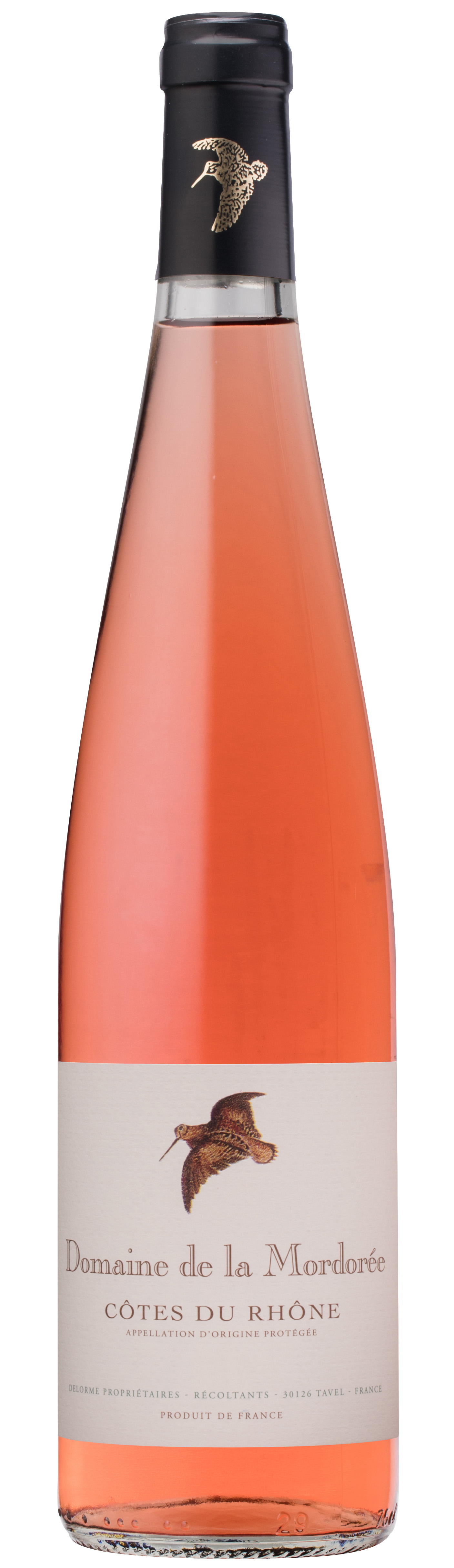
" We don't sell the wine without touching the vine "

Mordoree Cotes du Rhone Dame Rousse Rose is made from 40% Grenache, 35% Syrah, 15% Cinsault, 5% Carignan, 5% Mourvèdre
Domaine de La Mordoree Cotes du Rhone Rosé is produced from organically and biodynamically farmed vineyards. This dry, crisp, light, salmon-colored offering exhibits fruity aromas of strawberry and raspberry, citrus fruits and floral notes. It is round, fresh and well-balanced in the mouth, with a long finish.
Food pairing: cold meats and delicatessen, fowl, white meats, grilled lamb with Provence herbs, fish soup, fried fish, pastas, pizzas and all Asian dishes.

Color : pale gold
Aromas : subtle with notes of white fruit and flowers
Mouth : balanced, fresh and mineral
TA: 3.0 g/L
RS: 1.5 g/L

Domaine de la Janasse Chateauneuf-du-Pape Cuvee Vieilles Vignes is made from 65% Grenache, 20% Mourvèdre, 10% Syrah, 5% divers.
In contrast to Chaupin, which is made from old-vine Grenache on sandy soils, the cuvée Vieilles Vignes is from old vines of Grenache, Mourvedre, Syrah along with smaller percentages of other permitted varieties that are grown in these old vineyards. The wine is sourced from 4 terroirs: pebbly clay, sand, gravelly red clay and sandy limestone. Vieilles Vignes is always the most powerful and concentrated Châteauneuf-du-Pape cuvée made at Domaine de la Janasse.
Review:
-Jeb Dunnuck 98 Points
-Joe Czerwinski 98 Points
-Falstaff 98 Points
-Decanter World Wine Awards 97 Points
Domaine de la Janasse Chateauneuf-du-Pape Cuvee Vieilles Vignes is made from 65% Grenache, 20% Mourvèdre, 10% Syrah, 5% divers.
In contrast to Chaupin, which is made from old-vine Grenache on sandy soils, the cuvée Vieilles Vignes is from old vines of Grenache, Mourvedre, Syrah along with smaller percentages of other permitted varieties that are grown in these old vineyards. The wine is sourced from 4 terroirs: pebbly clay, sand, gravelly red clay and sandy limestone. Vieilles Vignes is always the most powerful and concentrated Châteauneuf-du-Pape cuvée made at Domaine de la Janasse.
Review:
-Wine Advocate 96 Points

Domaine de la Janasse Chateauneuf-du-Pape Cuvee Chaupin is made from 100 percent Grenache.
Chaupin is Domaine de la Janasse's single-parcel expression of old-vine Grenache, drawn mostly from the sandy-soiled Chapouin lieu-dit with smaller parts from La Crau and Janasse, some of the oldest vines planted in the early twentieth century. The Sabon family has run the estate near Courthezon since 1967 - today the brother-and-sister team of Christophe and Isabelle - and Janasse stands among Chateauneuf-du-Pape's benchmark producers. Partially destemmed and aged twelve months in foudre and demi-muids, Chaupin is the purest, most perfumed side of Grenache in its homeland.
Review:
All Grenache sourced mostly from the Chapouin lieu-dit with a splash from Janasse, the 2023 Châteauneuf Du Pape Cuvée Chaupin shows a medium ruby hue followed by a pretty, perfumed, remarkably elegant profile. It has a core of sweet red and black berry fruits, absolutely heavenly Provençal aromatics of herbes de Provence, black olive, pepper, and flowers, plus ripe, velvety tannins, flawless balance, and a great finish. Partially destemmed and aged 12 months in 70% foudre and 30% demi-muids, this heavenly 2023 will drink beautifully over the coming two decades. There are roughly 1,500 cases produced. Drink 2025-2045.
-Jeb Dunnuck 99 Points

Domaine La Maionnette Rose Cotes de Provence is made from 60% Syrah, 20% Cinsault and 20% Grenache.
The plots of Domaine de la Maïonnette benefit from a clay-limestone soil and are located on a plateau surrounded by hundred-year-old oaks. Bordered by the Provencal scrubland, the vineyard enjoys a dry climate typical of the region.
An emblematic cuvée of the estate, this Cotes de Provence rosé reveals concentrated aromas of citrus fruits and white flowers, and a beautiful structure. The fresh palate brings out sweet candy notes, gooseberry and litchi, and delivers bright acidity and ample length on the finish.
Mordoree Cotes Du Rhone Rose 2013 is made from 40% Grenache, 30% Syrah, 15% Cinsault, 10% Carignan, 5% Mourvèdre. 20 year-old vines.
Deep pink, slightly orange color typical of Mordoree rose wines. Aromas of crystallized oranges and cherries, hints of aniseed. Very round palate, fresh and a long finish.
Food pairing: cold meats and delicatessen, fowl, white meats, grilled lamb with Provence herbs, fish soup, fried fish, pastas, pizzas and all Asian dishes.
The Mordoree Estate
This is arguably the top estate in our Portfolio. Domaine de la Mordoree (woodcock), located in the town of Tavel, in the Southern Rhone Valley, is the most consistent producer of top quality wine in my entire selection. In 1986, the brothers Christophe and Fabrice Delorme decided to dedicate themselves to their passion for wine. They started their own estate with the objective to produce the best wines in each appellation while preserving the environment
The Mordoree Vineyard
The vineyard consists of 55 hectares (135 acres), on 38 different parcels, which provide with a rich, wide range of soils and climates. The soil is a mix of clay, chalk and sand with pebble stones. The improvements at the Domaine have been incredible: new pneumatic presses, new stainless steel vats, new destemmer, new vinification and aging plant, and aging in oak barrels for the top wines. All the grapes are raised by culture raisonnée which is very close to organic viticulture (intervention in the vineyard only when necessary). The yield is reduced in the vineyard by ébourgeonnage (de budding in spring) and vendanges vertes in summer (green harvesting). Oak aging for the top wines in special barrels like “jupille” for 10 months. No expense is spared at this Domaine to achieve quality.

Franz Prager, co-founder of the Vinea Wachau, had already earned a reputation for his wines when Toni Bodenstein married into the family. Bodenstein’s passion for biodiversity and old terraces, coupled with brilliant winemaking, places Prager in the highest echelon of Austrian producers.
Smaragd is a designation of ripeness for dry wines used exclusively by members of the Vinea Wachau. The wines must have minimum alcohol of 12.5%. The grapes are hand-harvested, typically in October and November, and are sent directly to press where they spontaneously ferment in stainless-steel tanks.
Klaus sits adjacent to Achleiten and is one of the Wachau’s most famous vineyards for Riesling. The vineyard is incredibly steep with a gradient of 77% at its steepest point. The southeast-facing terraced vineyard of dark migmatite-amphibolite and paragneiss produces a tightly wound and powerful wine. The parcel belonging to Toni Bodenstein was planted in 1952.
Tasting Notes:
Austrian Riesling is often defined by elevated levels of dry extract thanks to a lengthy ripening period and freshness due to dramatic temperature swings between day and night. “Klaus is not a charming Riesling,” says Toni Bodenstein with a wink. Klaus is Prager’s most assertive and robust Riesling.
Food Pairing
Riesling’s high acidity makes it one of the most versatile wines at the table. Riesling can be used to cut the fattiness of foods such as pork or sausages and can tame some saltiness. Conversely, it can highlight foods such as fish or vegetables in the same way a squeeze of lemon or a vinaigrette might.
Review:
-James Suckling 97 Points

Cristom Pinot Noir Eileen Vineyard 2023 is made from 100% Pinot Noir.
Cristom Vineyards was founded in 1992 by the Gerrie family in the Eola-Amity Hills of Oregon's Willamette Valley, farming their east-facing volcanic hillside biodynamically and organically. Their single-vineyard Pinot Noirs, each named for a woman in the family, are Willamette benchmarks.
Eileen Vineyard sits at the very top of the Cristom estate, its windswept upper blocks looking west to the Van Duzer Corridor, the ocean gap that draws cooling afternoon air into the valley. It is the estate's most structured and age-worthy site — dark-fruited, mineral and taut — from a warm but even 2023 Willamette vintage.
Review: