
" We don't sell the wine without touching the vine "
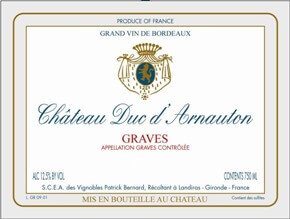
| Country: | France |
| Region: | Bordeaux |
| Winery: | Duc d'Arnauton |
| Grape Types: | Cabernet Sauvignon Merlot |
| Organic: | Yes |
| Vintage: | 2011 |
| Bottle Size: | 750 ml |

Lush, energetic and intense, this gorgeous 2017 Napa Valley Cabernet begins with aromas of blackberry, huckleberry and chocolate, as well as hints of mint, cardamom, clove and graham cracker. On the palate it displays lovely brightness, with firm, resolved tannins framing flavors of boysenberry and black currant. As it evolves in the glass, subtle sweet and savory notes are revealed, carrying the wine to a long, focused finish.
Review:
So complex and beautiful now with blackcurrants, olives, bark, and oyster shells. Full to medium body. Resolved, velvety and juicy tannins. Then turns firm and beautiful. 92% Cabernet Sauvignon and 8% Merlot. Drinkable now but will age beautifully.
-James Suckling 95 Points

This fresh and vibrant Napa Valley Cabernet Sauvignon is brimming with aromas of blackberry, mulberry, cassis, and violet. On the palate, bright flavors of cranberry, red plum, cherry, and lavender are intertwined with supple tannins, balanced acidity, and a long, smooth finish.
Review:
Seductive oak spices and a plush mouthfeel come with abundant red and black fruits in this full-bodied, appropriately tannic wine that needs time to reach its full potential. Pine and rosemary accents merge nicely with the blackberries and blueberries. Best from 2028–2038.
-Wine Enthusiast 94 Point

Delas Freres Cote Rotie La Landonne Rouge is made from 100 percent Syrah.
This very ancient region dates back to the Roman Era and is located on the right bank of the Rhône. It is said that during the Middle Ages, “The Seigneur de Maugiron” gave a hillside to each of his two daughters - one was brunette and the other fair - thus, were born the names of “Côte Brune” and “Côte Blonde.” Wines from the Côte Blonde tend to be more delicate and lighter in character than the fuller wines of the Côte Brune. Together, they make a wine of style and substance. This cuvée is a vineyard plot selection. The grapes come exclusively from a plot within the named slope of “La Landonne.”
This cuvée‘s first vintage was 1997. The wine is only made in the very best years. Its highly limited production never exceeds 2,500 bottles per year.
The steep, terraced hillsides along the river produce wines that are among the "biggest" reds of France. The Delas Côte-Rôtie is primarily Syrah with an addition of up to 10 to 20% of Viognier grapes in the crop. The soils of the northern part of the Côte Brune vineyard consists of extremely steep, terraced slopes of ferruginous mica schists which are covered with schist sand (arzel). The Côte Blonde has a varied geology with gneiss and granite predominating at the most southern side of the appellation. The area has dry, hot summers with regular rainfalls during other seasons. The grapes for the “La Landonne” cuvée are picked by hand at maximum maturity. Fermentation takes place in traditional open-topped concrete tanks, following three days of pre-fermentation cold maceration. Before fermentation, the maceration process continues under controlled temperatures of 82°F to 86°F. Daily cap pushing down and pumping over are carried out for about 10 days with total vatting time of up to 20 days. The wine is aged for 14 to 16 months in new or one year old oak casks. The barrels are topped up regularly.
Food Pairing: This wine pairs wonderfully with fine meats, roasted beef, water games, truffles and spicy stews. The bottle should be opened 1 to 3 hours before drinking. This wine needs at least 3 years cellaring before it can open up its complexity. In such case it is strongly recommended to decant before serving.
Tasting Notes: The wine‘s deep color is underscored by plummy hues. A complex nose shows deep, fruity aromas with hints of licorice and roasted coffee. Endowed with a dense and silky tannic structure, this is a full, fleshy wine that provides an ample and generous palate. Its lasting finish speaks of considerable ageing potential.
Reviews:
Deep in color, the espresso, licorice, smoke and flint, paired with layers of juicy, ripe fresh, red fruits show up with ease. On the palate, the wine offers richness, density, purity of fruit, herbs, crushed stones and a wall of ripe, lushly textured, dark red berries. This will age quite nicely.T
-Wine Cellar Insider 97 Points
Sun-baked garrigue and smoky notes of iron and earth accent intensely ripe black cherry and cassis in this wine. Made from 100% Syrah, it's a hulking powerhouse of black-fruit flavors but finessed by firm acidity and fine, integrated tannins. Stunning already it should improve through 2036 and hold further
-Wine Enthusiast 97 Points
Bright purple. Powerful cherry, cassis, potpourri, exotic spice and olive qualities on the highly perfumed, complex nose. Sweet and energetic on the palate, offering impressively concentrated black and blue fruit preserve, floral pastille and spicecake flavors that unfold steadily with aeration. In a powerful but energetic style and quite primary now. Aeration brings up smoky bacon and floral pastille qualities that carry through the strikingly long, youthfully tannic finish, which leaves behind sweet dark and floral notes.
-Vinous 95 Points
Alluring, with warm fruitcake and black tea aromatics leading off for a lush and warm core of crushed plum, cherry reduction and blackberry pâte de fruit flavors. Despite the showy fruit detail, there's a solid iron underpinning, with pretty floral notes and bright energy throughout. Best from 2023 through 2038. 300 cases made, 188 cases imported.
-Wine Spectator 96 Points
This very ancient region dates back to the Roman Era and is located on the right bank of the Rhône. It is said that during the Middle Ages, “The Seigneur de Maugiron” gave a hillside to each of his two daughters - one was brunette and the other fair - thus, were born the names of “Côte Brune” and “Côte Blonde.” Wines from the Côte Blonde tend to be more delicate and lighter in character than the fuller wines of the Côte Brune. Together, they make a wine of style and substance. This cuvée is a vineyard plot selection. The grapes come exclusively from a plot within the named slope of “La Landonne.”
This cuvée‘s first vintage was 1997. The wine is only made in the very best years. Its highly limited production never exceeds 2,500 bottles per year.
The steep, terraced hillsides along the river produce wines that are among the "biggest" reds of France. The Delas Côte-Rôtie is primarily Syrah with an addition of up to 10 to 20% of Viognier grapes in the crop. The soils of the northern part of the Côte Brune vineyard consists of extremely steep, terraced slopes of ferruginous mica schists which are covered with schist sand (arzel). The Côte Blonde has a varied geology with gneiss and granite predominating at the most southern side of the appellation. The area has dry, hot summers with regular rainfalls during other seasons. The grapes for the “La Landonne” cuvée are picked by hand at maximum maturity. Fermentation takes place in traditional open-topped concrete tanks, following three days of pre-fermentation cold maceration. Before fermentation, the maceration process continues under controlled temperatures of 82°F to 86°F. Daily cap pushing down and pumping over are carried out for about 10 days with total vatting time of up to 20 days. The wine is aged for 14 to 16 months in new or one year old oak casks. The barrels are topped up regularly.
The wine‘s deep color is underscored by plummy hues. A complex nose shows deep, fruity aromas with hints of licorice and roasted coffee. Endowed with a dense and silky tannic structure, this is a full, fleshy wine that provides an ample and generous palate. Its lasting finish speaks of considerable ageing potential.
This wine pairs wonderfully with fine meats, roasted beef, water games, truffles and spicy stews. The bottle should be opened 1 to 3 hours before drinking. This wine needs at least 3 years cellaring before it can open up its complexity. In such case it is strongly recommended to decant before serving.
Delas Freres Cote Rotie La Landonne Rouge is made from 100 percent Syrah.
This very ancient region dates back to the Roman Era and is located on the right bank of the Rhône. It is said that during the Middle Ages, “The Seigneur de Maugiron” gave a hillside to each of his two daughters - one was brunette and the other fair - thus, were born the names of “Côte Brune” and “Côte Blonde.” Wines from the Côte Blonde tend to be more delicate and lighter in character than the fuller wines of the Côte Brune. Together, they make a wine of style and substance. This cuvée is a vineyard plot selection. The grapes come exclusively from a plot within the named slope of “La Landonne.”
This cuvée‘s first vintage was 1997. The wine is only made in the very best years. Its highly limited production never exceeds 2,500 bottles per year.
The steep, terraced hillsides along the river produce wines that are among the "biggest" reds of France. The Delas Côte-Rôtie is primarily Syrah with an addition of up to 10 to 20% of Viognier grapes in the crop. The soils of the northern part of the Côte Brune vineyard consists of extremely steep, terraced slopes of ferruginous mica schists which are covered with schist sand (arzel). The Côte Blonde has a varied geology with gneiss and granite predominating at the most southern side of the appellation. The area has dry, hot summers with regular rainfalls during other seasons. The grapes for the “La Landonne” cuvée are picked by hand at maximum maturity. Fermentation takes place in traditional open-topped concrete tanks, following three days of pre-fermentation cold maceration. Before fermentation, the maceration process continues under controlled temperatures of 82°F to 86°F. Daily cap pushing down and pumping over are carried out for about 10 days with total vatting time of up to 20 days. The wine is aged for 14 to 16 months in new or one year old oak casks. The barrels are topped up regularly.
Food Pairing: This wine pairs wonderfully with fine meats, roasted beef, water games, truffles and spicy stews. The bottle should be opened 1 to 3 hours before drinking. This wine needs at least 3 years cellaring before it can open up its complexity. In such case it is strongly recommended to decant before serving.
Tasting Notes: The wine‘s deep color is underscored by plummy hues. A complex nose shows deep, fruity aromas with hints of licorice and roasted coffee. Endowed with a dense and silky tannic structure, this is a full, fleshy wine that provides an ample and generous palate. Its lasting finish speaks of considerable ageing potential.
Reviews:
This is dark and still a bit reticent, with a cast iron cloak around the core of dark currant, plum and blackberry paste flavors, showing lots of sweet bay leaf, anise and singed apple wood notes in the background. There's serious grip through the finish. For the cellar.
-Wine Spectator 96 Points
Very open, spicy and fresh on the nose, you could almost open this now. Struck flint notes assist in teasing out notes of leaf tea, tobacco, rosemary and rose. Very full-bodied, generous but powerful on the palate, tense and mineral. Mouthcoating ripe, sweet tannin and robust amounts of sweet baking spices, along with more tobacco and black fruit on the palate. Has depth, length, power and impressive balance despite the high alcohol. Drink from now into 2022, or from 2031 to 2040. Lieu-dit La Landonne, from the Brune side (mica schist bedrock). Matured in new and one-year-old barrels for 14 months.
-Decanter 96 Points
The 2019 Côte Rôtie La Landonne comes from one of the greatest sites for Syrah in the world, the La Landonne lieu-dit located close to the center of the appellation, on the Côte Brune side. It reveals a deeper purple hue (it's slightly more opaque than the Seigneur de Maugiron) and offers a brilliant nose of ripe cassis, black raspberries, scorched earth, smoked herbs, and seared meat. Full-bodied and powerful on the palate, this is a deep, spicy, concentrated Côte Rôtie with a plush, layered mouthfeel, sweet tannins, beautiful balance, and a great, great finish. This puppy brings the fruit, opulence, and texture of the vintage yet still has a classic Côte Rôtie character.
-Jeb Dunnuck 96 Points
Fresh aromatic layers of mint sit atop crushed red cherries and wild strawberries, with light clove and thyme on the nose. The palate is rich and enticing with black cherries, plums, rhubarb, pomegranate seeds, black olives and freshly picked rosemary leaves. Tremendous texture, structure, and refreshing acidity carry this wine to a robust finish of orange zest and black tea leaves. Maisons Marques & Domaines USA.
- Wine Enthusiast 96 Points
This very ancient region dates back to the Roman Era and is located on the right bank of the Rhône. It is said that during the Middle Ages, “The Seigneur de Maugiron” gave a hillside to each of his two daughters - one was brunette and the other fair - thus, were born the names of “Côte Brune” and “Côte Blonde.” Wines from the Côte Blonde tend to be more delicate and lighter in character than the fuller wines of the Côte Brune. Together, they make a wine of style and substance. This cuvée is a vineyard plot selection. The grapes come exclusively from a plot within the named slope of “La Landonne.”
This cuvée‘s first vintage was 1997. The wine is only made in the very best years. Its highly limited production never exceeds 2,500 bottles per year.
The steep, terraced hillsides along the river produce wines that are among the "biggest" reds of France. The Delas Côte-Rôtie is primarily Syrah with an addition of up to 10 to 20% of Viognier grapes in the crop. The soils of the northern part of the Côte Brune vineyard consists of extremely steep, terraced slopes of ferruginous mica schists which are covered with schist sand (arzel). The Côte Blonde has a varied geology with gneiss and granite predominating at the most southern side of the appellation. The area has dry, hot summers with regular rainfalls during other seasons. The grapes for the “La Landonne” cuvée are picked by hand at maximum maturity. Fermentation takes place in traditional open-topped concrete tanks, following three days of pre-fermentation cold maceration. Before fermentation, the maceration process continues under controlled temperatures of 82°F to 86°F. Daily cap pushing down and pumping over are carried out for about 10 days with total vatting time of up to 20 days. The wine is aged for 14 to 16 months in new or one year old oak casks. The barrels are topped up regularly.
Tasting Notes
The wine‘s deep color is underscored by plummy hues. A complex nose shows deep, fruity aromas with hints of licorice and roasted coffee. Endowed with a dense and silky tannic structure, this is a full, fleshy wine that provides an ample and generous palate. Its lasting finish speaks of considerable ageing potential.
Food Pairing
This wine pairs wonderfully with fine meats, roasted beef, water games, truffles and spicy stews. The bottle should be opened 1 to 3 hours before drinking. This wine needs at least 3 years cellaring before it can open up its complexity. In such case it is strongly recommended to decant before serving.

This signature wine contains only fruit farmed on Howell Mountain. The wine comes in a distinctive bottle that is hand dipped in red wax. 100% Cabernet Sauvignon. aged 32 months in 100% new French oak.

All older vintage wines have been purchased from a single collectors cellar. Pictures can be requested before shipment.
Duc d' Arnauton Graves Rouge 2011 is made from 80% Merlot, 20% Cabernet Sauvignon. The average age of the vines is 15 years.
Soil type: Clay limestone, rough sand, gravelly soil.
Vinification: Fermentation in stainless steel vats with thermoregulation; pumping over: twice a day. From 15 to 21 vatting days. 10% bleeding.
Matured in oak barrels, lovely ruby color, subtle nose, fruity with notes of spices.
The Chateau Duc d'Arnauton Estate
Patrick Bernard has a 30 year experience in winemaking, working for/with his family. In 2001 he and his wife Sabine and two daughters created their own business in Landiras in the Bordeaux Region.
The property dates back to the 19th century (it formerly welcomed pilgrims on the route to Santiago de Compostela). The wines are produced using traditional methods, matured in oak barrels for the most part and bottled at the property.
The Chateau Duc d'Arnauton Vineyard
The estate spreads over 13 hectares (32 acres) and three villages:
• Landiras,
• Fargues de Langon
• Pujols sur Ciron.
The vineyard is planted with:
• 8 hectares (19.8 acres) of red grapes (Merlot and Cabernet Sauvignon),
• 5 hectares (12.3 acres) of white grapes (Semillon, Sauvignon and Muscadelle), of which just over 1 ha is dedicated to the production of Sauternes.
The vineyard is farmed under the culture raisonnee method.
The soil is a mixture of gravel, limestone and sand. The method of pruning used here is double cordon, which makes it easier to control the yields. The 15-year-old vines are harvested by hand. The wine matures in stainless steel tanks and the Graves rouge is aged in oak barrels for 8 months.

Stags Leap Wine Cellars S.L.V. Cabernet Sauvignon is made from 100% Cabernet Sauvignon.
Stag’s Leap Wine Cellars stunned the world in 1976 when its 1973 S.L.V. Cabernet Sauvignon bested some of Bordeaux’s first-growth wines in a tasting in Paris. It was the winery’s first commercial vintage, a wine produced from young, three-year-old vines. While the “victory” over the French in “The Judgment of Paris” continues to be hailed throughout the world – and the winery is still humbled by the achievement – Stag’s Leap Wine Cellars enters its golden anniversary year with a commitment to producing more complex and age-worthy wines. No resting on laurels, no autopilot, no complacency, but rather a drive to ensure the next 50 years are even more glorious than the first 50.A step back in time puts Stag’s Leap Wine Cellars’ current and future plans in perspective.
The estate was founded in 1970 with the purchase of orchard land in what is now the Stags Leap District AVA in southeastern Napa Valley. Cabernet Sauvignon and Merlot grapes replaced the prunes and walnuts, and the winery was built in 1972. A wine was made there in that year, but it was the 1973 S.L.V. Cabernet Sauvignon that impressed – and shocked – a panel of experts on French wine. In the 1976 Paris Tasting, a blind tasting, they chose S.L.V as the finest red wine in the group, without knowing its provenance. The outcome brought international recognition to the infant Stag’s Leap Wine Cellars, the nascent Napa Valley wine region, and the entire American wine industry and put all on a path to worldwide renown.
S.L.V. Vineyard S.L.V. soils are predominantly volcanic in nature and contribute multilayered structure, concentration and spicy intensity, often referred to as the “fire-like” elements. S.L.V., also known as Stag’s Leap Vineyards, is the winery’s first vineyard. Planted in 1970, this vineyard achieved international fame when three-year old vines from the 1973 harvest produced a Napa Valley wine that triumphed over some of France’s greatest Bordeaux in a blind tasting among French wine experts in Paris. This history-making Stags Leap District vineyard continues to produce wines with complex black fruit and berry character, spicy intensity, excellent structure and complexity, promising long life and ageability. Today, the property encompasses roughly 35 acres of Cabernet Sauvignon and 1.5 acres of Cabernet Franc. The vineyard soil is volcanic and alluvial with good drainage, and benefits from warm afternoons and cool evening breezes.
Review:
All from the estate S.L.V. Vineyard in Stages Leap and aged 21 months in 90% new French oak, the 2014 Cabernet Sauvignon S.L.V. sports a deep purple/ruby color to go with a Saint-Julien like notes of blackcurrants, damp earth, tobacco and lead pencil. With medium to full-bodied richness, ripe, sweet tannin, beautiful purity and a great finish, it’s another terrific wine from this estate that can be drunk today of cellared for 15+ years.
-Jeb Dunnuck 95 Points

Tasting Notes: The Poet's Leap Riesling offers aromas of white peach, jasmine, Thai basil and nutmeg. Flavors of ripe melon, apricot and an appealing minerality continue across the palate. An underlying hint of honey sweetness is balanced by a streak of bright acidity that provides a long, clean finish.



