" We don't sell the wine without touching the vine "
| BUY MORE! SAVE MORE! | ||||||||||||||||||||
|
| Country: | France |
| Region: | Chateauneuf du Pape |
| Winery: | Grand Veneur |
| Grape Type: | Clairette |
| Organic: | Yes |
| Vintage: | 2025 |
| Bottle Size: | 750 ml |
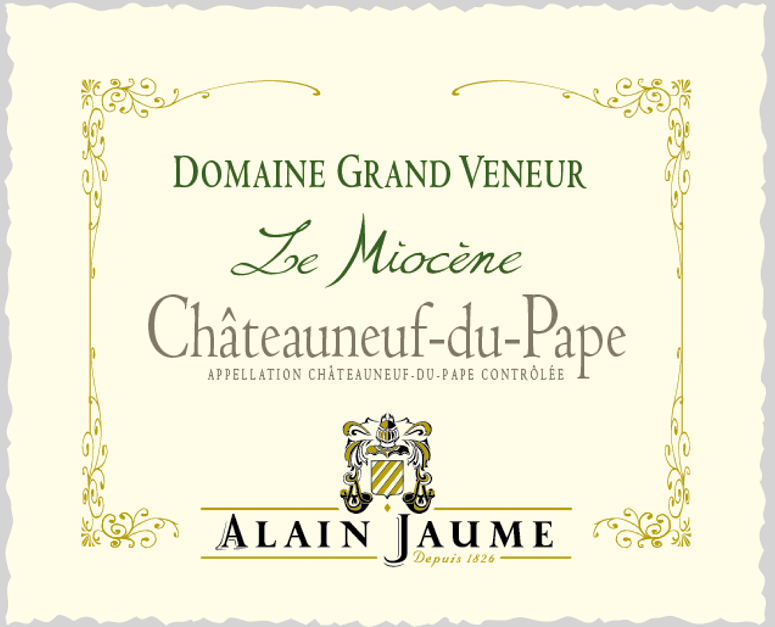
Grand Veneur Chateauneuf du Pape Blanc Le Miocene is made from 60% Clairette, 40% Roussanne
Pale yellow colour with hints of green, aromas of white flowers (may blossom, honeysuckle).
The palate is pleasantly balanced between liveliness and roundness, which brings out characteristics of dried apricot, honey and elderberry. A Châteauneuf du Pape white displaying a great finesse.
Best between 1 and 8 years.
Soil type Coming from the single vineyard named “La Fontaine”, the plot is facing north.It is made of clay-sand and limestone. Thanks to the northern orientation, it is always very well aired. This sector allow the Roussane and Clairette to mature in great conditions without losing freshness, which we believe is key point. Winemaking & ageing Whole-bunch pressing. Vinification in stainless-steel tanks. Fermentation temperature controlled at 15°C.
Review:
-Nicolas Greinacher (Vinous) 92 Points
The Grand Veneur Estate
In 1320 Pope Jean XXII planted the first vines of Chateauneuf-du-Pape, but it was only in 1360 that the wines of the region first gained fame. Oddly, the wine that gave Chateauneuf-du-Pape its original reputation was the Blanc and not the Rouge. The white wine was a favorite of Pope Innocent VI. The Domaine dates back to 1826, having been founded at that time by Mathieu Jaume. Since 1979, Alain Jaume has run the Domaine and now has the help of his two sons: Sebastien and Christophe.
"Popes throughout history have liked their juice, and when the papal see moved to Avignon in the 13th century, that juice was Chateauneuf-du-Pape ("the pope's new castle") made from grapes grown nearby in the Southern Rhone. The castle is a ruin now, the papal court long gone back to Rome, but the wines that bear the pope's coat of arms emblazoned on the bottle are still produced more or less according to the long-standing recipe. Not every winemaker uses all 13 of the grapes in the proscribed blend, though. At Domaine Grand Veneur, an estate that dates to 1826, Alain Jaume and his sons Sebastien and Christophe emphasize Grenache blended with Syrah and Mourvedre."
- Los Angeles Times
"Improved Chateauneuf with very accomplished, stylish reds since the late 1990s; also very good Vacqueyras and Cotes-du-Rhone Villages." - Anthony Dias Blue's pocket guide to wine 2006
"Grand Veneur is one of the most brilliant estates in Chateauneuf du Pape as well as the force behind the negociant wines sold under the Alain Jaume label. Virtually everything they produce has merit. Some of this estate’s 2009 red wines are just hitting the market as they are bottled early to preserve their fruit and freshness. I can’t say enough about the job Alain Jaume’s two sons, Sebastian and Christophe, have done with this estate. The impeccable attention to detail in the vineyards, the meticulous vinification, and the careful bottling benefit every consumer." - Wine Advocate (#190, August 2010)
"Great bargains continue to emerge from Domaine Grand Veneur as well as from their negociant arm of the business, labeled Alain Jaume" - Wine Advocate (#195, June 2011)
"Don't miss the following "Best Buys" reviewed in several previous issues: Alain Jaume 2010 Cotes du Rhone Haut de Brune (87), Grand Veneur 2010 Cotes du Rhone Blanc (88), Grand Veneur 2009 Cotes du Rhone Les Champauvins (89), Grand Veneur 2009 Cotes du Rhone Reserve Blanc (89), Grand Veneur 2010 Cotes du Rhone Blanc (91), Grand Veneur 2010 Cotes du Rhone Rose (86), Grand Veneur 2009 Lirac Clos de Sixte (91), and Grand Veneur 2010 Cotes du Rhone Blanc de Viognier (89). Credit Christophe and Sebastian Jaume for making this one of the most impeccably run estates in the Rhone Valley. To reiterate, this is an estate at the top of its game and the wines remain fairly priced as well. The 2010 Grand Veneur Chateauneuf du Papes reveal youthful, crisper, more focused styles than their 2009 counterparts. I suspect their pHs are lower, the total acids slightly higher, and the alcohols perhaps .5 to 1% lower across the board." - Wine Advocate (issue197, October 2011)"
The Grand Veneur Vineyard
The estate is located in the commune of Orange and consists of 50 hectares (123 acres). It covers four different appellations: Chateauneuf-du-Pape, Cotes-du-Rhone Villages, Cotes-du-Rhone and Lirac.
The family produces wines under two labels:
- Domaine Grand Veneur – Estate
- Alain Jaume – Negociant
Some wine by Grand Veneur:
Annual production:
- Cotes du Rhone Villages CHAMPAUVINS : +/- 9,000 cases
- Lirac Rouge CLOS DE SIXTE : +/- 5,000 cases
- Chateauneuf du Pape Rouge Grand veneur : 3,300 cases
- Chateauneuf du Pape Blanc Grand veneur : 400 cases
- Chateauneuf du Pape LES ORIGINES red : 1,700 cases
- Chateauneuf du Pape LA FONTAINE white : 300 cases
- Chateauneuf du Pape VIEILLES VIGNES : 530 cases

Domaine de la Janasse has been in the Sabon family since 1967, today run by siblings Christophe and Isabelle. Their Châteauneuf-du-Pape Blanc — Roussanne-led, with Grenache Blanc and Clairette — is consistently one of the finest whites in the appellation, combining richness with purity and the ability to age for two decades.
Review:
Based on 70% Roussanne and 15% each Grenache Blanc and Clairette and aged 12 months in 20% new French oak with the balance in used barrels and concrete. It has a medium gold hue and delivers remarkable intensity in its ripe stone fruits, fresh croissant, honeyed flowers, and orange blossom nuances. It's medium to full-bodied, has a pure, seamless, layered mouthfeel, beautiful balance, and a fabulous finish that will evolve for 20+ years if well stored. Drink 2025-2045.
Jeb Dunnuck 98 Points

Reynvaan The Contender Syrah is made from 97% Syrah and 3% Marsanne.
From cult Walla Walla producer Reynvaan Family Vineyards, The Contender is an estate Syrah of extraordinary depth and perfume. The 2021 — co-fermented with a touch of Marsanne and raised partly in new puncheons — is a benchmark for the sheer quality coming out of Washington's Rocks District.
Review:
The 2021 Syrah The Contender is 97% Syrah and 3% Marsanne that was fermented with 30% stems and raised in 25% new puncheons and barrels. Its deeper plum/purple hue is followed by a wild nose of red plums, blueberries, ground pepper, lavender, and violets. With medium to full-bodied richness, a seamless, layered, beautifully balanced mouthfeel, and polished tannins, it's another sensational 2021 that will benefit from just a handful of years in the cellar.
Jeb Dunnuck 98 Points

Reynvaan Family Vineyards is a cult Walla Walla estate whose vines in the cobblestone-strewn Rocks District produce some of Washington's most sought-after Syrah. Stonessence draws on the estate's In the Rocks fruit for a wild, perfumed, savory style that rivals the great Syrahs of the Northern Rhône.
Review:
Sourced from the estate's In the Rocks vineyard, this penetrating Syrah displays the haunting perfume of the Rocks District. Undulating blackberry and blueberry flavours are tinged with blood, iodine and ash. Powerful yet focused, freshly balanced with a finish that lingers on the bitter edges of quinine and olive pit. Made with 15% whole clusters vinified in stainless steel and matured for 18 months in both new puncheons and neutral oak.
Decanter World Wine Awards 98 Points

Sainte-Marie Bourgogne Blanc Vieilles Vignes is made from 100 percent Chardonnay.
The wine has a perfect light yellow color with green hues. Nose of white flower, sweet spice and bitter orange. Fresh and delicious attack. It shows roundness and a slight buttery note with a very saline finish that makes you slightly salivate.
Excellent with Seafood, grilled fish, clams and oysters of course. Also great with goat cheese or Comté cheese.
Aged on lees for 6 months in stainless steel vats. Adjustment of sulphites at the end of MLF and before bottling. Filtration on earth then on 1.2µ cartridge after bonding with bentonite.Machine harvest, and direct pressing with a pneumatic horizontal press. Static settling. Alcoholic and malolactic fermentation in stainless steel vats with native yeast and bacteria.
This wine is declassified Chablis, due to exceeding the volume limit per hectare it could not be labeled Chablis. They call it “over-production” Burgundy, but we call it an outstanding value. This exact same juice is selling for three times as much under the Chablis AOC label!

Reynvaan Foothills Reserve Estate Syrah 2021 is made from 100% Syrah.
Reynvaan Family Vineyards was founded in 2004 by Mike and Gale Reynvaan in Washington’s Walla Walla Valley, with son Matt Reynvaan as winemaker, and has become one of the most sought-after names in the state for its Rhône-inspired, estate-grown reds. The Foothills Reserve is a barrel selection from the family’s high-elevation Foothills in the Sun Vineyard, planted in 2008 on loess soils over deep basalt in the foothills of the Blue Mountains.
Walla Walla Valley Syrah is prized for two very different terroirs: the basalt-cobblestone Rocks District, known for savory, meaty, olive-and-mineral character, and the wind-swept loess hillsides that lend structure, freshness and lift. The Foothills site sits among the latter, giving a Syrah of both power and energy.
Review:
A total masterclass, the 2021 ‘Foothills Reserve’ is a barrel selection wine that comes from the Reynvaan’s high elevation estate Foothills In The Sun Vineyard. The site is set on Loess soils with deep basalt deposits and I have been writing about the potential of this site for more than a decade. Today, wines from this high-elevation location are every bit as good as those from their Rocks District vineyard. Hoisin sauce, beef drippings, menthol, and shades of wild blackberry all combine on the nose. The palate is utterly seamless with serious tension, weight and mouth-watering acidity. It offers La Landonne levels of flavor complexity, yielding blood orange zest notes alongside red cherry candy, cigar ash, wet stone and pipe tobacco that all brilliantly meld together on the palate. Showing seriously good flavor and aromatic range, enjoy this simply stunning Syrah now and over the next ten plus years to come. Drink 2023-2037.
Owen Bargreen, 99 points
Review:
-Jeb Dunnuck 98 Points
-Wine Enthusiast 97 Points
-Eric Guido (Vinous) 96 Points
-James Suckling 95 Points

Grand Veneur Chateauneuf Du Pape Blanc La Fontaine is made from 100% Roussane.
Yellow-gold color. The nose is rich in aromas of citrus fruit, tropical fruit, quince and honey, with a touch of vanilla. On the palate, the same aromas appear together with a fatness combining exotic fruit and vanilla : the wine is rich, generous and elegant, with extraordinary length. "La Fontaine" is often considered to be one of the best Châteauneuf du Pape white, and it is by definition a superb gastronomy wine.
Best between 1 and 8 years.
Review:
-Jeb Dunnuck 98 Points
-Decanter 95 Points

Grand Veneur Chateauneuf du Pape Blanc Le Miocene is made from 60% Clairette, 40% Roussanne
Pale yellow colour with hints of green, aromas of white flowers (may blossom, honeysuckle).
The palate is pleasantly balanced between liveliness and roundness, which brings out characteristics of dried apricot, honey and elderberry. A Châteauneuf du Pape white displaying a great finesse.
Best between 1 and 8 years.
Soil type Coming from the single vineyard named “La Fontaine”, the plot is facing north.It is made of clay-sand and limestone. Thanks to the northern orientation, it is always very well aired. This sector allow the Roussane and Clairette to mature in great conditions without losing freshness, which we believe is key point. Winemaking & ageing Whole-bunch pressing. Vinification in stainless-steel tanks. Fermentation temperature controlled at 15°C.
Review:
-Yohan Castaing (Robert Parker) 92 Points
Grand Veneur Chateauneuf Du Pape Blanc La Fontaine is made from 100% Roussane.
Yellow-gold color. The nose is rich in aromas of citrus fruit, tropical fruit, quince and honey, with a touch of vanilla. On the palate, the same aromas appear together with a fatness combining exotic fruit and vanilla : the wine is rich, generous and elegant, with extraordinary length. "La Fontaine" is often considered to be one of the best Châteauneuf du Pape white, and it is by definition a superb gastronomy wine.
Best between 1 and 8 years.
Review:
-Jeb Dunnuck 98 Points
-Decanter 95 Points

Grand Veneur Chateauneuf du Pape Rouge Le Miocene is made from 70% Grenache, 20% Syrah, 10% Mourvèdre .
An intense dark-ruby color. The nose develop aromas of ripe black fruit (such as blackberry), cherry and spice box. The palate reveals the presence of tannins, in high quantity and elegant. The finish is long and luxurious. This is the Châteauneuf du Pape expression, displaying all the characteristics of the terroir.
Soil type: Plots are located northern part of Châteauneuf du Pape and the vines are grown under organic process.The soil is marked by the violence wrought by the Rhone river. It consists of a layer of marine molasses of the Miocene period covered by alpine alluvium. The presence of a great number of rounded stones known as "galets" in the earth is evidence of the time when the Rhone, then a torrent, tore fragments of rock from the Alps and deposited them on the plain. The GRAND VENEUR cuvee will express year after year a great power and aromatic complexity.
Winemaking & ageing: Harvest is sorted by hand, destemmed and crushed. Fermentation temperature is controlled at 30°C. Vatting period of 18 to 20 days. Matured in vats and oak casks.
Review:
-Jeb Dunnuck 93 Points
Grand Veneur Chateauneuf du Pape Rouge Le Miocene is made from 70% Grenache, 20% Syrah, 10% Mourvèdre .
An intense dark-ruby color. The nose develop aromas of ripe black fruit (such as blackberry), cherry and spice box. The palate reveals the presence of tannins, in high quantity and elegant. The finish is long and luxurious. This is the Châteauneuf du Pape expression, displaying all the characteristics of the terroir.
Soil type: Plots are located northern part of Châteauneuf du Pape and the vines are grown under organic process.The soil is marked by the violence wrought by the Rhone river. It consists of a layer of marine molasses of the Miocene period covered by alpine alluvium. The presence of a great number of rounded stones known as "galets" in the earth is evidence of the time when the Rhone, then a torrent, tore fragments of rock from the Alps and deposited them on the plain. The GRAND VENEUR cuvee will express year after year a great power and aromatic complexity.
Winemaking & ageing: Harvest is sorted by hand, destemmed and crushed. Fermentation temperature is controlled at 30°C. Vatting period of 18 to 20 days. Matured in vats and oak casks.
Review:
-Wine Enthusiast 94 Points
-Joe Czerwinski (Robert Parker) 94 Points
-Jeb Dunnuck 92 Points
-James Suckling 92 Points
Grand Veneur Chateauneuf du Pape Rouge Le Miocene is made from 70% Grenache, 20% Syrah, 10% Mourvèdre .
An intense dark-ruby color. The nose develop aromas of ripe black fruit (such as blackberry), cherry and spice box. The palate reveals the presence of tannins, in high quantity and elegant. The finish is long and luxurious. This is the Châteauneuf du Pape expression, displaying all the characteristics of the terroir.
Soil type: Plots are located northern part of Châteauneuf du Pape and the vines are grown under organic process.The soil is marked by the violence wrought by the Rhone river. It consists of a layer of marine molasses of the Miocene period covered by alpine alluvium. The presence of a great number of rounded stones known as "galets" in the earth is evidence of the time when the Rhone, then a torrent, tore fragments of rock from the Alps and deposited them on the plain. The GRAND VENEUR cuvee will express year after year a great power and aromatic complexity.
Winemaking & ageing: Harvest is sorted by hand, destemmed and crushed. Fermentation temperature is controlled at 30°C. Vatting period of 18 to 20 days. Matured in vats and oak casks.
Review:
-Yohan Castaing (Robert Parker) 94 Points
-Jeb Dunnuck 93 Points
-Decanter World Wine Awards 93 Points
-James Suckling 92 Points

Domaine Jean Grivot Echezeaux Grand Cru is made from 100 percent Pinot Noir.
Domaine Jean Grivot is among the great names in Burgundian wine. Étienne Grivot and his wife Marielle took over from Étienne’s father Jean Grivot in 1987. The vineyards are densely planted and farmed organically “sans certification” while the aim in the cellar is for balance and clear expression of terroir.
Jean Grivot’s 15.5 hectares spread across 22 appellations with vineyards in the communes of Vosne-Romanée, Vougeot, Chambolle-Musigny, and Nuits-Saint-Georges. Besides the three grand crus, there are 8 premier crus including the much lauded Les Beaux Monts and Suchots in Vosne-Romanée. The grapes are completely de-stemmed and fermentation is spontaneous.
About the Vineyard:
Echézeaux grand cru is a large vineyard of 38 hectares divided into 11 individual climats. Grivot’s parcel is in the climat of Les Cruots and lies at the southern end of Echézeaux near the premier cru of Les Suchots. A good Echézeaux should have rich fruit, considerable earthiness, and be very complete on the palate.
Tasting Notes:
The wine shows aromas and flavors of red berries, herbs, and purple flowers. The palate is rich with ripe fruit and medium weight with bright acidity and fine tannins. Aging in 40-70% new Burgundian pièce brings notes of vanilla, toast, and baking spices.
Food Pairing:
Red Burgundy might be the world’s most flexible food wine. The wine’s high acidity, medium body, medium alcohol, and low tannins make it very food-friendly. Red Burgundy, with its earthy and sometimes gamey character, is a classic partner to roasted game birds, grilled duck breast, and dishes that feature mushrooms, black truffles, or are rich in umami.
Review:
-Decanter 97 Points
-Wine Spectator 97 Points

Pago de los Capellanes Reserva is made from 100% Tempranillo.
After carefully monitoring the vineyards, the harvest date is set by the maturity of the grapes, which are collected and fermented separately. They are given a six-day pre-fermentation cold maceration below 14ºC, then about 30 days of alcoholic fermentation at a controlled 28ºC, after which the wine is drawn off without pressing the skins; malolactic fermentation is slow and relaxed at 20ºC. The wine is aged 18 months in new French oak barrels, racked into fresh barrels every six months, then blended and bottled without filtration, clarification or cold treatment.
Ruby red with pure, intense garnet tones. The bouquet has fine complexity, with ripe fruit — especially cherry, blueberry and blackcurrant — in harmony with good wood, spice (vanilla and coconut) and a liquorice undertone. The palate shows great balance: pleasing, sweet-tannined from ripe fruit and exuberant on a pleasant level of acidity. Clay and chalk soils; 100% French oak, medium toast. Uncork and decant one hour before serving at 16–18ºC.
Review:
This is poised and polished, with fine acidity and a lingering mineral note grounding the rich blackberry, cassis, and dried cherry fruit. It's framed out by scents of violets, tobacco, incense, and coffee-toffee. It'll make for a beautiful wine at the table over the next 7-10 years.
- Wine Enthusiast 93 Points
Fresh blackberries with a herbal undertone. The palate is fleshy with firm fine-grained tannins and a savory touch. Drink or hold.
- James Suckling 91 Points