
" We don't sell the wine without touching the vine "
| BUY MORE! SAVE MORE! | ||||||||||||||||||||
|
| Country: | United States |
| Region: | California (Sonoma County) |
| Winery: | Ridge Vineyards |
| Grape Type: | Zinfandel |
| Organic: | Yes |
| Vintage: | 2024 |
| Bottle Size: | 750 ml |
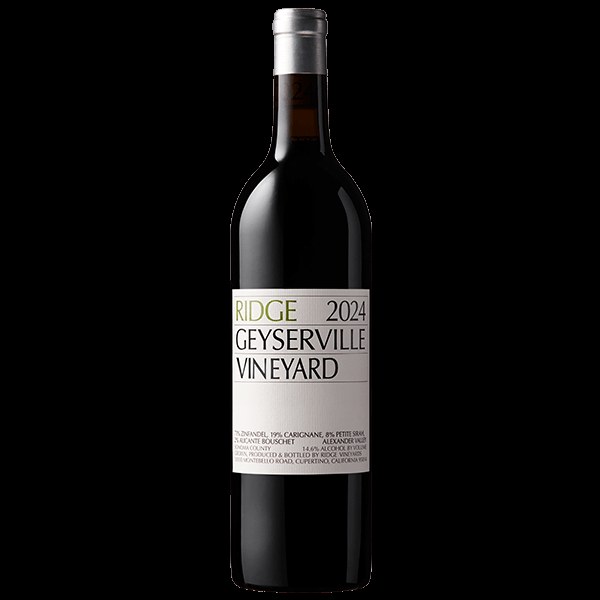
Ridge's Geyserville is one of California's iconic field-blend reds, drawn from century-old vines in Sonoma's Alexander Valley. Zinfandel-led, with Carignane and Petite Sirah, it is made in Ridge's signature natural-yeast, American-oak style — vivid, spicy and built to age.
Review:
Tasted from tank just prior to bottling, the 2024 Geyserville is one of the very best Geyservilles I've ever tasted. It's weightless and elegant but supremely concentrated and packed to the gills with intense flavor. Rich blue fruit, incense, crushed rocks and deeply pitched spice tones march with gravitas from open to close. What a sensational edition of this wine.
Vinous (Billy Norris) 97 Points
In 1962, Ridge made its first Monte Bello, and two years later its first zinfandel. Since that time, Ridge has championed single-vineyard winemaking, searching California for those rare and exceptional vineyards where climate, soil, and variety are ideally matched.
The history of Ridge Vineyards begins in 1885, when Osea Perrone, a doctor who became a prominent member of San Francisco’s Italian community, bought 180 acres near the top of Monte Bello Ridge. He terraced the slopes and planted vineyards; using native limestone, he constructed the Monte Bello Winery, producing the first vintage under that name in 1892. This unique cellar, built into the mountainside on three levels, is Ridge’s production facility. At 2600′, it is surrounded by the “upper vineyard”, now referred to as the Perrone Ranch.
In the 1940s, William Short, a theologian, bought the abandoned winery and vineyard just below the Perrone property; he replanted several parcels to cabernet sauvignon in the late 1940s. From these vines — now the “middle vineyard” and referred to as the Torre Ranch — new owners Dave Bennion, Hew Crane, Charlie Rosen, and Howard Ziedler, all Stanford Research Institute engineers, made a quarter-barrel of “estate” cabernet. That Monte Bello Cabernet was among California’s finest wines of the era. Its quality and distinctive character, and the wines produced from these same vines in 1960 and ’61, convinced the partners to re-bond the winery in time for the 1962 vintage. Dave Bennion left his role at S.R.I. to oversee winemaking duties full time.
The first zinfandel was made in 1964, from a small nineteenth-century vineyard farther down the ridge. This was followed in 1966 by the first Geyserville zinfandel. The founding families reclaimed the Monte Bello terraces, increasing vineyard size from fifteen to forty-five acres. Working on weekends, they made wines of regional character and unprecedented intensity.
By 1968, production had increased to just under three thousand cases per year, and in 1969, Paul Draper joined the partnership. A Stanford graduate in philosophy—recently returned from setting up a winery in Chile’s coast range—he was a practical winemaker, not an enologist. His knowledge of fine wines and traditional methods complemented the straightforward “hands off” approach pioneered at Ridge. Under his guidance the old Perrone winery (acquired the previous year) was restored, the finest vineyard lands leased or purchased, the consistent quality and international reputation of the wines established. Cabernet and Zinfandel account for most of the production; Syrah, Grenache, Carignane, and Petite Sirah constitute a small percentage. Known primarily for its red wines, Ridge has also made limited amounts of chardonnay since 1962.
Lytton Springs, in Sonoma County, became part of the Ridge estate in 1991. A quarter century’s experience with this vineyard had convinced us that it was an exceptional piece of ground. Forty consecutive vintages of Geyserville attest to yet another stunning combination of location and varietals. Though born in the early sixties to the post-Prohibition world of modern California winemaking, Ridge relies on nature and tradition rather than technology. Our pre-industrial approach is straightforward: find intense, flavorful grapes; intrude upon the process only when necessary; draw the fruit’s distinctive character and richness into the wine.

On the palate, it reveals a fresh attack followed by an ample, structured, long-lasting finish. The wine unfurls in successive stages and ends with top-quality tannins produced by whole cluster fermentation. It features aromas and flavors of smoked ham, violet, graphite, graphite, and licorice.
Syrah, with its deep flavors and firm tannins, is a natural match for grilled or smoked meat and dishes featuring herbs, roasted mushrooms, and onions. Seared venison or beef with black pepper and thyme or a Moroccan tagine of pigeon or chicken are complimented by the spicy characteristic of Syrah.
Review:
This refined, graceful version is winey, offering steeped currant flecked with bacon fat, dried leaves, white pepper and mocha. Streaming and fluid in feel, with salty, mineral intensity building toward the long, elegant finish, which shows polished tannins. Though drinking beautifully now, this will benefit from time in bottle. Best from 2026 through 2038.
-Wine Spectator 94 Points

All older vintage wines have been purchased from a single collectors cellar. Pictures can be requested before shipment.
All older vintage wines have been purchased from a single collectors cellar. Pictures can be requested before shipment.

I feel this wine expresses the greatness of California and its hidden pockets where Cabernet can excel. The cold Pacific Ocean running the entire length of the state presents maritime influences – and with each small distance eastward the climate warms. Stony soils, south facing slopes and moderately warm conditions are the keys to producing dark, rich and good tasting Cabernet.
A small release from Caymus Vineyards, this wine is a California-appellation Cabernet Sauvignon – supple, dark and rich, bearing the signature hallmarks of Caymus. It is sourced from sites throughout the state which feature climatic conditions, soils and topography that are ideally suited to Cabernet. This project stems from excitement over California's diverse vineyard land, often in lesser-known areas, with the potential to produce exceptional Cabernet.

Bernardins Beaumes de Venise Rouge Cru Cotes du Rhone is made from 65% Grenache, 25% Syrah, 5% Mourvedre and 5% Grenache Blanc.
Bright ruby color with cherry tinges. Complex black fruit aromas on the nose enhanced by spicy notes. Rounded palate with good length.
The wine is drinking well right now and can be kept for another 10 years.
Situation
Spreads out over the south-east side of the Dentelles de Montmirail hills, in Beaumes de Venise in the southern part of the Rhone valley.
Terroir
On a poor sandy, hungry and arid soil consisting of tender limestone and gritty zones of sandy mollasse.
In the vineyard
The vineyards and their terroir are the essence of our wines. This is where everything starts and where we focus our efforts throughout the year. You can’t make great wine without great grapes.
The viticulture is essentially done by hand. Five people work full-time in the vineyards. They are supplemented by seasonal employees who work during bunch thinning and the harvest in order to bring out the very best in our vines. Working by hand and the attention each vine gets are fundamental. Pruning, de-budding, trellising, leaf removal and picking are thus carried out by hand with the utmost care.
We prepare the soil by using good old-fashioned ploughing. Organic compost is made from grape marc (the discarded stalks and skins).
As a way of protecting the plants, we only use phytosanitary products when necessary and within strict guidelines by staggering the treatments appropriately, to minimise the amount of chemicals used. We prefer to use as much as possible manual and organic techniques . Leaving natural grass cover, removing buds and leaves from the vines, preserving biodiversity around the vineyard: olive, almond and cypress trees, wild rosemary and capers.
Winemaking
We make two red wines at the estate. Terroir wines shaped by the two classic Côtes du Rhône varieties: Grenache and Syrah. We don’t follow any winemaking recipe but are constantly searching for the perfect expression of terroir and each vintage’s particular characteristics. We don’t go for overripe grapes and over-extraction, as we think the wine has to stay refreshing and balanced.
Leaving the wine for 15 days in concrete vats, we try to gently extract the tannins and anthocyanins essential for the wine’s structure and colour. The wine doesn’t come into any contact with wood during ageing. This way the characteristics of our terroir can fully express
Serve with a meal especially red meat, game and cheese.
Review:
-Decanter 95 Points
-Decanter 93 Points

Trefethen Family Vineyards Dragon's Tooth Red is made from Malbec, Petit Verdot and Cabernet Sauvignon.
Our Nana, Catherine Trefethen, was Welsh. Her twin loves of wine and family were the original inspiration for our estate in Napa Valley’s Oak Knoll District. Celebrating our heritage, “Y Ddraig Goch”, the symbol of Wales, adorns this bottle of Dragon’s Tooth, a provocative blend born from the rockiest part of our vineyard.
This wine opens with expressive aromas of cherry and blackberry accented with notes of fig, tobacco leaf, and sarsaparilla. Full-bodied and balanced, the integrated flavors of ripe dark fruit lead to a lush and abundant finish.
Winery Chef Chris Kennedy enjoys Dragon‘s Tooth with earthy and rich cuisine. He suggests pairing it with our Creamy Mushroom Pasta. The complementary flavors, textures, and intensity of both the dish and the wine are stunning.
Trefethen Family Vineyards has farmed Napa Valley's cooler Oak Knoll District since 1968. Dragon's Tooth is their signature proprietary red — a nod to matriarch Catherine Trefethen's Welsh heritage and “Y Ddraig Goch,” the red dragon of Wales — a Malbec-led Bordeaux blend drawn from the rockiest parcels of the estate.
Review:
Aromas of blackberries, licorice, sweet spices and dried herbs. The palate is rich and structured with firm tannins and dark fruit. Bold and savory with a lasting finish. Drink or hold.
James Suckling, 93 points

Pine Ridge Vineyards has farmed the Stags Leap District since 1978, and its estate Cabernet is a benchmark for the appellation's signature of plush fruit framed by silky, fine-grained tannins. The 2023 comes from the warm volcanic benchland that makes Stags Leap one of Napa's most prized Cabernet sites.
Review:
Super silky, refined and relaxed, opulent, almost sweet, rich in dark chocolate and macerated cherry flavors. Made from clone 337, which is known for its luscious ripeness. Full-bodied yet elegant in texture due to super-fine powdery tannins. Long in the finish. Drink or hold.
James Suckling 97 Points

Drew's appellation Chardonnay draws on the far-coastal Mendocino Ridge, blending estate fruit from Faite de Mer Farm with cool-climate lots from Anderson Valley's Clow Ridge. Fermented and raised about ten months in neutral French oak, it's built for freshness — green apple and pear lifted by a saline, high-acid snap. Organically farmed from sites just a few miles off the Pacific.

Flanagan Chardonnay Bacigalupi 2024 is made from 100% Chardonnay.
This wine is sourced from the legendary Bacigalupi Vineyard in the Russian River Valley — the site that grew the Chardonnay fruit for the 1973 Chateau Montelena that famously bested white Burgundy at the 1976 Judgment of Paris. Barrel-fermented and aged in French oak, it is a rich yet vibrant Chardonnay with the depth and cut that made this vineyard a California landmark.
Winery Info: Flanagan Family Winery was founded by Eric Flanagan in 1999, farming estate vineyards on Bennett Mountain in Sonoma and sourcing from a handful of the Russian River Valley's most coveted sites. The winery specializes in small-lot, terroir-driven Chardonnay and Pinot Noir.
Review:
-James Suckling 94 Points

Hamilton Russell Vineyards Bramble Hill Pinot Noir is made from 100 percent Pinot Noir.
Hamilton Russell Vineyards in South Africa has developed an international reputation over 40 vintages for unusually restrained, classically styled Pinot noir, with deep structure and spice balancing fruit opulence. Hamilton Russell Oregon aims to express this stylistic philosophy with the very best Willamette Valley fruit - showcasing the restrained, structured classicism of great European Pinot noir and the bright purity of Oregon fruit. The celebrated Bramble Hill vineyard in Ribbon Ridge, delivers a particularly bright, pure, lively minerality to complement the complex lifted fruit the best Oregon Pinot noir is known for.
Review:
-Vinous 93 Points

A dramatic, ridgetop landscape — rising 1500 feet above Lake Hennessey, staring west over Pritchard Hill — persistently influenced by a push/pull draw between The Valley’s floor and Lake Berryessa. This wild, untamed, eastern frontier of Napa Valley, produces singular, terroir-driven wines of captivating beauty, power and lift. An unseasonably wet and cool springtime produced significant shatter at Sage Ridge in 2019, reducing our yields by 50%, leading to a particularly flamboyant edition of this wine.
An incomparable expression of Cabernet Sauvignon — massively pure red fruit character, delivered on a ribbon of ultra-suave tannins and gorgeously seductive high tones. The palate never relents its come-hither posture. Aromatically, puts forth an intriguing botanical complexity that is unmistakably site-specific. As our experience with this one-of-a-kind terroir deepens, we remain endlessly excited for the potential of these unique ridgetop vineyards. Get your hands on a bottle and pull the cork…a wine built for immense near-term gratification.
Review:
-Jeb Dunnuck 95 Points
-Lisa Perrotti-Brown (Robert Parker) 95 Points

Decoded Chardonnay Napa Valley 2024 is made from Chardonnay.
Decoded is the Napa Valley range from Navigator Wine Collection, the négociant house formerly known as Precision Wine Company. Founded in 2010 by winemaker Trevor Sheehan on a buy-the-best-lots model, the house has grown into one of the largest wine producers in the United States, sourcing from vineyards across Napa and greater California, and was renamed Navigator in 2025 under president Taylor Case. The Decoded label — its cipher-print bottle a nod to the name — is built to deliver Napa Valley character at an everyday price.
Review:
-James Suckling 90 Points

Arzuaga Gran Reserva 95% Tempranillo, 4% Cabernet Sauvignon and 1% Merlot.
Presenting a ruby red color, this wine has a wide range of aroma of ripe fruit compote, toast, and leather. Fine, complex, and attractive with a great balance. Silky and pleasant in the mouth with a bit of spice detected in the finish.
Serve with red meats, roasts, or game dishes. Its flavor is enhanced with cured or fatty cheeses.
Review:
-Jeb Dunnuck 98 Points

William and John Graham founded their Port house in 1820, and for more than two centuries the name has stood among the greatest in the Douro. Since 1970 the firm has been owned and run by the Symington family, who farm their own quintas — Quinta dos Malvedos chief among them — and personally make every Graham's wine.
A Graham's Vintage Port is drawn from the oldest vines on the steepest terraces and released only when the year merits it. The 2024 shows the classic Graham's signature: a deep, opaque core of black fruit and violets, framed by ripe tannin and the house's hallmark seam of sweetness that carries through a long, structured finish.
Built to reward the cellar, it will drink beautifully for decades. 750ml.
Review:
-Luis Gutiérrez (Robert Parker) 97 Points
-Neal Martin (Vinous) 97 Points
-James Suckling 95 Points



