" We don't sell the wine without touching the vine "
| Country: | United States |
| Regions: | California California (Central Coast) |
| Winery: | Bonny Doon Vineyard |
| Grape Type: | Mourvedre |
| Vintage: | 2018 |
| Bottle Size: | 750 ml |
Ancien Chardonnay Coombsville Haynes Old Block is made from 100 percent Chardonnay.
Inspired by the classic and most revered Chardonnay vineyard in the world, Le Montrachet, Ancien winery utilizes the same classic techniques. It is fermented in tight-grained French Oak cask after a gentle squeeze as whole clusters. The wine is not moved through the fermentation and aging period, only pushed by inert gas in gentle fashion into the bottling tank. In vintages where the wine achieves good clarity through natural settling, the wine is not filtered – otherwise it undergoes a light polish to help reveal is core of fruit.
The effusive nose welcomes with layers of lemon meringue, ripe apple, citrus zest, honey and grape blossom. The palate is vibrant and fresh, and the richly textured mouth-feel is expansive. Baked apple tart and stone fruit emerge as this opulent wine reaches the depths of your palate, with further notes brioche. The finish is a focused amalgamation of minerality and ripe fruit. Give this cellar worthy Chardonnay time to open up and it will reveal increasingly lush and creamy layers as it evolves over minutes in the glass and the years in the bottle.
Grace Town Old Vine Zinfandel Lodi is amde from 98% Old VIne Zinfandel + 2% Cabernet Sauvignon.
Ruby red in color, with red fruit, raspberry, and spice on the nose. This wine is medium in body, with notes of ripe cherry, cedar box, cinnamon, anise, black pepper, and hint of smoke on the palate. It has a long, silky finish.
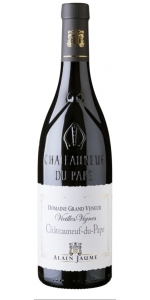
Grand Veneur Chateauneuf Du Pape Vieilles Vignes is made from 50% Grenache, 40% Mourvedre, 10% Syrah
Matured in concrete vats (40%) and oak casks (60%)
It boasts an inky/purple color in addition to a gorgeous perfume of crushed rocks, jammy black fruits, charcoal and graphite. Blackberry aroma with an air of dates pressed in alongside – this is sweet-noted. It is easy to appreciate, a sleek and stylish start. The palate holds excellent fruit that runs well and has kick. Its tannins move round freely and a minted finale comes forward. Its dark fruit is tasty, darkens on the finish, where tar and char from its oak enter. It is all very much together, a bundle of harmony, and will gain local attributes as it ages.
An outstanding Chateauneuf du Pape which display the best of its terroir.
The vines are 50 to 100+ year old. They are planted on red clay soils covered with pebble stones.
Harvest is destemmed and crushed. Fermentation temperature is controlled at 30°C. Vatting period of 18 to 20 days. Matured in concrete vats (40%) and oak casks (60%).
The vineyards are located in the north of Châteauneuf du Pape. GRAND VENEUR «Vieilles Vignes» cuvee is produced from the older vines. Thanks to time and an organic growing, roots go very deep in the soil. Yields are naturally low and grapes highly concentrated.
The vines are 50 to 100+ year old. They are planted on red clay soils covered with pebble stones.
Winemaking and aging
Harvest is destemmed and crushed. Fermentation temperature is controlled at 30°C. Vatting period of 18 to 20 days. Matured in concrete vats (40%) and oak casks (60%).
Pair with venisson, duck, braised lamb or strong cheese.
Review:
"Up with the crème de la crème of the vintage, the 2018 Châteauneuf Du Pape Vieilles Vignes is a bigger, richer wine than the Les Origines cuvée and has a beautiful core of smoked black fruits, candied violets, peppery garrigue, and scorched earth-like aromas and flavors. Playing in the medium to full-bodied end of the spectrum, it’s flawlessly balanced and has terrific tannins, a stacked mid-palate, and a great finish. It certainly shows the more front end-loaded, fleshy, mildly concentrated style of the 2018 vintage, yet the balance is top-notch, and it’s just a thrill to drink today. It should evolve nicely for 10-15 years."
- Jeb Dunnuck (October 2020),96 pts
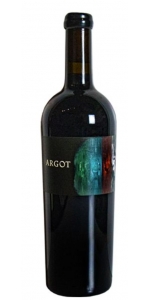
Among the tapestry of historic vineyards in Napa Valley, there are a few standout names, but even fewer sites, if any, involve the rare combination of legendary wine, romance, and a touch of mystery. Bonny’s Vineyard is such a place. This four-acre vineyard in the Oakville District is both a special piece of land and a unique part of Napa history. It was planted in 1974 by Justin Meyer, the winemaker and co-founder of Silver Oak Cellars, as a gift to his wife, Bonny. Ideally situated in a gravelly spot adjacent to Conn Creek on the valley floor, Bonny’s Vineyard was responsible for a memorable string of Silver Oak vintages over the course of two decades.
Justin Meyer stopped producing the Bonny's Vineyard designate after the 1991 vintage. After replanting in 1999, the family has again decided to make a single vineyard bottling. True to the orignal, this is 100% Cabernet Sauvignon aged in 100% American oak barrels for almost 3 full years. The nose exhibits dark fruit aromas of cherry and plum mingling with cedar and cardamom and a hint of eucalyptus. The palate is the heart of this wine, with concentrated fruit on the entry and luscious, silky tannins filling the mouth with an almost endless finish.
As distinct and impressive a terroir as we farm in the Napa Valley. The rocky, gravel-rich soils contribute a distinct sauvage/mineral character, creating a stunning complexity to play off of Cabernet’s natural robust and fruit-driven personality from Oakville. In 2021 Argot added a new vineyard block to our holdings at Bonny’s. Deeper gravel and the famously low-yielding Disney clone conspire towards awesome complexity, and a deeply mysterious, brooding personality. A wholly different Cabernet from its 2021 siblings that you will not want to miss. Only 150 cases produced.
Review:
"Opaque purple-black colored, the 2021 Cabernet Sauvignon Bonny's Vineyard prances out with showy scents of Morello cherries, wild blueberries, and black raspberries, leading to a core of black currant jelly and violets. The full-on, full-bodied palate is densely laden with black and blue berry layers, framed by fine-grained tannins and well-knit freshness, finishing long and earthy."
- 97 Points, Lisa Perrotti Brown, The Wine Independent
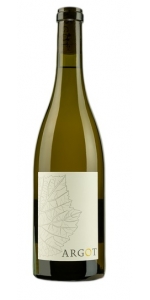
Argot Chardonnay Sonoma County is made from 100 percent Chardonnay.
Pouring a green-tinted gold, our Sonoma County Chardonnay is a beautiful wine from word go. Radiating from within, a blast of apple/pear fruit informs this wine both aromatically, and on the palate. As flavors unfurl, a progression of orange blossom, pineapple, white peach, and hazlenut are followed by a finish dominated by ginger, baked apple, with a trailing kiss of mint’s freshness. A stunning wine — wholly informed by the perfection of 2018’s growing season — defined by its dichotomy of massively intense flavors, and superb acidity and freshness.
Raised by minimalistic methods, often associated with the classic Chardonnay winemaking techniques of Meursault. With a focus on the coolest Chardonnay region in Sonoma County, 2018’s long, even growing season favored our vineyards’ moderate climate, old vines and deep volcanic soils. These grapes were allowed an extended ripening period on the vine, resulting in perfect balance and concentrated flavors.
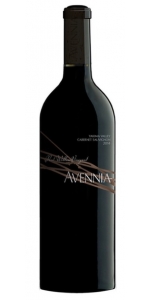
Avennia Red Willow Cabernet Sauvignon is made from 100% Cabernet Sauvignon.
The Red Willow Cabernet is a true blockbuster.
Coming from one specific block of 30 year old vines at this iconic vineyard, then strictly barrel selected, this is the essence of powerful, old vine Washington Cabernet. After all of our efforts promoting the idea of the Bordeaux blend, it would take a pretty compelling argument to suspend that idea and make a 100% varietal Cabernet. In 2016 Red Willow provided us with just that. Each time we tasted it in the barrel, the belief grew that this was something special. Something we can't make every year. In the end we were won over, and decided to make a limited amount of this wine. But don't be fooled, as this too is a blend and a selection. Each year as we are tasting the grapes as harvest approaches, we notice that the vines near the bottom of this long, steep west-facing slope, are a little different. The vines at the bottom are in a little richer soil, and get a little more water, so we pick them separately, sometimes even a week or ten days apart, and keep them separate in barrel.
This wine is all from the top of the vineyard, with its lower yield and poorer soils giving more concentration and interest. Then further, nearly every combination of new and used French oak barrels were trialed to find the best blend. It's not enough just to use the four best barrels, but to trial each combination to see how they complement each other. For a wine with this much mass, 100% new French oak was used for the first time at Avennia. It is a wine that needs a little cellaring to start, but should last a very long time.
Review:
The flagship Cabernet, the 2018 Cabernet Sauvignon Red Willow Vineyard is all varietal, from old vines in a great vineyard in Yakima Valley, that spent 20 months in 80% new French oak. It reveals a deep purple hue as well as a backward, brooding nose of smoked blackcurrants, tobacco, scorched earth, and violets. It has beautiful richness yet takes plenty of coaxing to open up. On the palate, it's medium to full-bodied and has a nicely textured, balanced mouthfeel, plenty of tannins, and outstanding length. It's mostly potential at this point and is going to benefit from at least 4-5 years of bottle age, but my money is on it having 20+ years of prime drinking.
-Jeb Dunnuck 96 Points
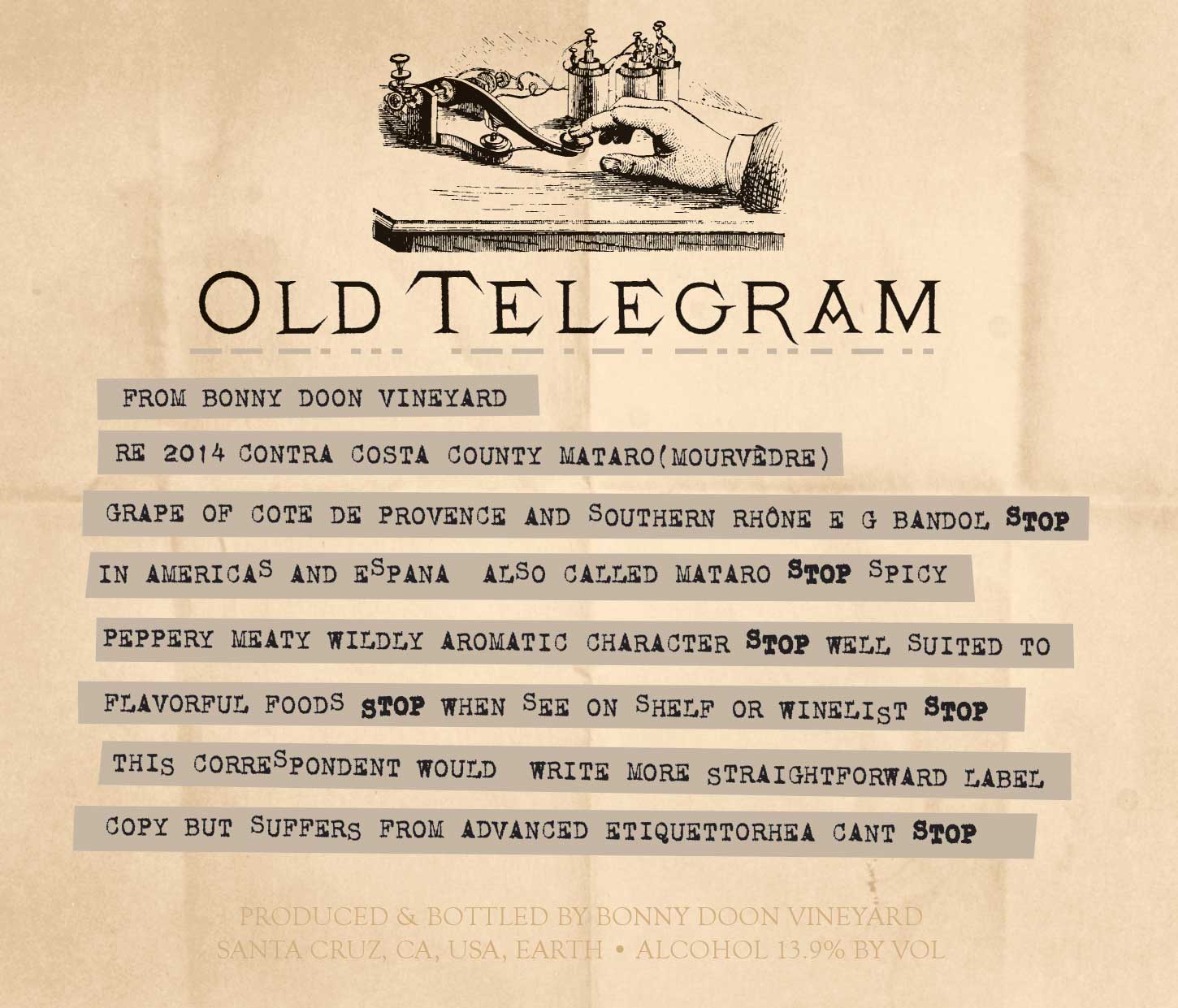
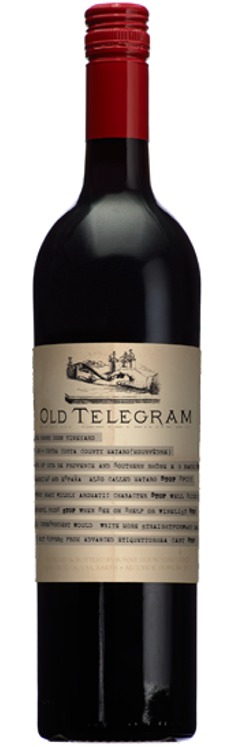
Bonny Doon Old Telegram Mourvedre is made from 100 percent 100% Mourvedre.
Like the Rhone classic, it is produced from grapes which the label identifies as Mataro, an alias under which thick-skinned, late-ripening Mourvedre sometimes goes. From the nose, one scents licorice, blood(!) (make that very rare meat), blackberries (both berry and leaf), wet earth. There is a definite scent of beef bouillon, one of the absolute true signifiers of (proper) Mourvèdre. On the palate, the tannins are very plush and soft, almost a sense of sweetness (emphatically no R.S. in this), but with a really vibrant acidity and very great length. We somehow skirted the peril of over- ripeness and raisination, which is always a bit of a peril in the sunny climes of Antioch, CA. The wine is rich but also quite elegant at the same time.
Pairs with Wine-braised lamb shanks with herbes de Provence. Enoki mushroom tempura with soy-based dipping sauce. Hoisin-marinated chicken breasts served with wild & brown rice medley. Wild mushroom & thyme pizza. Pork shoulder. Beef short ribs.
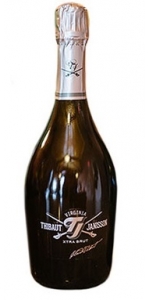
This 100% Chardonnay blend is made from Tête de Cuvée, or first pressing of the grapes, considered superior in quality, with a high percentage of reserve wines for extra complexity, depth and richness, and a low added dosage to preserve purity and freshness.
SALE!
Hugl Sparkling Gruner Veltliner NV is made from 100% Grüner Veltliner.
Did you know that most of the base wines for Austrian sparkling wines come from our region? Poysdorf lies on the same line of latitude as Champagne and the climate is similar in both Champagne and the Weinviertel. This gives us enough reasons to expand our portfolio with a top-quality “sparkler”. Of course, it can only be a Veltliner-Sekt!
Pale golden color with a glint of green. Yellow fruit aromas, dry with a soft, juicy structure and a pleasing streak of minerality. Notes of crisp apple and pear.
The ripe grapes are gently pressed and fermented refrigerated.
Vinified in Stainless Steel tanks. No Oak.
A firm mineral backbone, gives it the strength of character to work well with many cuisines.
Dominique Piron Morgon Cote du Py is made from 100 percent Gamay.
The Morgon Cru is based in the heart of Northern Beaujolais. Côte du Py is the heart of Morgon, a little hill of very old blue stone rocks - the oldest soils of Beaujolais (around 430 millions years old), with a typical blue color.
Côte du Py has been known for centuries for being the best terroir of the village, producing long lived wines with strong structure and flavors.
Wines of the Côte du Py are very dark, profound and dense. Classic aromas of red berries, cherry, kirsh. Fruity, structured and mineral in the mouth with graphite flavors and spicy notes of black and white pepper. Wine can age up to 10 years.
Hand picked grapes are sorted manually and destemmed for 50 to 70%. Fermentation starts in concrete tanks and lasts for 18-25 days with remontages and pigeages. Then after pressurage starts the aging, for 2/3 in concrete tanks, and 1/3 in recent French oak barrels with batonages on fine lies only. After 10 month we do the blending, keeping only the best cuvees and best barrels, and do the bottling.
Pairs well with red meat like beef, duck and game (Hare, Dear, Wild Pork,…), cheses.
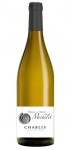
Michelet Chablis Premier Cru Beauroy is made from 100 percent Chardonnay.
Chablis is the northernmost wine region of Burgundy, renowned for producing some of the world's finest and most mineral-driven Chardonnay. The Premier Cru 'Beauroy' vineyard is located on the right bank of the Serein River on slopes with Kimmeridgian clay and limestone soils rich in fossilized oyster shells.
This wine displays a brilliant pale gold color with green reflections. The nose offers aromas of citrus, white flowers, and characteristic flinty minerality. On the palate, it is precise and elegant with bright acidity, flavors of green apple and lemon, and a long mineral finish.
Pairs excellently with oysters, shellfish, sushi, or simply prepared white fish.