
" We don't sell the wine without touching the vine "
In the 1850s, prospectors discovered gold in the southern region of the Oregon Territory. From the moment gold was struck, the Oregon Territory was flooded with miners seeking their fortune. During the rush, a gold prospector whose identity has been lost to history traveled from the goldfields of Southern Oregon to Portland to sell his gold and make his fortune. He made the fateful decision to stop for the night and set up camp at the top of what is currently the Bayliss farm, the place we now know as Ghost Hill. At the time, the hill and the surrounding land was heavily wooded making it an ideal place to camp in peace. During the night, someone snuck into his camp to rob him of his gold. The miner was killed and his horse was mortally injured. His hard-earned poke of gold disappeared into the night. To this day, the miner is said to wander the hill looking for his stolen gold and to right the wrongs that befell him.
While the miner never recovered his gold, we have found our treasure with our Pinot Noirs.
THE LAND:
Excellent wine starts in a remarkable vineyard. The resplendent, rolling hills of the farm are Willakenzie series soils with marine sediment bedrock. These soils are ideal for the propagation of the difficult-to-grow, but very rewarding, Pinot Noir grape. We strive to produce delicious, elegant wines from the grapes grown in our estate vineyard.
The Bayliss-Bower Vineyard is part of the family’s 234 acre section of land in the Yamhill-Carlton District. The Bayliss family has owned the farm since 1906. The first vines were planted in 1999. Currently, all 16 acres of vines are Pinot Noir of the Pommard, Wadenswil, and Dijon clones 114, 115, 777. One hundred percent of the fruit used to produce the wines of Ghost Hill Cellars comes from the estate vineyard. We only use around a third of the grapes we grow. The rest of our grapes are sold to other wineries looking for exceptional Pinot Noir grapes.
THE FAMILY:
The quote from Robert Frost “The land was ours before we were the land’s,” epitomizes the bond of the Bayliss family with the land. The Baylisses have been stewards of this piece of the Willamette Valley for more than a century. In 1906, brothers Daniel and Samuel Bayliss purchased the Donation Land Claim of James and Edith Greene. The family started clearing the trees and brush in order to farm the land. The farm added a dairy operation in the 1920s. Samuel Bayliss took milk into Portland to sell on a sternwheeler steamboat.
Daniel’s son, Samuel D. and his wife Barbara purchased the farm in the 1930s. They moved from dairy-based farming to raising wheat, hay, clover, peas and sheep. As their son Mike and daughter-in-law Drenda became more involved in the farm in the 70s and 80s, they began making more grass hay and raising Black Angus cattle for beef. Today, the vineyard is the only crop farmed by the Bayliss family. The fourth and fifth generations of the Bayliss family continue to work and live on the farm today. Mike and Drenda live in the original farmhouse built in 1906 by Daniel and Samuel. Mike, Drenda, their son Michael, their daughter Bernadette and son-in-law, Cameron Bower are working together to make the vineyard and Ghost Hill Cellars a success and preserve the farm for future generations.
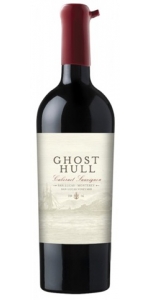
Ghost Hull Cabernet Sauvignon is made of 100 percent Cabernet Sauvignon.
Aromas of blackberry, elderberry and ripe plum are accentuated by notes of mocha, fresh tarragon, vanilla and oak. The palate is full-bodied and offers a lovely balance of acidity and tannins accompanied by rich flavors of dark fruit and black currant, ending with a juicy and lingering finish
Argot Napa Cabernet Sauvignon Sugarloaf Vineyard is made from 100 percent Cabernet Sauvignon.
Sugarloaf’s terroir continues to impress with its expression of classically-styled Napa Valley Cabernet Sauvignons — impeccably pure black and red fruit character; broad, rich, perfectly ripe tannins; classic Napa Valley notes of cigar leaf, eucalyptus, and freshly-tilled earth; and definitive complexities of clove, all-spice and bay leaf. Having assessed past vintages with a few years of age, we have come to greatly value the significant reward Sugarloaf delivers after a few years in the cellar.
From Block 6, an acre of fiercely steep, ferociously rocky hillside, located in Napa’s far south-eastern foothills, deeply affected by the cooling influences of San Pablo Bay. One of the latest harvests in all of Napa Valley each vintage. Mother Nature was kind to this site in 2019, being our most bountiful year here ever. With perfect set, and vines displaying great health, this normally stingy hillside delivered superlative quality, without restraint of yield. After a slow start in the Spring, 2019’s particularly warm September and October played beautifully to the vineyard’s strengths, and delivered a classic Halloween-time harvest.
Review:
"It is not often that you see a 100% Cabernet Sauvignon coming from this rising star, cooler-climate vineyard in south Napa. This wine comes exclusively from the low-yielding, steep, rocky "Block 6." Deep purple-black in color, the 2019 Cabernet Sauvignon Sugarloaf Vineyard needs a little coaxing to reveal wonderfully pure scents of blackcurrant cordial, juicy blueberries and ripe blackberries, plus suggestions of iris bulb, dark chocolate, molten licorice and cedar chest. The big, rich, seductive, full-on full-bodied palate is laden with ripe, energetic black berry layers, framed by firm, ripe, grainy tannins and seamless freshness, finishing long and perfumed. A stunning, true-blue Napa blockbuster with its own very evocative signature, this comes highly recommended! 175 cases were made. - Lisa Perrotti-Brown"
- Robert Parker's Wine Advocate (November 2021), 97+ pts
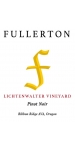
Fullerton Lichtenwalter Pinot Noir is made from 100% Pinot Noir - 10 years old
12 months in 100% neutral French Oak
On the western slope of the south-facing Ribbon Ridge sits the lovely Lichtenwalter Vineyard. Here Willakenzie soils, derived from ancient sedimentary seabed, coax black fruits and concentrated spices out of the wines.
Aromas of blackcurrant, blueberry, blackberry, and black cherry with concentrated spices followed by hints of sandalwood, smoke and oolong tea. Depth in the mid-palate pairs with balanced acidity, and so, yet structured tannins. The Willamee Valley’s smallest AVA speaks clearly and compellingly through this wine.
This wine comes from 100% destemmed rotator barrels fermented at ambient temperature reaching a peak temperature of 73° F. The rotator barrel spun twice daily during fermentation yielding a gentle extraction. Aer fermentation, the wine went through a three-week extended maceration, allowing the tannins to polymerize, soening the wine. Aged for 12 months in French oak barrels and three months in tank, the wine was then boled aer filtration.



