
" We don't sell the wine without touching the vine "
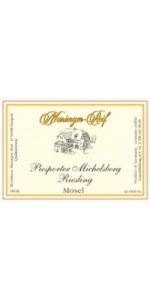
Maringer-Reif Piesporter Michelsberg (liter) is 100 percent Riesling.
This Mosel-Riesling is fruity and semi-sweet. It is easy to drink on the evening of a hot summer day. It's got a hint of lemon flavor and a very good minerality.
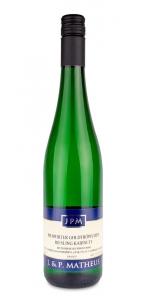
Matheus Piesporter Goldtropfchen Riesling Kabinett is made from 100 percent Riesling.
This Goldtröpfchen ranks as an unofficial "Grand Cru" delivering light floral and fresh Kabinett style wines.
Their later harvest wines, Spatlese and Auslese, tend toward apricot flavors, honeyed notes and superb intensity. All grapes are grown on Devonian slate.
Enjoy with slightly spiced sushi or moderately spicy Indian cuisine such as chicken Vindaloo.
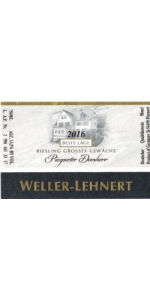
Weller-Lehnert Piesporter Domherr Grosses Gewachs Riesling is made from 100 percent Riesling.
Made in accordance with the stringent production criteria of the classification of the Bernkasteler Ring, wines with the designation “Grosses Gewächs Bernkasteler Ring” represent the premium line of the association’s dry wines. These Grand Crus can only come from the best sites of the steep slopes and are distinguished by their exceptional aging potential. To be awarded the status of “Grosses Gewächs”, selective hand-harvesting, a restriction of yields to 50 hl/ha and the passing of a stringent sensory examination by a highly qualified professional panel are required.
Piesporter Domherr is the ancient and original Piesporter Goldtröpfchen. It lies in the heart of Piesporter Goldtröpfchen right by the Mosel River. It consists of 4 hectares that are south-southeast facing.
The locatio on the river creates a mirror effect, offering optimum conditions for the production of outstanding mineral wine with fine, fruity elegance. Because of its prolonged vegetation period, Riesling (frequently referred to as the “queen of white varieties”) is often capable of expressing the characteristics of its terroir like no other.
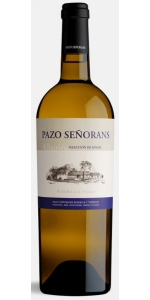
Pazo de Senorans Seleccion de Anada Albarino is made from 100 percent Albarino.
Straw yellow with greenish tints, vivid and brilliant. High intensity and very expressive. Profusion of aromas with traces of mineral. Great volume and ample body leaving a lasting impression from beginning to end.
Reviews:
The 2015 Albariño Selección de Añada is nothing short of phenomenal. For some reason, I hadn't tasted the young 2015 Albariño at the time it was released. It comes from the Los Bancales vineyard planted some 50 years ago and fermented with indigenous yeasts but without malolactic fermentation. It has a bright, almost fluorescent color and a complex, subtle and nuanced, elegant and expressive nose, with notes of sea shells and sea breeze, grass and white flowers. It's very clean, and the palate shows great balance and even feels a bit young. It has remarkable acidity and freshness (seven grams of tartaric acid) with good ripeness and 13% alcohol. This matured in tank with lees for over 30 months and was bottled in June 2024. It feels more serious and less exotic than earlier vintages. 18,000 bottles produced. This is the finest vintage that I can remember. Bravo!
-Wine Advocate 97 Points
Tech:
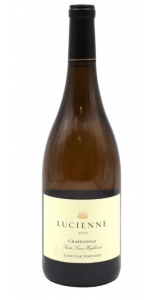
Hahn Estate Lucienne Chardonnay Lone Oak Vineyard is made from 100 percent Chardonnay.
Reviews:
Lemon blossom, grapefruit rind, pastry flake and a hint of ash show on the nose of this single-vineyard expression from the Hahn family. It's suave and broad on the palate at first, then it chisels down to pinpoint acidity, delivering flavors of apricot, lime zest and chalk before the slightly nutty finish. Matt Kettmann
-Wine Enthusiast 94 Points
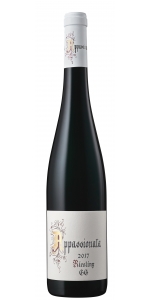
Inspired by the historical winemaking techniques of Erni Loosen’s great-grandfather, the Appassionata Riesling GG is made in the same way as the Dr. Loosen Grosses Gewächs (“Great Growth”) Rieslings he produces in Germany. The GG designation indicates a dry-style wine from a vineyard of special distinction — in this case, the old-vine Medici vineyard, planted in 1976. We farm this exceptional site, which is just a few miles east on the Chehalem Mountain ridge.
The fruit for this wine was harvested from old Rieslng vines (planted in 1976) in the Medici Vineyard, which is also in the Chehalem Mountains AVA, just a few miles from the winery. We lease this vineyard and have been farming it organically since 2015. The wine was fermented in a 3,000-liter German oak cask, and rests on the full lees for 12 months before bottling. The extended lees contact allows the wine to clarify and find its own harmonious balance naturally.
Production notes:
Whole-cluster pressing; natural fermentation in a neutral 3,000-liter oak cask; matured on the full lees for 12 months; no bâtonnage.
Review:
If you prefer a thinking person's wine you'll run out of superlatives to describe this Riesling from Dr Loosen's Oregon project with J Christopher Wines. From a personal favourite, the old vines of the Medici Vineyard, the winemaking shows serious patience and determination. Fermented in a 3,000-liter, neutral oak German Fuder cask. It rests on the full lees for two years and is then held in bottle for three to five years before release. Aged, savoury and delicious. Aromas are savoury and saline. Lanolin, dandelion, seafoam, and beeswax with hints of fresh herbs and dried lemon peel. The palate is brilliant, savoury and bright and complex. Energetic flavours of wet slate, savoury bee pollen, white tea and lanolin notes. The finish offers crushed stone vibrancy.
-Decanter 93 Points
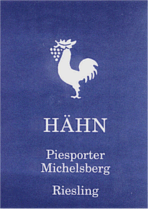
Hahn Piesporter Michelsberg Riesling is made from 100 percent Riesling.
This wine appears fruit forward, light bodied and easy sipping with light effervescence. It is a wonderful summer sipper or aperitif wine. It will also accompany most light seafood, poultry and veal dishes.
The wine shows very nice fruits, mineral finesse with a very well balanced finish.
The Hahn Estate
The Hahn family has been in the wine business since 1650 and moved to Kobern, the present location, in 1892 to start a small winery. Konrad Hahn took over the operation in 1991, when his father retired, and works now with his Colorado-born wife Laurel Kerns-Hahn. The winery is recognized as one of the top estates in the region. The high quality of the wines is continuously confirmed by awards and medals received in regional and national as well as international competitions.
The Hahn Vineyard
The vineyards are located in Michelsberg, which is near the town of Piesport (Mosel Valley). In this most northern part, the Mosel valley is very narrow and the vineyards very steep. The warm micro climate and the use of terraces along the south facing slopes allows the vines to grow to full ripeness despite the northern location. The use of machinery is impossible and all work including harvesting is done by hand. The grapes for this wine were grown in slate soil, which is typical for the Mosel area and provides a unique minerality. The harmonious climate, warm summers and mild winters promote a long growing season providing fine fruit with balancing acidity and low alcohol.
A warm, but by far not as hot summer as 2003, continued into a beautiful sunny autumn. This allowed a perfect ripening of the grapes in 2005 vintage. Especially the always late ripening Riesling grapes achieved exceptional quality with must-weights similar to 2003 but with higher acidity levels and mineral concentration similar to 2004.
We view the 2005 vintage as the best vintage in our estate in years even though it is following several great vintages such as 2001, 2002 and 2003. We are very excited about this great vintage
Franz Prager, co-founder of the Vinea Wachau, had already earned a reputation for his wines when Toni Bodenstein married into the family. Bodenstein’s passion for biodiversity and old terraces, coupled with brilliant winemaking, places Prager in the highest echelon of Austrian producers.
Smaragd is a designation of ripeness for dry wines used exclusively by members of the Vinea Wachau. The wines must have minimum alcohol of 12.5%. The grapes are hand-harvested, typically in October and November, and are sent directly to press where they spontaneously ferment in stainless-steel tanks.
Zwerithaler is a sub-site of Buschenberg and sits to the east of Weißenkirchen. The name Zwerithaler, meaning "nestled between the valleys," is a near monopole of Weingut Prager. It has a complex soil of paragneiss with alternating layers of dark and calcareous rock. Zwerithaler Kammergut is a 0.34-hectare parcel planted before WWI. The wine from these ungrafted, 100-year-old vines was bottled separately by Prager for the first time in 2015.
Light greenish yellow, silver reflections. Fine savory, delicate nuances of anise, tobacco notes, delicate yellow fruit, a touch of mango and honey blossom. Full-bodied, juicy white apple fruit, well-integrated, silky acidity structure, finesse and long persistence, saline finish, lingers for minutes, Veltliner at its best.
-Falstaff 99 Points
"The aromas of this old-vine gruner veltliner leap out and shake you to the core. Full-bodied and full of weighty and balanced layers of papayas, mangoes, nectarines, chives, white tea and oranges. Fantastic concentration, giving so much pleasure already, but it will keep blossoming if you give it time. From vines planted in 1907. Sustainable. Drink or hold."
-James Suckling 98 Points
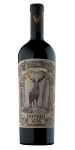
Bright deep ruby color, with spicy aromas reminiscent of red pepper, pepper and slight sensations of licorice.
In the mouth we can again find the typicity in its spicy flavors, balanced tannins, fresh, vibrant acidity and good volume.
Persistent, complex finish, with the authentic characteristics of a great Cabernet Franc.
Perfect companion for red and game meats, pasta, stews, rice and a variety of winter cuisine dishes.



