
" We don't sell the wine without touching the vine "
My name is Brian Loring and my obsession is Pinot Noir. OK, I'm also pretty crazy about Champagne, but that's another story. While in college, I worked at a wine shop in Hollywood (Victor's), where one of the owners was a Burgundy fanatic. So, my very first experiences with Pinot Noir were from producers like Domaine Dujac, Henri Jayer, and DRC. Needless to say, I found subsequent tasting safaris into the domestic Pinot Noir jungle less than satisfying. It wasn't until I literally stumbled into Calera (I tripped over a case of their wine in the store room) that I found a California Pinot Noir that I could love. But it would be quite a while before I found someone else that lived up to the standard that Josh Jensen had established. I eventually came to understand and enjoy Pinots from Williams Selyem, Chalone, and Sanford, but I really got excited about California Pinot Noir when I met Norm Beko from Cottonwood Canyon at an Orange County Wine Society tasting.
I'd made about 3 trips around the booths at the tasting without finding a single good Pinot Noir. So, being the open minded person that I am (remember I passed him up 3 times), I stopped at the Cottonwood booth. I was BLOWN away by Norm's 1990 Santa Maria Pinot Noir. After a few years of attending every Cottonwood event and asking Norm 10,000 questions about winemaking, he offered to let come learn the process during the '97 crush. I checked sugar levels, picked, crushed, punched down, pressed, filled barrels, and generally moved a bunch of stuff around with fork lifts and pallet jacks! It was the time of my life... I was totally hooked. And even though I hadn't planned it, I ended up making two barrels of Pinot Noir. That was the start of the Loring Wine Company. What had started out as a dream 15 years earlier was now a reality - I was a winemaker!
My philosophy on making wine is that the fruit is EVERYTHING. What happens in the vineyard determines the quality of the wine - I can't make it better - I can only screw it up! That's why I'm extremely picky when choosing vineyards to buy grapes from. Not only am I looking for the right soil, micro-climate, and clones, I'm also looking for a grower with the same passion and dedication to producing great wine that I have. In other words, a total Pinot Freak! My part in the vineyard equation is to throw heaping piles of money at the vineyard owners (so that they can limit yields and still make a profit) and then stay out of the way! Since most, if not all of the growers keep some fruit to make their own wine, I tell them to farm my acre(s) the same way they do theirs - since they'll obviously be doing whatever is necessary to get the best possible fruit. One of the most important decisions made in the vineyard is when to pick. Some people go by the numbers (brix, pH, TA, etc) and some go by taste. Once again, I trust the decision to the vineyard people. The day they pick the fruit for their wine is the day I'm there with a truck to pick mine. Given this approach, the wine that I produce is as much a reflection of the vineyard owner as it is of my winemaking skills. I figure that I'm extending the concept of terroir a bit to include the vineyard owner/manager... but it seems to make sense to me. The added benefit is that I'll be producing a wide variety of Pinots. It'd be boring if everything I made tasted the same.
Sounds pretty straight forward, last name Loring, therefore Loring Wine Company. Ahhh, but what about the "Wine Company" part? That is an hommage to Josh Jensen at Calera... which is actually Calera Wine Company. Since he was the guy who showed me that great Pinot Noir could be made in California, I decided to name my winery Loring Wine Company to "honor" him. Hopefully, Josh sees it for what it is and doesn't want to sue me for trademark infringement!
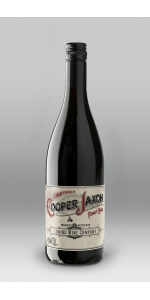
Loring Cooper Jaxon Pinot Noir is made from 100% Pinot Noir
Aged 10 Months in French Oak (15% New)
A special blend in honor of Cooper Jaxon Loring - the next generation of Loring. We don't limit the wine to any
specific AVA, but rather look for a blend that is big, bold, and super tasty!
Juicy and vibrant, with aromas of raspberry puree, blackberry and spring flowers.
Vines are planted on Arroyo Seco Sandy Loam soils on the following vineyard sites: Rancho La Viña, Kessler-Haak, Clos Pepe, John Sebastiano, Aubaine, Rosella's and Sierra Mar.
Vinification is traditionnal with minimal intervention.
Wine went thought Malo-Lactic fermentation and was bottled without filtration.
pH 3.61
Clones: Pisoni, 113, 115, 667, 777, 23
Pairs well with steak and lamb, spicy foods & mild cheeses.
Review:
"This fun and whimsical label from Brian Loring delivers his rich style of Pinot Noir at an affordable price, offering aromas of black cherry, forest herbs, damp sage and crushed slate. The palate is earthy, offering flavors of dark berry, fennel frond, roasted meat and clove. Matt Kettmann"
- Wine Enthusiast (June 2019), 92 pts - Editors' Choice
Chavy-Chouet Meursault Premier Cru Les Genevrieres is made from 100 percent Chardonnay.
Fruity flavors and typical nutty nuances. The Genevrières parcels are located in the heart of Meursault's southern premiers crus. "Genevrieres" takes its name from the presence, years ago, of the juniper bushes which covered its slope, and it is sometimes said that the tang of this aromatic berry can be detected in the wine.
The Genevrières parcels are located in the heart of Meursault's southern premiers crus. "Genevrieres" takes its name from the presence, years ago, of the juniper bushes which covered its slope, and it is sometimes said that the tang of this aromatic berry can be detected in the wine.
Fruity flavors and typical nutty nuances.
Ptit Paysan Cabernet Sauvignon is made from 91% Cabernet Sauvignon, 6% Petite Verdot, 3% Cabernet Pfeffer.
Oak: 11 months on lees in neutral barrels
The Cabernet Sauvignon is sourced from a vineyard at the foot of the Santa Cruz Mountains west of Morgan Hill, which grows in a mix of granitic and volcanic soils, and a 25-year-old vineyard east of Gilroy, which grows in deep, extremely sandy soils against the foothills of the Diablo Range. The Petite Verdot is sourced from the Paicines AVA and grows in rocky alluvial deposits above the Tres Piños Arroyo. All three vineyards experience the warm days and cold nights typical of the Central Coast, allowing these late ripening Bordeaux varieties to be picked at high acidity and moderate sugars.
Le P'tit Paysan offers intense blackberry, dark cherry aromas, chocolate, herbaceous and toasty notes on the palate. Medium-bodied, well-balanced with moderate and integrated tannins that give structure and liveliness to the wine.
Pairs well with steak, duck, game, hearty stews, ribs, and dark, rich sauces.



