" We don't sell the wine without touching the vine "
| Country: | Greece |
| Region: | Crete |
| Winery: | Lyrarakis Estate |
| Grape Type: | Muscat of Spina |
| Vintage: | 2016 |
| Bottle Size: | 750 ml |
Crown Point Estate Selection is made from 75% Cabernet Sauvignon, 10% Merlot, 6% Petit Verdot, 6% Cabernet Franc, 3% Malbec.
The 2016 Crown Point Estate Selection exhibits a heady aromatic array of baking spices, ripe red and black fruits, with deep intonations of earth and minerals. The palate is elegant and bright, with appealing acids and nuanced notes of savory mocha and dried herbs. Polished and seamless, the tannins finish with a comet-like trail of textural opulence highlighted by glossy flavors of baked berry pie and warm toast. Recommended drinking window: now through 2030s.The 2016 Estate Selection is representative of all five red Bordeaux varieties. The selection process starts in the vineyard and continues on through the winemaking process: only the best lots make the final blend. All blocks were harvested & fermented separately. The individual components were blended after 12 months in barrel. Total time in 225 liter French oak barrels was 26 months.
Review:
Deeply colored, the 2016 Estate Selection checks in as 75% Cabernet Sauvignon, 10% Merlot, 6% Petit Verdot, 6% Cabernet Franc, 3% Malbec that was brought up 26 months in 75% new French oak. Deeply colored, it has a smoking good bouquet of crème de cassis, smoke tobacco, lead pencil, camphor, and hints of chocolate. This gives way to a powerful, opulent Cabernet Sauvignon that has plenty of sweet tannins, a layered, multi-dimensional texture, no hard edges, and an awesome finish. I’d happily put this beauty in a lineup of top Napa Valley Cabernet Sauvignon and blends.
-Wine Enthusiast 97 Points
There’s an impressive amount of complexity on the nose of this bottling by winemaker Adam Henkel, from crushed graphite and concentrated black strawberry to cinnamon pastry, licorice and a brush of herbs. The sip is intense, with leathery but chiseled tannins presenting flavors of charred black currant, licorice, black olive, dried flower and white pepper
-Jeb Dunnuck 97 Points
Domaine Nico le Paradis Pinot Noir is made from 100 percent Pinot Noir.
The cool climate vineyard that belongs to Laura and her sister Adrianna Catena feels like paradise itself to Laura. It is lined by trees and fruit orchards, with majestic views of the Andes. Inside the 12 Hectare vineyard, there is a little house with two tiny bedrooms and a kitchen, where Laura dreams of spending a whole month reading books-Laura's version of paradise. The little house is affectionately named Chateau Laura. About the Vineyard The tiny parcel where Le Paradis is grown was planted in 2011 with Dijon 667 Clones over two acres. Wine Production The grapes from this small parcel were elaborated in 15 separate microvinifications.
All the microvinifications were fermented with indigenous yeast. 20% of the microvinifications were fermented with 100% whole clusters in oak roll-fermentor of 600L and low temp (22 Celcius degrees). 40% were fermented with 20% whole cluster in small vats of 800L and 40% fermented in small vats of 800L without sulfites until 4%V/V of alcohol.
Review:
From soils rich in calcium carbonate and sand, in a vineyard 1,600 meters above sea level, this wine comes from a selection of 2.7 hectares that produced very little fruit in 2016, just barely enough to fill 800 bottles. But watch out for this white, with its edge, its minerality, those saline notes that are so characteristic of chardonnay from the chalky Gualtallary soils. The wine was aged for a year in used barrels, and it has some of the toast, but here it’s the deep minerality that dominates.
Patricio Tapia - Descorchados 96 Points

All older vintage wines have been purchased from a single collectors cellar. Pictures can be requested before shipment.

No Syrah terroir in Sonoma County compares with Sonoma Mountain’s northwest crown—cool fog-affected mornings, sun-bathed afternoons, cooled by persistent coastal breezes, and temperate evenings. The soils in Steiner’s Syrah blocks — ashy and moondust-like, littered with decomposing sea bed — further contribute to the unique nature of this site. After a 3-vintage hiatus, I am thrilled to be back working with Steiner Vineyard’s Syrah. By its nature, this slow-to-ripen, cool-climate site produces fabulously deep, intense, structured wines. Now, raising a big, brawny Syrah is no rare act of alchemy. It is the wonder of Steiner’s terroir — a magical elegance and beauty, informing the inherent power, depth and intensity — that makes this bottling so special. 2016 produced a classic wine that deftly balances massive flavors and texture, while retaining vital freshness, and a palpable sense of cool. Production was low, so get it while you can. Simply a “WOW” wine, not to be missed.
VINEYARD: Steiner Vineyard. Located at 1,100 ft, on the northwest crown of Sonoma Mountain. CRUSH: Early morning harvest by hand, October 1st, cluster and berry sorted, destemmed and crushed. FERMENT: 5-day cold soaks, followed by 14 day native fermentation in open-top bins. AGING: 20 months, French oak, 100% new, mixture of 300L hogsheads and barrique shapes. Never racked prior to bottling. Bottled unfined, unfiltered.
Review:
"Refined and stylish, featuring a complex core wrapped in multilayered blackberry and blueberry flavors, laced with bitter chocolate, black licorice and smoky meat notes. Drink now through 2030.- Tim FISH"
- Wine Spectator Insider (January 15th 2020), 93 PTS
Avennia Red Willow Cabernet Sauvignon is made from 100% Cabernet Sauvignon.
The Red Willow Cabernet is a true blockbuster.
Coming from one specific block of 30 year old vines at this iconic vineyard, then strictly barrel selected, this is the essence of powerful, old vine Washington Cabernet. After all of our efforts promoting the idea of the Bordeaux blend, it would take a pretty compelling argument to suspend that idea and make a 100% varietal Cabernet. In 2016 Red Willow provided us with just that. Each time we tasted it in the barrel, the belief grew that this was something special. Something we can't make every year. In the end we were won over, and decided to make a limited amount of this wine. But don't be fooled, as this too is a blend and a selection. Each year as we are tasting the grapes as harvest approaches, we notice that the vines near the bottom of this long, steep west-facing slope, are a little different. The vines at the bottom are in a little richer soil, and get a little more water, so we pick them separately, sometimes even a week or ten days apart, and keep them separate in barrel.
This wine is all from the top of the vineyard, with its lower yield and poorer soils giving more concentration and interest. Then further, nearly every combination of new and used French oak barrels were trialed to find the best blend. It's not enough just to use the four best barrels, but to trial each combination to see how they complement each other. For a wine with this much mass, 100% new French oak was used for the first time at Avennia. It is a wine that needs a little cellaring to start, but should last a very long time.
Review:
"The 2016 Cabernet Sauvignon Red Willow Vineyard is 100% Red Willow Cabernet Sauvignon that will spend roughly 20 months in close to 100% new French oak. Blackcurrants, smoked herbs, chocolate, and graphite notes all give way to a full-bodied, plump, rich, concentrated effort that's going to be better with short-term cellaring and keep for two decades."
- Jeb Dunnuck (April 2018), 94-96 pts
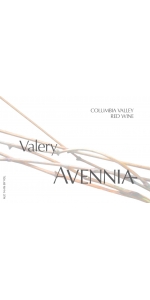
Avennia Valery Red Blend is made from 86% Merlot and 14% Cabernet Franc
Valery is named for the patron saint of wine in the St. Emilion region that inspired it.
We started with old vine Merlot from a stony block in the heart of the Yakima Valley and added complex, aromatic Cabernet Franc from the Horse Heaven Hills. The result is a balanced, complex wine with the elegance and ethereal perfume that this blend of two of Washington’s best varietals are known for.
The nose on this wine is very perfumed, almost exotic with notes of fresh violets, red plum, winter mint, fresh herbs and crushed limestone qualities. The palate is poised and balanced, with red fruits and mocha powder encapsulated in limestone. The finish lingers delicately, with the Cabernet Franc asserting a light tobacco and herb note, giving depth. A compelling wine that will continue to unwind for 7-10 years in the cellar.
Review:
"Brought up in 30% new French oak, the 2016 Valery (70/30 Merlot and Cabernet Franc) offers more black cherry and earthy, herbal notes as well as a medium-bodied, seamless, beautifully balanced style. It too shows a vibrant, fresh, yet concentrated style that has a Bordeaux feel in its weight and texture."
- Jeb Dunnuck (April 2019), 93 pts
"Good medium-dark red. Aromas of blueberry, mocha, licorice and violet are a bit darker than those of the 2015 version. Dense and penetrating, with wild flavors of dark berries, licorice and game given lift by rocky minerality and a minty nuance. Chris Peterson slightly acidified his Cabernet Franc from Champoux Vineyard, which he added to the wine for richness. This beauty may yet tighten up in the bottle.- Stephen Tanzer"
- Antonio Galloni's Vinous (November 2018), 92+ pts
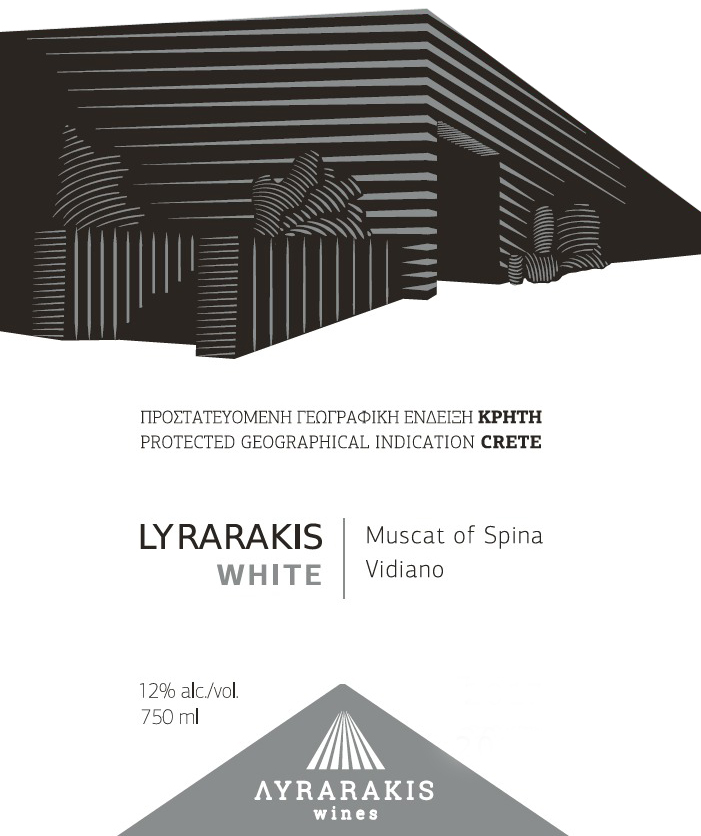
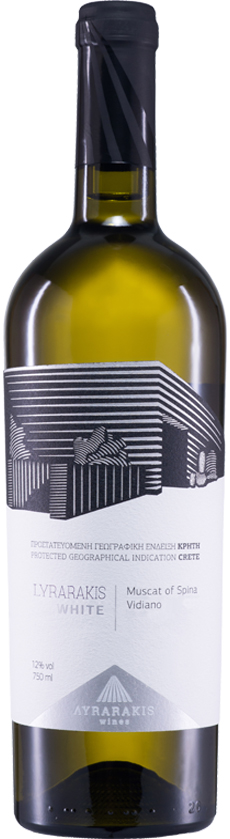
Lyrarakis White is made from 75% Muscat of Spina and 25% Vidiano.
Description: An aromatic white wine with an exciting, crispy mouthfeel, vinificated by combining indigenous and international grape varieties, which have perfectly acclimatized on our island.
Tasting Notes: Bright and lively pale yellow color. Mature aromas of grapefruit and stone fruit enhanced by a persistent presence of rose petals. Elegant and fine balanced with pleasant acidity and plushy finish.
Alcohol: 12% ABV
Acidity: 6.39 g/L
pH: 3.25
RS: 1.02 g/L
Region: Alagni area - central Crete
Soil: Clay - loam
Pruning Technique: Cordon trained, spur pruned
Altitude: 480m above sea level
Irrigation: Not irrigated
Yield: 9tn/ha
Varieties: 75% Muscat of Spina and 25% Vidiano
Winemaking: Hand-harvested in the last week of August (exact harvest time defined by berry sensory assessment, to obtain the optimum taste and aromatic balance). Grapes are vinificated separately. After de-stemming, the almost uncrushed berries remain in the press under reductive conditions for about 8 to 10 hours. Blending was performed using tasting results, choosing the ones with the best characteristics of texture and freshness. Matured on fine lees for 3 months.
Food pairing: Sea food, Thai or spicy cuisine and a large variety of salads.
Review:
"Classy muscat aromatics with serious peach undertones and minerality on the nose. The palate displays refreshing lingering acidity ."
- 2018 Decanter World Wine Awards, 91 pts - SILVER MEDAL
The Lyrarakis Estate is a family winery which has been producing high quality wines since 1966 with a strong focus on rare local varieties and producing single variety wines.
The family is credited with the revival of two ancient Cretan varieties, Dafni and Plyto while a third “vineyard treasure”, the indigenous Melissaki, is recently added to the credits.
Surrounded by the idyllic setting of the vineyards and the Lassithi mountains we offer you the opportunity to enjoy nature and discover local varieties and wines distinguished by the uniqueness of their origin and heritage.
The founders of the Lyrarakis Estate decided 40 years ago to get actively involved with winemaking in their native land. The company now known as GEA (Alagni Agricultural Enterprises) was founded in 1966. The family has always used its privately owned vineyards. At that time, the dominant varieties included Vilana, Kotsifali and Mantilaria. After careful selection of the Vilana strain, the first organised planting of this particular variety was completed and served to supply the farmers of the region. But the family’s grape-growing did not stop there. In the late 1980s, there was an attempt to save two rare native varieties, Dafni and Plyto, from the Phylloxera blight. Efforts were ultimately successful as indicated by the wines of the same name first made available by the Lyrarakis company in the early 1990s.
The village of Alagni, from which the Lyrarakis family originated, is located in the heart of Heraklion Prefecture, in the most mountainous area of Crete’s Peza region with the extensive wine-producing tradition (stone-carved wine presses from the Venetian era are scattered throughout the region).
Today, the family vineyard is 15 hectares (37 acres) and produces seven single-variety wines from native grape varieties: The selection of products is rounded off with combined vinification of native and foreign varieties, the best-known of which include Kotsifali-Syrah and Cabernet-Merlot.
Pierre Olivier Brut Vin Mousseux NV is made from 100% Airen.
A value sparkling brut, made with Airen grapes from around the French/Spanish border (next to the Pyrenees). This is a new Kysela Project.
The bubbles are obtained using the Charmat method, named after Eugene Charmat, where the second fermentation takes places in a large, closed pressurized tank. It is different from the Methode Champanoise as the secondary fermentation doesn't take place in the bottle.
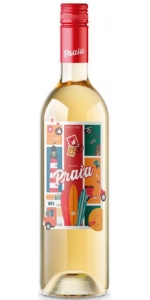
Praia Aveleda Vinho Verde NV is made from 40% Loureiro, 20% Trajadura, 20% Arinto, 20% Azal.
Praia, which means "beach" in Portuguese, is a smooth and fresh wine with delicate and lovely fruity flavors. Slightly spritzy, it is well balanced and very refreshing.
The region is typical for its unique wines that are fresh and light, combined with a very well balanced acidity. These characteristics result from the region's unique soil and climate, with a strong Atlantic influence that you will identify when you taste it.
The wine is ideal as an aperitif or throughout a meal, especially with fish, seafood, white meat and salads. Due to it freshness, it is particularly pleasant in a relaxed and informal ambiance.
Long Shadows Chester Kidder is made from 60% Cabernet Sauvignon, 25% Syrah and 15% Petit Verdot
Allen Shoup named this wine in honor of his mother, Elizabeth Chester, and his grandmother, Maggie Kidder. He selected Long Shadows' director of winemaking and viticulture, Gilles Nicault, to craft this New World blend of Cabernet Sauvignon, Syrah and other classic Bordeaux varieties.
Select Cabernet Sauvignon lots underwent an extended maceration of 40 days to produce supple yet firm tannins that stand up to 30 months of barrel aging in tight-grained French oak barrels (85% new). The extra time in barrel helped to integrate the fruit, enhance the mid-palate with an extra layer of complexity, and provide an appealing earthiness to the finish.
Review:
The Cabernet Sauvignon-dominated 2017 Chester Kidder is another more closed, reserved wine that's loaded with potential. Cassis, toasted spices, violets, and leafy herb notes give way to a rich, full-bodied red that has ripe, velvety tannins, a rounded, mouth-filling texture, and one heck of a great finish. Give bottles 3-5 years if you can and it should be very long lived.
-Jeb Dunnuck 93 Points
Laurent-Perrier Grand Siecle No. 27 is a blend of 60% Chardonnay, 40% Pinot Noir.
Grand Siècle was born from the vision of Bernard de Nonancourt: to recreate the perfect year, one that nature alone could never deliver. Iteration N°27 embodies this idea, crafted from a masterful blend of three outstanding years – 2015, 2013, and 2012 – with a predominance of Chardonnay complemented by Pinot Noir, sourced from eight Grand Cru vineyards.
After at least 10 years of aging on the lees, the result is a wine of rare aromatic complexity, combining freshness, energy, and timeless elegance. Grand Siècle is never tied to a single vintage but represents a higher concept: the pursuit of absolute balance between intensity, finesse and harmony. Since 1959, it has been revealed only 27 times in bottle and 24 times in magnum, affirming its place among the most exclusive and refined champagnes.
Vintage in Champagne is usually synonymous with excellence for Prestige Cuvées. Contrarily, Laurent‑Perrier believes that only the art of assemblage can offer what nature can never provide, that is, the perfect year.
The expression of the perfect year is that of a great champagne wine that has long ageing potential and over time develops depth, intensity and aromatic complexity yet retains its freshness and vibrancy.
Since 1959, Grand Siècle has been revealed only 26 times in bottle format and 23 times in magnum.
The « Grand Siècle » (Great Century) is the name given to one of the most prosperous periods (17th century) in the history of France known for the capacity of man, through his works, to create what nature cannot. Louis XIVth, known as the « Sun King », by creating the « Château de Versailles » and its gardens, was the architect of this model of harmony, balance and perfection.
The symmetry and perspective of the « Jardins à la française », the capacity to grow Mediterranean fruits (especially Oranges inside the « Orangerie ») in such a Northern climate, creating the Grand Canal, the fountains and ponds with no nearby rivers are many illustrations of this ability of man to sublimate natural elements. The name of Grand Siècle was chosen for Laurent‑Perrier’s Prestige Cuvée based on this common vision to reach a perfection that Nature, on its own, cannot provide.
Review:
Impressively aromatic, showing honeysuckle, violets and lavender with bread dough and just a hint of light caramel as well as dried apples, cooked pears and tarte tatin. Reductive with graphite, stone and iodine. Some chalk too. Full-bodied but not at all heavy, turning almost weightless. Nine years on the lees and 7 g/L dosage give energy, length and form. Goes on for minutes. This will age beautifully but is already fascinating, evolving in the glass. Drink or hold.
James Suckling 99 Points