
" We don't sell the wine without touching the vine "
| BUY MORE! SAVE MORE! | ||||||||||||||||||||
|
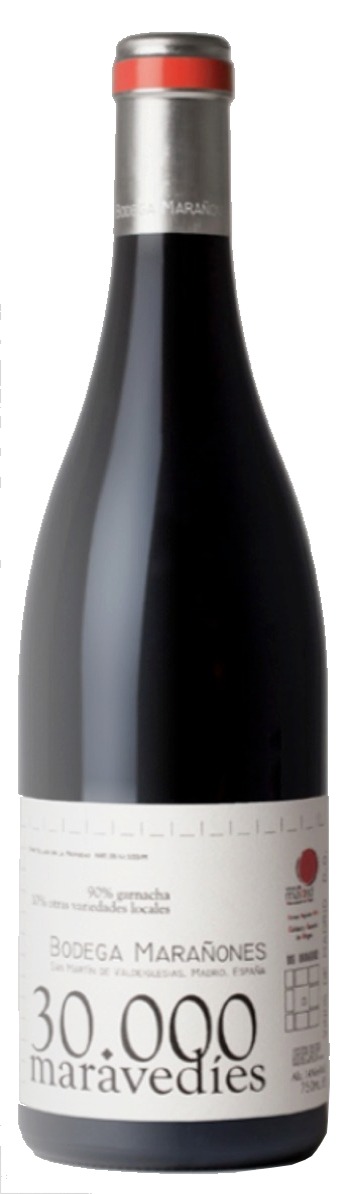
Maranones 30.000 Maravedies Vinos de Madrid Sierra Gredos is made from 90% Garnacha and 10% local grape varietals called Morenillo (Morate).
“The first of our red wines would be 30,000 maravedíes, which is our Comarca wine, a regional wine, village wine.
30,000 maravedíes is the coming together of all soils, orientations, dominantly Garnacha at 90 percent with a remaining 10 percent of local grapes.
The name also reflects the union between history, the winery, the structure and the place. Álvaro de Luna paid 30,000 maravedíes to buy the whole region from the monks who fostered the cultivation of the vine. It is a historical name. It refers to what was paid for the Valley and pays homage to the Valley. It also evokes what the monks had developed. This history is part of our heritage and we continue it.
This village wine wants to tell you the whole history of the Valley. At the end it delivers a structure tending towards the mineral, the floral, length, fruitiness and ease of drinking.”
30-70 year-old vines produce a vibrant, fresh wine that boasts juicy red berry, wild herb, flower and balsamic flavors with hints of sweet spice. Smooth tannins provide finesse and longevity.
Review:
-James Suckling 93 Points
-Luis Gutiérrez (Robert Parker) 93 Points
-Joaquín Hidalgo (Vinous) 92 Points
Marañones Winery is a coming together of vineyards and people. Our winery logo conveys this idea through the representation of various spaces assembled into one.Our people are devoted to wine making. Our wines reflect the nature, the character of both vineyards and people. This is our company.
-150x300.jpg "Maranones Garnacha Vinos de Madrid Sierra Gredos 2023")
Maranones Garnacha Vinos de Madrid Sierra Gredos is made from 100% Garnacha.
Bodega Marañones sits in San Martín de Valdeiglesias, in the granite highlands of the Sierra de Gredos west of Madrid, where Fernando García helped lead the revival of old-vine Garnacha grown at altitude. The Marañones vineyard is the estate's namesake and signature site: north-facing parcels near 800 meters, planted across the three local granites — white, brown and pink — that give the wine its texture and lift.
This cuvee draws on a mix of estate parcels rather than a single plot, fermented with whole clusters and native yeasts, given a long maceration, then aged in foudre and old oak. The result is a pale, perfumed, high-altitude Garnacha — red berries, wild herbs and crushed flowers over a fine-grained, saline, granite-driven frame; ethereal in feel but full of energy.
Review:
The bottled version of the 2023 Marañones Garnacha Tinta that I had the chance to preview last year is stunning. The eight different plots all within the Marañones estate property fermented separately with full clusters and indigenous yeasts with 30 days of maceration. It matured separately in oak vats and barrels, then the wine is blended at the end. It has a bright and pale ruby color and a fragrant nose, high pitched, herbal, complex and nuanced, with some bittersweet sensations. The wine feels ethereal but full of energy, with great aromatic complexity. It's full of personality and Gredos character, with a mixture of flowers, berries and herbs infused in granite. It's super juicy, with a velvety texture, refined tannins and superb balance. It has a moderate 13.4% alcohol and freshness. 23,600 bottles and 100 magnums produced. It was bottled in April 2025.-Luis Gutiérrez (Robert Parker) 96 Points
“Marañones is so to say our signature vine. This is why the winery was named after this location.
It is part of the mountain at 800 m in altitude, oriented North. We find there the three types of granite of San Martin: the white granite, the brown and the pink. Each vineyard at Marañones has a different soil. Some are on a hill. Others are more towards the plains.
In this wine we wish to convey the Marañones area so representative of the whole winery. this is why we make this wine from the great Garnacha grape. We use a mix of vines since it is not a Parcela wine, which would be much more delicate and of more limited production.
The 100 percent Garnacha expresses itself fully, both in the nose and in the mouth, with flavours of blackthorn, a sensation of fleshy fruit retaining a slightly crispy texture. Then comes a full silkiness, with the granularity of these granite soils rich in quartz. That nugget of quartz is noticeable in the texture, length, fineness, elegance and the floral element of the wine.”
bright, ruby Grenache with wild herb, flower and crunchy red fruit flavors. Sharp tannins add structure to this full-bodied wine.
Review:
-Joaquín Hidalgo (Vinous) 93 Points

Decoded Cabernet Sauvignon Napa Valley 2023 is made from Cabernet Sauvignon.
A Napa Valley red built around Cabernet Sauvignon with a splash of Merlot, Petite Sirah and Petit Verdot, aged roughly ten months in French oak (about 30% new).
Decoded is the Napa Valley range from Navigator Wine Collection, the négociant house formerly known as Precision Wine Company. Founded in 2010 by winemaker Trevor Sheehan on a buy-the-best-lots model, the house has grown into one of the largest wine producers in the United States, sourcing from vineyards across Napa and greater California, and was renamed Navigator in 2025 under president Taylor Case. The Decoded label — its cipher-print bottle a nod to the name — is built to deliver Napa Valley character at an everyday price.
Review:
-Wine Enthusiast 90 Points

Decoded Pinot Noir Napa Valley 2023 is made from Pinot Noir.
Decoded is the Napa Valley range from Navigator Wine Collection, the négociant house formerly known as Precision Wine Company. Founded in 2010 by winemaker Trevor Sheehan on a buy-the-best-lots model, the house has grown into one of the largest wine producers in the United States, sourcing from vineyards across Napa and greater California, and was renamed Navigator in 2025 under president Taylor Case. The Decoded label — its cipher-print bottle a nod to the name — is built to deliver Napa Valley character at an everyday price.
Review:
-James Suckling 91 Points
-Wine Enthusiast 90 Points

Turley Zinfandel Buck Cobb is made from 100 percent Zinfandel.
Organically farmed head-trained vines planted at 1500' in the granite and quartz soils of the Sierra Nevada Mountains. Primarily savory and red-fruited, with characteristics of black pepper, dried meats and fine-grained tannin texture.
This would be an excellent pairing with wood-fired pizza.
Review:
-Antonio Galloni (Vinous) 92 Points

Domaine Jean-Claude et Nicholas Fayolle Hermitage Les Dionneres Blanc is made from 100% Marsanne.
Fayolle Hermitage Blanc Les Dionnieres boasts a superb golden yellow color and extraordinary smoothness and creamy, honeyed aromas of hazelnut, peach and apricot developping into scents of iris, narcissus and lime blossom. Pure and crisp, a solid texture and a clean finish.
Delicious with poultry, veal, seafood, shellfish, veal and most cheeses.
Review:
-Jeb Dunnuck 91 Points

In 2007, production was just less than 5000 kg per hectare. This wine is prepared with Tempranillo 100% grapes from our vineyards.
The grapes are initially subjected to a six-day pre-fermentation cold maceration below 14ºC. They then undergo 30 days of alcoholic fermentation at a controlled temperature of 28ºC, after which the wine is removed from the tanks without pressing the grape skins. The malolactic fermentation is slow and relaxed at a temperature of 20 ºC for 28 days without the addition of bacteria.
The wine is aged for18 months in new French oak barrels and is decanted into new barrels every six months. At the end of this period, the wine is blended and bottled without undergoing any type of filtration, clarification or cold treatment.
Prepared with Tempranillo grapes (100%), this wine has a ruby red colour with very pure, intense garnet tones.
Its bouquet has fine complexity with tones of ripened fruit, especially cherries, blue berries and black currants, which are in harmony with tones of good wood, spices (vanilla and coconut) and a liquorice undertone.
In the mouth, this wine displays great balance, proving pleasing to the taste, sweet due to the maturity of its tannins and exuberant on account of its pleasant level of acidity.
Vineyard:
Pago de los Capellanes, Pedrosa de Duero.
Variety composition:
100% Tempranillo.
Type of soil:
Clayey and chalky.
Aging:
18 months in barrel and remainder on rack.
Type of oak:
100% French oak, medium toast.
Serving:
Uncork and decant one hour before serving at a temperature of 16-18 ºC.
The 2019 Ribera del Duero Reserva is also terrific, with gorgeous aromatics of black and blue fruits supported by Asian spices, lead pencils, cedarwood, and violets. It's beautifully textured, medium to full-bodied, has a concentrated, powerful mouthfeel, and ripe, integrated tannins.
-Jeb Dunnuck 95 Points
-Vinous 93 Points
"Draws you in with enticing aromatics of black tea leaf, lavender and graphite box, with creamy layers of ripe black cherry and plum compote flavors and hints of ground coffee and fresh loamy earth, all married to refined tannins. Focused and medium- to full-bodied, with a long, spiced finish. Lovely. Drink now through 2033. 65,000 cases made, 180 cases imported. - Alison NAPJUS"-Wine Spectator 92 Points

Davila L100 Loureiro Rias Baixas 2023 is made from Loureiro.
Adegas Valmiñor sits in the O Rosal valley, the warm southwestern corner of Rías Baixas where the Miño River meets the Atlantic. The Davila range is the winery's tribute to the native grapes of Galicia, and the L100 is its purest expression of Loureiro — a single-varietal bottling (the "100" is for 100% Loureiro) drawn from vines in O Rosal.
The fruit is picked late for extra ripeness, given a short cold maceration, and the wine then rests six months on its fine lees in stainless steel. The result is an aromatic, textured white — white flowers and bay leaf lifting over ripe stone fruit, with a broad, almost unctuous mouthfeel balanced by the saline freshness O Rosal is known for.
A natural match for shellfish, grilled fish, and fresh cheeses.



