
" We don't sell the wine without touching the vine "
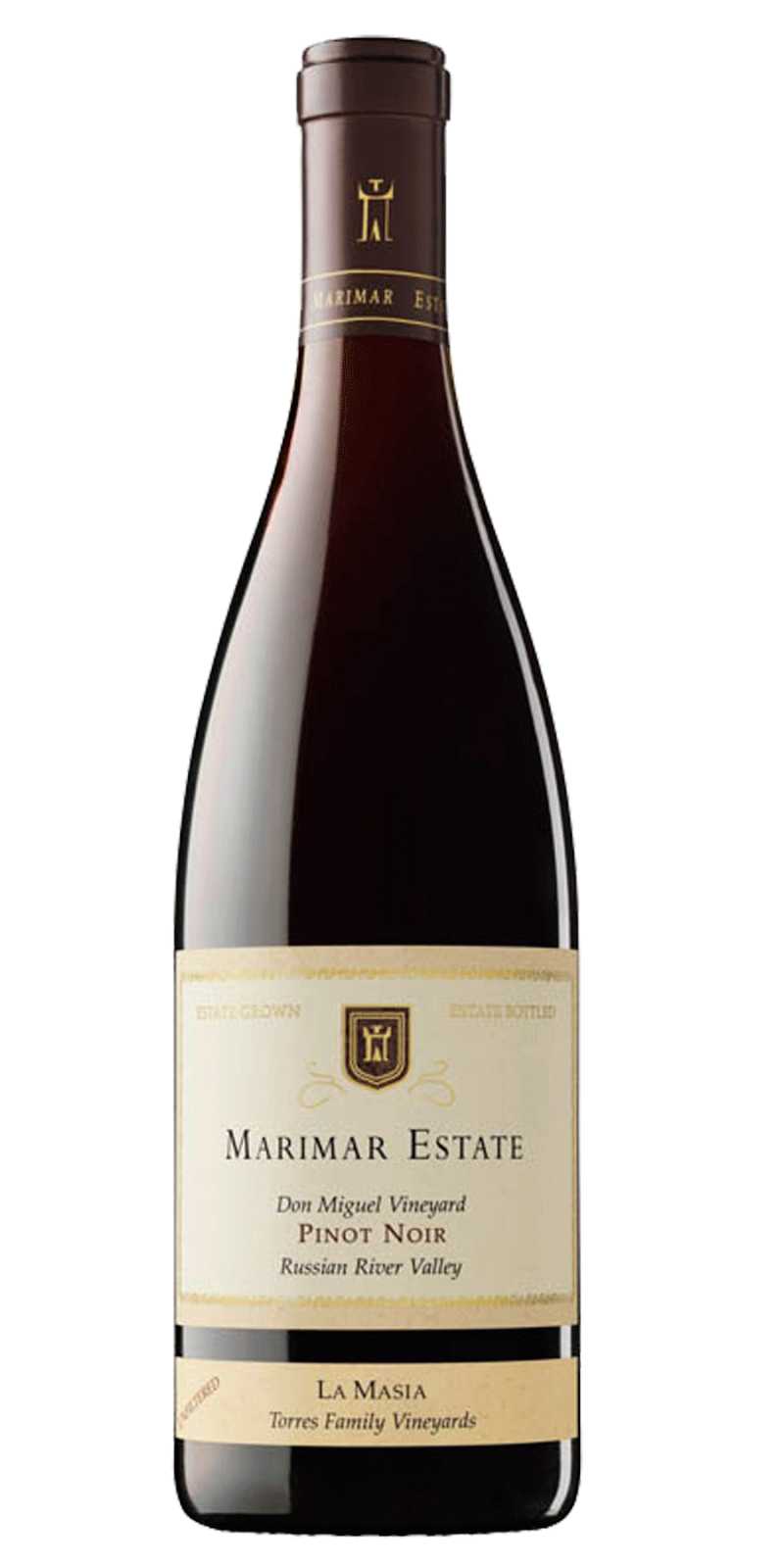
| Country: | United States |
| Regions: | California California (Sonoma County) |
| Winery: | Marimar Estate |
| Grape Type: | Pinot Noir |
| Vintage: | 2010 |
| Bottle Size: | 750 ml |
La Crema Fog Veil Pinot Noir is made from 100 percent Pinot Noir.
A lush, earthy, and balanced Pinot Noir from select estate vineyards in California's famous Russian River Valley. This red wine opens with aromas of wild strawberry, blackberry, and cardamom. Flavors of boysenberry, raspberry, and sassafras with hints of baking spice. Soft tannins are balanced by vibrant acidity. This Red Wine has a Cork closure. Alcohol Content: 14.8% Pair with grilled filet mignon, bacon wrapped pork tenderloin and camembert. Aromas of wild strawberry, blackberry, and cardamom. Flavors of boysenberry, raspberry, and sassafras with hints of baking spice. Soft tannins are balanced by vibrant acidity.
Review:
Tremendous energy is conveyed through a guiding light of spiced cher- rywood and notes of tea leaves and flint. Rich and concentrated, with a hint of smoked cedar on the finish. The grapes come from neighboring estate vineyards in the Santa Rosa Plains region of the Russian River Valley.
-Tasting Panel 94 Points
Bright fruit on the nose boasts notes of black cherry, black plum, violets, rose, orange, cocoa nibs, tobacco, mushroom and forest floor. On the palate, complex layers of fruit slowly melt into a bold, structured wine that impresses from start to finish. Velvety tannins interact gracefully with the wine’s fruit and acidity, all coming together to create a delightful wine and a beautiful expression of Willamette Valley Pinot Noir.
Review:
The 2021 King Estate ‘Domaine’ Pinot Noir was stored in 26% new French oak before bottling and represents the top one percent of Estate Pinot Noir barrels. Red currants combine with freshly tilled soils, Black cherry and shades of dried herbs. The palate is soft and refined with silky tannins that frame a core of red and dark fruit flavors. Finishing long, with good viscosity, this is already sgiwubg beautifully right now.
Owen Bargreen 94 Points
The nose reveals aromas of blueberry, raspberry, and black tea, while the palate offers cranberry and plum fruit complemented by subtle notes of forest floor and exotic spices. Integrated tannins and balanced acidity carry through to a long, refined finish.
Review:
Jeb Dunnuck 92 Points
Wine Enthusiast 92 Points
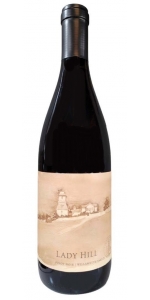
Lady Hill Pinot Noir Willamette Valley is made from 100 percent Pinot Noir.
A combo of garnet to cardinal highlights the hues of this fruit forward Willamette Valley Pinot Noir. Subtle floral hints of tea leaf and rose petal give way to a complexity of viney, brambled red and black fruit, wet moss and baking spices. A hint of savory jerky barrel nuance and turned earth contrast the freshness and vibrancy of boysenberry fruit. The finish is refined and juicy, as the elegant tannin structure builds into a crescendo of salivating acids built for food.
Pair with herb crusted pork loin, mushroom risotto drizzled with truffle oil, or a creamy textured Roucoulons cheese.
Laird Pinot Noir Ghost Ranch is made from 100 percent Pinot Noir
9 months in French Oak (60% new)
Vineyard workers have long reported seeing people between the rows and down by the creek, people who simply disappear when approached. Hence the name “Ghost Ranch”. This is our family’s seventh vintage of Pinot Noir.
Tasting Notes: With enticing garnet hues, that leads way to aromas of fresh raspberries, toasty oak, Bing cherries and baking spice. With a medium body and a balanced smooth palate that opens to distinct layers of wild strawberry, vanilla & sweet cherry compote.
Easily paired with a variety of cuisine including Pasta Puttanesca, cedar plank salmon or Paella.
Laird Pinot Noir Ghost Ranch is made from 100 percent Pinot Noir
9 months in French Oak (60% new)
Vineyard workers have long reported seeing people between the rows and down by the creek, people who simply disappear when approached. Hence the name “Ghost Ranch”. This is our family’s seventh vintage of Pinot Noir.
Tasting Notes: With enticing garnet hues, that leads way to aromas of fresh raspberries, toasty oak, Bing cherries and baking spice. With a medium body and a balanced smooth palate that opens to distinct layers of wild strawberry, vanilla & sweet cherry compote.
Easily paired with a variety of cuisine including Pasta Puttanesca, cedar plank salmon or Paella.
Marimar Estate La Masia Pinot Noir 2010 is made from 100 percent Pinot Noir.
Don Miguel Vineyard
Russian River Valley AVA
The Vinification
The grapes were harvested August 30 - September 13. After minimal crushing, they fermented in stainless steel, with no whole clusters. The wine was aged in premium French oak barrels, 33% new, coopered by Remond, Rousseau, Marsannay, Mercurey and Marchive from the forest of Bertranges. It was bottled, unfined and unfiltered, in August 2010.
The Clones
The six clones planted in the vineyard’s 30 acres of Pinot Noir yield wines with complex layers of flavors. The blend of clones in this vintage is 22% Swan, 21% Pommard, 21% Cristina 88, 19% Dijon 115, 10% Dijon 667, and 7% Lee.
Tasting Notes
The aromas reflect the classic Russian River/Green Valley fruit: dark berries, sassafras, and a hint of orange peel. On the palate the wine has great concentration of flavors but it is supple and silky, with notes of clove and cinnamon plus a trace of peat and forest floor. Perfect balance and roundness that augur a long aging potential.
"Although this is tight, acidic and tannic, the core is so rich, it should easily negotiate the next 5–6 years in a good cellar. The texture is of pure silk, and the flavors are rich in cherry, pomegranate and spice. — S.H."
- Wine Enthusiast (December 31st 2012), 93 pts
The Marimar Estate
Exporting a Legacy To California
Nestled in the rolling hills of western Sonoma County, the Russian River/Green Valley appellation is a perfect microclimate for growing Chardonnay and Pinot Noir. Only 10 miles from the Pacific Ocean and 50 miles north of San Francisco, the site is influenced by the sea's cooling breezes and drifting fog. That is why Marimar Torres selected this privileged location to "export" the Torres family legacy of fine wines to California.
A Catalan Farmhouse-Winery
Built in 1992 with a capacity of 15,000 cases, the winery sits on a hill surrounded by vines. The production wing is outfitted with carefully selected equipment, to allow the control essential to producing a wine based on minimal handling. Its three barrel rooms with independent temperature and humidity controls provide flexibility to experiment with various vinification techniques, in order to best express the fruit's character.
The Marimar Vineyard
The Don Miguel Vineyard: A Unique Site
Marimar came to live in California in 1975. After two years of searching, she acquired the land and began planting the vineyard in 1986. Today there are 30 acres planted with Chardonnay and 30 with Pinot Noir. The wines are made entirely from estate-grown grapes. Named in honor of the late patriarch of the family, the vineyard is unique in California because it is totally European in style. The vines are trained very close to the ground on an open vertical trellis, following the slope of an east-facing hillside; the rootstocks are phylloxera resistant; and the planting density is 2000 vines per acre, four times more than is traditional in California. Such high density promotes root competition and diminishes vigor, naturally reducing the output per vine.
Yields are low and labor is intensive, but the vines live longer and produce grapes with greater concentration of flavors, more refined and elegant aromas, and better balance. To contribute complexity, Marimar did extensive research to select several clones of each varietal: See, Rued and Spring Mountain for Chardonnay; and Cristina 88, Swan, Pommard, Lee, Dijon 115 and Dijon 667 for Pinot Noir. Each clone brings different attributes to the final blend, resulting in wines with deep layers of flavor
Franz Prager, co-founder of the Vinea Wachau, had already earned a reputation for his wines when Toni Bodenstein married into the family. Bodenstein’s passion for biodiversity and old terraces, coupled with brilliant winemaking, places Prager in the highest echelon of Austrian producers.
Smaragd is a designation of ripeness for dry wines used exclusively by members of the Vinea Wachau. The wines must have minimum alcohol of 12.5%. The grapes are hand-harvested, typically in October and November, and are sent directly to press where they spontaneously ferment in stainless-steel tanks.
Klaus sits adjacent to Achleiten and is one of the Wachau’s most famous vineyards for Riesling. The vineyard is incredibly steep with a gradient of 77% at its steepest point. The southeast-facing terraced vineyard of dark migmatite-amphibolite and paragneiss produces a tightly wound and powerful wine. The parcel belonging to Toni Bodenstein was planted in 1952.
Tasting Notes:
Austrian Riesling is often defined by elevated levels of dry extract thanks to a lengthy ripening period and freshness due to dramatic temperature swings between day and night. “Klaus is not a charming Riesling,” says Toni Bodenstein with a wink. Klaus is Prager’s most assertive and robust Riesling.
Food Pairing
Riesling’s high acidity makes it one of the most versatile wines at the table. Riesling can be used to cut the fattiness of foods such as pork or sausages and can tame some saltiness. Conversely, it can highlight foods such as fish or vegetables in the same way a squeeze of lemon or a vinaigrette might.
Review:
Superbly cool, restrained and refined, this austere, beautiful dry riesling is a slow-burn masterpiece that's only just beginning to reveal its complex white-peach, white-tea, wild-herb and dark-berry character. Super-long and mineral finish. Drink or hold.
-James Suckling 97 Points
Mortet Bourgogne Cote d'Or Rouge is made from 100 percent Pinot Noir.
A parcel of 90 ares, one part is 20 years old and the other part is 55 years old. Its is called Les Pressonniers, in Gevrey-Chambertin.
Bourgogne Rouge Côte d’Or comes from a plot of Gevrey-Chambertin vines, giving delicate fruit and body, as well as the character and complexity of the Gevrey-Chambertin terro



