
" We don't sell the wine without touching the vine "
The Walla Walla Valley is a very special place with a deep, rich, geological, cultural and agricultural history. It is a unique setting that has been recognized as possessing some of the greatest potential anywhere to grow a whole plethora of crops at a high degree of quality – from dryland wheat to vegetables of all kinds, to stone and pome fruits, to wine grapes.
One of the most special locations in the Valley, and the entire region in fact, is a very small geographical area within the Valley; an alluvial fan comprised of basalt cobblestones. In this place, nestled just to the west of the Blue Mountains in northern Oregon and south of the Washington state line, some of the most singular and unique expressions of wine anywhere in the world are grown. It is a place that has captured our attention, our imaginations, our senses and our motivations.
Thus, we have begun a very special endeavor to explore the terroir of this fascinating and unique place in the world through our own lens; to tell the story of this geology through top-notch grape-growing and winemaking, in our efforts to transmit the tale of this place, while also employing a commitment to sustainability, organic farming and low-impact winemaking.
When we set out to create PÁŠXA (pronounced “Pahk-sha”), we wanted to emphasize our commitment to sustainable farming and winemaking practices. We also wanted to give a nod to the history of our beautiful valley – a history that stretches back long before the land was settled by those who traveled west along the Oregon Trail. The indigenous people of the Walla Walla Valley had a name for this place that was Pášxapa or Place of the Sunflowers, as the valley was strewn with balsamroot sunflowers that grew wild here, and we wanted to pay homage to that heritage of these lands.
No products found
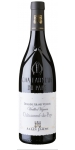
Grand Veneur Chateauneuf Du Pape Vieilles Vignes is made from 50% Grenache, 40% Mourvedre, 10% Syrah
Matured in concrete vats (40%) and oak casks (60%)
It boasts an inky/purple color in addition to a gorgeous perfume of crushed rocks, jammy black fruits, charcoal and graphite. Blackberry aroma with an air of dates pressed in alongside – this is sweet-noted. It is easy to appreciate, a sleek and stylish start. The palate holds excellent fruit that runs well and has kick. Its tannins move round freely and a minted finale comes forward. Its dark fruit is tasty, darkens on the finish, where tar and char from its oak enter. It is all very much together, a bundle of harmony, and will gain local attributes as it ages.
An outstanding Chateauneuf du Pape which display the best of its terroir.
The vines are 50 to 100+ year old. They are planted on red clay soils covered with pebble stones.
Harvest is destemmed and crushed. Fermentation temperature is controlled at 30°C. Vatting period of 18 to 20 days. Matured in concrete vats (40%) and oak casks (60%).
The vineyards are located in the north of Châteauneuf du Pape. GRAND VENEUR «Vieilles Vignes» cuvee is produced from the older vines. Thanks to time and an organic growing, roots go very deep in the soil. Yields are naturally low and grapes highly concentrated.
The vines are 50 to 100+ year old. They are planted on red clay soils covered with pebble stones.
Winemaking and aging
Harvest is destemmed and crushed. Fermentation temperature is controlled at 30°C. Vatting period of 18 to 20 days. Matured in concrete vats (40%) and oak casks (60%).
Pair with venisson, duck, braised lamb or strong cheese.
Review:
"Up with the crème de la crème of the vintage, the 2018 Châteauneuf Du Pape Vieilles Vignes is a bigger, richer wine than the Les Origines cuvée and has a beautiful core of smoked black fruits, candied violets, peppery garrigue, and scorched earth-like aromas and flavors. Playing in the medium to full-bodied end of the spectrum, it’s flawlessly balanced and has terrific tannins, a stacked mid-palate, and a great finish. It certainly shows the more front end-loaded, fleshy, mildly concentrated style of the 2018 vintage, yet the balance is top-notch, and it’s just a thrill to drink today. It should evolve nicely for 10-15 years."
- Jeb Dunnuck (October 2020),96 pts
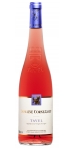
Corne Loup Tavel Rose is made from 60% Grenache, 15% Cinsault, 10% Syrah, 15% mix of Mourvèdre, Clairette & Carignan
Elegant, refreshing, food-friendly and versatile, this Tavel offers mouth-watering aromas of strawberry and berry pie.
Corne Loup Tavel represents the pinnacle of the rose pyramid quality wise that can be achieved in the Southern Rhone. The town of Tavel has been famous for its rose wine since the time of the Popes in Avignon (1300's). Tavel is about 2,300 acres in size and produces about 500,000 cases yearly of 9 liter cases, plus can age for 2-3 years, unlike many other roses. Produced from a blend of Grenache, Cinsualt, Syrah, Mourvedre, Cinsault and Carignan, the wine comes from a famous sub-parcel called the Plateau de Vallongue between Tavel and Lirac AOC's.
The 20 hectare-vineyards are located in the hamlets of Oliver, Campet, Vestides and Vallongue. The Tavel from this producer is a blend of all 3 soils types you can find in the AOC:
Dry and lively, it is an ideal wine for barbecues as it makes a wonderful sipper that's also capable of matching with a wide variety of summer foods, including grilled chicken, seafood and summer salads



