
" We don't sell the wine without touching the vine "
I am a new customer.
By creating an account at Timeless Wines you will be able to shop faster, be up to date on an orders status, and keep track of the orders you have previously made.

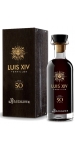
Luis XIV Fondillon Oro 50 years NV is made from 100 percent 100% Monastrell (Mourvedre). Only 24 9 liter cases produced.
The wine is produced in the village of Cañada, in the subarea of Alto Vinalopó in the province of Alicante. Made from 100% Monastrell planted on traditional dry land as bush vines, at 550-580 meters above sea leval and enjoying a Mediterranean climate with great marine influence due to the easterly winds.
Fondillon 50 years is mahogany in color with orange tile rim, medium layer and great density. On the nose, it has a very deep aroma of old wood, black tea and carob. In the mouth, it has a sweet entry balanced by a rich high acidity. Its aromas are long, almost eternal and very intense. It tastes like old mahogany, a very old barrel and bygone times.
Bottled in December 2019.
AGEING:
CASK NAME: Saboners.
AGEING: Aged more than 50 years (single barrel).
TYPE OF WOOD: 19th-century American oak barrels
CASK SIZE: 70 “cántaros valencianos” (805 litros).
ANALYSIS:
GLUCOSE AND FRUCTOSE: 34 gr/litre.
VOLATILE ACIDITY: 1.35 gr/l.
ALCOHOL: 16.2º (NO ADDED ALCOHOL).
FREE SULFITES: less than 10 mg/litre.
TOTAL SULFITES: 76 mg/litre.
Review:
Dark mahogany color, candied fruit aromas, fruit liqueur notes, spicy, varnish, acetaldehyde, bakery, complex. Fine solera notes, bitter flavors."
- Penin 2022, 99 pts
"The NV Fondillón Luis XIV has the subtitle Edad Superior a 50 años (over 50 years old), and it's a dark mahogany, bottled from a single barrel that has the specific profile of a very old wine greatly concentrated by age, which tends to make it similar to other very old and concentrated wines, be it a Mediterranean rancio or a very old Moscatel. It has notes of bitter chocolate, coconut and iodine, carob beans (algarroba) and some bittersweet sensations. It's dense and concentrated, and the palate is pungent, with very intense flavors and a bitter twist in the finish. This has 16.3% alcohol, 6.45 grams of acidity and 34 grams of sugar, but it comes through as very dry. The wine is long and extraordinary, but it just doesn't have any Fondillón character after decades of concentration by evaporation. The price is ludicrous. Only 435 half-liter bottles were filled in December 2019. - Luis GUTIERREZ
- Wine Advocate (September 2020), 95 pts
"Fondillón is an extraordinary treasure of Alicante, a rare product, made from late harvest, non-botrytised grapes, unfortified, but with a final alcohol of no less than 16%. Intense, aged, but not sweet (deliciously not more than 45g/l). Fab with cheese or dark chocolate. The wines have to be a minimum of 10 years; this release is more than 25 years. The project is a revival by David Carbonell of Vins del Comtat and two local families. Very limited quantities. - Sarah Jane Evans MW"
- Decanter (December 2021, My top 10 Spanish fine wines of 2021), 95 pts

Fullerton Three Otters Rose is made from 60% Pinot Noir, 40% Pinot Gris (7-50 years old)
This Willamee Valley blend hails mainly from three different vineyards in the north, east, and south of the Willamee Valley, with a smaering from five of our other sites. The soils of the vineyards represent the breadth and diversity of the Willamee Valley with both sedimentary- and volcanic-based soils.
Acid: TA 5.6 g/L
pH: 3.45
Aging: 100% stainless steel
Bottled Unfined
Clones: Pommard, Wadensville, Dijon 113, 114, 115, 667, and 777
Winemaker Alex Fullerton and his father and proprietor Eric Fullerton couldn’t decide on a house style for rosé, so they held a friendly competition. They each made a rosé to see whose would win over a crowd. Though the wines were destined to be boled separately, Alex got curious and tried blending the two. Voila! The sum was better than the parts, and a tradition was born. Alex now makes one rosé that is whole cluster pressed and tank fermented, yielding a very crisp and light colored wine, while Eric crafts his rosé from a more robust extraction, which yields a darker and fuller-bodied wine. The two lots are then blended to taste, delivering a crisp, fresh rosé with wonderful structure. The juice spent three weeks on the gross lees prior to fermentation to extract aroma precursers, and then six months on lees post-fermentation.
Pairs with soft cheeses, chicken/turkey.



