
" We don't sell the wine without touching the vine "
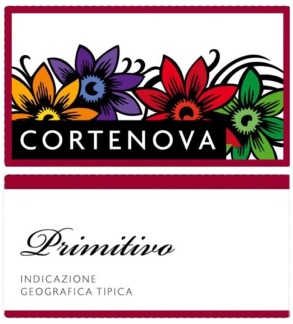

Cortenova Primitivo is made from 100% Primitivo
The grapes are harvested and immediately pressed at controlled temperature. Fermentation is carried out with maceration on the skins for 10-12 days; daily remontages; malolactic fermentation.
Dark, ruby-red color with violet highlights. Intense and fragrant bouquet with a rich array of red and black fruit aromas and flavors. Harmonious and velvety on the palate. Great balance and structure.
Excellent with grilled or roasted meats, game and cheeses.

Cortenova Montepulciano d' Abruzzo is made from 100% Montepulciano d'Abruzzo
Deep ruby red color with violet highlights and a pleasant and fruity bouquet. Full bodied, soft tannins and good acidity.
Excellent with pasta dishes and red meats.

Cortenova Pinot Grigio is 100 percent Pinot Grigio.
Brilliant straw color with emerald reflections.
Fresh and floral bouquet with a hint of pears, apricots and bananas. Fresh and inviting with bright fruit and an easy drinking style with a pleasing hint of almonds in the aftertaste.
Pairs well with seafood dishes, risottos with scampi, spaghetti with clams, sole in white wine Perfect also as an aperitif.

Cortenova Prosecco Spumante NV is 100 percent Prosecco
This Prosecco comes from the highly esteemed area of Valdobbiadene. There are two recognized quality zones for Prosecco, Conegliano and Valdobbiadene. Of the two, Valdobbiaden has always been recognized a having the superior quality due to its naturally higher acidity and its more northern location.
The vineyards lie at 350 meters above sea level. The vines are an average of 25 years old.
The grapes are soft pressed and the free run juice is placed in stainless steel. There is a brief maceration period of 4 hours. Specially selected yeast are added and fermentation is controlled at 20° C. There is no malolactic fermentation and the wine is transferred to autoclaves and a second fermentation is induced following the Charmat tradition. When the desired atmospheric pressure is reached (usually 1 month) the wine is bottled.
Light straw colored with greenish reflections. The perlage is fine and continuous. Fragrant bouquet full of flowers and almonds. In the palate it is fresh and clean with a soft body and a pleasing sparkle. The fruit is subtle and reminiscent of apples and pears with a hint of almond in the background. The finish is inviting.
Can be drunk by itself as an aperitif or with seafood and fish, pastas with cream sauces, chicken and fresh cheeses.
Review:
"Pale straw color. Bright, attractive aromas and flavors of roasted lemons and kiwis, green nectarine, nougat, and grass with a soft, vibrant, spritzy, dry-yet-fruity medium body and a tingling, complex, medium-length spiced clementine and delicate herbal honey finish with silky, crunchy, fruit tannins and no oak. A delicious, nicely layered Prosecco with an elegant style." - Beverage Testing Institute (November 23rd 2015), 91 pts, Best Buy

All older vintage wines have been purchased from a single collectors cellar. Pictures can be requested before shipment.

No Syrah terroir in Sonoma County compares with Sonoma Mountain’s northwest crown—cool fog-affected mornings, sun-bathed afternoons, cooled by persistent coastal breezes, and temperate evenings. The soils in Steiner’s Syrah blocks — ashy and moondust-like, littered with decomposing sea bed — further contribute to the unique nature of this site. After a 3-vintage hiatus, I am thrilled to be back working with Steiner Vineyard’s Syrah. By its nature, this slow-to-ripen, cool-climate site produces fabulously deep, intense, structured wines. Now, raising a big, brawny Syrah is no rare act of alchemy. It is the wonder of Steiner’s terroir — a magical elegance and beauty, informing the inherent power, depth and intensity — that makes this bottling so special. 2016 produced a classic wine that deftly balances massive flavors and texture, while retaining vital freshness, and a palpable sense of cool. Production was low, so get it while you can. Simply a “WOW” wine, not to be missed.
VINEYARD: Steiner Vineyard. Located at 1,100 ft, on the northwest crown of Sonoma Mountain. CRUSH: Early morning harvest by hand, October 1st, cluster and berry sorted, destemmed and crushed. FERMENT: 5-day cold soaks, followed by 14 day native fermentation in open-top bins. AGING: 20 months, French oak, 100% new, mixture of 300L hogsheads and barrique shapes. Never racked prior to bottling. Bottled unfined, unfiltered.
Review:
"Refined and stylish, featuring a complex core wrapped in multilayered blackberry and blueberry flavors, laced with bitter chocolate, black licorice and smoky meat notes. Drink now through 2030.- Tim FISH"
- Wine Spectator Insider (January 15th 2020), 93 PTS
Cortenova Primitivo is made from 100% Primitivo
The grapes are harvested and immediately pressed at controlled temperature. Fermentation is carried out with maceration on the skins for 10-12 days; daily remontages; malolactic fermentation.
Dark, ruby-red color with violet highlights. Intense and fragrant bouquet with a rich array of red and black fruit aromas and flavors. Harmonious and velvety on the palate. Great balance and structure.
Excellent with grilled or roasted meats, game and cheeses.
The Cortenova Estate
Part of the production is from their own lands which mainly lie on the alluvial rich soil at the confines of the Veneto and Friuli, other is furnished by growers who have worked with the family for years and is basically an extension of their own vineyards.
The winery produces several lines of different quality levels using Pinot Grigio, Pinot Bianco, Chardonnay, Cabernet, Merlot, Valpolicella, Prosecco, Soave and Bardolino. They have also expanded their production to include wines from Apulia, Calavria, Sicily to offer their clients a complete range of wines.
The family has expanded into the foreign markets slowly making sure that they could handle production requests and maintain quality levels before proceeding on to the next market. This cautiousness has earned them the reputation of being reliable and quality-orientated.

Siegel San Elias Cabernet Sauvignon is made from 100 percent Cabernet Sauvignon.
Fresh and delicate cassis tones, a great structure. Draw the cork half an hour before serving and serve at room temperature.
Smooth and fruity on the palate, the wine goes well with pasta, salads.

Wolfberger Cremant d Alsace Rose Brut is 100 % Pinot Noir.
The wines from Alsace date back to 589 A.D., but Cremant d’Alsace has more recent beginnings, starting in 1900. Dopff au Moulin (founded in 1574) was the first to produce Cremant d’Alsace in the Method Champenoise style. Cremant d’Alsace received AOC status for sparkling wine in 1976. Two types of Cremant are produced today, resulting in about 2.5 million+ cases of Cremant d’Alsace production annually:
Wolfberger's Cremant d'Alsace Rose Brut displays a lovely delicate salmon color with active, small bubbles. Round and full-bodied, this Cremant Rose displays beautiful watermelon and strawberry aromas cascading in a smooth finish. A minimum of 15 months bottle aging before disgorging ensures ripeness.

Obsidian Vineyard Syrah is bathed in terroir. The vines experience severe stress, pushing the roots ever deeper through rock in search of water, producing miniature clusters of intense power. Given the wine’s natural propensity for tannin, we take extreme care in the cellar to chisel/whittle its rough edges and leave room for richness to flatter its distinctive scaffold. The mid-palate supports flavors of roasted coffee beans, sarsaparilla, and dark chocolate. The finish marches on long after most wines have tired.
Our estate vineyard — the six-acre Obsidian Vineyard in the Knights Valley AVA — has an incredibly complex soil structure. It takes its name from a layer of volcanic obsidian rock that was discovered when we drilled for water.
Chocolate ganache, black currants, fig, graphite, and an expansive mouthfeel.
Review:
"Joe Donelan believes his Obsidian Vineyard is one of the world’s greatest sites for Syrah. I’ve visited the site twice, and can say candidly it certainly sits among the most striking vineyards I've ever laid eyes on within the U.S. It sits like a rock on a promontory—two switchbacks to reach the top—and the stones under the top soil, quite literally, never stop emerging from the ground. The place has an ancient, almost sacred, temple-like feel. It is consistently swept by afternoon breezes. The vineyard was replanted in 2017 after fires ravaged it. Winemaker David Milner laid out the site at denser spacing than before, at 2,000 vines per acre to keep yields per vine low while still achieving sensible tonnage, averaging around three tonnes per acre. Viognier was planted for co-fermentations, alongside some Cabernet Sauvignon, for a single vineyard bottling of that grape. ‘God put on his viticultural hat when he designed this site,’ says Milner. The vineyard is planted with ENTA 174, 877, and Alban 1 clones, along with Donelan Heritage selections certified virus-free. The wine, the 2023 vintage release (the first from the new vines), was aged for 21 months in 36% new oak and co-fermented with 1.8% Viognier, using 32% whole clusters. And it is positively gorgeous: composed of nine different blocks, each fermented separately, then assembled through sequential blending, with no racking until bottling. From just five-year-old vines, this wine is utterly extraordinary—something oddly achievable from young vines on rare occasion. I tasted this wine from the same bottle over three days. While the high-toned espresso-bean and cedar accents are present at first pull of the cork, they mellow out a day later, and the fruit profile is so vibrant. This is the sign of an excellent wine. I first tasted wines from the Donelan’s Obsidian Vineyard years ago at Tasting Panel Magazine in the late, great Anthony Dias Blue’s office. Cushing Donelan showed the wines, and to this day, I recall the first moment I put my nose into a glass of Obsidian Syrah. In early January of 2026, as I nosed this brand new release of Obsidian Syrah, I was transported straight back to that tasting twelve years ago. What’s remarkable is that the aromatics are unmistakably the same, yet from these new, more densely planted vines, the aromas are more refined—precision-farmed wines from young vines delivering a level of detail and poise that feels beyond their years. So what’s in the glass? Pure red, black, and blue fruit nuances layered with tobacco, white truffle character, violet pastille, and an intoxicating perfume. White pepper notes emerge on the medium- to full-bodied palate, framed by velvety tannins. Iron-like and crushed slate minerality underpins dazzling black cherry and blackberry fruit, brown spices, and blood orange richness. There’s a velvety, iron-fist quality here that exudes polish, complexity, and undeniable quality. You want to drink it now—and you absolutely can—but it will also reward time in the cellar. Either way, you’ll be utterly wowed. And when you realise the price is under £100, the achievement becomes even more staggering. As these vines mature, what will become of them in subsequent vintages? I suspect that as the vines mature, they'll go in and out of phases, but so long as Mother Nature cooperates, I expect this wine to continue to dazzle each vintage. - Jonathan CRISTALDI"
Decanter (January 5th 2026), 100 points
This is the first vintage of the Obsidian Syrah after wildfires torched the vineyard in 2017, leading to significant redevelopment. Throughout all those years, the Donelans have exhibited remarkable patience and a clear sense of purpose. This is their reward: a truly magnificent, towering wine of the highest level.
Knights Valley is one of the most magical grape-growing districts in the United States, but it is not very well known because only a few estate wineries are located there.
The 2023 Syria Obsidian Estate is one of the most profound, moving wines I have tasted in Sonoma County. Blackberry, gravel, incense, chocolate, lavender, and dried herbs race out of the glass. Delicate yet powerful, the 2023 is spectacular. It is also very fairly priced in today’s market.
Vinous 100 Points



