" We don't sell the wine without touching the vine "
| Country: | Chile |
| Region: | Colchagua Valley |
| Wineries: | Rubus Siegel |
| Grape Type: | Chardonnay |
| Vintage: | 2018 |
| Bottle Size: | 750 ml |
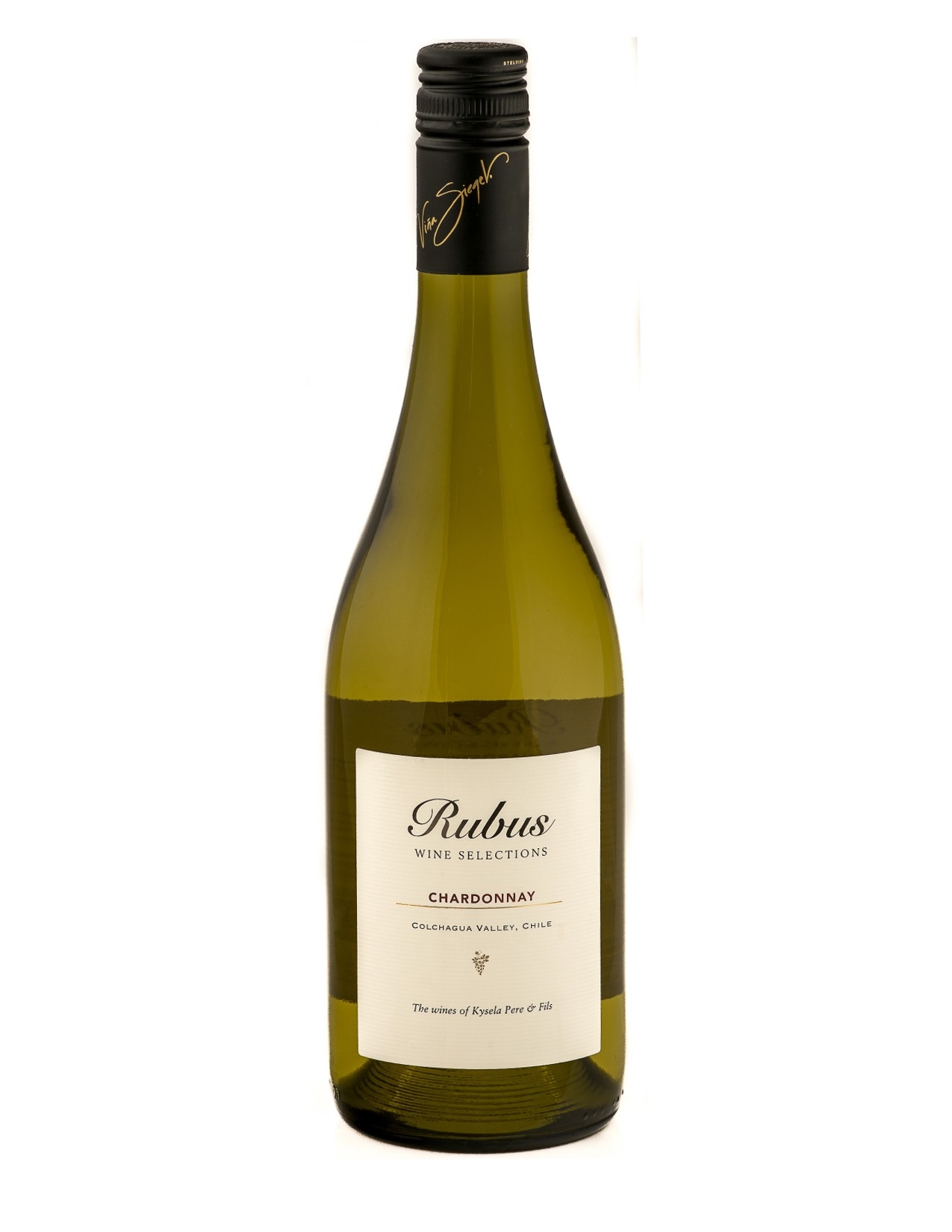
Rubus Chardonnay Colchagua Valley is made from 100 percent Chardonnay.
Attractive yellow color with some green tones. Its intense varietal character reminds one ripe fruits like pineapple, with notes of melon and honey well harmonized with oak. In the mouth it is full, rich and buttery.
Grapes are harvested in the morning in order to avoid high temperatures.
At the winery, the grapes are gently pressed.
Alcoholic fermentation is held between 15º and 16º Celsius.
Then, 25% of the wine goes into American Oak barrels for 3 months.
After this, the blend is made, clarified, cold stabilized and filtered. Right before bottling, the wine goes through an on-line filtration system (plate and sterile membrane) to ensure microbiological stability
As far as the food pairing, it is delicious with pasta, fish, seafood and mild cheeses. It is also delicious on its own as an aperitif.
SALE!
Lodi, American Viticulture Area (AVA) – The Lodi AVA is located in the northern end of the San Joaquin Valley, Central Valley California, east of the San Francisco Bay. Lodi has warm days and cool nights, similar to the Mediterranean climate. The lower temperatures that occur in Lodi result in fruit with good acidity. A wide range of soils are found in the Lodi AVA, but they generally are deep, loamy, sandy, rocky soils similar to that found in southern Rhone valley.
The Lodi appellation totals almost one half million acres, and the approximately eight hundred growers farm roughly 90,000 acres. Lodi produces more Cabernet Sauvignon, Chardonnay, Merlot, Sauvignon Blanc, and Zinfandel than any other wine region in California, but it is probably best known for its old vine Zinfandel. The vines are often head trained giving them a classic old world appearance.
Zinfandel – The Zinfandel grape is a hearty variety that produces grapes with high sugar levels, often resulting in wines with a high alcohol content. Thought to be a relative of Primitivo that is found in southeast of Italy (the boot heel), Zinfandel can be made into a wide range of wine styles, including White Zinfandel, light or full bodied red wines, and even late harvest desert style wine. However Zinfandel, especially Old Vine Zinfandel from Lodi, is usually made into a full bodied, spicy red wine with characteristics of red fruit, raspberry, and cherry.
Produced in the heart of Lodi AVA.
Rubus Zinfandel Lodi is made from 98% Zinfandel + 2% Cabernet Sauvignon
Bottled after aging in French and American oak for 9 months.
Rubus Zinfandel Lodi presents with ruby red in color, with red fruit, raspberry, and spice on the nose. This wine is medium in body, with notes of ripe cherry, cedar box, cinnamon, anise, black pepper, and hint of smoke on the palate. It has a long, silky finish.
Selected by Fran Kysela MS.
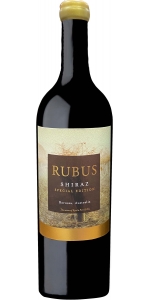
Rubus Special Edition Barossa Shiraz is made from 100 percent
The Rubus Project was created by Fran Kysela as a way to source & sell incredible wines at value prices. All wines in this international project are hand-selected by Fran Kysela. Rubus wines are fruit driven, true-to-type values that over deliver - a true representation of quality for the consumer at an excellent price.
Deep red with a slight purple hue on release. The wine has a rich mix of dark chocolate infused with coffee bean and black liquorice, then scents of tar, aniseed, raw (pure) soy and black olive on the nose. The palate is expansive, and yet balanced and finessed. An amalgam of dark berried flavors and textural sensations. The 100% new oak is completely absorbed, meshed with ripe tannins, completing a palate of impressive length and youthfulness.
Sourced from Thorn-Clarke’s St Kitts vineyard (Block 7) in the far north of the Barossa, the Rubus Reserve demonstrates both the strengths of the region and the unique characters of the vineyard.
A thin layer of topsoil over weathered marble, schist and shale mean the vines work hard to source water and nutrients. The result is naturally low yields concentrating the power and density of the fruit. Diurnal temperature variation is another important aspect of St. Kitts. Warm daytime temperatures are followed by cool nights with variations of up to 30°C (55°F) from the peak during the day into the cool night minimums.
Review:
“Earthy detail develops in this sleek and juicy shiraz, a tarry streak under fresh plum and bruised strawberry. The tannins have gravity and precision, their bracing intensity and concentration integrated into what panelist David Hawkins described as “a big, powerful wine with great liveliness.” While suited to aging, this is accessible now if you’re grilling meats to serve with it.”
- Wine & Spirits (February 2023), 94 pts
"Made by Thorn-Clarke for the US market, this has a rich and vivid nose with blueberry, violet, dark plum and subtle oak spice in play. The palate has a succulent feel with plenty of rich, open-knit blackberry and blueberry flavor. Smoothly delivered tannins carry long and even. Drink over the next decade."
- James Suckling (November 2021), 94 pts
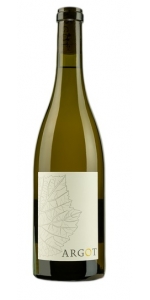
Argot Chardonnay Sonoma County is made from 100 percent Chardonnay.
Pouring a green-tinted gold, our Sonoma County Chardonnay is a beautiful wine from word go. Radiating from within, a blast of apple/pear fruit informs this wine both aromatically, and on the palate. As flavors unfurl, a progression of orange blossom, pineapple, white peach, and hazlenut are followed by a finish dominated by ginger, baked apple, with a trailing kiss of mint’s freshness. A stunning wine — wholly informed by the perfection of 2018’s growing season — defined by its dichotomy of massively intense flavors, and superb acidity and freshness.
Raised by minimalistic methods, often associated with the classic Chardonnay winemaking techniques of Meursault. With a focus on the coolest Chardonnay region in Sonoma County, 2018’s long, even growing season favored our vineyards’ moderate climate, old vines and deep volcanic soils. These grapes were allowed an extended ripening period on the vine, resulting in perfect balance and concentrated flavors.
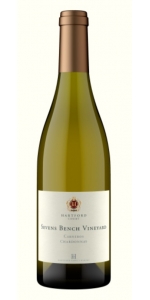
Hartford Court Sevens Bench Vineyard Chardonnay is made from 100 percent Chardonnay.
True to its Carneros roots, the 2018 Sevens Bench Chardonnay carries the hallmark of the region – fruit intensity balanced by and good acidity. The aromas are driven by classic lemon drop, Meyer lemon, and lemongrass. That fruit style follows in the flavors, with the citrus focus carrying through with candied lemon drop balanced by the mineral and flint characters inherent to the region and the clonal selections. Barrel fermentation notes in the background add even more complexity to this elegant wine.
Review:
I always seem to find a tropical slant in Chardonnay from Carneros, and the 2018 Chardonnay Sevens Bench Vineyard has it in spades, with ample pineapple, honeyed peach, pear, and toasted spice-like aromas and flavors. This is another balanced, rich, medium to full-bodied Chardonnay from this estate that's loaded with character. Drink it over the coming 5-7 years
-Jeb Dunnuck 95 Points
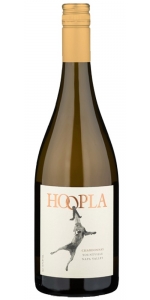
Hoopes Chardonnay Napa Valley is made from 100 percent Chardonnay.
Serendipity was in the morning air when Maya and Sophie took Lindsay for a walk down a Yountville country lane. Maya, the feisty one, spied a jackrabbit and bounded off in hot pursuit. When Lindsay caught up with her, she found herself surrounded by some fine looking Chardonnay vines. Always on the look-out for the best fruit for Hoopla, with some neighborhood super-sleuthing, Lindsay tracked down the vineyard owner and kept talking until she got his handshake. That chance discovery gave us really great Chardonnay that we offer at a really great price. In fact, chasing rabbits is exactly what we’re talking about. This cheeky Chardonnay will make you want to get into some mischief too.
Our goal with the Hoopla Chardonnay is a fresh juicy wine showcasing flavors and aromas of the grape. A long cool fermentation and aging in stainless steel shines helps preserve the luscious aromas and fruit characters in the wine. Classic notes of fresh pineapple, ripe pear and Fuji apple greet the nose with a lovely warmth and creaminess in the mouth from aging sur-lie in tank without the introduction of oak. This mid-palate breadth yields to an open, clean and refreshing finish. We find ourselves reaching for this crowd-pleasing wine time and time again without fail.
This wine is delicious with roast chicken and buttery mashed potatoes, fish tacos, Chinese chicken salad, lobster mac and cheese, triple crème Brie slathered on French baguette and salt & pepper flavored kettle-cooked potato chips.
Rubus Chardonnay Colchagua Valley is made from 100 percent Chardonnay.
Attractive yellow color with some green tones. Its intense varietal character reminds one ripe fruits like pineapple, with notes of melon and honey well harmonized with oak. In the mouth it is full, rich and buttery.
Grapes are harvested in the morning in order to avoid high temperatures.
At the winery, the grapes are gently pressed.
Alcoholic fermentation is held between 15º and 16º Celsius.
Then, 25% of the wine goes into American Oak barrels for 3 months.
After this, the blend is made, clarified, cold stabilized and filtered. Right before bottling, the wine goes through an on-line filtration system (plate and sterile membrane) to ensure microbiological stability
As far as the food pairing, it is delicious with pasta, fish, seafood and mild cheeses. It is also delicious on its own as an aperitif.
The Rubus Concept
Rubus wines are a private label created and used by Kysela Pere et Fils, LTD in order to buy, bottle and market wine found at incredible quality/price ratio. All Rubus wines are selected by Fran Kysela MS.
It was first used for a superb batch of 1,200 cases of Amador county Zinfandel back in 1997. The wine sold in a few days and the Rubus brand was not used since then.
During a trip in California in 2009, when Fran Kysela tasted some incredible wines (available in bottle but without label), he decided to help resurrect the brand creating an outstanding Cabernet Sauvignon from Stag's Leaps district in Napa Valley (California) , followed by an excellent Chardonnay from Russian River Valley (California)
We then developed the Rubus Zinfandel from Lodi (California).
In 2011, we added a Shiraz/Viognier blend from the Barossa in Australia.
For 2012, the newest addition to the Rubus line is a Chardonnay from Colchagua Valley in Chile.
Rubus is now its own brand representing quality for the consumer and an incredible price along the way.
Rubus Meaning
The name RUBUS means "raspberry" in Latin and it is the name given to the genus of flowering plants in the rose family. For instance, here are some famous fruit from the Rubus family with their latin names:
Rubus fruticosus agg. – Blackberry
Rubus idaeus – European Red Raspberry
Rubus occidentalis – Black Raspberry
Rubus pensilvanicus – Pennsylvania Blackberry
Rubus strigosus – American Red Raspberry
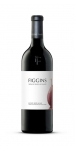
Figgins Estate Red Wine is a blend of Cabernet Sauvignon, Petit Verdot & Merlot
Dark to the rim, with signature aromatic notes of ripe red and blue fruits, tanned leather, black olive, and lilac. The nose simply brings a smile. On the palate, if I had to describe the wine in one word it would be precision. The way the sweet fruit and dramatic length are braced by lively acidity and tannins aligns so perfectly that the wine is, quite simply, delicious.
Review:
Inviting aromas of vivid red fruit, fresh herbs and paprika. Full-bodied with juicy, fruit-soaked, fine tannins. Delightful. So much happening here. The fruit is plentiful and full of charming spice and herbal complexity. Very well balanced and long. Fresh. A blend of cabernet sauvignon, merlot and petit verdot. Best after 2024 but attractive now.
-James Suckling 96 Points
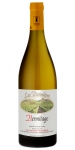
Domaine Jean-Claude et Nicholas Fayolle Hermitage Les Dionneres Blanc is made from 100% Marsanne.
Fayolle Hermitage Blanc Les Dionnieres boasts a superb golden yellow color and extraordinary smoothness and creamy, honeyed aromas of hazelnut, peach and apricot developping into scents of iris, narcissus and lime blossom. Pure and crisp, a solid texture and a clean finish.
Delicious with poultry, veal, seafood, shellfish, veal and most cheeses.