" We don't sell the wine without touching the vine "
| Country: | United States |
| Regions: | California California (Lodi) |
| Winery: | Rubus |
| Grape Type: | Zinfandel |
| Vintage: | 2015 |
| Bottle Size: | 750 ml |

SALE!
Lodi, American Viticulture Area (AVA) – The Lodi AVA is located in the northern end of the San Joaquin Valley, Central Valley California, east of the San Francisco Bay. Lodi has warm days and cool nights, similar to the Mediterranean climate. The lower temperatures that occur in Lodi result in fruit with good acidity. A wide range of soils are found in the Lodi AVA, but they generally are deep, loamy, sandy, rocky soils similar to that found in southern Rhone valley.
The Lodi appellation totals almost one half million acres, and the approximately eight hundred growers farm roughly 90,000 acres. Lodi produces more Cabernet Sauvignon, Chardonnay, Merlot, Sauvignon Blanc, and Zinfandel than any other wine region in California, but it is probably best known for its old vine Zinfandel. The vines are often head trained giving them a classic old world appearance.
Zinfandel – The Zinfandel grape is a hearty variety that produces grapes with high sugar levels, often resulting in wines with a high alcohol content. Thought to be a relative of Primitivo that is found in southeast of Italy (the boot heel), Zinfandel can be made into a wide range of wine styles, including White Zinfandel, light or full bodied red wines, and even late harvest desert style wine. However Zinfandel, especially Old Vine Zinfandel from Lodi, is usually made into a full bodied, spicy red wine with characteristics of red fruit, raspberry, and cherry.
Produced in the heart of Lodi AVA.
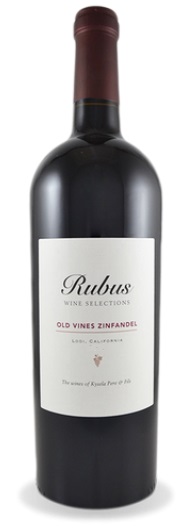
Rubus Zinfandel Lodi is made from 98% Zinfandel + 2% Cabernet Sauvignon
Bottled after aging in French and American oak for 9 months.
Rubus Zinfandel Lodi presents with ruby red in color, with red fruit, raspberry, and spice on the nose. This wine is medium in body, with notes of ripe cherry, cedar box, cinnamon, anise, black pepper, and hint of smoke on the palate. It has a long, silky finish.
Selected by Fran Kysela MS.

Grace Town Old Vine Zinfandel Lodi is amde from 98% Old VIne Zinfandel + 2% Cabernet Sauvignon.
Ruby red in color, with red fruit, raspberry, and spice on the nose. This wine is medium in body, with notes of ripe cherry, cedar box, cinnamon, anise, black pepper, and hint of smoke on the palate. It has a long, silky finish.

Collier Creek Old Press Zinfandel is made from 93% Zinfandel and 7% Petite Sirah.
Nestled in the heart of the Lodi Appellation, where farmland ran as far as the eye could see, Collier Creek is a place that reminds us of simpler times. The ol' press may look different these days, but this Zinfandel is still a classic with notes of dark fruit, baking spice, vanilla and a velvet mouthfeel.
Pair with blue cheese, bbq pork ribs, leg of lamb.

The Rubus Project was created by Fran Kysela as a way to source & sell incredible wines at value prices. All wines in this international project are hand-selected by Fran Kysela. Rubus wines are fruit driven, true-to-type values that over deliver - a true representation of quality for the consumer at an excellent price.
Grapes are sourced from the Lessini hills in the Colli Berici, where the cold nights allow the aromatic compounds in the grapes to develop. The vines, 20 years old on average, are planted on calcareous soils of volcanic origin.
Nice garnet and red color. Expressive and charming on the nose with cherry and blackberry aromas. On the palate, the wine has a nice spicy note. The length to the finish is round and long.
Rubus Pinot Noir is made from 100 percent Pinot Noir from Veneto Italy
Tasting notes: Nice garnet and red color. Expressive and charming on the nose with cherry and blackberry aromas. On the palate, the wine has a nice spicy note. The length to the finish is round and long.
Vineyards:
The grapes are grown primarily on the hills south of Vicenza, the Colli Berici, where the hillside sites ensure lower yields and better ripeness of the grapes.
The vineyards are located in the hills and are south-west facing. The hillside sites experience cooler nights, allowing the aromatic compounds in the grapes to develop. The vines are trained using the Guyot system, planted on calcareous soils of volcanic origin.
Average age of the vines is around 20 years old.
Vinification:
The grapes were harvested, destemmed, crushed and then cool soaked for 24 hours. Maceration on the skins took place before fermentation at temperatures of up to 22°C. Following malolactic fermentation, 30% of the wine was aged in oak for four to five months prior to bottling.
Winemaker: Alberto Marchisio
Acidity: 5.3 g/Liter
RS: 5.6 g/Liter
pH: 3.42
Nice with roasted or grilled beef, game and a very good companion for matured cheese.

Pazo de Senorans Seleccion de Anada Albarino is made from 100 percent Albarino.
Straw yellow with greenish tints, vivid and brilliant. High intensity and very expressive. Profusion of aromas with traces of mineral. Great volume and ample body leaving a lasting impression from beginning to end.
Reviews:
The 2015 Albariño Selección de Añada is nothing short of phenomenal. For some reason, I hadn't tasted the young 2015 Albariño at the time it was released. It comes from the Los Bancales vineyard planted some 50 years ago and fermented with indigenous yeasts but without malolactic fermentation. It has a bright, almost fluorescent color and a complex, subtle and nuanced, elegant and expressive nose, with notes of sea shells and sea breeze, grass and white flowers. It's very clean, and the palate shows great balance and even feels a bit young. It has remarkable acidity and freshness (seven grams of tartaric acid) with good ripeness and 13% alcohol. This matured in tank with lees for over 30 months and was bottled in June 2024. It feels more serious and less exotic than earlier vintages. 18,000 bottles produced. This is the finest vintage that I can remember. Bravo!
-Wine Advocate 97 Points
Tech:

The Royal Chenin Blanc Old Vines Steen is 100 percent Chenin Blanc.
As the unofficial drink of the Riebeek Valley, Chenin Blanc is the perfect every day wine that offers uncomplicated quality for the novice and connoisseur alike. Packed with upfront melon fruit, the nose charms with an abundance of guava and gooseberries as well as the signature hint of honey. The palate follows through with fruit flavors balanced by a crisp acid to ensure a fresh and fruity style of wine.
Enjoy well-chilled as a lovely crisp glass on its own but ideal for al fresco dining and with light summer fare. Beautiful with salads, anti pasti and seafood.
Lodi, American Viticulture Area (AVA) – The Lodi AVA is located in the northern end of the San Joaquin Valley, Central Valley California, east of the San Francisco Bay. Lodi has warm days and cool nights, similar to the Mediterranean climate. The lower temperatures that occur in Lodi result in fruit with good acidity. A wide range of soils are found in the Lodi AVA, but they generally are deep, loamy, sandy, rocky soils similar to that found in southern Rhone valley.
The Lodi appellation totals almost one half million acres, and the approximately eight hundred growers farm roughly 90,000 acres. Lodi produces more Cabernet Sauvignon, Chardonnay, Merlot, Sauvignon Blanc, and Zinfandel than any other wine region in California, but it is probably best known for its old vine Zinfandel. The vines are often head trained giving them a classic old world appearance.
Zinfandel – The Zinfandel grape is a hearty variety that produces grapes with high sugar levels, often resulting in wines with a high alcohol content. Thought to be a relative of Primitivo that is found in southeast of Italy (the boot heel), Zinfandel can be made into a wide range of wine styles, including White Zinfandel, light or full bodied red wines, and even late harvest desert style wine. However Zinfandel, especially Old Vine Zinfandel from Lodi, is usually made into a full bodied, spicy red wine with characteristics of red fruit, raspberry, and cherry.
Produced in the heart of Lodi AVA.
Rubus Zinfandel Lodi is made from 98% Zinfandel + 2% Cabernet Sauvignon
Bottled after aging in French and American oak for 9 months.
Rubus Zinfandel Lodi presents with ruby red in color, with red fruit, raspberry, and spice on the nose. This wine is medium in body, with notes of ripe cherry, cedar box, cinnamon, anise, black pepper, and hint of smoke on the palate. It has a long, silky finish.
Selected by Fran Kysela MS.
The Rubus Concept
Rubus wines are a private label created and used by Kysela Pere et Fils, LTD in order to buy, bottle and market wine found at incredible quality/price ratio. All Rubus wines are selected by Fran Kysela MS.
It was first used for a superb batch of 1,200 cases of Amador county Zinfandel back in 1997. The wine sold in a few days and the Rubus brand was not used since then.
During a trip in California in 2009, when Fran Kysela tasted some incredible wines (available in bottle but without label), he decided to help resurrect the brand creating an outstanding Cabernet Sauvignon from Stag's Leaps district in Napa Valley (California) , followed by an excellent Chardonnay from Russian River Valley (California)
We then developed the Rubus Zinfandel from Lodi (California).
In 2011, we added a Shiraz/Viognier blend from the Barossa in Australia.
For 2012, the newest addition to the Rubus line is a Chardonnay from Colchagua Valley in Chile.
Rubus is now its own brand representing quality for the consumer and an incredible price along the way.
Rubus Meaning
The name RUBUS means "raspberry" in Latin and it is the name given to the genus of flowering plants in the rose family. For instance, here are some famous fruit from the Rubus family with their latin names:
Rubus fruticosus agg. – Blackberry
Rubus idaeus – European Red Raspberry
Rubus occidentalis – Black Raspberry
Rubus pensilvanicus – Pennsylvania Blackberry
Rubus strigosus – American Red Raspberry

Winemaking: This wine is a classic Bordeaux blend of 78% Cabernet Sauvignon, 10% Malbec, 8% Merlot, 2% Cabernet Franc, 2% Petit Verdot.
. The 2010 growing season was moderate, thus promoting slow ripening and full flavor development. We hand-harvested and fermented each variety separately, then moved the wines to barrel, where they aged twelve months. Once we determined our blend, we returned the wine to barrel for an additional twelve months, to 'marry' the varietals. We used tight-grained French oak barrels (45% new) from coopers Taransaud, Vicard and Bossuet.
Winemaker Notes:
Complex, rich aromas foretell rich flavors of black currants, allspice and a hint of clove. The wine is full bodied, with velvety texture, smooth tannins and an extensive finish. Beautifully balanced, this Cabernet will age for ten more years.
Alcohol: 14.25 percent by volume
Review:
"Savory, dried red capsicum with cedar, cocoa powder and dried mushrooms on top of black cherries. Juicy and layered with some currants and savory earthy spices on the palate. Not quite deep, but a very elegant and savory expression of cabernet with a very long, subtle finish. A little sweet-sour, but quite refined and approachable, too. Drink now."
- James Suckling (June 2022), 93 pts

Continuum Red Blend 2022 is made from 45% Cabernet Sauvignon, 43% Cabernet Franc, 8% Petit Verdot, 4% Merlot.
2022 tells a story of subtle drama of the seasons. Aromatically effusive, 2022 Continuum is a seductive wine with an upright and regal core. Elegantly interwoven notes of black plum, black cherry, cacao, forest floor and tobacco leaf mingle with our sage mountain garrigue and volcanic minerality. Energetic and expressive, 2022 Continuum is a harmoniously integrated wine with structural complexity wrapped in a velvet robe.
WINEGROWING- Continuum is estate grown on our Sage Mountain Vineyard. It’s location, high on Pritchard Hill along the eastern ridge above Oakville, overlooks Napa Valley and the San Francisco Bay. The rocky, volcanic soils of the site focus the vine’s energy keeping yields low yielding fruit of depth and complexity. 38 acres of mature estate vineyard, planted in 1991 and 1996, with additional plantings in 2004, 2010, together comprise 38 distinct vineyard blocks. Cabernet Sauvignon, Cabernet Franc, Petit Verdot, and Merlot are grown from 1300 to 1600 feet in elevation, on western and southern facing aspects with slight northern and eastern slopes in places. This diversity of plantings on our volcanic soils are the essence of the complexity of Continuum.
PRODUCTION- Continuum is 100% estate grown, produced and bottled. All fruit is selectively hand-harvested at night. The fruit is then sorted before and after de-stemming, and gravity fed into French oak or concrete tanks. A threeday cold soak is followed by fermentation, receiving three to four pumpovers daily, and délestage two to three times in total during the most active period. The wine remains on skins in tank for 20 to 40 days. All lots are then drained, basket pressed, and transferred with lees for malolactic fermentation and aging. Continuum spent 22 months in barrel. 63 percent of French oak barrels were new and 35 percent were once used. A single concrete amphora was also used for aging. The wine clarified slowly and settled naturally in our cold barrel room, was racked sparingly and bottled without fining or filtration. Each vineyard lot was tasted and carefully considered many times to assemble the blend.
Review:
Perfumed aromas of subtle currants, roses, lavender and sage, following through to a medium body with super-fine tannins that caress the palate and leave it fresh and inspired.
- James Suckling 99 Points