" We don't sell the wine without touching the vine "
| Country: | Chile |
| Region: | Colchagua Valley |
| Winery: | Siegel |
| Grape Type: | Carmenere |
| Vintage: | 2017 |
| Bottle Size: | 750 ml |

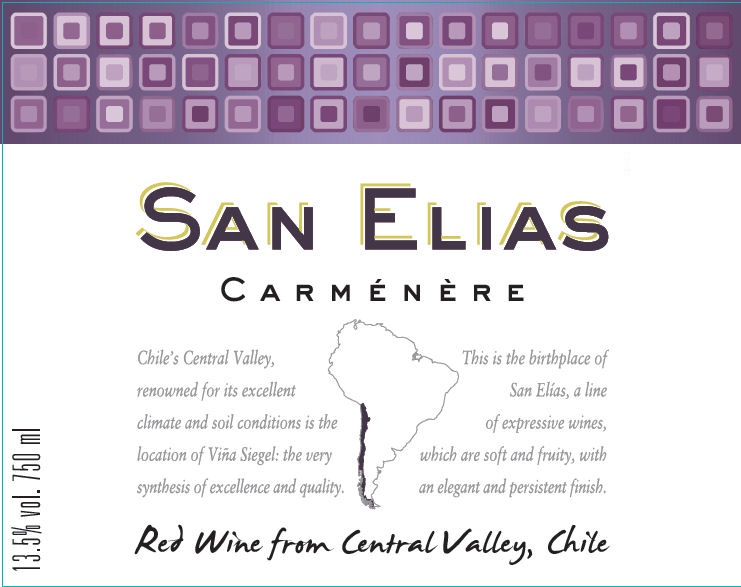
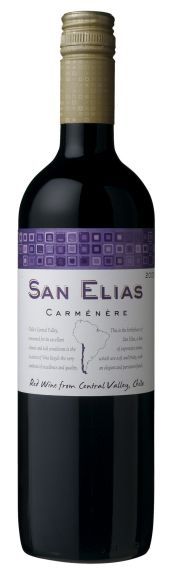
Siegel San Elias Carmenere is made from 100 percent Carmenere.
The nose shows beautiful red and dark fruit aromas, earthy notes and violets with balanced acidity. Supple and round in the mouth, juicy tannins, good concentration.
Pairs well with pasta dishes, Mediterranean cuisine and grilled vegetables.

Siegel San Elias Cabernet Sauvignon is made from 100 percent Cabernet Sauvignon.
Fresh and delicate cassis tones, a great structure. Draw the cork half an hour before serving and serve at room temperature.
Smooth and fruity on the palate, the wine goes well with pasta, salads.

Siegel San Elias Chardonnay is made from 100 percent Chardonnay.
This Chardonnay has a light yellow color with green highlights. The nose shows fresh and intense tropical fruit aromas of pineapple, citrus, herbs and a touch of honey. On the palate it is lush, smooth and well-balanced with good acidity and lovely tropical fruit flavors.

Siegel San Elias Merlot is 100 percent Merlot
Soft, rich and concentrated with juicy plum and blackberry fruits, soft tannins and a velvety texture.
Try with hearty stews, pasta and roast red meats.
Siegel San Elias Merlot is 100 percent Merlot
Soft, rich and concentrated with juicy plum and blackberry fruits, soft tannins and a velvety texture.
Try with hearty stews, pasta and roast red meats.
Beautiful red fruit aromas. Supple and round in the mouth.
The wine pairs well with full flavored cheeses and lamb.
The Vina Siegel Crucero Estate
Alberto Siegel was born in Santiago in 1946, the third generation in Chile of an Austrian family. His grandfather was an Austrian architect that built some very important and traditional buildings in downtown Santiago, at the beginning of the 20th century, including the Chilean Federal Reserve.
His father, Don Germán, was a viticulturist that spent most of his career in charge of Viña San Pedro’s vineyards near the town of Molina, 140 miles south of Santiago. There Alberto grew up, literally in the middle of the vines. It was not a surprise when he decided to study Agronomy and specialize in winemaking at the Universidad Católica in Santiago.
After finishing high school, he spent a year working in wineries in Germany, and upon his return in 1971, he joined the German company Bayer. His job was to sell fertilizers to farm owners in the Colchagua area, 100 miles south of Santiago. Through this job he got to know almost every land owner, most of which were grape growers and wine producers.
A few years later and as a natural consequence, he started to act as a wine and grape broker, selling the production of small owners to the big Chilean wineries. He established Sociedad La Laguna, and he soon became the most important Chilean broker in this field, a position that he holds today by far. There is hardly any Chilean person or company involved in the wine business that has not dealt with Alberto Siegel at least once.
In parallel, and together with his father, Alberto founded Viña Siegel in 1980. They started planting vineyards in Colchagua and building the Winery in Santa Cruz. When Don Germán died in 1998, Alberto became the owner, together with his family. In the beginning, Viña Siegel only sold bulk wines to the biggest Chilean wineries, like Concha y Toro, San Pedro and Santa Rita. In 1997, Alberto decided to enter the bottled wines business and made the necessary investments to go ahead with this project.
Today, the winery has a capacity of over 3 million gallons and the company owns over 1,850 acres of vineyards in Colchagua. Their wine cellar has state of the art technology, such as vertical pneumatic presses, vacuum filters, and stainless steel tanks with total temperature control, for both cooling and heating. Viña Siegel Winery is still a family operation, with Alberto Siegel as chairman and chief winemaker. The winery has two consultants in enological matters.
The Vina Siegel Crucero Vineyard
The varieties of grapes grown are Cabernet Sauvignon, Merlot, Carménère, Syrah, Chardonnay and Sauvignon Blanc, with other new varieties being added as markets demand. Viña Siegel is currently working with terroir consultant Pedro Parra to design a new site in Los Lingues, which will be planted with several new varietals, including Carignan, Grenache, and Mourvedre. The winery produces a range of varietal wines, along with reserve wines that highlight the quality of the grapevines born in this valley. The Colchagua Valley is truly a synthesis of the country’s way of life and wine has been produced here since time out of mind. This area, which has deservedly been raised to the category of estate bottling in wine making, has maintained its prestige due to the great quality of its wines. One of its noted symbols is its high quality Cabernet Sauvignons, and its red wines in general. Its variety of soils and climatic variations, some warmer, some cooler, have given the region innumerable attributes for grapevine cultivation.

Robert Mondavi The Reserve Cabernet Sauvignon To Kalon Vineyard is made from 94% Cabernet Sauvignon, 3% Cabernet Franc, 3% Petit Verdot.
The story of Robert Mondavi Winery begins here, with the To Kalon Reserve. This tier represents the pinnacle of the wines produced by the winery. The 2021 vintage offers fresh black fruit with dark chocolate, dried herbs, and hints of vanilla and violet. Flavors of black plum and blackberry with red fruit and a hint of graphite on the finish. Elegant and plush with sweet, beautifully integrated tannins and a lengthy finish.
Review:
-Decanter 98 Points

Davila M100 White Blend Rias Baixas 2022 is made from Albariño, Caíño Blanco and Loureiro.
Adegas Valmiñor farms the O Rosal valley at the Atlantic edge of Rías Baixas, and the Davila range is where the winery showcases the native grapes of that corner of Galicia. The M100 is an O Rosal blend built around Albariño, rounded out with Caíño Blanco and Loureiro from the estate's older parcels.
The Albariño is cold-macerated and barrel-fermented in large French oak, aged three months on its lees with bâtonnage, then blended with the Caíño Blanco and Loureiro and given further time in tank. It is a richer, more structured Rías Baixas white — ripe orchard fruit and subtle spice over a firm mineral spine, deep and expressive on the palate.
Pairs beautifully with richer seafood, white meats, and creamy dishes.