
" We don't sell the wine without touching the vine "
William and John Graham founded their firm in Porto in northwest Portugal to trade in textiles. In 1820 they accepted twenty-seven barrels of Port as payment of a debt. The two brothers decided then to devote their energies to making the best Port wines from the Douro Valley: and so the Graham’s Port house was born.
The Graham family already had extensive business interests overseas, both in their native Scotland and in India. They were considered by one contemporary historian to be, ‘among the merchant princes of Great Britain’.
The story of two families across three centuries. For almost two hundred years W & J Graham’s has been an independent family business renowned for producing the finest Port wines.
Graham’s has always been a pioneer. Graham's was one of the first Port companies to invest in its own vineyards in Portugal’s Douro Valley in 1890 and is now at the cutting edge of innovation in winemaking techniques. Today, five Symington cousins share responsibility for every aspect of the company and personally make the Graham’s wines. They too have been involved with Port and the Douro for many generations, with ancestry dating back to the mid-17th century.
Graham’s first harvest under the ownership of the Symington family was extremely auspicious, with Graham’s 1970 Vintage Port being declared. The 1970 is thought by many to be one of the greatest wines of that century.
Nearly an hundred years after their ancestor AJ Symington left Graham’s to set up on his own as a Port producer, the family’s relationship with this Port house came full circle.
Besides the family’s other Port marques, Graham’s is the only remaining British Port company independently owned by a single family. This ensures that every aspect in the making of Graham’s Ports is controlled and cared for intimately.
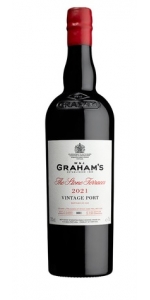
The Stone Terraces 2021 Vintage Port has incredibly fresh and lifted aromas with the hallmark tropical fruit character. The wine is concentrated whilst being supremely refined with polished tannins and taut acidity combining to deliver sublime elegance and balance.
Review:
What a polished and beautifully structured vintage port with ultra-fine tannins that run the length of the wine. It’s medium-bodied with a terrific intensity and brightness. Seems slightly drier than normal for a Graham’s vintage. Fantastically fine tannins. Black berries and tangerines with other tropical fruits. Hints of nuts at the end. Racy and muscular.
-James Suckling 95 Points
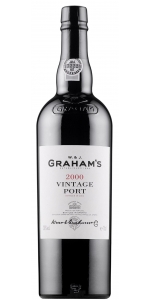
W & J Graham's Vintage Port is made from 35% Touriga Nacional, 47% Touriga Franca and various others.
It is with great pleasure that Graham's announces the declaration of the 2000 Vintage, a wine that has been deemed to meet our very exacting standards, and one that shows every promise of living up to the reputation of the very best Vintage ports that the Twentieth Century provided.
This is a landmark wine for Graham's, not only being the first Vintage of a new millennium, but being the first Vintage wine to enjoy the extraordinary results achieved by the new robotic 'lagares' at Malvedos in the inaugural year of our remodelled winery. Significant also has been the decision to include a rather larger proportion of mature Touriga Francesa and Touriga Nacional from Vila Velha, a classic riverside Quinta a short distance downstream from Malvedos, and some spectacular old vine lots from Vale de Malhadas in the Upper Douro. These wines each from family-owned Quintas have been used to reinforce the predominant component from Malvedos and the traditional excellence of the Rio Torto lots from Lages, to produce a rounded and even blend in the hallmark rich Graham style.
Picking began at Malvedos on September 22nd and the last lagar was run off on October 10th, an unusually short and compact Vintage. Fruit arrived in good condition although yields were less than three quarters of a kilogram per vine, and the juice to skin ratio well below normal. 2000 was a year noted for a very low average yield across the Douro, and with the grapes unusually lacking in liquid, the extra amount of treading work required made it an ideal time to employ our new, tireless, mechanical treaders alongside the two original 1890 stone lagares still worked by human feet. It was evident early on in the Vintage from the colour and aroma of the fermenting musts that we were looking at a spectacular year, and after the usual waiting period of sixteen months or so to see how the lots would develop, we have now made our final selection and assembled the final blend.
The blend displays many of the typical Graham aromas of ripe plum and 'esteva' (gum cistus) and is pleasantly smooth on the palate despite its youth. It is full and rich in the mouth with fresh blackberry and red plum notes. Despite the hallmark Graham sweetness in the mouth the finish is long and clean.
As with all Graham Vintages, this is a wine made to last for years and the patience of laying down the wine for fifteen to twenty years will certainly be rewarded.
Clos Saint-Jean is a 41-hectare estate in Châteauneuf-du-Pape run by brothers Vincent and Pascal Maurel. Considered by many critics and wine-writers as the preeminent estate espousing the modern style of winemaking in Châteauneuf, this cellar is one of the oldest in the region, having been founded in 1900 by the greatgreat-grandfather of Vincent and Pascal, Edmund Tacussel. A short time after its founding and well before the AOP of Chateauneuf-du-Pape was created in 1923, Edmund began bottling estate wines in 1910.
The farming at Clos Saint-Jean is fully sustainable due to the warm and dry climate, which prevents the need for chemical inputs. Instead, Vincent and Pascal employ organic methods for pest control, mainly pheromones, to prevent pests from taking up residence in their vines, a process called amusingly enough in French, confusion sexuelle. The vines tended manually, and harvest is conducted in several passes entirely by hand.
Deus ex Machina is a literary and dramatic term for a miraculous intervention that interrupts a logical course of events in a plot or play. A suitable name for a cuvée that had it’s start in the torrid vintage of 2003 when Philippe Cambie and Vincent Maurel made the decision to harvest at the end of September, weeks after their neighbors. Deus ex Machina is a blend of old vine Grenache from La Crau, aged in tank with equally ancient Mourvedre from the sandy soils of BoisDauphin aged in demi-muid. Deus ex Machina is only made in the best vintages.
Review:
Lastly, the 2022 Châteauneuf Du Pape Deus-Ex Machina shows a similar profile to the Combes des Fous, yet it brings another level of tannins and concentration. Kirsch liqueur, white flowers, sandalwood, cured meats, and graphite notes all shine here, and it's full-bodied, has a deep, layered, powerful, yet weightless profile, lots of ripe tannins, and a blockbuster of a finish. This ripe, sexy, seamless, incredibly impressive beauty will compete with anything in the vintage. As usual, this cuvée is 60% Grenache and 40% Mourvedre, which is brought up in roughly 40% new demi-muids.
Review: Jeb Dunnuck 97 Points
'Ma Belle-Fille' was named by Sir Peter as a warm tribute to Emily Michael, his "Daughter-in-Law", and mother of the third generation of the family. Planted at the highest elevation on the estate, the marine influence on Ma Belle-Fille vineyard is greater, resulting in cooler daily temperatures in the summer and autumn months. Situated above the summer fog ceiling and exposed to the southeast, the vineyard receives the very first rays of sunshine each morning and remains sunny all day long. This full exposure, combined with cooler temperatures, causes the fruit to mature earlier than the rest of our estate.
Vintage Notes
The combination of a wet winter with significant rains in December through March and cool weather delayed budbreak nearly a month. Flowering and fruit set were also pushed back and the weather during the later flowering was favorable resulting in decent fruit set and slightly above average yields for the Chardonnay vineyards—a marked improvement over the record-low yielding 2022 vintage. The growing season was temperate without major heat spikes allowing the berries to hold onto their acidity which carried through into the wines. Harvest was almost a month later than normal with the last Belle Cote block coming in on November 2nd.
At the highest elevation on the estate, the marine influence on Ma Belle-Fille is greater, resulting in cooler daily temperatures in the summer and autumn months. Situated far above the summer fog ceiling and exposed to the southeast, the vineyard receives the very first rays of sunshine each morning and remains sunny all day long. This full exposure, combined with cooler temperatures, causes the fruit to mature earlier than the rest of our estate.
Beautifully perfumed with layers of honeysuckle, jasmine and dried orange peel accented by apricot, vanilla cream and spring flower notes, the 2023 ‘Ma Belle-Fille’ delivers with a rich, creamy entry and generous, structured mid-palate showing great drive and intensity with a long, mouth-watering finish. A truly special wine from an extraordinary vintage.
Review:
So delicious and drinkable from the first whiff to the lingering finish. An uber-chardonnay that packs in all the richness of fruit and smooth spiciness of oak fermentation, with vibrant acidity and a silky texture. Well balanced in a cool, ideal vintage and a great candidate for aging longer term. Drinkable now and best from 2030.
James Suckling 99 Points