
" We don't sell the wine without touching the vine "

The AALTO project was founded in February 1999, in the prestigious winemaking region of Ribera del Duero (Spain). The foundational aim of Mariano Garcia and Javier Zaccagnini in AALTO was to make a wine that shows a different personality, of high quality and being a faithful reflection of distinct locations, blending them at the end of the aging process to obtain balance and complexity.
A few years later, in 2006, Masaveu and Nozaleda families joined AALTO, both owners of wineries in other wine regions of Spain, providing experience and stability to the project, which meant the consolidation of the winery to this day.
From its beginnings in 1999 until the harvest of 2004, the production of our wines took place in rented facilities in Roa (Burgos, Spain). While the project was being established, the founders began looking for a new place to locate their own new winery. A beautiful plot of 15 hectares belonging to the municipality of Quitanilla de Arriba (Valladolid) was chosen.
The first phase of the new winery was completed in 2005, being that year the first harvest that was produced in these facilities. The modern design chosen for this new winery was carried out only with the very highest quality criteria. The architecture of the winery is perfectly integrated into the environment, in a typical Ribera del Duero plateau, with a lineal and harmonic design without ostentation, and minimalistic details, elegant and comfortable. The second phase of the winery corresponding to the more social part of the winery was completed in 2016.
Mariano García Fernández
Born in Valbuena de Duero
Mariano García studied at the “Escuela de la Vid y el Vino” in Madrid and made his first harvest in 1968 at Vega Sicilia, where he developed his professional career as Technical Director of the company for 30 years, until 1998. In 1999, he founded with Javier Zaccagnini, Bodegas AALTO, as Technical Director from the first day. As a winemaker, Mariano García firmly controls the yields, respecting the grapes as much as possible and his philosophy of minimum intervention, searching for the maximum expression of the terroir in each plot. The wines unite the power and structure with elegance and complexity.
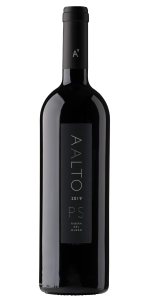
Aalto P.S. Pagos Seleccionados Tinto is made from 100 percent Tempranillo.
Climatic conditions
The farming year began with a mild autumn and little precipitation. A very dry winter started with -9ºC reaching at the end higher temperatures than normal for that time of the year. Spring and summer characterized by little rain, only some rain showers in July and late August avoided the hydric stress of the vines. The vegetative cycle of the vine developed with big variations of temperatures, alternating warm and atypical low temperatures of 4ºC for mid-June. The ripening of the grapes happened under very good conditions and the harvest started on 24th September 2019.
100% Tinto Fino (Tempranillo) primarily from very old vines – 60 to 90 years old – from selected plots in La Horra and La Aguilera. The harvest was done by hand, in small boxes of 15 kilos that are thoroughly inspected, bunch by bunch, on the selection table.
Tasting notes
Review:
Color: dark cherry, Aroma: toasty, spicy, fine cocoa, black fruit, Mouth: tasty, toasty, fine bitterness, ripe tannins
Guia Penin 94 Points
Aalto P.S. Pagos Seleccionados Tinto is made from 100 percent Tempranillo.
Climatic conditions
The farming year began with a mild autumn and little precipitation. A very dry winter started with -9ºC reaching at the end higher temperatures than normal for that time of the year. Spring and summer characterized by little rain, only some rain showers in July and late August avoided the hydric stress of the vines. The vegetative cycle of the vine developed with big variations of temperatures, alternating warm and atypical low temperatures of 4ºC for mid-June. The ripening of the grapes happened under very good conditions and the harvest started on 24th September 2019.
100% Tinto Fino (Tempranillo) primarily from very old vines – 60 to 90 years old – from selected plots in La Horra and La Aguilera. The harvest was done by hand, in small boxes of 15 kilos that are thoroughly inspected, bunch by bunch, on the selection table.
Tasting notes
Review:
Lots of depth here, with ripe blackberries and some nicely baked black cherries, roasted herbs, incense, dark spices, mussels and a balsamic tinge. An admirably fine dollop of tannins on the palate, which are immaculate and juicy, as they thoroughly dunk into the black fruit, melting into a persistent finish that lasts for over a minute. Very impressive. Drink or hold.
-James Suckling 96 Points
Paul Hobbs George Menini Estate Chardonnay is made from 100 percent Chardonnay.
Located on the southwestern edge of the Russian River Valley appellation in an area known as the Sebastopol Hills, this Chardonnay from George Menini Estate displays pale straw in color and boasts an elixir of white and yellow florals, tart yellow apple, bartlett pear, and baking spice. A precise yet supple wine with notes of juicy Gravenstein apple, vibrant sea salt, and crushed rock, complemented by a cool-climate zing of acidity. An impressive level of complexity for a young vineyard.
Review:
Lots of pears and pear blossom with lemon rind undertones. Medium body with plenty of fruit and energetic acidity with a pumice undertone. Some terra-cotta, too. Flavorful finish. Salty, too. Complex. Lots going on here. Drink or hold.
-James Suckling 97 Points

Segries Tavel Rose is made from 50% Grenache, 30% Cinsault, 15% Clairette, 5% Syrah.
The age of the vines is 30 years. Traditional vinification at low temperature, "vin de saignée" with a maceration during one night in cement vat.
This is large for a Rose...structured and focused, with the color of dark ruby. The nose is loaded up with fresh fruit. Strawberry, blackcurrant, and raspberry beam from the glass. On the palate, the mouth-feel is ripe and succulent. It has strength, but maintains its fresh and crisp expression. The finish is filled with Asian spice and slight hints of smoke. Drink this juice now or over the next year or two.



