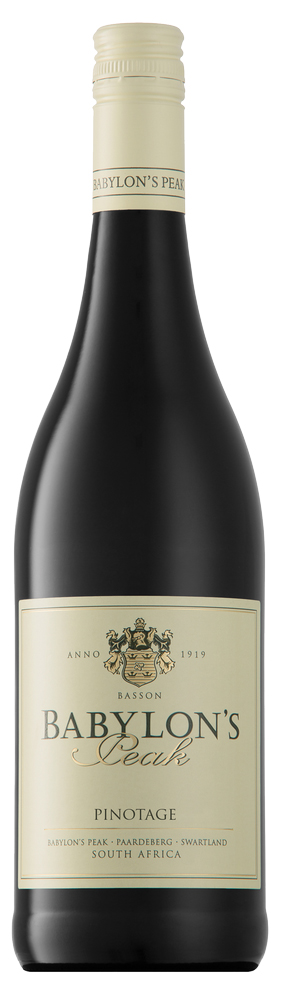
" We don't sell the wine without touching the vine "
| Country: | South Africa |
| Region: | Swartland Region |
| Winery: | Babylon’s Peak |
| Grape Type: | Pinotage |
| Vintage: | 2017 |
| Bottle Size: | 750 ml |
Babylons Peak Pinotage is made from 100 percent Pinotage.
Babylon's Peak winery, situated on the highest weathered granite slopes of the Paardeberg Mountain, is privately owned by the Basson family who has passed down the tradition, passion and art of winemaking over four generations. Predominantly low-yield dryland bushvines are selected to produce these excellent wines with distinctive character.
Dark red color, with ripe plums and mocha on the nose. Dark fruit followed by spice on the palate. A well balanced wine with smooth integrated tannins.
The Pinotage is dryland bushvines, planted on the highest south-east facing granite slopes on the farm. Due to its unique terroir, this vineyard ripens slowly over a very long period. This results in very dark color, soft tannins and good flavor compounds. The baboons normally harvest their quantity first and we pick the rest.
The grapes were harvested by hand at 25,6°B.and destalked only. No crushing was done. Cold maceration was done before fermentation started in open fermenters. The grapes fermented between 24-26°C for 5-7 days, after which the wine was taken to barrels where it went through malolactic fermentation. After malolactic fermentation was completed, the wine spent 12 months in 225 liter French oak barrels until bottling.
Pairs with lamb, bobotie and braaied red meat.
Babylons Peak Pinotage is made from 100 percent Pinotage.
Babylon's Peak winery, situated on the highest weathered granite slopes of the Paardeberg Mountain, is privately owned by the Basson family who has passed down the tradition, passion and art of winemaking over four generations. Predominantly low-yield dryland bushvines are selected to produce these excellent wines with distinctive character.
Dark red color, with ripe plums and mocha on the nose. Dark fruit followed by spice on the palate. A well balanced wine with smooth integrated tannins.
The Pinotage is dryland bushvines, planted on the highest south-east facing granite slopes on the farm. Due to its unique terroir, this vineyard ripens slowly over a very long period. This results in very dark color, soft tannins and good flavor compounds. The baboons normally harvest their quantity first and we pick the rest.
The grapes were harvested by hand at 25,6°B.and destalked only. No crushing was done. Cold maceration was done before fermentation started in open fermenters. The grapes fermented between 24-26°C for 5-7 days, after which the wine was taken to barrels where it went through malolactic fermentation. After malolactic fermentation was completed, the wine spent 12 months in 225 liter French oak barrels until bottling.
Pairs with lamb, bobotie and braaied red meat.
Babylons Peak Chenin Blanc is made from 100 percent Chenin Blanc.
Babylon's Peak winery, situated on the highest weathered granite slopes of the Paardeberg Mountain, is privately owned by the Basson family who has passed down the tradition, passion and art of winemaking over four generations. Predominantly low-yield dryland bushvines are selected to produce these excellent wines with distinctive character.
The Chenin Blanc grapes were picked from very old dryland bushvine vineyards. The vineyard grows on weathered granite soils, contributing to the flavor of the grapes and mineral character of the wine. Production is limited to 5 tons/ha.
The grapes were harvest by hand at 22.1°B. The grapes were destalked and lightly crushed. Only the first 450 litres free-run juice per ton were fermented in stainless steel tanks at a cold temperature (10-12°C) for 21 days. The wines was left on the fermentation lees until bottling.
A crisp, fresh and fruity Chenin Blanc from low-yield dryland bushvines.
Pairs with salads, seafood, chicken and other light dishes. The perfect wine for every occasion.
Babylons Peak Chenin Blanc is made from 100 percent Chenin Blanc.
Babylon's Peak winery, situated on the highest weathered granite slopes of the Paardeberg Mountain, is privately owned by the Basson family who has passed down the tradition, passion and art of winemaking over four generations. Predominantly low-yield dryland bushvines are selected to produce these excellent wines with distinctive character.
The Chenin Blanc grapes were picked from very old dryland bushvine vineyards. The vineyard grows on weathered granite soils, contributing to the flavor of the grapes and mineral character of the wine. Production is limited to 5 tons/ha.
The grapes were harvest by hand at 22.1°B. The grapes were destalked and lightly crushed. Only the first 450 litres free-run juice per ton were fermented in stainless steel tanks at a cold temperature (10-12°C) for 21 days. The wines was left on the fermentation lees until bottling.
A crisp, fresh and fruity Chenin Blanc from low-yield dryland bushvines.
Pairs with salads, seafood, chicken and other light dishes. The perfect wine for every occasion.
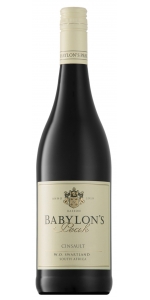
Babylons Peak Cinsault is made from 100 percent Cinsault.
Medium to light bodied. Fruit driven with spicy undertones. Soft tannins and fine complexity. A fruit driven wine with lively light palate and lingering mouthfeel.
Review:
"Savory aromas of black olives, grilled meat, thyme, peppercorns and dark fruit. It’s medium-bodied with fine tannins and a flavorful, succulent and peppery palate. Drink now."
- James Suckling (December 2021), 90 pts
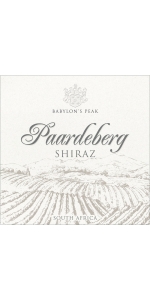
Babylons Peak Paardeberg Shiraz is made from 100 percent Shiraz.
Babylon's Peak winery, situated on the highest weathered granite slopes of the Paardeberg Mountain, is privately owned by the Basson family who has passed down the tradition, passion and art of winemaking over four generations. Predominantly low-yield dryland bushvines are selected to produce these excellent wines with distinctive character.
A classic Shiraz with dark fruit, violets and white pepper. An elegant wine with ripe tannins and a lingering aftertaste.
The grapes were harvested by hand. The grapes were destalked only, no crushing was done. Cold maceration was done before fermentation started in open fermenters. The grapes fermented between 24-26°C for 5-7 days, after which the wine was taken to barrels where it went through malolactic fermentation. After malolactic fermentation was completed, the wine spent 14 months in 225 litre French oak barrels until bottling.
Pairs with rich and creamy meat dishes eg. oxtail and venison.
Babylons Peak Pinotage is made from 100 percent Pinotage.
Babylon's Peak winery, situated on the highest weathered granite slopes of the Paardeberg Mountain, is privately owned by the Basson family who has passed down the tradition, passion and art of winemaking over four generations. Predominantly low-yield dryland bushvines are selected to produce these excellent wines with distinctive character.
Dark red color, with ripe plums and mocha on the nose. Dark fruit followed by spice on the palate. A well balanced wine with smooth integrated tannins.
The Pinotage is dryland bushvines, planted on the highest south-east facing granite slopes on the farm. Due to its unique terroir, this vineyard ripens slowly over a very long period. This results in very dark color, soft tannins and good flavor compounds. The baboons normally harvest their quantity first and we pick the rest.
The grapes were harvested by hand at 25,6°B.and destalked only. No crushing was done. Cold maceration was done before fermentation started in open fermenters. The grapes fermented between 24-26°C for 5-7 days, after which the wine was taken to barrels where it went through malolactic fermentation. After malolactic fermentation was completed, the wine spent 12 months in 225 liter French oak barrels until bottling.
Pairs with lamb, bobotie and braaied red meat.
Review:
"Semi-opaque. An outstanding value in South African Pinotage, the 2017 vintage shows an effusive nose of dark cherry, chocolate and tobacco. It’s big and rich in the mouth with flavors that evoke black raspberry and dark cocoa powder. Quite ripe in style with a long finish. At 14.5° alcohol, it’s a big wine. - Don Winkler" - i-winereview.com (The Wines of Babylon’s Peak in South Africa’s Swartland, September 30th 2019), 90+ pts
Babylon’s Peak is a private cellar located on the slopes of the Paardeberg Mountains between Malmesbury and Paarl.
Four generations have farmed here, passing down their winemaking knowledge and passion through the ages. Current winemaker Stephan Basson joined his father in 2003 and started making wine under the Babylon’s Peak brand. Stephan is a passionate and warm-hearted family man. He has dedicated his life to the wine industry and is passionate to keep the Basson legacy alive through the range of characterful Babylon’s Peak wines.
The name Babylon’s Peak is derived from the very high granite peak on the farm, which is known to local people as ‘Babylonstoren’ (in English, ‘The Tower of Babylon’). Some of the highest vineyards in the Swartland region are found here at about 700 metres above sea level. The Paardeberg area is characterized by decomposed granite soils and unique terroir which result in optimum soil expression and fruit purity. All the grapes used for the wines are carefully selected and treated before the wine is made in the traditional way. Being a private cellar, they have the opportunity to select and bottle only the best quality wines.
Hailing from the newly established West Sonoma Coast AVA, this inaugural release displays deep ruby in tint with Bing cherry, wild mountain berry, and an ethereal note of damp earth. Vibrant red and blue fruits dance on the palate, accompanied by oyster shell and a stony tension in character with its coastal influences. A silky texture and uplifted acidity add a sophistication and intensity to this wine, as well as a remarkably long finish.
Review:
The 2021 Pinot Noir (West Sonoma Coast), a new wine in this range, is lights out. Rich, ample and bold, the 2021 races across palate with layers of purplish fruit, lavender, spice, menthol, licorice and spice. A dollop of stems adds nuance, but without dominating the overall balance. There's terrific acidity and structure to play off the natural fruit richness that is such a distinctive attribute of the best sites in the appellation.
-Vinous 96 Points
The 2022 Jayson Chardonnay achieves a beautiful equilibrium of richness, buoyancy, and intricacy. Aromas of sweet Meyer lemon, crushedalmond, and grilled pineapple lead to a concentrated palate of bright lemon curd and orange blossom honey underscored by fresh pear andtoasted nuttiness with a hint of baking spice. The texture is classic Pahlmeyer, plush and detailed, while the presence of bright Carneros fruitbrings energy and litheness. Flavors are lifted and extended on a spine of bright acidity, the lingering finish striking an ideal balance betweenopulence and mouthwatering freshness.
Review:
This generous, buttery and spicy wine is sourced from several parts of Napa Valley and brings gorgeous richness to the nose, palate and finish. Elements of brown butter, marzipan, toasted almonds and poached pears flood the flavors, with vanilla bean and a touch of sweet coconut. Barrel fermented in 36% new French oak, it’s full-bodied and nicely viscous in texture.
James Suckling 93 Points