" We don't sell the wine without touching the vine "
| BUY MORE! SAVE MORE! | ||||||||||||||||||||
|
| Country: | Portugal |
| Region: | Douro |
| Winery: | Boeira |
| Grape Type: | Touriga Nacional |
| Vintage: | NV |
| Bottle Size: | 100 ml |
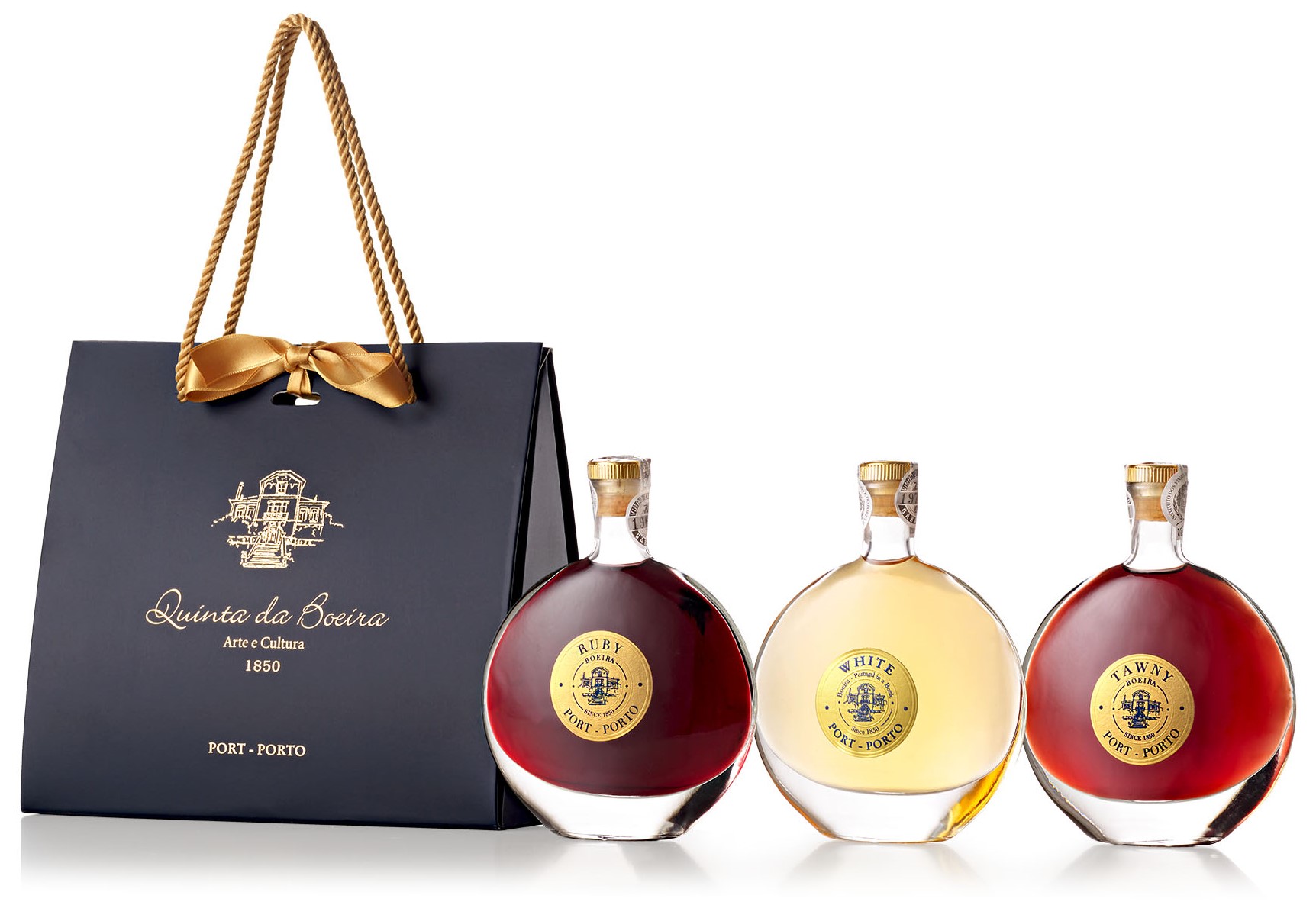
This gift pack consists of 3 different 100ML bottles :
- one bottle of White Port (100ml)
- one bottle of Tawny Port (100ml)
- one bottle of Ruby Port (100ml)
Perfect impulse buy for the holidays or for a birthday gift !
Quinta da Boeira was built by an emigrant named Manuel da Rocha Romariz, who returned from Brazil in the early 19th century. Knowing the Brazilian market, he registered as an exporter of Port Wine in 1850, using two trade names for the labels: ROMARIZ and BOEIRA.
These brands quickly won the consideration and confidence of consumers and distributors due to their quality, expanding to several markets, among which Portuguese, English, French and Brazilian stood out, among others.
In 1966, the property was acquired by an English family, the warehouses by a textile company and the wines were sold to a Port Wine exporting company.
In 1999 the property was put up for sale with the main interest of a contractor who intended to build luxury homes in a closed condominium.
Father João de Freitas Ferreira, director of a school in Vila Nova de Gaia, warned of the situation of the eminent possibility that the 3 hectares of the property could be transformed into massive construction, with the consequent destruction of its centennial grove.
Concerned and sensitized to the cause, Father João de Freitas Ferreira, integrating a group of ten friends, decided to acquire the property, thus protecting the centenary trees and the palace of the early 19th century.
For the acquisition of the property, a financial study was carried out with the division of investments into five phases:
FIRST PHASE
The transformation of stables and greenhouses into a multi-purpose hall with auditorium and the restoration of all paths in the gardens represented the initial phase of the project which, from the beginning, intended to transform Quinta da Boeira into a visiting room in the north of the country and, more specifically , in Vila Nova de Gaia.
SECOND PHASE
The recovery of the mansion, which was in an advanced state of deterioration, began, transforming it into offices and a luxury restaurant with a capacity for about 80 people seated.
THIRD PHASE
In order to attract tourists to the high elevation of the city of Vila Nova de Gaia, the largest bottle in the world was built, measuring 32 meters in length and 10 in diameter, thus allowing the creation of a tasting room and exhibition room to promote Portuguese wines, culture and gastronomy. It was also possible to adapt the room for the transmission of films in 3D, letting tourists know the different wine regions of Portugal.
FOURTH PHASE
With the objective of financially consolidating the entire project, Quinta da Boeira registered at the Instituto dos Vinhos do Douro e do Porto (IVDP) in 2017, thus returning to the genesis of Quinta da Boeira in 1850, as an exporter of Vinhos do Porto, under the BOEIRA brand.
FIFTH PHASE
The project, in its fifth and final phase, concluded with the construction of a 5-star hotel, with 119 rooms and 5 suites, whose construction was based on the green system. The most up-to-date environmental techniques were implemented, such as the use of groundwater to supply sanitary tanks and automatic irrigation of about 3 hectares of the property, with photovoltaic and solar energy also being used, which allowed for remarkable savings and drastic reduction in carbon emissions, transforming it into an ECO hotel.
The most recent challenge was the acquisition of the C. da Silva family home, a name also linked to the export of Port Wines, designed in the 19th century by the architect Teixeira Lopes. Quinta da Boeira is a reference in wines of superior quality, namely in Port Wine, duly certified by the Institute of Douro and Port Wines and proudly marked with the knight seal on the neck, according to the guidelines that the Observatório do Port wine advocates for the defense of the Porto Denomination of Origin.
Each Quinta da Boeira wine is a unique experience, in which Wine and Art are intimately linked, having their maximum exponent in unique bottles and which are distinguished by their shape and aesthetics, such as Diamond or Decanter.
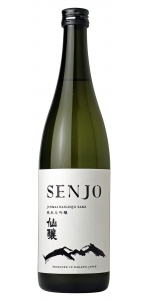
Juicy & Refreshing. Full of fruity flavors with clean sweetness. Brewed with Hitogokochi, the special sake rice harvested in Nagano, and natural water slowly filtered down the Japan Alps. In 1866, toward the end of the Edo period, Matsujirou Kurogouchi and his family started a small sake brewery currently called Senjo named after Senjo Ga Take, a 3000-meter peak in the Japanese Alps. Today Senjo Brewery strives to combine art with science and old skill with new technology by adding modern twits to the rich historical traditions of Sake brewing.
Pair with Deep-fried fish with sweet & sour sauce, Young sweetfish tempura (chiayu tempura), Caesar salad.
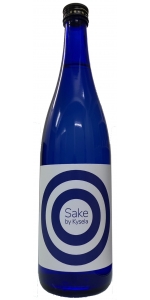
Sake By Kysela has been a project in the making for three years now. In the end, we selected a Sake made from the famous Yamada Nishiki rice produced in the Southern Prefecture of Shimane. Flavorful, rich, and clean; this sake is best as an aperitif or with seafood like fluke, dover sole or halibut. Kanpai!!!
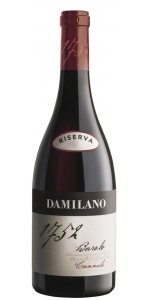
“1752” is the name of the Damilano Barolo Cannubi Riserva, in honor of the year in which the historic bottle was first marked “Cannubi”. It still exists today perfectly conserved by the Manzone family in Bra, close to Barolo. The bottle is clearly marked as being of “1752” vintage, indicating that Cannubi historically precedes Barolo.
About the Vineyard:
The Cannubi Cru is in found within one of the 6 core zones which comprise a UNESCO heritage site in Italy. A mixture of Tortonian and Helvetian calcareous marl gives the grapes intense aromas of cherry, plum and tobacco, rose and violet in sequence. Its low potassium and high calcium/magnesium content offer the wine a fine and polished touch. The vineyard is located at about 270 m. a.s.l. and has a south-east sun exposure. Barolo Riserva Cannubi 1752 It is a small plot of about 2 hectares of Nebbiolo vines, currently between 30 and 50 years of age.
Tasting Notes:
Garnet ruby red in color, the bouquet is intense and balanced, with notes of violet, red fruit, cherry and plum, spices, liquorice, cocoa, leather and tobacco. Dry, robust, full-bodied, very persistent, rich and velvety
Food Pairing:
This wine is excellent with typical piedmontes pasta (tajarin, ravioli); perfect with red meat, braised and roast meat, game and absolutely ideal with all types of cheeses.
Review:
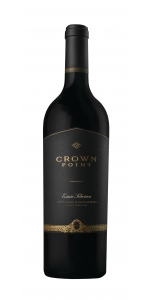
Crown Point Estate Selection is made from 75% Cabernet Sauvignon, 10% Merlot, 6% Petit Verdot, 6% Cabernet Franc, 3% Malbec.
The 2016 Crown Point Estate Selection exhibits a heady aromatic array of baking spices, ripe red and black fruits, with deep intonations of earth and minerals. The palate is elegant and bright, with appealing acids and nuanced notes of savory mocha and dried herbs. Polished and seamless, the tannins finish with a comet-like trail of textural opulence highlighted by glossy flavors of baked berry pie and warm toast. Recommended drinking window: now through 2030s.The 2016 Estate Selection is representative of all five red Bordeaux varieties. The selection process starts in the vineyard and continues on through the winemaking process: only the best lots make the final blend. All blocks were harvested & fermented separately. The individual components were blended after 12 months in barrel. Total time in 225 liter French oak barrels was 26 months.
Review:
Deeply colored, the 2016 Estate Selection checks in as 75% Cabernet Sauvignon, 10% Merlot, 6% Petit Verdot, 6% Cabernet Franc, 3% Malbec that was brought up 26 months in 75% new French oak. Deeply colored, it has a smoking good bouquet of crème de cassis, smoke tobacco, lead pencil, camphor, and hints of chocolate. This gives way to a powerful, opulent Cabernet Sauvignon that has plenty of sweet tannins, a layered, multi-dimensional texture, no hard edges, and an awesome finish. I’d happily put this beauty in a lineup of top Napa Valley Cabernet Sauvignon and blends.
-Wine Enthusiast 97 Points
There’s an impressive amount of complexity on the nose of this bottling by winemaker Adam Henkel, from crushed graphite and concentrated black strawberry to cinnamon pastry, licorice and a brush of herbs. The sip is intense, with leathery but chiseled tannins presenting flavors of charred black currant, licorice, black olive, dried flower and white pepper
-Jeb Dunnuck 97 Points
“1752” is the name of the Damilano Barolo Cannubi Riserva, in honor of the year in which the historic bottle was first marked “Cannubi”. It still exists today perfectly conserved by the Manzone family in Bra, close to Barolo. The bottle is clearly marked as being of “1752” vintage, indicating that Cannubi historically precedes Barolo.
About the Vineyard:
The Cannubi Cru is in found within one of the 6 core zones which comprise a UNESCO heritage site in Italy. A mixture of Tortonian and Helvetian calcareous marl gives the grapes intense aromas of cherry, plum and tobacco, rose and violet in sequence. Its low potassium and high calcium/magnesium content offer the wine a fine and polished touch. The vineyard is located at about 270 m. a.s.l. and has a south-east sun exposure. Barolo Riserva Cannubi 1752 It is a small plot of about 2 hectares of Nebbiolo vines, currently between 30 and 50 years of age.
Tasting Notes:
Garnet ruby red in color, the bouquet is intense and balanced, with notes of violet, red fruit, cherry and plum, spices, liquorice, cocoa, leather and tobacco. Dry, robust, full-bodied, very persistent, rich and velvety
Food Pairing:
This wine is excellent with typical piedmontes pasta (tajarin, ravioli); perfect with red meat, braised and roast meat, game and absolutely ideal with all types of cheeses.
Review:
The purity of this wine is pretty phenomenal with blackberries, strawberries, fresh flowers and licorice. Hints of tar. It’s full-bodied, yet composed and compact with ultra fine tannins and a long, flavorful finish. Very structured. Try after 2024.
-James Suckling 97 Points
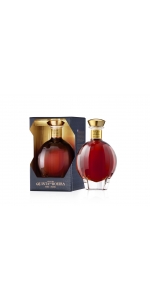
Boeira White Diamond Port is made from Malvasia Fin, Viosinho, Gouveio, and Côdega de Larinho.
Clear amber color, on the nose aromas of citrus, tangerine peel, peaches and honey. In the mouth it is full but elegant, well integrated and persistent finish
Boeira White Diamond Port is the perfect companion for a number of foods including appetizers, lean fish, salads, pasta or desert like apple pie or crème brulée.
Review:
The NV White Diamond Port is the estate's 10-year Tawny based on Málvasia Fina, Viosinho, Gouveio, and Côdega de Larinho. Caramelized orange, toffee, fig, and spicy white chocolate notes all shine on the nose, and this beauty hits the palate with medium to full-bodied richness and a round layered, incredibly seamless mouthfeel. It's all about its seamless, decadent, sweetly fruited, yet balanced style.
-Jeb Dunnuck 94 Points

Simpily checkout with the number of gift cards you would like to purchase.
On the checkout page, in the comment section, enter the recipient (s) Name, Address and email address.
As well, feel free to put a gift note in the comment section.
We will notify the reciept of the gift.
You can also use the contact us page to email your recipient information.
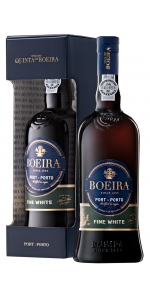
Boeira Fine White Port is Malvasia fina, Viosinho, Gouveio and Codega de Larinho.
Straw yellow color.
Rich and fragrant nose dominated by honey aromas.
In the mouth, fresh palates with perfect acidity and an excellent finish.
Harvest by hand.
Porto wine classical method with skin maceration and short alcoholic fermentation in stainless steel tanks followed by fortification.
As an appetizer served chilled. It goes well with dried fruits and salty snacks.
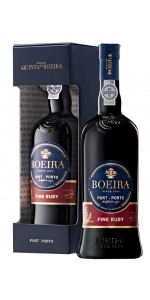
Medium intensity ruby color.
Nose dominated by red fruits.
In the mouth, elegant structure with solid but well integrated tannins. Rich and fruity finish.
RS: 104 g/Liter
TA: 3.8 g/Liter
pH 3.73
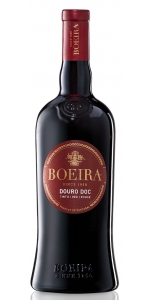
Boeira Douro Red is made from 35% Touriga Nacional, 35% Tinta Roriz and 30% Touriga Franca.
Deep ruby color with purple hints. Aromas of red and black fruits, toasty notes and dark chocolate. Smooth on the palate with good structure and excellent mouthfeel. Fresh, with well integrated tannins bringing elegance and a gastronomic profile to the wine. Very well balanced. Boeira Douro DOC Red from the Douro Valley is the result of a careful blend of different varieties from the Douro. After fermentation the wine was left in contact with its lees until bottling in order to develop complexity and richness.
Pair with pork roast stuffed with prunes and apricots, grilled meats, marinated leg of lamb, chicken curry, pasta with beef or pork ragout, vegetable timbale with roasted tomatoes and grilled almonds. A very “friendly” food wine.
Boeira Douro Red is made from 35% Touriga Nacional, 35% Tinta Roriz and 30% Touriga Franca.
Deep ruby color with purple hints. Aromas of red and black fruits, toasty notes and dark chocolate. Smooth on the palate with good structure and excellent mouthfeel. Fresh, with well integrated tannins bringing elegance and a gastronomic profile to the wine. Very well balanced. Boeira Douro DOC Red from the Douro Valley is the result of a careful blend of different varieties from the Douro. After fermentation the wine was left in contact with its lees until bottling in order to develop complexity and richness.
Pair with pork roast stuffed with prunes and apricots, grilled meats, marinated leg of lamb, chicken curry, pasta with beef or pork ragout, vegetable timbale with roasted tomatoes and grilled almonds. A very “friendly” food wine.
Long Shadows Pirouette Meritage is made from 68% Cabernet Sauvignon 15% Merlot 8% Petit Verdot 6% Cabernet Franc 3% Malbec
Philippe Melka, named one of the top nine winemakers in the world by Robert Parker, used small lots from Washington State's finest vineyards to craft this enticing red blend.
Like the last several growing seasons, 2016 was another hot year that required extra care in the vineyards. Building on the success of our canopy managment program over the last few vintages, we worked with growers throughout the season to encourage growth of the canes and outside foliage to protect against the sun while opening up the fruit zone for even maturation. Warm temperatures in the fall hastened ripening, but the Columbia Valley's cool autumn nights protected the grapes' acidity, yielding bright, vibrant wines that will drink well in their youth but also promise to bring enjoyement to those who cellar.
A variety of fermentation methods were used to enhance complexity and richness in this classic Bordeaux blend. Hand-harvested Cabernet was fermented in 400L French oak barrels that were gently rolled throughout fermentation to integrate the oak with refined, dark fruit flavors and give the wine its silky mouthfeel. All other varieties were fermented in traditional stainless steel tanks, with select lots enjoying longer skin contact to enhance the wine's dark color and mid-palate. The finished wine was aged 22 months in French oak barrels (75% new) before bottling unfiltered and unfined.
Review:
"The 2016 Pirouette is made by Philippe Melka and it's a total blockbuster based on 68% Cabernet Sauvignon, 15% Merlot, and the palate Petit Verdot, Cabernet Franc, and Malbec that was fermented in barrel and aged 22 months in 75% new oak. Crème de cassis, blackberries, toasted spices, cedar, and forest floor notes all emerge from this deep, rich, opulent red that has sweet tannins, a thrilling texture, no hard edges, and a monster finish. This is another best-to-date from this estate and it's an awesome wine." -Jeb Dunnuck 97 Points
Marie Baron Bourgueil Rouge is made from 100 percent Cabernet Franc.
Bourgueil is a renowned red wine appellation in the Loire Valley, situated on the north bank of the Loire River in Touraine. The appellation is known for producing expressive Cabernet Franc wines that range from light and fruity to structured and age-worthy.
This wine displays a beautiful ruby color with aromas of red fruits, violets, and a characteristic hint of green pepper. On the palate, it is medium-bodied with supple tannins, bright acidity, and flavors of raspberry and blackcurrant with a touch of graphite.
Pairs wonderfully with charcuterie, grilled meats, goat cheese, or rillettes.