
" We don't sell the wine without touching the vine "
| Country: | Italy |
| Region: | Tuscany |
| Wineries: | Busi Travignoli |
| Grape Type: | Sangiovese |
| Vintage: | 2011 |
| Bottle Size: | 750 ml |

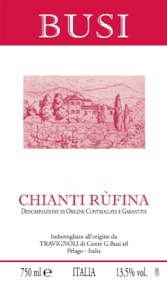
Busi Chianti Rufina (Half Bottle) is made from 100% Sangiovese.
Fresh, fruity, with classic tart cherry.
Appearance: ruby-red in color.
Aroma: clean, floral notes.
Flavor: well structured and harmonic on the palate; easy drinking with a soft and lingering finish. Ageing potential: 10/15 years.
Production area: amidst the hills of Pelago in the Chianti Rufina D.O.C.G. area, with a soil composition of marly, calcareous clay as typically found in the Arno valley east of Florence.
Aspect: south-facing.
Altitude: 200/350 m above sea level.
Cultivation method: spurred cordon.
Harvest period: from the 20th of September until the middle of October.
Vinification: the grapes are fermented in stainless steel tanks at a controlled temperature (26/28°C) for 10 days before racking and malolactic fermentation in stainless steel. After fermentation the wine is put into wooden barrels.
Fermentation in stainless steel at controlled temperatures for 7 to 8 days, with an additional 3 to 4 days on the skins. The wine is then racked and goes through malolactic. It is then racked again and stays another 7 months in stainless steel.
Adapts well to both light and more substantial dishes.

Busi Chianti Rufina is made from 100% 100% Sangiovese
Fresh, fruity, with classic tart cherry.
Appearance: ruby-red in color.
Aroma: clean, floral notes.
Flavor: well structured and harmonic on the palate; easy drinking with a soft and lingering finish. Ageing potential: 10/15 years.
Adapts well to both light and more substantial dishes.
Producer Information: Villa Travignoli Travignoli, a name which literally means “Tra Vignoli” (between the vineyards), is located in the middle of Frescobaldi’s Nipozzano vineyard, in the heart of the Rufina zone. Aged six months in wood and six months in stainless steel. Pairs well with salamis, pastas, grilled or roasted meats, dishes flavored with mushrooms, or rosemary. Excellent with polenta dishes.

Busi Chianti Rufina Riserva is made from 100% Sangiovese
Vineyards: Travignoli, a name which literally means “Tra Vignoli” (between the vineyards) is located in the middle of Frescobaldi’s Nipozzano vineyard in the heart of the Rufina zone. There is documented evidence that wine was first produced there in the 5th C BC by the Etruscans who called it “Nectar of the Gods”. The Church acquired the land and constructed the cellars in 1100.
Count Busi and his family acquired the estate in the 1800’s. Overall, 91
hectares belong to the estate. The 60 hectares of vineyards are excellently
position on the slopes with a southerly exposure at an elevation between 270 to 370 meters. Clay, marl and calcareous soil with a large percentage of rocks and stones for good drainage. Vines are an average of 10–25 years old.
Harvest: October– by hand.
Yield per hectare: 40 Quintals per hectare
Vinification: Fermentation in stainless steel at controlled temperatures for 7 to 8 days with an additional 7 to 8 days on the skins. The wine is then racked and goes through malolactic. It is then racked again and stays another 3 months in stainless steel.
Aging: 25 to 30 hectoliter barrels of Slavonian oak for 18 months and 3 months in Allier barriques. There is a period of refinement of 4 to 5 months in the bottle.
Alcohol: 13% by vol.
Color: Ruby red with garnet reflections.
Bouquet: Intense, ethereal bouquet with hints of leather, tar and ripe cherry fruit.
Taste: The flavor is full of mature fruit with nuances of leather and liquorice. The taste is complex and round and rich with character. The finish is persistent and satisfying.
Foods: Grilled, braised or roasted meats, dishes flavored with mushrooms, or rosemary. Excellent with polenta dishes.
Total Production: 3,300 cases
Enologist: Mauro Orsoni

Busi Vin Santo del Chianti Rufina Riserva is made from 100% Sangiovese.
This is a Riserva level Chianti showing prestige and elegance, being powerful and elegant at the same time.
Color: Ruby red with garnet reflections.
Aromas: Intense, ethereal bouquet with hints of leather, tar and ripe cherry fruit.
Flavors: Full of ripe fruit with nuances of leather and liquorice. The taste is complex and round and rich with character. The finish is persistent and satisfying.
Pair with grilled, braised or roasted meats, dishes flavored with mushrooms, or rosemary. Excellent with polenta dishes.

All older vintage wines have been purchased from a single collectors cellar. Pictures can be requested before shipment.
All older vintage wines have been purchased from a single collectors cellar. Pictures can be requested before shipment.
Busi Chianti Rufina 2011 is made from 100% Sangiovese.
Fresh, fruity, with classic tart cherry. The wine is grown right off the Sieve River on a hillside, which is the site of an old Etruscan Village.
Fermentation in stainless steel at controlled temperatures for 7 to 8 days, with an additional 3 to 4 days on the skins. The wine is then racked and goes through malolactic. It is then racked again and stays another 7 months in stainless steel.
The Busi Estate
The winery was founded in the 1700’s and has been operated by the Busi family since the 1800s. Grapes have been grown on the property since the 1400’s. The property is partially surrounded by the vineyards of Frescobaldi, in the heart of the Rufina zone where wine has been produced since the 15th century.
The farm also produces olive oil within the confines of the group Laudemio, which is olive oil that is extra virgin in quality, vintage date, and less than .02% acid (normal extra virgin is .05% acid).
Giovani Busi is the winemaker with the advice of internationally enologist Giacomo Tachis. The cellars date backt to the 12th century but equipped with the latest technology.
The Busi Vineyard
Total farm size 90 hectares (222.3 acres): 60 hectares of vines (148.2 acres), 25 hectares of olive trees. The vineyard surface is broken down as follow:
A. 50.5 ha Chianti Rufina
B. 8.0 ha Cabernet Sauvignon
C. 1.0 ha Chardonnay
D. 0.5 ha Merlot
Chianti Rufina, the smallest Chianti area, is located northeast of Florence on the sandy calcareous lower slopes of the Apennines. It is said to be "one of Tuscany's most priviliged vineyard areas where Chianti reaches heights of size and longevity rivalled only on privileged parts of Classico".
The Chianti Rufina vineyard is planted on clay, marl and calcareous soil with a large percentage of rocks stones for good drainage. The vines are an average of 10-25 years old.

Deep red with a slight purple hue on release. The wine has a rich mix of dark chocolate infused with coffee bean and black liquorice, then scents of tar, aniseed, raw (pure) soy and black olive on the nose. The palate is expansive, and yet balanced and finessed. An amalgam of dark berried flavors and textural sensations. The 100% new oak is completely absorbed, meshed with ripe tannins, completing a palate of impressive length and youthfulness.
Parcels of fruit for this wine were identified in the vineyard by the winemakers. Daily fruit inspection led to the fruit being harvested at optimum flavor ripeness. The fruit was harvested at night and quickly transported to the winery. The fruit was destemmed to 6T open fermenters for fermentation. A Shiraz specific yeast was selected to ferment the wine and fermentation was carried out at a maximum of 28°C. The fermenter was manually pumped over twice daily in the first half of fermentation to give the winemakers control of color, flavor and tannin extraction. Pump over regimes were adjusted toward the end of fermentation to suit the tannin and flavor extraction of the wine. The cap was completely broken up on each pump over. The wine remained in fermenters for 6-8 days (dependent on parcel) before being pressed, inoculated with malolactic bacteria and filled to American oak (100% new barrels). The wine was racked post malolactic fermentation and returned to the same barrels. The wine was topped every month and after six months racked and returned to the same barrels again. Prior to bottling the parcels were emptied from oak and blended. Minimal fining and filtration was carried out prior to bottling.
Review:
-Jeb Dunnuck 96 Points
-Wine Spectator 94 Points

Opus One 2023 is made from Cabernet Sauvignon.
Opus One was founded in 1979 as a partnership between Baron Philippe de Rothschild of Chateau Mouton Rothschild and Napa Valley pioneer Robert Mondavi, a meeting of two great winemaking cultures with a single ambition: a Bordeaux-style blend to stand among the finest wines in the world. From the heart of the Oakville district, every acre of the estate is farmed with meticulous, parcel-by-parcel attention under winemaking director Michael Silacci, and the fruit is shaped into one flagship wine each vintage.
The 2023 comes from a cool, balanced Napa growing season and is a classic, finesse-driven Opus One, aged in French oak and built for decades in the cellar.
Review:
The 2023 Opus One is a super classic wine. Brisk acids, fine tannins and lifted aromatics signal an Opus One of exquisite finesse and class. Red/purplish fruit, mint, orange peel and chalk are all woven together in a fabric of nearly indescribable class. The 2023 floats on the palate with understated finesse and lightness, but it's not light in any way. This is class personified.
-Antonio Galloni, Vinous 98 Points
The bouquet is utterly enticing, offering cool blue-fruit notes and a dusting of cocoa-powder freshness that stirs anticipation for the first sumptuous sip. On the palate, satiny richness unfolds, imbued with crunchy red cherry and juicy blackberry fruit, alongside refined sagebrush and tobacco nuances. There is a sense of intricately fine-knit tannins – compact yet impressively integrated at this youthful stage – framed by subtle, refined oak spice. The finish is long and mineral, marked by graphite and a touch of black sea salt. The wine was fermented entirely with native yeasts in stainless steel, with a portion aged in amphora in this vintage, before maturing for 19 months in 95% new French oak. The blend is rounded out by small additions of Malbec and Petit Verdot. In 2023, the vines were farmed regeneratively for the first time, with harvest completed by mid-October.
-Decanter 98 Points



