
" We don't sell the wine without touching the vine "
| Country: | Italy |
| Region: | Tuscany |
| Wineries: | Busi Travignoli |
| Grape Type: | Sangiovese |
| Vintage: | 2024 |
| Bottle Size: | 375 ml |

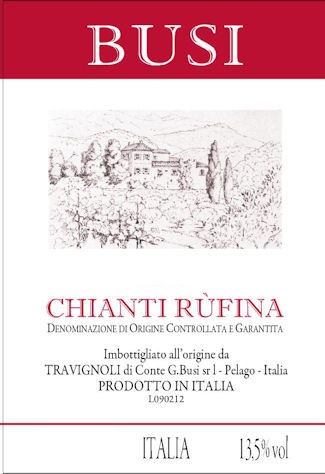
Busi Chianti Rufina is made from 100% 100% Sangiovese
Fresh, fruity, with classic tart cherry.
Appearance: ruby-red in color.
Aroma: clean, floral notes.
Flavor: well structured and harmonic on the palate; easy drinking with a soft and lingering finish. Ageing potential: 10/15 years.
Adapts well to both light and more substantial dishes.
Producer Information: Villa Travignoli Travignoli, a name which literally means “Tra Vignoli” (between the vineyards), is located in the middle of Frescobaldi’s Nipozzano vineyard, in the heart of the Rufina zone. Aged six months in wood and six months in stainless steel. Pairs well with salamis, pastas, grilled or roasted meats, dishes flavored with mushrooms, or rosemary. Excellent with polenta dishes.

Busi Chianti Rufina (Half Bottle) is made from 100% Sangiovese.
Fresh, fruity, with classic tart cherry.
Appearance: ruby-red in color.
Aroma: clean, floral notes.
Flavor: well structured and harmonic on the palate; easy drinking with a soft and lingering finish. Ageing potential: 10/15 years.
Production area: amidst the hills of Pelago in the Chianti Rufina D.O.C.G. area, with a soil composition of marly, calcareous clay as typically found in the Arno valley east of Florence.
Aspect: south-facing.
Altitude: 200/350 m above sea level.
Cultivation method: spurred cordon.
Harvest period: from the 20th of September until the middle of October.
Vinification: the grapes are fermented in stainless steel tanks at a controlled temperature (26/28°C) for 10 days before racking and malolactic fermentation in stainless steel. After fermentation the wine is put into wooden barrels.
Fermentation in stainless steel at controlled temperatures for 7 to 8 days, with an additional 3 to 4 days on the skins. The wine is then racked and goes through malolactic. It is then racked again and stays another 7 months in stainless steel.
Adapts well to both light and more substantial dishes.

Busi Chianti Rufina Riserva is made from 100% Sangiovese
Vineyards: Travignoli, a name which literally means “Tra Vignoli” (between the vineyards) is located in the middle of Frescobaldi’s Nipozzano vineyard in the heart of the Rufina zone. There is documented evidence that wine was first produced there in the 5th C BC by the Etruscans who called it “Nectar of the Gods”. The Church acquired the land and constructed the cellars in 1100.
Count Busi and his family acquired the estate in the 1800’s. Overall, 91
hectares belong to the estate. The 60 hectares of vineyards are excellently
position on the slopes with a southerly exposure at an elevation between 270 to 370 meters. Clay, marl and calcareous soil with a large percentage of rocks and stones for good drainage. Vines are an average of 10–25 years old.
Harvest: October– by hand.
Yield per hectare: 40 Quintals per hectare
Vinification: Fermentation in stainless steel at controlled temperatures for 7 to 8 days with an additional 7 to 8 days on the skins. The wine is then racked and goes through malolactic. It is then racked again and stays another 3 months in stainless steel.
Aging: 25 to 30 hectoliter barrels of Slavonian oak for 18 months and 3 months in Allier barriques. There is a period of refinement of 4 to 5 months in the bottle.
Alcohol: 13% by vol.
Color: Ruby red with garnet reflections.
Bouquet: Intense, ethereal bouquet with hints of leather, tar and ripe cherry fruit.
Taste: The flavor is full of mature fruit with nuances of leather and liquorice. The taste is complex and round and rich with character. The finish is persistent and satisfying.
Foods: Grilled, braised or roasted meats, dishes flavored with mushrooms, or rosemary. Excellent with polenta dishes.
Total Production: 3,300 cases
Enologist: Mauro Orsoni

Busi Vin Santo del Chianti Rufina Riserva is made from 100% Sangiovese.
This is a Riserva level Chianti showing prestige and elegance, being powerful and elegant at the same time.
Color: Ruby red with garnet reflections.
Aromas: Intense, ethereal bouquet with hints of leather, tar and ripe cherry fruit.
Flavors: Full of ripe fruit with nuances of leather and liquorice. The taste is complex and round and rich with character. The finish is persistent and satisfying.
Pair with grilled, braised or roasted meats, dishes flavored with mushrooms, or rosemary. Excellent with polenta dishes.

Ottella Lugana Bianco is a white wine made from 100% Trebbiano di Lugana (same as Verdicchio)
The grapes for this wine come from the estate vineyards in San Benedetto di Lugana - vineyards that are most suitable due to the high content of white clay.
Intense straw yellow color with green tinges. Exotic notes, candied and citrus fruits, fine and elegant minerality. Warm and deep on the nose. Expressive finesse, rich and persistent texture on the palate.
Pairs best with fish-based plates, soup, pasta or rice, white meats.

Ottella Lugana DOC Le Creete is made from 100% Trebbiano di Lugana (same as Verdicchio)
The grapes for this wine come from the estate vineyards in San Benedetto di Lugana.
Golden, warm, intense straw yellow. Exotic notes of pineapple and grapefruit with delicate minerality.
Finesse yet a strong character. Rich and well balanced, firm, mineral wine with a superb pulp.
Pairs best with sea or lake fish to bring out its outstanding features; goes well with white meat and soup, and has quite a surprising affinity with full-flavored and blue cheeses.
Busi Chianti Rufina (Half Bottle) is made from 100% Sangiovese.
Fresh, fruity, with classic tart cherry.
Appearance: ruby-red in color.
Aroma: clean, floral notes.
Flavor: well structured and harmonic on the palate; easy drinking with a soft and lingering finish. Ageing potential: 10/15 years.
Production area: amidst the hills of Pelago in the Chianti Rufina D.O.C.G. area, with a soil composition of marly, calcareous clay as typically found in the Arno valley east of Florence.
Aspect: south-facing.
Altitude: 200/350 m above sea level.
Cultivation method: spurred cordon.
Harvest period: from the 20th of September until the middle of October.
Vinification: the grapes are fermented in stainless steel tanks at a controlled temperature (26/28°C) for 10 days before racking and malolactic fermentation in stainless steel. After fermentation the wine is put into wooden barrels.
Fermentation in stainless steel at controlled temperatures for 7 to 8 days, with an additional 3 to 4 days on the skins. The wine is then racked and goes through malolactic. It is then racked again and stays another 7 months in stainless steel.
Adapts well to both light and more substantial dishes.
The Busi Estate
The winery was founded in the 1700’s and has been operated by the Busi family since the 1800s. Grapes have been grown on the property since the 1400’s. The property is partially surrounded by the vineyards of Frescobaldi, in the heart of the Rufina zone where wine has been produced since the 15th century.
The farm also produces olive oil within the confines of the group Laudemio, which is olive oil that is extra virgin in quality, vintage date, and less than .02% acid (normal extra virgin is .05% acid).
Giovani Busi is the winemaker with the advice of internationally enologist Giacomo Tachis. The cellars date backt to the 12th century but equipped with the latest technology.
The Busi Vineyard
Total farm size 90 hectares (222.3 acres): 60 hectares of vines (148.2 acres), 25 hectares of olive trees. The vineyard surface is broken down as follow:
A. 50.5 ha Chianti Rufina
B. 8.0 ha Cabernet Sauvignon
C. 1.0 ha Chardonnay
D. 0.5 ha Merlot
Chianti Rufina, the smallest Chianti area, is located northeast of Florence on the sandy calcareous lower slopes of the Apennines. It is said to be "one of Tuscany's most priviliged vineyard areas where Chianti reaches heights of size and longevity rivalled only on privileged parts of Classico".
The Chianti Rufina vineyard is planted on clay, marl and calcareous soil with a large percentage of rocks stones for good drainage. The vines are an average of 10-25 years old.

Saint Pierre Saint Julien is made from 79% Cabernet Sauvignon and 21% Merlot.
Chateau Saint-Pierre Saint-Julien 4th Grand Cru Classé boasts a rich and brilliant purple color, a complex aromatic expression marked by beautiful ripe fruits combined with soft spices, chocolate and licorice nuances. Well-balanced and a good texture, the palate is round and subtle, supported by velvety tannins that enhance the elegant and pure character of this Saint Julien.
Review:
"Very pretty and typical for the appellation with aromas of blackcurrants, violets and sandalwood that follow through to a full body with layers of polished tannins and a long, flavorful finish. Lasts a long time on the palate. Classic structure. Drink after 2027."
- James Suckling (January 2022), 96 pts

Domaine La Maionnette Rose Cotes de Provence is made from 60% Syrah, 20% Cinsault and 20% Grenache.
The plots of Domaine de la Maïonnette benefit from a clay-limestone soil and are located on a plateau surrounded by hundred-year-old oaks. Bordered by the Provencal scrubland, the vineyard enjoys a dry climate typical of the region.
An emblematic cuvée of the estate, this Cotes de Provence rosé reveals concentrated aromas of citrus fruits and white flowers, and a beautiful structure. The fresh palate brings out sweet candy notes, gooseberry and litchi, and delivers bright acidity and ample length on the finish.



