
" We don't sell the wine without touching the vine "
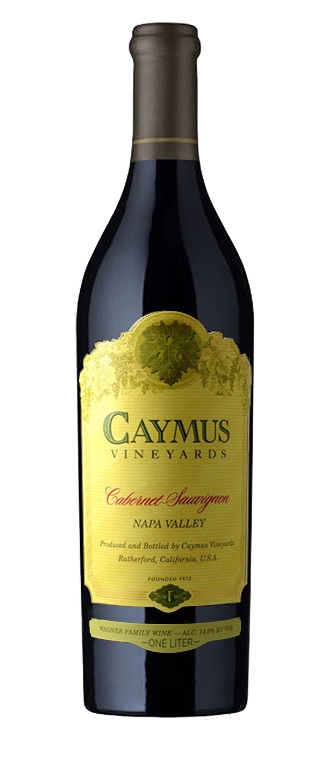
| Country: | United States |
| Regions: | California California (Napa) |
| Winery: | Caymus |
| Grape Type: | Cabernet Sauvignon |
| Organic: | Yes |
| Vintage: | 2020 |
| Bottle Size: | 1000 ml |

Caymus has a signature style that is dark in color, with rich fruit and ripe, velvety tannins – as approachable in youth as in maturity. We farm Cabernet grapes in eight of Napa’s 16 sub-appellations, with diversification enabling us to make the best possible wine in a given year. This Cabernet offers layered, lush aromas and flavors, including cocoa, cassis and ripe dark berries.

While the wine has sufficient tannins and structure for long-term bottle aging, Caymus Cabernet is dark and concentrated, with ripe, luxurious, fruit-driven softness that shows from the day of release.

Mark your calendars for June! Caymus 50th Anniversary Napa Valley Cabernet Sauvignon 2022 is a testament to fifty years of exceptional winemaking by the dedicated, passionate, and family-owned Caymus Vineyards. Since 1972, they have remained a beacon of excellence in Napa Valley, staying true to their roots and producing unparalleled Cabernet Sauvignon. This limited edition wine is a celebration of their rich history, tradition, and relentless pursuit of quality across generations.

The Grade Cabernet Sauvignon Serpent's Back Napa Valley is made from 100 percent Cabernet Sauvignon.
Review:
The 2019 Cabernet Sauvignon Serpent's Back shows a more aromatic, high-toned side of this site. Bright red/purplish berry fruit, pomegranate, cinnamon and sweet floral accents are all laced together. The Serpent's Back is the most refined of these three Cabernets, but it has plenty of Calistoga punch.
-- Antonio Galloni 95 Points
The Grade Cabernet Sauvignon Serpent's Back Napa Valley is made from 100 percent Cabernet Sauvignon.
Review:
The 2019 Cabernet Sauvignon Serpent's Back shows a more aromatic, high-toned side of this site. Bright red/purplish berry fruit, pomegranate, cinnamon and sweet floral accents are all laced together. The Serpent's Back is the most refined of these three Cabernets, but it has plenty of Calistoga punch.
-- Antonio Galloni 95 Points

The Grade Napa Cabernet Sauvignon Winfield Vineyard is made from Napa Valley Cabernet Sauvignon.
“2016 produced wines that are very giving, round, coating and streamlined. Year after this year, this bottling aims to highlight the best attributes of the Winfield Vineyard, and also creates a wine that possesses qualities that allow it to age well in the cellar and evolve over many years.
“This wine expresses a focused balancing act of dark, rich black fruit, and a fine tannin structure, illuminated through the core with a laser-like acidity. The wine displays a deep purple-red hue with a cranberry halo. Aromas of cassis, cinnamon, citrus oil, roasted meat, and lilac swell from the glass.
“The palate is marked by a wave of jet-black brambly fruit up front, followed by an exotic spice mid-palate and a long, complex finish that lasts and lasts expressing notes of flowering jasmine, and oolong tea. The silky tannins hold everything together and will certainly allow this wine to evolve in the cellar for at least 7-10 years.” - Thomas River Brown
Review:
Coming from the Winfield Vineyard in Calistoga, the 2016 Cabernet Sauvignon is another brilliant wine from the hands of winemaker Thomas Rivers Brown. This deep purple-colored effort boasts tons of blueberry and jammy blackberry fruits as well a medium to full-bodied, concentrated, yet elegant style on the palate. It has the purity of fruit that’s the hallmark of the vintage, ripe, sweet tannins, and no hard edges, and is already hard to resist.
-Jeb Dunnuck 94 Points
Caymus has a signature style that is dark in color, with rich fruit and ripe, velvety tannins – as approachable in youth as in maturity. We farm Cabernet grapes in eight of Napa’s 16 sub-appellations, with diversification enabling us to make the best possible wine in a given year. This Cabernet offers layered, lush aromas and flavors, including cocoa, cassis and ripe dark berries.
In 1971 Charles F. (Charlie) Wagner and his wife Lorna Belle Glos Wagner asked their son Charles J. (Chuck) Wagner, who had just graduated from high school, if he would be interested in joining them in starting up a winery. If Chuck declined the offer, Charlie and Lorna were planning to sell out of their ranch in Napa Valley and move to Australia. Chuck accepted his parents’ offer to launch the winery, Caymus Vineyards.
The Wagners produced their first vintage in 1972, consisting of 240 cases of Cabernet Sauvignon. Since then, Caymus has focused their efforts in the production of quality Cabernet Sauvignon. Today’s production is 65,000 cases.
Caymus Vineyards remains 100% family-owned by the Wagners. Charlie, Lorna Belle, and Chuck worked together as a remarkable team for over 30 years building Caymus Cabernet. Today, Chuck, his two sons, Charlie and Joe, and one daughter, Jenny, have joined the family team. Farming grapes remain the priority with the family farming about 350 acres of choice Napa Valley land.
The Wagners took the name Caymus from the Mexican land grant known as Rancho Caymus, given to George Yount in 1836, which encompassed what eventually became the town of Rutherford and much of the surrounding area.

Avennia Sestina Red Blend is made from 77% Cabernet Sauvignon, 17% Merlot, 6% Cabernet Franc.
The Sestina is a poetic form from Medieval France. Just as a contemporary poet can use an old form like the Sestina to express modern ideas, we use the traditional Bordeaux blend to make modern wines that express Washington fruit. Sestina is our vision for an old vine blend where the focus is on structure, balance, and complexity. This wine is designed for the cellar, but is enjoyable now.
Sestina: This wine is a blockbuster, with black currant, black raspberry, saddle leather, freshly tilled earth, vanilla, and violet on the nose. Exceedingly rich and balanced on the palate, with great poise and structure for long aging. The finish echoes with fresh black fruits, minerally touches, and floral notes.
Review:
The 2020 Sestina showed beautifully, with lots of ripe black fruits, tobacco, and spring flower notes in a medium to full-bodied, fresh, focused, elegant style. It has fine tannins and a great finish and should drink nicely right out of the gate. The tannins here are terrific.
Jeb Dunnuck 94-96 Points

Tamarack Ciel de Cheval Vineyard Reserve holds dark and chocolate nauces, spiced with pretty notes of allspice and clove, this wine is round and rich, bursting with ripe berries, combined with an earthy complexity and a velvety finish.
Cabernet Sauvignon makes up half of this blend, with the balance Cabernet Franc, Petit Verdot and Merlot
The wine spent 22 months on 75% new French oak with the remaining 25% second vintage French oak. Select barrels from the best forests of Taransaud, Boutes, Quintessance, and Vicard cooperages.

Neyers Cabernet Sauvignon Neyers Ranch is made from 100 percent Cabernet Sauvignon.
"We harvested the 2017 Cabernet Sauvignon crop from our Conn Valley Ranch in the first week of October, a week later than we picked the same vineyard the prior year. The size of the crop was about 20% smaller in 2017 as well, mostly due to the cold, wet weather we experienced in spring during flowering. Grapevines are self-pollinating, and cold, windy or damp weather interferes with this process, a problem known the French call coulure. Ironically, the harsh spring weather of 2017 had a huge impact on the size of our crop. Still, this smaller crop ripened fully and evenly, and at harvest time we picked beautiful, dark-colored clusters under near-perfect conditions. The finished wine was immediately remarkable for its flavor and complexity, and the wine looks to be one that will improve for many years. During my career in the Napa Valley wine business, I’ve learned to expect the best wines from cold years like 2017. These are vintages that are viewed initially with lowered expectations, but my experience has been just the opposite. Going back to my first Napa Valley harvest in 1971, these ‘colder years’ invariably result in wines with brighter, more attractive flavors, and the wines age longer and more gracefully.
Following harvest, the wine was fermented using wild, native yeast in an temperature-controlled stainless steel tank. After 45 days or so, the tank was drained and the pomace pressed, and the wine transferred to 60-gallon French oak barrels, 25% of them new. During the first year, we racked the wine off of the yeast lees three times, and by May 2019 it had been sufficiently clarified to bottle without fining or filtration. I am especially impressed by its bright ruby hue, a color so commanding it reminded me of the 1995 red Bordeaux wines I tasted from barrel during my trip to France in the Spring of 1996. It’s loaded with flavors that range from wild cherry to chocolate, enhanced by the lovely hint of tobacco leaf and mint. Each aromatic component has its own individual fascination, but all of them together provide a remarkable experience. Here’s a complete Napa Valley Cabernet Sauvignon that we expect it to improve for 20 years. It's a from a very small crop that will provide decades of pleasure." - Bruce Neyers
Review:
Attractive aromas of blueberries and lavender follow through to a medium body, firm and silky tannins and a slightly chewy finish. Needs a couple of years to soften. Better after 2022.
-James Suckling 93 Points

Charles Krug Peter Mondavi Family Vintage Selection Cabernet Sauvignon is made from 100 percent Cabernet Sauvignon.
Review:
The 2016 Cabernet Sauvignon Vintage Selection has a deep garnet-purple color and features exuberant notes of crushed black cherries, mulberries and blackcurrant cordial with touches of unsmoked cigars, menthol, yeast extract and pencil shavings. Full-bodied, concentrated and opulent in the mouth, it has a solid line of plush tannins and plenty of backbone freshness to lift the generous fruit to a long fruity finish.
-Wine Advocate 95 Points
The Grade Cabernet Sauvignon Serpent's Back Napa Valley is made from 100 percent Cabernet Sauvignon.
Review:
The 2019 Cabernet Sauvignon Serpent's Back shows a more aromatic, high-toned side of this site. Bright red/purplish berry fruit, pomegranate, cinnamon and sweet floral accents are all laced together. The Serpent's Back is the most refined of these three Cabernets, but it has plenty of Calistoga punch.
-- Antonio Galloni 95 Points

G.D. Vajra Barolo Coste di Rose is made from 100 percent Nebbiolo.
The Coste di Rose is a very seductive wine right out of the gate. Cherries and roses burst on the nose, with hints of amarena, red hard candy, wild berries, wet stone, mint and thyme. The palate is radiant and expressive, with all of the signature elements of Coste di Rose in nice evi-dence: the ethereal character, the saline, up-front tannic structure, and further whiffles of roses and cherries in the finish.
Review:
This wine shows a darker and more savory profile than Vajra’s Costa di Rose, its black-cherry flavors tinged with notes of licorice and tobacco. Scents of lavender and violet lend a delicate touch to the wine, which continued to gain verve and freshness with time in the glass.
-Wine & Spirits 96 Points

All older vintage wines have been purchased from a single collectors cellar. Pictures can be requested before shipment.

Obsidian Vineyard Syrah is bathed in terroir. The vines experience severe stress, pushing the roots ever deeper through rock in search of water, producing miniature clusters of intense power. Given the wine’s natural propensity for tannin, we take extreme care in the cellar to chisel/whittle its rough edges and leave room for richness to flatter its distinctive scaffold. The mid-palate supports flavors of roasted coffee beans, sarsaparilla, and dark chocolate. The finish marches on long after most wines have tired.
Our estate vineyard — the six-acre Obsidian Vineyard in the Knights Valley AVA — has an incredibly complex soil structure. It takes its name from a layer of volcanic obsidian rock that was discovered when we drilled for water.
Chocolate ganache, black currants, fig, graphite, and an expansive mouthfeel.
Review:
"Joe Donelan believes his Obsidian Vineyard is one of the world’s greatest sites for Syrah. I’ve visited the site twice, and can say candidly it certainly sits among the most striking vineyards I've ever laid eyes on within the U.S. It sits like a rock on a promontory—two switchbacks to reach the top—and the stones under the top soil, quite literally, never stop emerging from the ground. The place has an ancient, almost sacred, temple-like feel. It is consistently swept by afternoon breezes. The vineyard was replanted in 2017 after fires ravaged it. Winemaker David Milner laid out the site at denser spacing than before, at 2,000 vines per acre to keep yields per vine low while still achieving sensible tonnage, averaging around three tonnes per acre. Viognier was planted for co-fermentations, alongside some Cabernet Sauvignon, for a single vineyard bottling of that grape. ‘God put on his viticultural hat when he designed this site,’ says Milner. The vineyard is planted with ENTA 174, 877, and Alban 1 clones, along with Donelan Heritage selections certified virus-free. The wine, the 2023 vintage release (the first from the new vines), was aged for 21 months in 36% new oak and co-fermented with 1.8% Viognier, using 32% whole clusters. And it is positively gorgeous: composed of nine different blocks, each fermented separately, then assembled through sequential blending, with no racking until bottling. From just five-year-old vines, this wine is utterly extraordinary—something oddly achievable from young vines on rare occasion. I tasted this wine from the same bottle over three days. While the high-toned espresso-bean and cedar accents are present at first pull of the cork, they mellow out a day later, and the fruit profile is so vibrant. This is the sign of an excellent wine. I first tasted wines from the Donelan’s Obsidian Vineyard years ago at Tasting Panel Magazine in the late, great Anthony Dias Blue’s office. Cushing Donelan showed the wines, and to this day, I recall the first moment I put my nose into a glass of Obsidian Syrah. In early January of 2026, as I nosed this brand new release of Obsidian Syrah, I was transported straight back to that tasting twelve years ago. What’s remarkable is that the aromatics are unmistakably the same, yet from these new, more densely planted vines, the aromas are more refined—precision-farmed wines from young vines delivering a level of detail and poise that feels beyond their years. So what’s in the glass? Pure red, black, and blue fruit nuances layered with tobacco, white truffle character, violet pastille, and an intoxicating perfume. White pepper notes emerge on the medium- to full-bodied palate, framed by velvety tannins. Iron-like and crushed slate minerality underpins dazzling black cherry and blackberry fruit, brown spices, and blood orange richness. There’s a velvety, iron-fist quality here that exudes polish, complexity, and undeniable quality. You want to drink it now—and you absolutely can—but it will also reward time in the cellar. Either way, you’ll be utterly wowed. And when you realise the price is under £100, the achievement becomes even more staggering. As these vines mature, what will become of them in subsequent vintages? I suspect that as the vines mature, they'll go in and out of phases, but so long as Mother Nature cooperates, I expect this wine to continue to dazzle each vintage. - Jonathan CRISTALDI"
Decanter (January 5th 2026), 100 points
This is the first vintage of the Obsidian Syrah after wildfires torched the vineyard in 2017, leading to significant redevelopment. Throughout all those years, the Donelans have exhibited remarkable patience and a clear sense of purpose. This is their reward: a truly magnificent, towering wine of the highest level.
Knights Valley is one of the most magical grape-growing districts in the United States, but it is not very well known because only a few estate wineries are located there.
The 2023 Syria Obsidian Estate is one of the most profound, moving wines I have tasted in Sonoma County. Blackberry, gravel, incense, chocolate, lavender, and dried herbs race out of the glass. Delicate yet powerful, the 2023 is spectacular. It is also very fairly priced in today’s market.
Vinous 100 Points



