
" We don't sell the wine without touching the vine "
| BUY MORE! SAVE MORE! | ||||||||||||||||||||
|
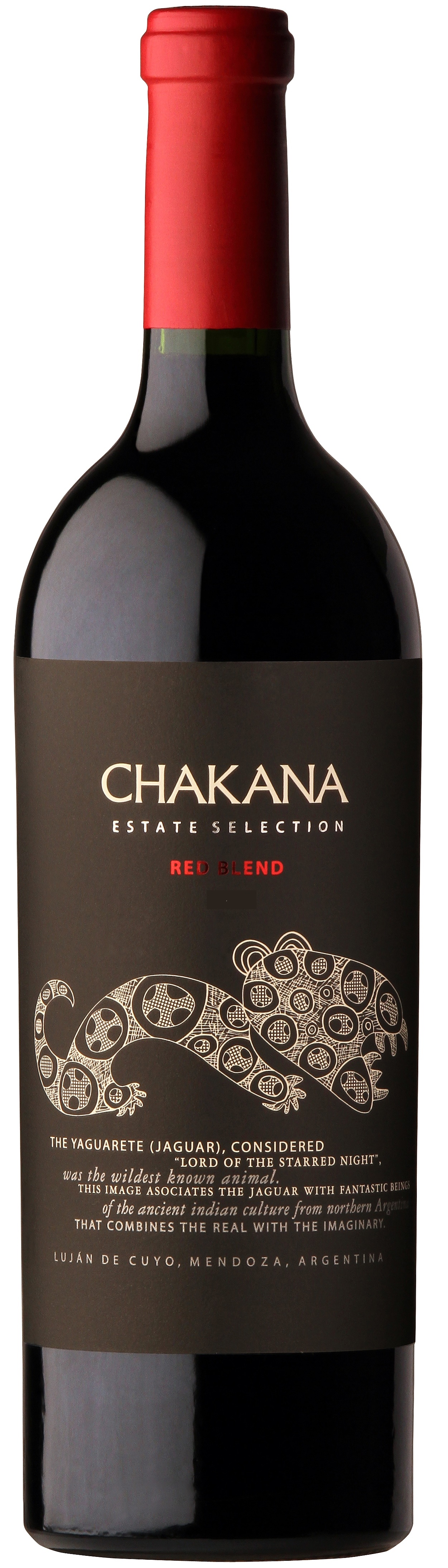
Chakana Estate Red Mendoza is made from 70% Malbec, 25% Cabernet Sauvignon, 5% Cabernet Franc
Deep red color with violet hints. Dark fruits and exotic spices with tobacco and mocha hints. Elegant, well balanced, harmonious, long persistence with chocolate flavors.
Vineyard: Gualtallary in Valle de Uco.
2 days maceration on skins in temperature controlled steel vats; 12 days fermentation with selected yeasts allowed to rise to a maximum of 28°C.
Review:
"Notes of fresh blackcurrants and dark cherries with subtle hints of nutshells, cocoa and spice box. Rich and flavorful on the palate with a medium to full body and ripe, glossy tannins. Succulent, lightly spicy finish. Malbec, cabernet sauvignon and cabernet franc. Vegan. Drink or hold."
- James Suckling (February 2024), 91 pts
The Chakana Estate
Looking for Chakana's other labels?
Click below:
Malbec, Bonarda Argentina, Cabernet Sauvignon
Elegant and mature wines with 12 months of oak aging, produced
only with grapes grown in our own estates.
Ayni is our icon wine. It is the result of our permanent quest
for the best Malbec terroirs that Mendoza can offer. This wine
comes from the gravely limestone soils of Altamira: powerful
but fresh and lively, this 100% Malbec has been aged in
French oak barrels for 18 months. It is presented in 6-bottle
wooden cases.
Chakana Estate Selection is a line of wines which represent the
best terroirs of each of our estates. Aged in French oak barrels
for 12 months these wines give pre-eminence to the expression
of terroir rather than oak. In every wine we try to craft a drinkable
and seductive style through the careful management of our
soils and grapes and in accordance with our consumers’ taste.
Chakana winery was founded by Juan Pelizzatti on May 2nd, 2002. Juan was driven to enter the wine industry first and foremost by his passion for wine, and also by the desire to invest his time and money on a product of agriculture. Although Juan did not know it at the time, the company was founded on the same day the Chakana was celebrated on the Andes highlands: on that same day, the Southern Cross (the Chakana for the Inca people) becomes vertical in the night Andean sky.
Juan's mission is to create an integral experience to introduce world consumers to the taste and culture of the Andes. His vision is to become one of the top 20 exporters of wine from Argentina, by consistently offering outstanding value for money.
"An incredible discovery for me, this winery was founded a decade ago and named after the Southern Cross ("Chakana" is the local Indian dialect for that constellation). It is located approximately 20 miles south of Mendoza in Agrelo. All three of these wines are highly recommended, and all are fabulous bargains in Malbec." - Robert Parker's Wine Advocate (June 2012)
Wine is currently produced in four different levels at Chakana, by winemaker Gabriel Bloise:
Entry Level: Maipe
Reserve Level: Maipe Reserve, Cueva de las Manos, Nuna
Estate Selection
Ayni
The Chakana Estate Vineyards
Our grapes are grown in our own estates located in diverse premium micro-regions of Mendoza.
Each of them contributes its character to the final blend of our top quality wines.
Our wines are made in a state-of-the-art 2 million liter facility located in our Agrelo estate.
The Three Chakana Vineyard Areas:
FINCA AGRELO
LOCATION: AGRELO, Lujan de Cuyo, Mendoza
Description: 120 ha. planted with different varieties between 2002 and 2010. Mainly Malbec,
Bonarda, Cabernet Franc, Viognier and Syrah.
Altitude: 960 meters above sea level.
TERROIR: Varied. Deep clay to loam. Gravel in some areas. Dry and cool climate with important
amplitude in temperature.
Wine Profile: Medium-bodied, elegant, fruity.
FINCA TERRADA
LOCATION: MAYOR DRUMMOND, Lujan de Cuyo, Mendoza.
Description: 21 ha. 100 year old Malbec.
Altitude: 919 metres above sea level.
TERROIR: Loam and clay with 70 cm deep gravel. Some limestone. Urban
influenced climate, relatively warm.
WINE PROFILE: Complex, ripe fruit.
FINCAS ALTAMIRA
LOCATION: ALTAMIRA, Valle de Uco, Mendoza
Altamira I |16 ha. Malbec. Altitude: 1,068 meters above sea level.
Altamira II |26 ha. Malbec, Pinot Noir, Chardonnay, planted in 2006. Altitude: 1,097 meters above sea
level.
TERROIR: Sandy-loam with gravel at 50 cm depth. Dominated by limestone. Temperate climate.
WINE PROFILE: Full-bodied and mineral.
They also source wines from contract suppliers in Ugarteche and Medrano, for entry level wines, and in Vista Flores, for Estate Selection & Ayni levels.
The Wine Making Team:
WINEMAKING CONSULTANT: ALBERTO ANTONINI. Alberto is an Italian winemaker with a pioneering role in
the discovery and development of high quality Malbec. Alberto has brought to us his profound knowledge of
the wine industry, his uncompromising commitment to authenticity and the belief that Argentina will become
one of the leading winegrowing regions of the world.
VITICULTURE CONSULTANT: ALAN YORK. Alan is one of the world’s leading consultants on biodynamic
viticulture. He is also a permanent source of inspiration and insight into the relationship between man, spirit
and nature.
WINEMAKER: GABRIEL BLOISE. Gabriel is one of the stars of the younger generation of Mendoza’s winemakers.
30 years old, he has already made 15 vintages in top estates in some of the most important winegrowing
areas in the world: Tuscany, Priorat, Australia, California, North Carolina, Salta and Mendoza. He is a tireless
explorer of the relationship between nature and its effect on the aromas in wine.
TERROIR CONSULTANT: PEDRO PARRA. Pedro's expertise helps us to understand how to identify and
manage the soil in each plot of our vineyards. His palate is fine-tuned to understanding the impact of soil
structure on the taste of wine. This has made him one of the 50 most influential people in wine according to
Decanter Magazine.

Ayni Malbec Paraje Altamira is made from 100 percent Malbec.
Ayni is the Quechua term for the principle of reciprocity, practiced for centuries by the Andean people - "in order to receive, you first have to give." Chakana's renowned Paraje Altamira vineyard, which sits 3,300 feet above sea level, bears the name Ayni & is the source of the Ayni wines.
Deep ruby-red in color with violet hints. Complex and intense bouquet, featuring blackberries, cherries and plums, with delicate floral notes and spices. Balanced and fresh; full-bodied with good length of spices.
Pairs well with grilled meats and stews.
Review:
"Chakana is an organic and biodynamic producer in Mendoza, that harvests from a vineyard in Paraje Altamira to produce this terroir-focused, minimal intervention Malbec. Aged in a mixture of casks and barrels for 12 months, this is a pure, energetic red in which fresh red fruit aromas combine with spice, herbs and mineral notes. In the mouth, it’s fluid with lively acidity and firm, chalky tannins. A potent, long-lasting wine. Drinking Window: 2023 - 2030"
- Decanter Magazine, 94 pts

Cueva de las Manos Malbec Organic is made from 100 percent Malbec.
Cueva de las Manos translates to "Cave of Hands". There are a series of caves in Patagonia containing stenciled paintings of hands, dating back over 9,000 years ago. The caves have been named a World Heritage Site, and they are the inspiration for the label on these wines.
Cueva de las Manos Malbec is deep purple in color. Fruity intensity on the nose with floral notes. A juicy texture, mild tannins and good structure balanced by a well-integrated freshness. Clean and pure finish.

This chardonnay has a characteristic pale yellow color with a shade of gold and subtle nose that will remind you the fresh butter nuts and roasted almonds. On the palate, it is full bodied and fruity with a pleasant roundness.
Average age of the vines is 25 years old.
We produce a part of this cuvee with 12 hours skin maceration and another part from directly pressed grapes.
Wine was slightly filtered before bottling to insure the wine remains stable.
Best friend as an aperitive or with freshwater fish, shellfish and goat cheeses.

I feel this wine expresses the greatness of California and its hidden pockets where Cabernet can excel. The cold Pacific Ocean running the entire length of the state presents maritime influences – and with each small distance eastward the climate warms. Stony soils, south facing slopes and moderately warm conditions are the keys to producing dark, rich and good tasting Cabernet.
A small release from Caymus Vineyards, this wine is a California-appellation Cabernet Sauvignon – supple, dark and rich, bearing the signature hallmarks of Caymus. It is sourced from sites throughout the state which feature climatic conditions, soils and topography that are ideally suited to Cabernet. This project stems from excitement over California's diverse vineyard land, often in lesser-known areas, with the potential to produce exceptional Cabernet.

Salvadori Chianti Riserva DOCG 2017 is made from Sangiovese 90% , Merlot 10

James Goddard was an ancestor of the Clarke family. Born in West Sussex, England in 1823, James spent his 74 years as a sailor, a whaler, a bullock driver, farmer, prospector, miner and hotel keeper. From an illiterate runaway living rough on the streets of London, he became a rich, successful and admired pillar of South Australian society.
James arrived in Adelaide in 1839 as a 16-year-old sailor. Twelve years later, his life changed forever with the news of gold findings. For the next 20 years, James roamed the country learning the geology that improved his chances of prospecting.
James Goddard Shiraz is made from 100 percent Shiraz.
In 1870, he tried his luck near his farm in the Barossa Valley and discovered the region’s first gold deposits, creating the prosperous Lady Alice Mine. The Lady Alice Mine, though it is no longer operational, was & still is the most successful gold mine in South Australia. From these roots, the Thorn-Clarke family has been connected to the region for the last 150 years.
James Goddard Shiraz is a blend Shiraz sourced from the Milton Park vineyard in the north of Eden Valley, and the St Kitts vineyard in the far northern area of the Barossa. Fruit is harvested in the cool of the night to maintain maximum flavour and freshness and it is fermented for 8 days. The ferment is pumped over twice daily to extract the colour and flavour from the fruit. Once finished fermentation the wine was then matured in a blend of French and American oak for a period of 10 to 12 months depending on the vintage.
Deep vibrant red with purple hues to the rim. The nose shows lifted plums, vibrant purple berries and a delicate spice note. The palate has concentrated satsuma plum, blackberry with lovely charry oak in the background. Long, juicy and even with plush fruit on the finish.
Review:
“Blended from two estate vineyards, St. Kitts and Milton Park, this shiraz offers its richness without any aggression or overt perfume. It’s just lush and delicious, a friendly embrace of firm tannins and purple-red fruit. The texture and flavor combine in a saturated meatiness, for Korean barbecue.”
- Wine & Spirits Magazine, 92 points

Chakana Estate Malbec is made from 100 percent Malbec.
hakana is the name of the Southern Cross constellation. Its rotation in the sky throughout the year made it an effective agricultural calendar for the ancient Andean people.
The "yaguarete" (jaguar) on the label was known by the ancient Andean people as the "lord of the starred night"; the wildest known animal.
Chakana Estate Malbec is from Chakana's Altamira (3,200 ft elevation) and Gualtallary (5,500 ft elevation) vineyards.
The color is deep purple, very intense, typical of Malbec. Plum, brambly berries, spices and an iris/violet note are apparent on the nose. Intense, fruity flavors with velvety tannins.

Calcareous gravels deposited by the Tunuyan river in the South of Valle de Uco and by the Las Tunas river in the North of Valle de Uco have created the two most promising growing areas of Mendoza, which are only now being developed and explored, bringing a new dimension to the wines of Argentina.
Aromas of black fruit and spices blended with mineral, graphite notes and freshness typical of calcareous soils. The palate demonstrates the power of Gualtallary combined with the structure of Cabernet Sauvignon. A fine finessed texture, which is tight and refreshing.
Vineyard: This wine is a blend of Cabernet Sauvignon from the two outstanding subregions of Valle de Uco - the power and structure of Gualtallary with the elegance and freshness of Paraje Altamira. 20-year old vines.
Soil: Sandy with calcium carbonate-coated fine gravel up to 45 cm deep
Vinification techniques are performed in the most gentle way, avoiding the use of enzymes and must amendments. Fermentation is performed with native yeast only.
Superb with grilled red meat and grilled vegetable (Argentinean Asado).

Bright fruit on the nose boasts notes of black cherry, black plum, violets, rose, orange, cocoa nibs, tobacco, mushroom and forest floor. On the palate, complex layers of fruit slowly melt into a bold, structured wine that impresses from start to finish. Velvety tannins interact gracefully with the wine’s fruit and acidity, all coming together to create a delightful wine and a beautiful expression of Willamette Valley Pinot Noir.
Review:
The 2021 King Estate ‘Domaine’ Pinot Noir was stored in 26% new French oak before bottling and represents the top one percent of Estate Pinot Noir barrels. Red currants combine with freshly tilled soils, Black cherry and shades of dried herbs. The palate is soft and refined with silky tannins that frame a core of red and dark fruit flavors. Finishing long, with good viscosity, this is already sgiwubg beautifully right now.
Owen Bargreen 94 Points

Solomon Hills Estate Pinot Noir is made from 100 percent Pinot Noir.
Solomon Hills Pinot Noir is always distinctive and singular in its ability to harness the Coastal influence of Santa Maria Valley. Earth tones alongside briar bush and blueberries contrast aromas of forest floor and fired red clay. The noticeable savory elements of cracked black pepper and teriyaki beef nicely balance ripe cherries and blackberries on the palate.
Review:
I loved the bouquet of the 2021 Pinot Noir Solomon Hills, a light ruby-hued effort with perfumed darker cherry, mulberry, leafy herb, and smoked earth nuances. It's medium-bodied, has a layered, seamless texture, integrated tannins, and a gorgeous finish. It's absolutely brilliant. Enjoy bottles over the coming decade or more.
-Jeb Dunnuck 96 Points

Continuum Red Blend 2021 is made from 45% Cabernet Sauvignon, 35% Cabernet Franc, 11% Merlot, 9% Petit Verdot.
A vintage set apart for its perseverance and resilience, the 2021 Continuum is one of refined concentration – a resounding expression of both measured intensity and enduring vibrancy. This is a multi-layered magnificent vintage that reveals floral notes, with black cherry and wild foraged mixed berries throughout. One can perceive the chemise, sage, and bay giving a gorgeous savory expression, reflective of the natural environment that surrounds the Sage Mountain Vineyard. 2021 is a wine of incredible complexity and nuance – a wine for the ages.
WINEGROWING- Continuum is estate grown on our Sage Mountain Vineyard. It’s location, high on Pritchard Hill along the eastern ridge above Oakville, overlooks Napa Valley and the San Francisco Bay. The rocky, volcanic soils of the site focus the vine’s energy keeping yields low yielding fruit of depth and complexity. 38 acres of mature estate vineyard, planted in 1991 and 1996, with additional plantings in 2004, 2010, together comprise 38 distinct vineyard blocks. Cabernet Sauvignon, Cabernet Franc, Petit Verdot, and Merlot are grown from 1300 to 1600 feet in elevation, on western and southern facing aspects with slight northern and eastern slopes in places. This diversity of plantings on our volcanic soils are the essence of the complexity of Continuum.
PRODUCTION- Continuum is 100% estate grown, produced and bottled. All fruit is selectively hand-harvested at night. The fruit is then sorted before and after de-stemming, and gravity fed into French oak or concrete tanks. A threeday cold soak is followed by fermentation, receiving three to four pumpovers daily, and délestage two to three times in total during the most active period. The wine remains on skins in tank for 20 to 40 days. All lots are then drained, basket pressed, and transferred with lees for malolactic fermentation and aging. Continuum spent 22 months in barrel. 63 percent of French oak barrels were new and 35 percent were once used. A single concrete amphora was also used for aging. The wine clarified slowly and settled naturally in our cold barrel room, was racked sparingly and bottled without fining or filtration. Each vineyard lot was tasted and carefully considered many times to assemble the blend. TASTING NOTES- Continuum shows energy and verve. The wine expresses purity and precision, with high tone aromatics of red and blue fruit, deep plum and rose oil. This vintage shows an approachable nerve of the land in the refined mineral quality on the palate. The surrounding native vegetation of bay and sage is evidenced in an earthy, savory profile. This is a shimmering, silky and harmoniously integrated wine with densely packed fine grain tannins.
DECANTING- For the fullest sensory experience we encourage decanting to allow the wine to breathe before serving. Decanting awakens the wine’s more purely fragrant expression and enhances the suppleness of the palate. Continuum is accessible and enjoyable upon release; however extended aging will be richly rewarded.
Review:
This note is written before the final blend of the 2021 Continuum. Deep purple-black in color, it hits the ground running with an intense nose of red and black currant preserves, lilacs, baker's chocolate, and graphite, leading to an undercurrant of black olives and red loam. On the medium to full-bodied palate it is very lively, grainy and super-concentrated, finishing long and shimmery.
-Wine Independent 98-100 Points
The 2021 Continuum is a blend of 45% Cabernet Sauvignon, 35% Cabernet Franc, 11 % Petit Verdot, and 9% Merlot. Deep garnet-purple colored, notes of black cherries, warm cassis, and plum preserves storm from the glass, giving way to nuances of dark chocolate, violets, and Sichuan pepper. The full-bodied palate is fabulously concentrated and yet so energetic, delivering firm, finely grained tannins and wonderful freshness, finishing long and perfumed. Wow.
-Wine Palate 100 Points
This is so aromatic with blackcurrant, blackberry, graphite, iron, pine bark and orange peel. Hints of wild sage and peppermint. Seductive perfumes. Full-bodied with extremely well-integrated tannins that have great length. Elegant firmness at the finish. The quality of the tannins is some of the best I have had in a young Continuum. Seamless silk. Great finish. 45% cabernet sauvignon, 35% cabernet franc, 11% merlot and 9% petit verdot. Best after 2027.
-James Suckling 99 Points

Dominus Napa Valley Red Blend is made from 88% Cabernet Sauvignon, 7% Cabernet Franc, 5% Petit Verdot.
The historic Napanook Vineyard, a 124-acre site west of Yountville, was planted in 1838. This vineyard was the source of fruit for some of the finest Napa Valley wines. Estate-bottled in the spirit of the Bordeaux châteaux, Dominus Estate is dry-farmed to allow natural stress and good concentration of fruit. Grape clusters are crop-thinned to allow sun and air to pass in between, helping to achieve full maturation and soften the tannins. Only 20% to 40% new French oak barrels are used in order to limit the extraction of oak notes. To express the unique terroir, the classic Bordeaux grape varietals of Cabernet Sauvignon, Merlot, Cabernet Franc and Petit Verdot are planted with different root stocks best suited for the varying soil composition of gravel, heavy clay and loam.
Reviews:
One of the legendary Dominus, the 2021 Cabernet Sauvignon is unquestionably in the same league as the 2018, 2016, 2015, 2013, 2010, and 1991, and to my mind, wine simply doesn't get any better. Sporting a dense purple hue as well as an incredible perfume of blackcurrants, crushed stone, cedar pencil, smoke tobacco, and baking spices, it s rich, full-bodied, and voluptuously textured, with ripe yet building tannins. It reminds me slightly of the 2010 (maybe the 2013), and I suspect it will have a similar evolution. Hide bottles for 7-8 years, and it will evolve gracefully for 30+ years. Hats off to the team of Christian Moueix and director Tod Mostero.
Jeb Dunnuck 100 Points

Dark plum in color with abundant aromas of dark chocolate, black cherry, and sun-ripened blackberry with a hint of cedar. Layered flavors of blackberry and raspberry pie filling, accompanied by notes of cinnamon, chocolate, and nutmeg play on the palate. Smooth and focused with refined tannins and a medium finish.

Marie Baron Bourgueil Rouge is made from 100 percent Cabernet Franc.
Bourgueil is a renowned red wine appellation in the Loire Valley, situated on the north bank of the Loire River in Touraine. The appellation is known for producing expressive Cabernet Franc wines that range from light and fruity to structured and age-worthy.
This wine displays a beautiful ruby color with aromas of red fruits, violets, and a characteristic hint of green pepper. On the palate, it is medium-bodied with supple tannins, bright acidity, and flavors of raspberry and blackcurrant with a touch of graphite.
Pairs wonderfully with charcuterie, grilled meats, goat cheese, or rillettes.




