" We don't sell the wine without touching the vine "
| Country: | France |
| Regions: | Burgundy Chablis |
| Winery: | Chartron et Trebuchet |
| Grape Type: | Chardonnay |
| Vintage: | 2013 |
| Bottle Size: | 750 ml |

Michelet Chablis Premier Cru Beauroy is made from 100 percent Chardonnay.
Chablis is the northernmost wine region of Burgundy, renowned for producing some of the world's finest and most mineral-driven Chardonnay. The Premier Cru 'Beauroy' vineyard is located on the right bank of the Serein River on slopes with Kimmeridgian clay and limestone soils rich in fossilized oyster shells.
This wine displays a brilliant pale gold color with green reflections. The nose offers aromas of citrus, white flowers, and characteristic flinty minerality. On the palate, it is precise and elegant with bright acidity, flavors of green apple and lemon, and a long mineral finish.
Pairs excellently with oysters, shellfish, sushi, or simply prepared white fish.

Corinne Perchaud Chablis Premier Cru Fourneaux is made from 100 percent Chardonnay.
This is the south facing portion of the slope and very hot, heavy "Fourneaux" or "oven" effect.
The wine is expressive and vivacious with beautiful aromas.
Well-balanced, round and fruity wine with a fine minerality on the finish.
1er Cru Fourneaux is located on the Fleys village and faces the field. the plots are very steep and exposed full south on soil type Kimmeridgian consists of marl clay-limestone with shallow ground and a very stony ground. After a slight settling, the juice starts its fermentation in tank, then ¼ of juice is racked in barrels. Both wines perform their alcoholic fermentation and malolactic and their aging on the lees, separately. The two cuvées are blended six months after harvesting. The wine is then filtered and is bottled 15 months after harvesting. 2013 Conditions and Harvest The relatively high temperatures at the end of winter allowed an early bud vines in early March. With a hot, dry spring flower took place in good conditions. In July, a hailstorm located did some damage to our Fourchaume plot. July and early August, rainy and stormy brought the water needed by the vineyards. The dry and sunny weather of the second half of August brought the grapes to maturity. The harvest began on September 2 under cloudy skies.
Coquille St. Jacques (scallops) with leeks and cream.

Domaine Louis Moreau Chablis Vaillons Premier Cru is made from 100 percent Chardonnay.
Chablis achieves its highly distinctive mineral character due to its cool northerly climate and its highly calcareous soil. The Domaine Louis Moreau Chablis Vaillons Premier Cru is a generous, fleshy and lively wine that displays a beautiful balance of minerality, fruitiness and elegance.
Chablis, with its steely character and fresh citrus flavor, pairs well with white fish and shellfish and its naturally high acidity can counterbalance cream-based sauces. Unoaked Chablis lends itself well to vegetables, starches, Comté, or fresh goat cheese.

Chavy-Chouet Meursault Premier Cru Les Genevrieres is made from 100 percent Chardonnay.
Fruity flavors and typical nutty nuances. The Genevrières parcels are located in the heart of Meursault's southern premiers crus. "Genevrieres" takes its name from the presence, years ago, of the juniper bushes which covered its slope, and it is sometimes said that the tang of this aromatic berry can be detected in the wine.
The Genevrières parcels are located in the heart of Meursault's southern premiers crus. "Genevrieres" takes its name from the presence, years ago, of the juniper bushes which covered its slope, and it is sometimes said that the tang of this aromatic berry can be detected in the wine.
Fruity flavors and typical nutty nuances.

Saumaize Michelin Pouilly Fusse Premier Cru La Marechaude is made from 100 percent Chardonnay.
A beautiful Pouilly-Fuisse from "La Marechaude" parcel that Saumaize-Michelin acquired in 2013. Planted on clay and limestone slopes and hand harvested, this Chardonnay offers fresh and elegant notes of white flowers, crisp, citrus and exotic fruits. Powerful and mineral on the palate with a fantastic balance, finesse and freshness. The exceptional terroir brings minerality and juicy flavors of stone fruits, peach and melon supported by subtle toasty notes.
It is now a Premier Cru.
Jasper Morris - Inside Burgundy 94 Points

Saumaize Michelin Pouilly Fuisse Marechaude is made from 100 percent Chardonnay.
A beautiful Pouilly-Fuisse from "La Marechaude" parcel that Saumaize-Michelin acquired in 2013. Planted on clay and limestone slopes and hand harvested, this Chardonnay offers fresh and elegant notes of white flowers, crisp, citrus and exotic fruits. Powerful and mineral on the palate with a fantastic balance, finesse and freshness. The exceptional terroir brings minerality and juicy flavors of stone fruits, peach and melon supported by subtle toasty notes.
It is now a Premier Cru.
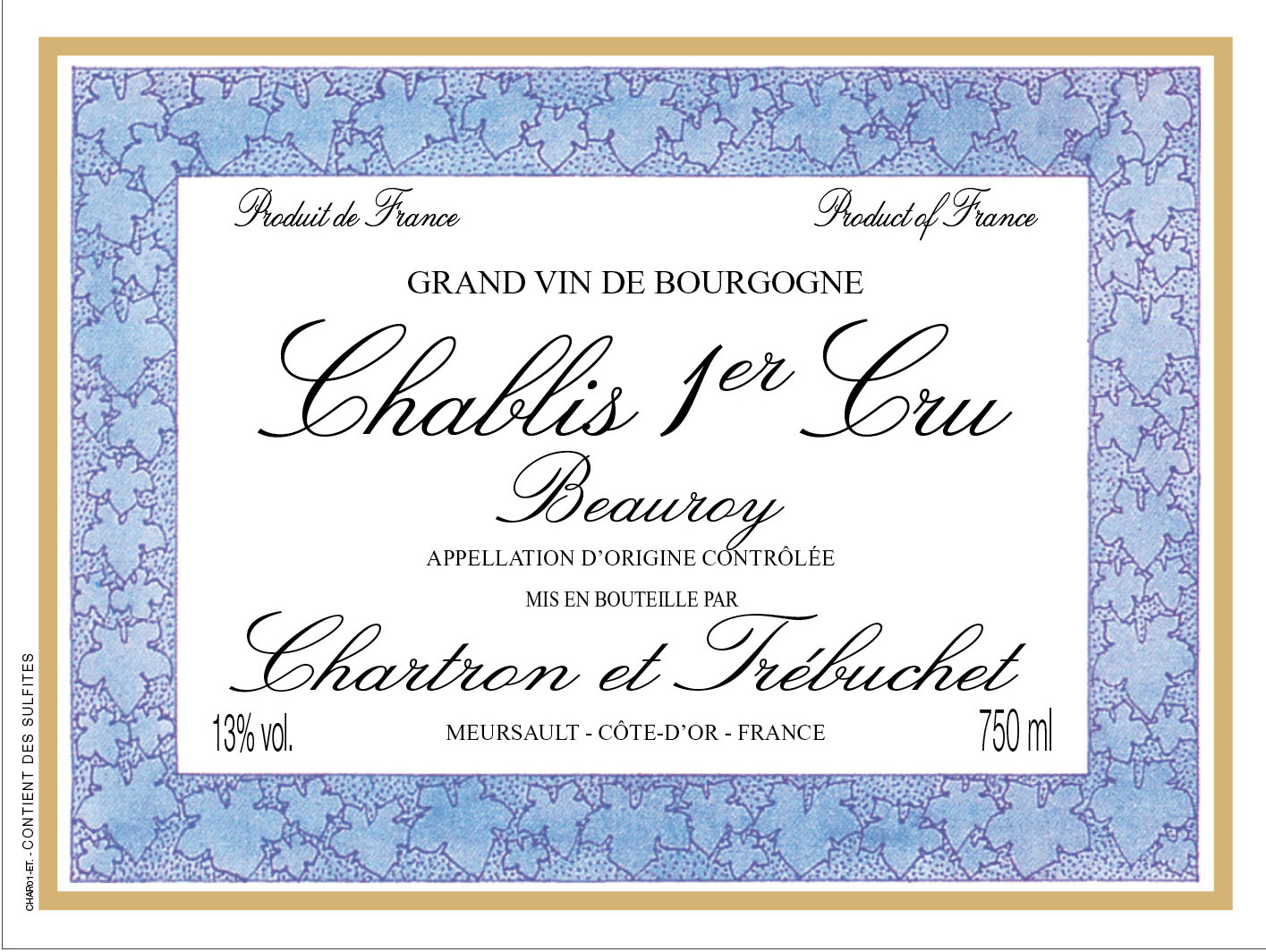
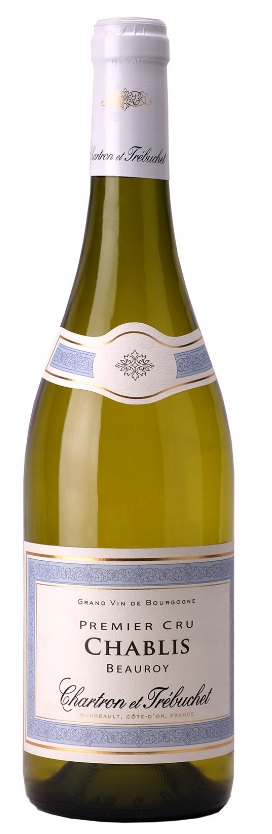
Chartrons et Trebuchet Chablis 1er Cru Beauroy is a crisp and clean Chardonnay that offers a rich and intense bouquet of fresh citrus fruits and white flowers. The mouth is round, ample and powerful. The rich and rounded palate is expressive and voluptuous with a mineral character and good acidity. A long finish. Delicious.
Chartrons et Trebuchet Chablis 1er Cru Beauroy is a perfect match with cooked oysters or fish in sauce, white meats (veal, poultry), sushi, goat cheese, blue cheese and Comté.
The Chartron et Trebuchet Estate
Owners of Premiers and Grands Crus in Puligny-Montrachet since 1859 with the Domaine Jean Chartron, Jean-René Chartron founded the Maison Chartron et Trébuchet in 1984 with Louis Trébuchet, manager of a wine trading company.
Vincent Sauvestre acquired the company in 2004. His objective is to continue to promote the great white wines of Burgundy, whilst respecting and perpetuating the quality work achieved by Jean Chartron and Louis Trébuchet.
The Maison Chartron et Trébuchet specialises in producing great white Burgundy wines. The know-how of the winemakers begins with a radical selection of the very best plots: the highest-quality terroirs of the Côte are chosen and the grapes are carefully monitored throughout the ripening period. Grapes are hand-picked when the balance between acidity and sweetness is at its prime: the fruit must not be too ripe so that the full potential of the terroir is maintained, including its acidity, to ensure that the wines age properly. All of the winemaking is done in casks: the alcoholic fermentation is followed by malolactic fermentation. A proportion of 20 to 40% of new barrels is used, depending on the appellations and the vintage. Wines are left to age for 12 to 18 months depending on the appellations.
The Chartron et Trebuchet Vineyards
Chartron et Trébuchet's vineyards are all planted on Limestone and Clay based soils. In average, the age of the vines is 30 years old.

M. Chapoutier Hermitage Monier de la Sizeranne is made from 100 percent Shiraz.
In Hermitage, Syrah achieves its noblest expression and La Sizeranne has become a benchmark wine for the region. M. Chapoutier's roots in the Rhône date back to 1808, when the family first settled in Tain l'Hermitage. The family purchased a winery owned by Comte Monier de la Sizeranne and over time, acquired a number of excellent vineyards, including some of the oldest in France. M. Chapoutier was the first winery to put Braille on a wine label in 1996. Maurice Monier de la Sizeranne was the owner of the plot of the Hermitage, la Sizeranne until he was blinded in a hunting accident and unable to take care of the land, choosing instead to sell to the Chapoutier family. Following his accident, Maurice became the inventor of the first version of abbreviated Braille, and Chapoutier included Braille on the wine labels as a tribute to his work.
he grapes ferment in open wooden vats after total destemming. Two daily treadings ensure a good extraction of the tannins. Maturation takes place in oak casks, of which one third is new. Several rackings permit a slow and natural clarification process. The wine is unfiltered and unfined.
Review:
I was blown away by the 2019 Hermitage Monier De La Sizeranne, and if there’s a best buy out there in 2019 Hermitage, this might be it. Blackberries, black raspberries, spice box, new leather, and bouquet garni all dominate the bouquet, and it’s full-bodied, with a round, layered mouthfeel, beautiful tannins, and a rare mix of richness and elegance. It’s a stunning wine that’s guaranteed to put a smile on your face over the coming 2+ decades. Hats off to the team at Chapoutier!
-Jeb Dunnuck 97 Points

Continuum Red Blend 2022 is made from 45% Cabernet Sauvignon, 43% Cabernet Franc, 8% Petit Verdot, 4% Merlot.
2022 tells a story of subtle drama of the seasons. Aromatically effusive, 2022 Continuum is a seductive wine with an upright and regal core. Elegantly interwoven notes of black plum, black cherry, cacao, forest floor and tobacco leaf mingle with our sage mountain garrigue and volcanic minerality. Energetic and expressive, 2022 Continuum is a harmoniously integrated wine with structural complexity wrapped in a velvet robe.
WINEGROWING- Continuum is estate grown on our Sage Mountain Vineyard. It’s location, high on Pritchard Hill along the eastern ridge above Oakville, overlooks Napa Valley and the San Francisco Bay. The rocky, volcanic soils of the site focus the vine’s energy keeping yields low yielding fruit of depth and complexity. 38 acres of mature estate vineyard, planted in 1991 and 1996, with additional plantings in 2004, 2010, together comprise 38 distinct vineyard blocks. Cabernet Sauvignon, Cabernet Franc, Petit Verdot, and Merlot are grown from 1300 to 1600 feet in elevation, on western and southern facing aspects with slight northern and eastern slopes in places. This diversity of plantings on our volcanic soils are the essence of the complexity of Continuum.
PRODUCTION- Continuum is 100% estate grown, produced and bottled. All fruit is selectively hand-harvested at night. The fruit is then sorted before and after de-stemming, and gravity fed into French oak or concrete tanks. A threeday cold soak is followed by fermentation, receiving three to four pumpovers daily, and délestage two to three times in total during the most active period. The wine remains on skins in tank for 20 to 40 days. All lots are then drained, basket pressed, and transferred with lees for malolactic fermentation and aging. Continuum spent 22 months in barrel. 63 percent of French oak barrels were new and 35 percent were once used. A single concrete amphora was also used for aging. The wine clarified slowly and settled naturally in our cold barrel room, was racked sparingly and bottled without fining or filtration. Each vineyard lot was tasted and carefully considered many times to assemble the blend.
Review:
Perfumed aromas of subtle currants, roses, lavender and sage, following through to a medium body with super-fine tannins that caress the palate and leave it fresh and inspired.
- James Suckling 99 Points