" We don't sell the wine without touching the vine "
Larroque Bordeaux Blanc is made from 73% Sauvignon Blanc and 27% Colombard.
No oak.
Color : Pale yellow with green tints.
Nose : Complex aromas of white flowers, exotic fruits, citrus and boxwood, with a touch of minerality.
Mouth : Aromatic, with a nice richness and freshness. Predominant flavors of tart, crisp fruit.
Marie-Christine, the daughter of Henri Ducourt, purchased this prestigious left-bank property in 1979, which lies on the border of the Graves appellation.
The 60-hectare vineyard was rapidly replanted and the château building, which dates from 1348, was restored.
Our family now produces three different-colored wines there: red, white and rosé.
Grown on loamy-clay soil.
Harvest : Machine harvesting in the cool, early morning
Maceration : Skin-contact maceration for several hours, depending on ripeness, and pressing
Fermentation : Beginning of the cold alcoholic fermentation (12°C / 53°F) then an increase in temperature to finish the fermentation at 20°C / 68°F.
Enjoy this wine as an aperitif or during the meal with fish, seafood or chicken salad.
Larroque Bordeaux Blanc is made from 73% Sauvignon Blanc and 27% Colombard.
No oak.
Color : Pale yellow with green tints.
Nose : Complex aromas of white flowers, exotic fruits, citrus and boxwood, with a touch of minerality.
Mouth : Aromatic, with a nice richness and freshness. Predominant flavors of tart, crisp fruit.
Marie-Christine, the daughter of Henri Ducourt, purchased this prestigious left-bank property in 1979, which lies on the border of the Graves appellation.
The 60-hectare vineyard was rapidly replanted and the château building, which dates from 1348, was restored.
Our family now produces three different-colored wines there: red, white and rosé.
Grown on loamy-clay soil.
Harvest : Machine harvesting in the cool, early morning
Maceration : Skin-contact maceration for several hours, depending on ripeness, and pressing
Fermentation : Beginning of the cold alcoholic fermentation (12°C / 53°F) then an increase in temperature to finish the fermentation at 20°C / 68°F.
Enjoy this wine as an aperitif or during the meal with fish, seafood or chicken salad.
Larroque Bordeaux Blanc is made from 73% Sauvignon Blanc and 27% Colombard.
No oak.
Color : Pale yellow with green tints.
Nose : Complex aromas of white flowers, exotic fruits, citrus and boxwood, with a touch of minerality.
Mouth : Aromatic, with a nice richness and freshness. Predominant flavors of tart, crisp fruit.
Marie-Christine, the daughter of Henri Ducourt, purchased this prestigious left-bank property in 1979, which lies on the border of the Graves appellation.
The 60-hectare vineyard was rapidly replanted and the château building, which dates from 1348, was restored.
Our family now produces three different-colored wines there: red, white and rosé.
Grown on loamy-clay soil.
Harvest : Machine harvesting in the cool, early morning
Maceration : Skin-contact maceration for several hours, depending on ripeness, and pressing
Fermentation : Beginning of the cold alcoholic fermentation (12°C / 53°F) then an increase in temperature to finish the fermentation at 20°C / 68°F.
Enjoy this wine as an aperitif or during the meal with fish, seafood or chicken salad.
Chateau Arnauds des Bordeaux Rouge is made from 100% Merlot.
The wine shows a deep red purple color and intense aromas of black fruits (blackcurrant, black cherry) with hints of liquorice. Very fruity and well-balanced. It is powerful and well structured in the mouth with round and silky tannins, ripe flavors of black fruits. Strong and a slightly spicy finish.
Grapes are coming from 30 year old vines planted on gravelly soils.
The land benefits from sun exposure, warmth and humidity that are strong assets for the vine culture.
The wine pairs well with game meat and beef on the grill.
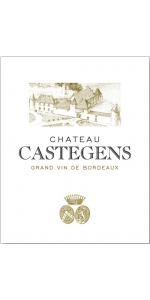
Chateau Castegens Cotes de Bordeaux Castillon is made from 80% Merlot, 18% Cabernet Franc and 2% Cabernet Sauvignon.
The wine boasts an intense, deep and lively red color. The nose offers black fruit, blackberry, cigar box, licorice, some delicate and integrated oak flavors as well. The mouth is full of fruit flavors, spice and fine toasty flavors. The structure is rich, but the tannins are well integrated already. The finish is long and a slight mintiness give the wine a great length and some purity.
Pairs great with meat and vegetables on the grill.
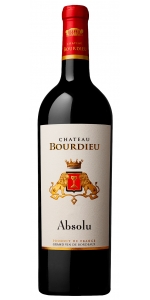
Chateau Bourdieu Absolu Blaye Cotes de Bordeaux is made from 79% merlot, 17% Cabernet Sauvignon, 4% Malbec.
When Luc Schweitzer was joined by his two sons Richard and Ludovic at the estate, he wanted to embrace this new chapter in the family history and launched in 2016 a special cuvée from Château Bourdieu called "Absolu". This top-of-the-range cuvée is the best of what their terroir has to offer. The 35 year-old facing south vines benefit from a meticulous care: regular maintenance of the soil, yield control, manual leaf stripping, sorting of the berries - all practices that ensure the quality of this great Bordeaux wine.
A deep garnet color with magnificent purple highlights. The nose is intense and full, revealing notes of ripe black fruits and subtle hints of vanilla and roasted coffee. Great structure with finesse and tannic density that brings depth and length to the mouth. The aromatic purity of the perfectly ripened grape varieties is magnified by the complex and subtle oak flavors.
Pair: Rib of grilled beef and tournedos Rossini - butter pan-fried beef filet served on a crouton, and topped with a hot slice of fresh foie gras.
Review:
"A rich, opulent wine, this is full of dark tannins and powerful fruit. It's a big wine, with licorice and dense wood flavors that give a smoky character and reflect some serious extraction. The wine needs to smooth out to showcase its concentrated richness. Drink from 2024. - Roger VOSS"
- Wine Enthusiast (May 2021), 91 pts
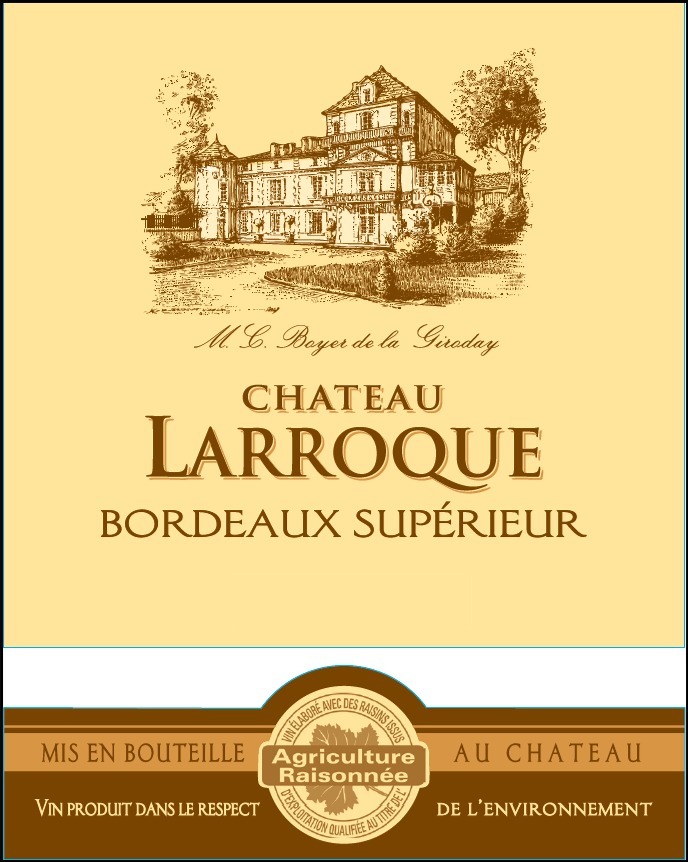
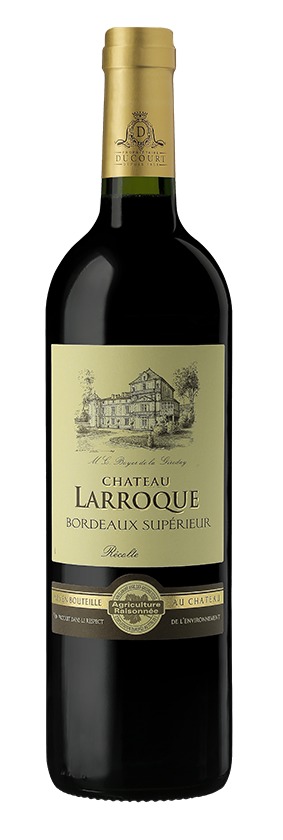
Chateau Larroque Bordeaux Superieur Rouge is a blend of 51% Merlot and 49% Cabernet Sauvignon.
Nose : Red fruits, almond and hazelnut, with a faint vanilla aroma.
Mouth : The silky, velvety attack reveals a pleasant, concentrated and well structured wine. It offers a combination of fruits pastes’ flavors, licorice and toasted notes, and an elegant finish.
The 60-hectare vineyard was rapidly replanted and the château building, which dates from 1348, was restored.
Our family now produces three different-colored wines there: red, white and rosé.
Fermentation : Alcoholic fermentation in thermo-regulated stainless steel vats at around 26°C / 78°F then a gentle vatting for 3 weeks at 30°C / 86°F. Running off and pressing,separation of the press and free-run juice. Malolactic fermentation in thermo-regulated stainless steel vats at around 18°C / 64°F
- 2017 Decanter World Wine Awards Decanter 95 Points
Color : Dark garnet hue
Marie-Christine, the daughter of Henri Ducourt, purchased this prestigious left-bank property in 1979, which lies on the border of the Graves appellation.
Grown on loamy-clay soil.
Macération : Pre-fermentation cold maceration of 24 to 48 hours
Enjoy this wine with charcuterie, roasted meats, BBQ, cheeses.
Marie Christine, the daughter of Henri Ducourt, purchased this prestigious left-bank property in 1979, which lies on the border of the Graves appellation. The 60-hectare vineyard was rapidly replanted and the château building, which dates from 1348, was restored. The family now produces three different-colored wines there: red, white and rosé.
In 1858, Ducourt family settled at Château des Combes in Ladaux, a small rural village in the south east of Bordeaux, in the heart of Entre-Deux-Mers area. Over time, new generations have followed in their footsteps; a passion for wine has become a profession, and their knowledge and the estate have grown ever greater as they have been passed down the line.
Pierre Ducourt, then his children and his grand-children farmed several hectares of vines that belonged to the estate. The arrival of the grandfather, Henri Ducourt, at the property marked an important turning point in the family business. He, with the help of his three children (Marie Christine, Philippe and Bernard), decided to drastically revitalize the company and turned the family vineyard into one of Bordeaux’s largest winemaking facilities, with 450 hectares of land and 14 chateaus in 6 different AOC's.
The crocodile is the emblem of Henri Ducourt’s vigorous business spirit, which lives on today, as strong as ever, in each family member. And what better ambassadors could exist to remind people that Entre-Deux-Mers is where this family adventure began?
In 1962, Henri Ducourt, a young winemaker, used to work 14 hours a day managing the 20 hectares of vines he had inherited from his father. He had a good friend, his neighbor, who owned 14 hectares and used to work with his two sons. At this time, suffice to say that running a vineyard was not the career that parents wished for their children, preferring instead to steer them towards more stable jobs. Some though, including Henri, were obstinate and unwilling to part from the vineyard. So, hard-working and hard-headed, Henri Ducourt slowly but surely bought the land and the vines of the neighboring producers and found himself by the mid-80’s at the head of almost 300 hectares of vineyards! One day, as much to poke fun as through admiration, the son of his friend drew a crocodile on a sign to represent the tenacity, lucidity and cold-blooded business spirit of Henri Ducourt, then planted this sign among the far-reaching vines of his neighbor.
Amused by the gesture, Henri Ducourt was inspired by the crocodile when he rebuilt the winery and asked that the new vats were decorated with this symbol. Today, Henri’s children and grandchildren manage 450 hectares of vineyards, always persistent, ready for new challenges, and faithful to what their parents have built. The crocodile has since become the emblem of the family.
Graduated as Oenologist in 2002 (University of Toulouse).
Before joining Ducourt in 2014, he worked for various estates :
- Domaine de l’Hortus in Pic Saint Loup
- Les caves de Sieur d’Arques in Limoux
- Chateau Carbonnieux, Grand Cru Classé in Pessac Léognan
The Ducourt's have always known that quality grapes are essential for making a good wine. Therefore they take the utmost care in the vineyards, to get the best from every plot of land. The size of the business also allows them to make numerous investments in the latest tools, which enable to unite traditional knowledge with the latest technologies, and therefore become ever more precise and respectful of the environment in their work.
The latest equipment
They regularly invest in new equipment for two main reasons : a desire to constantly evolve and improve quality while reducing the amount of strenuous and dangerous work undertaken by their co-workers.
With the development of the vineyard's surface, the harvests are now carried out with the help of the latest generation of harvesting machines, which make it possible to collect the grapes in the cool of the morning. Harvest is quicker offering more flexibility and quality improvement.
Among the latest acquisitions is a machine that allows to plant using a GPS guidance as well as an innovative and precise spraying system and flexible frames that allow to reduce waste and the amount of treatment products used.
A Grand-Cru-worthy setup
The family invests in equipment that is worthy of a Grand Cru, and therefore push further in the constant quest for quality, which applies to the entire range of wines.
The new pressing system allows them to press the grapes in a completely inert environment to prevent any oxygenation of the juice and to preserve the aromas of each varietal, to obtain more intense and fresher wines. The wineries and the stainless-steel vats are thermo-regulated in order to keep the juice in the best conditions possible and to maintain complete control over the entire fermentation process. They have also invested in a cross-flow filtration system for filtering wines before bottling, which ensures optimal quality and no waste. Finally, to improve safety for the co-workers they also regularly invest in new equipment such as carbon-monoxide detectors, helping to prevent accidents including asphyxiation during the cleaning of the vats. The most recent investment to date involves the bottling line that was set up with the collaboration of the employees in order to reduce their workload.
6 generations of shared experience
They have the good fortune to be able to build on several generations of winemaking experience and produce wines that respect their local typicity. They frequently organize tastings of two old vintages so as to improve their understanding of the wines’ evolution over time, and so as to be able to really tell people when is the best time to drink the wines.
Franz Prager, co-founder of the Vinea Wachau, had already earned a reputation for his wines when Toni Bodenstein married into the family. Bodenstein’s passion for biodiversity and old terraces, coupled with brilliant winemaking, places Prager in the highest echelon of Austrian producers.
Smaragd is a designation of ripeness for dry wines used exclusively by members of the Vinea Wachau. The wines must have minimum alcohol of 12.5%. The grapes are hand-harvested, typically in October and November, and are sent directly to press where they spontaneously ferment in stainless-steel tanks.
Klaus sits adjacent to Achleiten and is one of the Wachau’s most famous vineyards for Riesling. The vineyard is incredibly steep with a gradient of 77% at its steepest point. The southeast-facing terraced vineyard of dark migmatite-amphibolite and paragneiss produces a tightly wound and powerful wine. The parcel belonging to Toni Bodenstein was planted in 1952.
Tasting Notes:
Austrian Riesling is often defined by elevated levels of dry extract thanks to a lengthy ripening period and freshness due to dramatic temperature swings between day and night. “Klaus is not a charming Riesling,” says Toni Bodenstein with a wink. Klaus is Prager’s most assertive and robust Riesling.
Food Pairing
Riesling’s high acidity makes it one of the most versatile wines at the table. Riesling can be used to cut the fattiness of foods such as pork or sausages and can tame some saltiness. Conversely, it can highlight foods such as fish or vegetables in the same way a squeeze of lemon or a vinaigrette might.
Review:
Superbly cool, restrained and refined, this austere, beautiful dry riesling is a slow-burn masterpiece that's only just beginning to reveal its complex white-peach, white-tea, wild-herb and dark-berry character. Super-long and mineral finish. Drink or hold.
-James Suckling 97 Points
Tasting Notes
This Pinot Gris is filled with great fruit intensity of ginger spice and pear drop aromas, beautifully balanced with a smooth juicy finish. A wine to be enjoyed on any occasion.
Winemakers Notes
Following harvest the fruit was fermented in batches using a number of fermentation techniques, including barrel fermentation (10%), on skins fermentation (90%), and lees aging for five months. The resulting blend of these techniques has resulted in a rich and complex Pinot Gris with concentration and balance.
Alcohol %
13.5%
Food Matching
Chicken Tikka Masala or sticky sesame prawns with a spicy sauce.