" We don't sell the wine without touching the vine "
| BUY MORE! SAVE MORE! | ||||||||||||||||||||
|
| Country: | Italy |
| Regions: | Tuscany Brunello di Montalcino |
| Winery: | Collemattoni |
| Grape Type: | Sangiovese |
| Vintage: | 2018 |
| Bottle Size: | 750 ml |
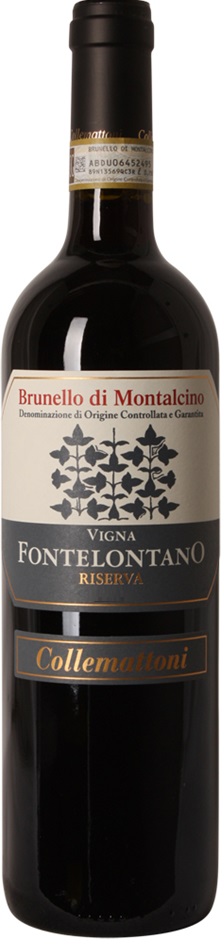
Collemattoni Brunello di Montalcino Riserva is made from 100 percent Sangiovese.
Intense ruby red with brilliant burgundy reflects in color. Reminiscent of wild black fruits, vanilla and spices on the nose and dry, warm, slightly austere but velvety in the palate.
This wine comes from the oldest vineyard of Collemattoni: Fontelontano. Less than half hectare. It's one of the few Single Vineyard Brunello di Montalcino riserva.
Coming from a parcel with 15-18 year old vines planted in sandy clay and marl soils.
Harvest is 100% destemmed with a soft pressing, fermentation in stainless steel tanks at controlled temperature of 28-30°C, pumping over for the first week of maceration following by skin-contact maceration for 20-25 days with rack and return technique (delestage).
Malolactic fermentation completed. The delestage and the pumping over are then spaced out along the process.
Wine is slightly filtered before bottling.
Review:
This is intense with aromas of dried cherries, sweet licorice, cloves, crushed walnuts and hints of chocolate and undergrowth. Full-bodied, deep and structured with taut, tightly packed tannins. Long and persistent. Drink or hold.
-James Suckling 94 Points
Collemattoni takes its name from the farmhouse, which, over time, has become the trademark of our winery and of our wines. The farmhouse dates back to at least 1672, year in which it is registered in the parish archives as a family home. Collemattoni is located on a hill top on the south side of the municipal area of Montalcino, just a short distance from the village of Sant’Angelo in Colle.
At the beginning of 1980, Adon Bucci ( father of Marcello Bucci) bought the land and the farm house from the Church and the Bucci family started to produce wine. The 1988 has been the first vintage of Collemattoni Brunello di Montalcino.
Azienda Agricola Collemattoni owns 12 hectares:
7.5 hectares of Sangiovese grown in the villages of Collemattoni (2.5ha), Fontelontano (0.5ha), Sesta (2.70ha) and Cava (1.80ha).
The 4.5ha of Merlot, Canaiolo, Colorino and Trebbiano are all grown in the village of Orcia.
The age of the vines ranges between 5 years old for the youngest and 18 years old for the oldest vineyards.
The have been using organic farming methods for several years and the 2016 vintage will bear the organic certification.
Collemattoni Brunello di Montalcino is made from 100 percent Sangiovese.
Color: brilliant red with burgundy reflects; Bouquet: penetrating with memories of wild black fruits, black cherry and noble wood; Taste: warm, dry and persistent
Coming from a parcel with 10-15 year old vines planted in sandy clay and marl soils.
Harvest is 100% destemmed with a soft pressing, fermentation in stainless steel tanks at controlled temperature of 28-30°C, pumping over for the first week of maceration followed by skin-contact maceration for 20-25 days with rack and return technique (delestage).
Malolactic fermentation completed.
Wine is slightly filtered before bottling.
Review:
This is a really balanced and pretty young Brunello with dark-cherry and citrus character on both the nose and palate. It’s medium-bodied with integrated tannins and a beautiful, succulent finish. Nicely done. Drinkable now, but better in two or three years.
-James Suckling 95 Points
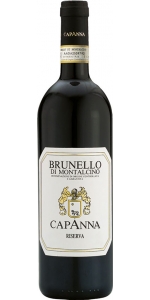
Capanna Brunello di Montalcino Riserva is made from 100 percent Sangiovese.
TYPE: DOCG
BLEND: 100% Sangiovese carefully selected in the oldest vineyards and only of the best harvests.
VINIFICATION:
Alcoholic fermentation with maceration of the skins (30-35 days) at a controlled temperature and spontaneous malolactic fermentation, both in truncated cone-shaped Slavonian oak vats.
AGEING:
In Slavonian oak casks of 10 to 25 hl for over 40 months; followed by ageing in bottles for at least 15 months.
NOTES:
Colour: deep ruby red, strong, lively.
Bouquet: very intense and complex, fruity and spicy, with red fruit, jam and liquorice shades; great prospects of future development.
Taste: great structure in the acid-tannin components, well supported by the soft ones; extremely persistent.
Food pairings: roast red meats, game and very aged cheeses.
Review:
Bright ruby in the glass. First impact is low key, with red cherry, leather, tobacco, fresh violet and balsamic notes. The attack is velvety, with a full body, lifted acidity and dense, ripe tannins. Character emerges from the glass, meaty and bloody. Thick, dry finish that’s fierce. Drink or hold
-James Suckling 95 Points
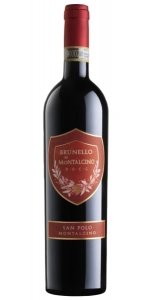
Poggio San Polo Podernovi Brunello di Montalcino is made from Sangiovese.
Intense ruby red in color with garnet hues, clear and glossy. The bouquet exhibits typical aromas of violets and small red berries. Subtle nuances of forest undergrowth, aromatic wood, a touch of vanilla and jammy mixed fruit then give way to subtle hints of coffee. This Brunello is intense, persistent, broad and heady. Full-bodied and warm on the palate, with a densely-woven texture and robust body, it has a persistent finish with well-rounded tannins. The particular features of the terroir at San Polo produce a Brunello with a capacity for lengthy aging, while patient cellaring enhances the wine during ageing in the bottle.
Review:
Lovely purity of fruit with ultra fine tannins and depth, finesse and complexity. Black cherries, cedar and some flowers. It’s full-bodied with very fine tannins that drive the finish. Give it a year or two to open more, but already so enticing. Drink or hold.
-James Suckling 96 Points
The San Polo 2015 Brunello di Montalcino Riserva (with 8,000 bottles produced) is a textured wine with hearty fruit and touches of smoked meat and spice. At its core, the wine offers dark fruit, blackberry and ripe plum. The rich fruitiness of the wine cedes to campfire ash, mahogany and furniture wax. These results are sultry and even a bit flashy, with distant background tones of teriyaki and plum sauce. The wine is fermented in cylindrical oak fermenters and aged in oak for three years. We'll see this bottle hitting the market sometime after February 2021.
-Wine Advocate 95 Points
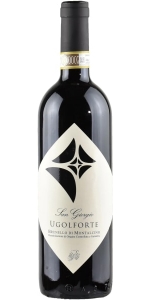
San Giorgio Ugolforte presents a dark core of red and black berry fruit layered with earth, leather, smoke, and herbs. Complex and elegant, the wine is full on the palate and firm in tannin structure. Refreshing acidity frames a graceful finish. Classic Brunello di Montalcino.
This red is marked by cherry, plum, thyme, sage and loam aromas and flavors. Lively and firmly structured, featuring a saline undercurrent. An open-knit version, with nice equilibrium, fine energy and a long, resonant finish.
-Jeb Dunnuck 94 Points
-Wine Spectator 94 Points
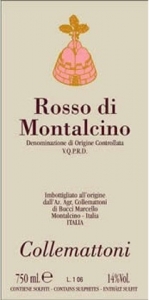
Collemattoni Rosso di Montalcino is 100% Sangiovese.
Color: intense ruby red.
Bouquet:violet flowers, black cherry and wild black fruits.
Taste: warm, dry and with good balance.
Coming from a parcel with 8-13 year old vines planted in sandy clay and marl soils.
Harvest is 100% destemmed with a soft pressing, fermentation in stainless steel tanks at controlled temperature of 28-30°C, pumping over for the first week of maceration followed by skin-contact maceration for 20-25 days with rack and return technique (delestage).
Malolactic fermentation completed.
Wine is slightly filtered before bottling.
Pairs with steak, pheasants and strong cheese.
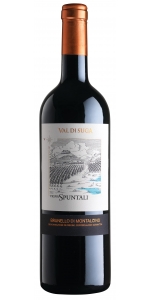
This is a 6 pack with 2 bottles each from vintages from 2013, 2015, and 2016.
***Tenimenti Angelini Val di Suga Vigna Spuntali Brunello di Montalcino 2016:
The 2016 Vigna Spuntali Brunello di Montalcino is the most brooding of the lineup from Val di Suga and is sourced from the southwest of the region on sandy soils. There are aromatics of black raspberry, licorice, menthol, sage, cinnamon, and iron-rich earth. Its Mediterranean influence is felt on the palate with ripe black cherry, dried herbs, and sun-baked earth. This is the fullest bodied and most savory of the Val di Suga lineup, with more roundness and grip. Its structure will benefit from cellaring for several years and will be great drinking over the next 20 years or more. 2026-2040.
-Jeb Dunnuck 96 Points
***Tenimenti Angelini Val di Suga Vigna Spuntali Brunello di Montalcino 2015:
The 2015 Vigna Spuntali Brunello di Montalcino is more introverted on first opening, with notes of black plum, licorice, dried Mediterranean herb, and sun-baked earth. On the palate, it offers a tart dried fruit character, with a building tannin structure that finishes with tomato leaf, and bitter herbs. The most rustic and burly of the wines in the lineup of the 2015 Val di Suga vintage, it will benefit from allowing some time in cellar to see how this matures and its tarriness develops. Drink 2026-2036
-Jeb Dunnuck 94 Points
***Tenimenti Angelini Val di Suga Vigna Spuntali Brunello di Montalcino 2013:
Plenty of spices and fresh herbs on the nose, such as dried rosemary and nutmeg, to match the underlying dried redcurrants and cranberries. Full-bodied with plenty of concentration, but still shows a very sturdy, tannin backbone and punchy acidity, to drive this through to a long finish. Drink in 2021.
-James Suckling 94 Points
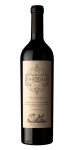
Enemigo El Enemigo Gran Enemigo is made from 100% Cabernet Franc.
In the spectrum of people who pay attention to detail, winemakers are often incredibly detail-oriented. This can sometimes spill over to become an internal battled, and, as Alejandro Vigil and Adrianna Catena state, "We are our own worst enemy." El Enemigo pays homage to this internal struggle.
The nose presents sweet aromas of black ripen fruits with hints of vanilla and chocolate, which appear after the oak ageing. The mouthfeel is sweet with structured, persistent tannins due to the natural acidity of this wine, leading into an excellent long finish.
Review:
The nose of the 2018 Gran Enemigo El Cepillo Single Vineyard, from a low-yielding and drier year, is full of curry, a note that was a constant across the three vintages I tasted together, but it tends to be stronger in low-yielding and dry years like this. It's also floral and comes through as aromatic and a little exotic, in a good way, with elegance, persistence and very pure flavors. It has fine-grained tannins, great acidity and balance. 7,200 bottles. All these single-vineyard bottlings mature in ancient 4,000-liter oak foudres for some 15 months.
-Wine Advocate 97 Points"Pretty and inviting on the nose with gorgeous aromas of floral violet, cassis and completed with a lifted, delicate liquorice note. The palate is graced with deep herb, pepper, crunchy red fruit and graceful, silky tannins."
-Decanter 97 Points

Cattail Creek Chardonnay Russian River Valley is made from 100 percent Chardonnay.
From the heart of Sonoma's Russian River Valley, one of California's premier Chardonnay appellations, this wine showcases the region's signature combination of rich fruit character and bright acidity. Cool morning fog and afternoon breezes produce Chardonnay of exceptional balance, with notes of ripe pear, green apple, and citrus complemented by subtle hints of vanilla and toast. The palate is round and full-bodied yet refreshing, with a long, elegant finish.