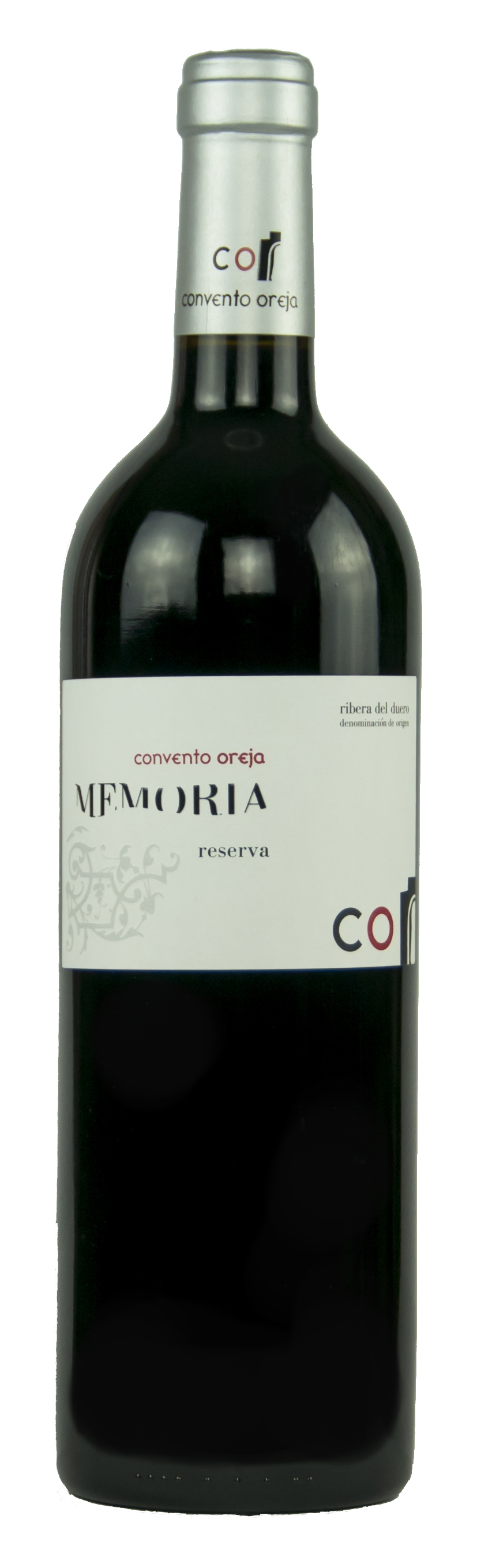
" We don't sell the wine without touching the vine "
| BUY MORE! SAVE MORE! | ||||||||||||||||||||
|
| Country: | Spain |
| Region: | Ribera del Duero |
| Winery: | Convento de Oreja |
| Grape Type: | Tempranillo |
| Vintage: | 2018 |
| Bottle Size: | 750 ml |
Convento Oreja Memorias Reserva is made from 100 percent 100% Tempranillo.
The wine comes from a special vineyard at 950 meters altitude. The cuvee is called MEMORIA to pay tribute to good friends and great time spent together.
Deep cherry color. On the nose, the wine is elegant and well balanced with black fruits, reminiscent of vanilla and leather. Hints of spices, minerals and coffee. On the palate the wine is also well balanced and pleasant. Round and elegant with a long and pleasing aftertaste.
Pairs well with pastas, creams and soups. Likewise, these wines are ideal for more subtle and elaborate first courses, like a rice with lobster.
Ideal for grilled red meats and stews and game stews and for the typical roast lamb.
Review:
"Deep garnet to the eye, this wine has a nose of black cherry, cocoa powder and aniseed. A sense of fruit brightness permeates the palate alongside blackberry preserve, orange zest, clove, violet and milk chocolate flavors. Lingering brightness and velvety tannins make for a gorgeous, long-lasting finish. - Mike DeSimone"
- Wine Enthusiast (June/July 2023), 94 pts
The Convento de Oreja Estate
The winery is located near the town of Peñafiel, and its name Oreja (ear) comes from the fact that Convento is located on a bend in the Duero river. This exagerated bend/oxbow is referred to as an oreja or ear shaped. Owner Antonio Vaquero lives and works in Madrid, but hails from Peñafiel, where he has been managing family vineyards. Recently, Antonio and a small group of associates decided to build their own winery, hence Convento de Oreja.
Convento de Oreja does not own winemaking facilities, but supervises the vinification in a modern facility in Peñafiel. Once the wine has been fermented/macerated, the resulting juice is barrel aged.
The Convento de Oreja Vineyard
The vines are 10-15 years old except for a small plot of 40 year old vines. The wines of Convento de Oreja are all 100% Tempranillo. Currently they own 6 hectares (14.82 acres) and manage 12 hectares more. Recently they planted 4 hectares more and all soil types are nutrient poor alluvial soils with a mix of sand and gravel. Deeper down the soil is clay and limestone, good for water retention. For now they make both Joven and Crianza style wines.

Pago de Carraovejas Ribera Del Duero is made from 92%, Cabernet Sauvignon 5% and Merlot 3%.
The Pago de Carraovejas Ribera del Duero vintage marks a turning point in the history of the winery. From now on, the Crianza and Reserva are unified in this wine that focuses on the terroir and character rather than the time of aging. Its renewed label reflects the three key elements of this red: origin, soul and emotion.
Pago de Carraovejas Ribera Del Duero is made with grapes grown in the Botijas River valley, and planted between 1988 and 2011. Our work over the last 30 years has been geared to handcrafted viniculture, that puts as much care as possible into the microclimate conditions and the details. We have placed particular attention on the maintenance of the soil by plant cover that already grows spontaneously. It allows us to develop the ecosystem of the valley, which we respect scrupulously, using organic fertilizer and sulfur as the sole basis of our viticulture.
Depending on which plot they come from and the time they enter the winery, the grapes may be deposited in cold chambers to prevent oxidation and preserve the aroma. We carry out a two-part selection: first on the vine, where we choose the bunches, and then on a belt in the winery, where we remove the grapes that do meet the necessary conditions. The grapes enter the winery and are transported with the assistance of gravity. The deposits are filled slowly and gently. Depending on the characteristics that we detected when tasting the grapes, we ferment them either in stainless steel deposits or French oak barrels. For years we have worked with our own yeast that has been isolated from the vines by our team. This work is also partly responsible for the Carraovejas character.
The wine was aged in barrels for around twelve months.
Review:
The eponymous 2021 Pago de Carraovejas comes from a cooler year when they consider the grapes had exceptional quality. The bottled wine is composed of Tinto Fino with 5% Cabernet Sauvignon and 3% Merlot with 15% alcohol but good freshness and integration of the oak after spending 12 months in 226- and 600-liter barrels. It's medium to full-bodied, with fine tannins, a juicy mouthfeel and a tasty finish. This is a more elegant Carraovejas. It was bottled in the spring of 2023.
-Wine Advocate 93+ Points


Romariz 20 Years Old Tawny is rich, warm and well balanced. Concentrated, firm tannins. Aromas of hazelnuts and walnuts, raisin, honey, caramel and dark chocolate notes. Excellent with desserts, cheese or by itself at the end of a meal.

Milsetentayseis 1076 Ribera del Duero Tinto is made with 95% Tempranillo and 5% other native varieties.
TASTING NOTES: A product of its unique landscape, extreme altitude and mineral-rich soil, 1076 Tinto is a bold wine with a distinct character designed to evolve over time. Its freshness and intensely fruity expression are representative of a modern style, moving away from excess, in search of the elegance, smoothness and balance found in the great wines of the world.
TERROIR: A recently restored vineyard situated at over 3,280 feet of altitude where ancestral vines over 100 years old grow harmoniously together with new, indigenous plantings in varied soil comprised of red clay, sand and mineral deposits of quartz, mica, and feldspar.
WINEMAKING: Hand-harvested from a selection of the best plots in the vineyard then separated into concrete, oak or stainless steel fermentation vats depending on the characteristics of the grape and the soil where it was grown. Its production is defined by the team´s constant vigilance throughout the process and their in-depth knowledge of the region, the soil and the native varieties that thrive there.
AGEING: Aged for 18 months in French oak of various sizes and according to the needs of each plot. Bottled in June 2020.
VINTAGE: The 2018 vintage began with abundant rainfall that lasted until late spring. Budding had already begun by the end of April, and as is usual in the Ribera del Duero, mid-May posed great risk of frost. Thankfully, consistent high winds in the area kept it at bay allowing the vineyards to remain unaffected. Spring extended into June with rain and cool temperatures, unusual for this time of year, while summer did not arrive until July bringing with it dry, hot conditions that allowed for the fruit to reach optimal ripeness. The harvest ran from October 5th-October 13th.
Pair with spit-Fire Roasted Suckling Pig.
Reviews:
"Inky violet. Potent aromas of cassis, cherry preserves, incense and potpourri, plus oak spice and mineral topnotes. Alluringly sweet and concentrated, with a spine of smoky minerality supporting intense flavors of dark berry liqueur, bitter chocolate, cola and candied lavender. Youthful, slow-building tannins add shape and grip to an impressively long, juicy finish that echoes the dark berry and floral notes. - Josh Raynolds."
- Vinous (February 2021), 95 pts
"The wine is deep cherry in color exhibiting complex, expressive aromas. Its minerality comes from the soil, the black fruit from the Tempranillo and the spice from a sometime in oak. The combination leads to a full body that finishes with great length.
- Guia Penin, 95 pts
"Very fine-tannined Duero with berry, chocolate and walnut character. Medium body. Solid core of fruit. Linear and very long. Polished and thought-provoking. Drinkable now, but better in 2023."
- James Suckling (November 2021), 94 pts

Convento Oreja Ribera del Duero Crianza is made from 100 percent Tempranillo.
Bright cherry color. On the nose you will find plenty of fruit aromas, well balanced as well as some reminiscences of spices that are appreciable. The oak presence gives elegant hints of black chocolate and vanilla. On the palate, the wine is very smooth and well balanced with the right amount of acidity. Fresh, long lasting and elegant.
The wine went through malolactic fermentation. The wine was aged 12 Months in French Oak barrels. Before bottling, the wine was slightly filtered.
Convento Oreja Ribera del Duero Crianza is made from 100 percent Tempranillo.
Bright cherry color. On the nose you will find plenty of fruit aromas, well balanced as well as some reminiscences of spices that are appreciable. The oak presence gives elegant hints of black chocolate and vanilla. On the palate, the wine is very smooth and well balanced with the right amount of acidity. Fresh, long lasting and elegant.
The wine went through malolactic fermentation. The wine was aged 12 Months in French Oak barrels. Before bottling, the wine was slightly filtered.
Review:
A bouquet of Luxardo cherry, blackberry preserves and lavender wafts from the glass. Surprisingly juicy on entry, this wine has flavors of pomegranate, ripe cherry, orange zest, dried thyme, dark chocolate and violet. Opulent tannins build in volume and then recede into a finish that is filled with bright fruit notes. — Mike DeSimone
- Wine Enthusiast (June/July 2023), 94 pts

Licenciado Rioja Reserva is made from 100% Tempranillo
This single vineyard wine is always produced from the same vineyard that is also used to make the Gran Reserva wine.
Licenciado shows a ruby red color and outstanding aromas of wild berries, vanilla and spice. The palate is well-balanced, rounded and elegant, and offers black pepper, ripe black fruits and vanilla flavors. Its freshness, oak ageing and high extraction guarantee a longevity of at least 10 years after the year of harvest.
Best enjoyed with red meat and game
Review:
"A soft, fruity red with berry and cherry character. Full body, round tannins and a flavorful finish. 100% tempranillo. Drink now."
- James Suckling (August 2021), 91 pts

A deep powerful Gran Reserva from one of Rioja Alavesa’s most enduring family run wineries. The hillside terraced vineyards are sheltered by the Sierra Cantabria Mountains to the north from harsh weather extremes. Small plot production is utilized in this region of infertile chalky clay soil to produce clusters of excellent quality. Almost 900 plots are needed to complete the approximately 400 hectares of estate-owned or cellar-controlled vineyards, some with vines more than 100 years in age.
Tasting notes
Ruby red color with earthy tones. The wine shows finesse, elegance and complexity with good concentration of black fruit, thyme and rosemary with secondary aromas of leather and tobacco leaves. In the palate it is polished and rounded, making it pleasant and easy to drink. Fleshy with both elegance and power. It has touches of black fruit jam and liquorice. A long, delicious and persistent finish.
Suitable for pairing with a long, copious meal where it can accommodate braised vegetables, cold cuts, peppers stuffed with hake and shrimp, mushroom omelettes, cod Rioja style, both red and white meat... and so on.

Luis Canas Rioja Reserva is made from 100 percent 95% Tempranillo and 5% Graciano
A classic style Rioja Reserva from one of the regions most enduring family run wineries. The hillside terraced vineyards are sheltered by the Sierra Cantabria Mountains to the north from harsh weather extremes. Small plot production is utilized in this region of infertile chalky clay soil to produce clusters of excellent quality. Almost 900 plots are needed to complete the approximately 400 hectares of estate-owned or cellar-controlled vineyards, some with vines more than 100 years in age.
Tasting notes
Rich color. Very pleasant on the nose, subtle and elegant, complex, with aromas of fine wood, ripe fruit, coffee. Thick, unctuous and round on the palate with solid structure and juicy tannins. The second nose shows spiced nuances and black ripe fruit aromas.
Winemaking and aging
Upon entering the bodega, bunches undergo a manual selection and then individual grapes are sorted based on their weight. Following this double selection process, they are de-stemmed and crushed before undergoing fermentation and then aceration in stainless steel tanks for a total of 8 days, obtaining better color extraction as well as much more complex and tannic wines, suitable for prolonged aging.
After its primary fermentation, the wine is placed in barrels where it undergoes malolactic fermentation and is aged for 18 months in French (70%) and American (30%) oak barrels, then aged minimum 18 months in bottle before release.
Total acidity: 5 g./l. Volatile acidity: 0,6 g./l. PH: 3,59 Free SO2: 25 mg./l. Residual sugar: 1,9 g./l.
Excellent with red or white meats, all types of game, roasts, oily fish, rice with meat and cheese. Within Rioja cuisine it is perfection accompanying peppers stuffed with cod, artichokes with ham, migas pastoriles and trotters

Venancio da Costa Lima Palmela Reserva is made from 100% Castelao (also known as Periquita)
Intense garnet color, complex nose with touches of ripe fruit, jam and spices, full-bodied flavor and a very balanced finish.
100% Castelao (also known as "Periquita" and "Joao de Santarem". As the most widely-grown red grape variety in Portugal it is still often referred to in Portuguese as Periquita, although that name is legally owned by José Maria da Fonseca in the Setúbal Peninsula outside of Lisbon. It is highly adaptable to different climatic conditions and its remarkable versatility enables winemakers to make a range of wines – from the easy drinking and quaffable reds and rosados to the powerful and intense reds perfectly suited to lengthy cellaring. Castelão comes into its own and is most expressive in the Sétubal Peninsula, where it makes meaty and intense wines with aromas of red berries and blue flowers that marry well with the deft use of oak.
Made from 45 year old vines.
Classic vinification at controlled temperature (25 °C) with prolonged maceration for phenolic extraction. Wine went through malolactic fermentation.
Wine was slightly fitered before bottling to avoid sedimentation in the bottle and to ensure stability.
Pasta, Cheese, red meat and game.

Clos Saint-Jean is a 41-hectare estate in Châteauneuf-du-Pape run by brothers Vincent and Pascal Maurel. Considered by many critics and wine-writers as the preeminent estate espousing the modern style of winemaking in Châteauneuf, this cellar is one of the oldest in the region, having been founded in 1900 by the greatgreat-grandfather of Vincent and Pascal, Edmund Tacussel. A short time after its founding and well before the AOP of Chateauneuf-du-Pape was created in 1923, Edmund began bottling estate wines in 1910.
The farming at Clos Saint-Jean is fully sustainable due to the warm and dry climate, which prevents the need for chemical inputs. Instead, Vincent and Pascal employ organic methods for pest control, mainly pheromones, to prevent pests from taking up residence in their vines, a process called amusingly enough in French, confusion sexuelle. The vines tended manually, and harvest is conducted in several passes entirely by hand.
Deus ex Machina is a literary and dramatic term for a miraculous intervention that interrupts a logical course of events in a plot or play. A suitable name for a cuvée that had it’s start in the torrid vintage of 2003 when Philippe Cambie and Vincent Maurel made the decision to harvest at the end of September, weeks after their neighbors. Deus ex Machina is a blend of old vine Grenache from La Crau, aged in tank with equally ancient Mourvedre from the sandy soils of BoisDauphin aged in demi-muid. Deus ex Machina is only made in the best vintages.
Review:
Lastly, the 2022 Châteauneuf Du Pape Deus-Ex Machina shows a similar profile to the Combes des Fous, yet it brings another level of tannins and concentration. Kirsch liqueur, white flowers, sandalwood, cured meats, and graphite notes all shine here, and it's full-bodied, has a deep, layered, powerful, yet weightless profile, lots of ripe tannins, and a blockbuster of a finish. This ripe, sexy, seamless, incredibly impressive beauty will compete with anything in the vintage. As usual, this cuvée is 60% Grenache and 40% Mourvedre, which is brought up in roughly 40% new demi-muids.
Review: Jeb Dunnuck 97 Points

Grand Veneur Cotes Du Rhone Blanc is made from 50% Viognier, 30% Clairette, 20% Roussanne.
Pale yellow colour, brilliant with a gold tinge. Primary aroma of flowers and stone fruit. On the palate, the fruit is immediately present with touches of almond and white peach. A slight liveliness appears in the finish, which creates a perfect balance for the natural generosity of this wine.
To consume young in order to preserve the fruitness typicity. Could age 2-3 years
Direct press, fermentation in temperature controlled stainless-steel vats. Early bottling 6 months after harvest.
Excellent with fish, seafood.