" We don't sell the wine without touching the vine "
| Country: | France |
| Regions: | Burgundy Chablis |
| Winery: | Corinne Perchaud |
| Grape Type: | Chardonnay |
| Vintage: | 2020 |
| Bottle Size: | 750 ml |
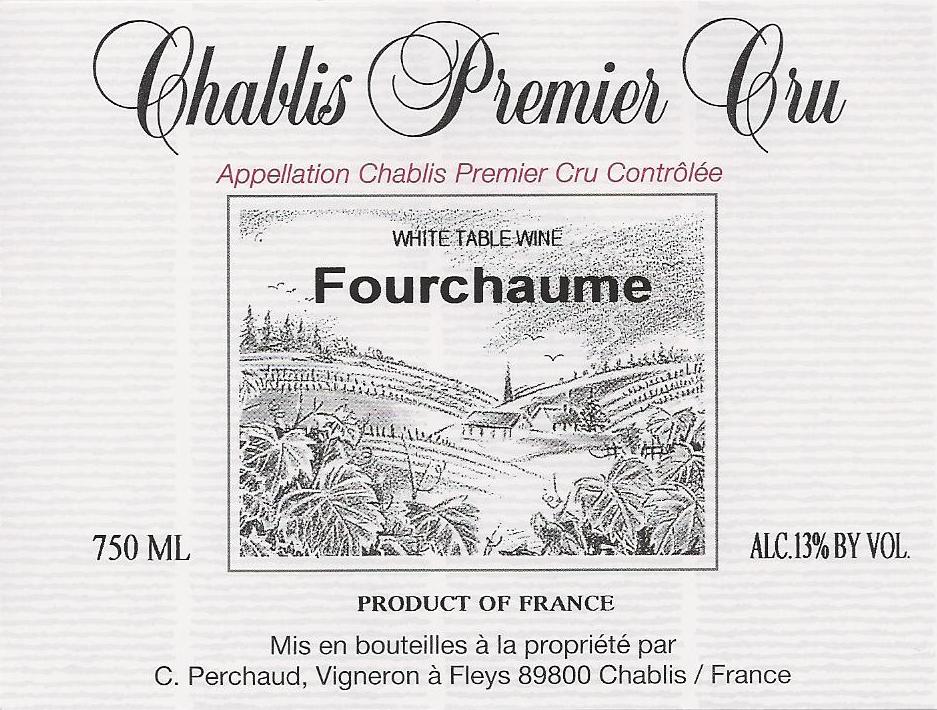
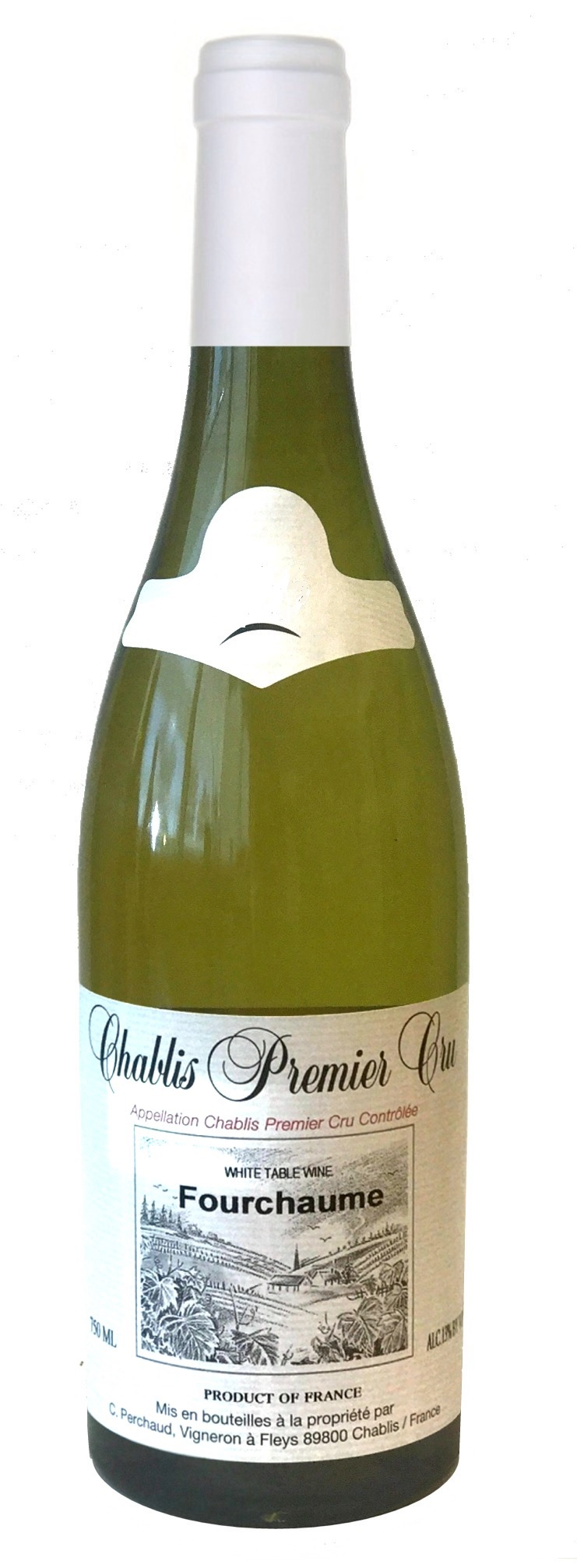
Corinne Perchaud Chablis 1er Cru Fourchaume is made from 100 percent Chardonnay
Elegant citrus aromas. Concentrated and finessed, combining flavors of dried fruit with slight hints of woody notes. Perfect balance between body and acidity, long and persistent finish. This one is drinking great now, but as with all exceptional Chablis, it is possible to pay it down for years to come.
Made from 35 year old vines. The owners take great care to produce exceptional Chablis wine by keeping the lively Chardonnay fruit and the unique mineral quality imparted by the Kimmeridgian soil, the fruity acidity and bouquet in perfect balance. The grapes are harvested by hand and gently pressed in a horizontal pressoir to ensure the fullest extraction and range of flavors and aromas.
Pair with Scallops Jacques cream, roast veal with oyster mushrooms.
Corinne Perchaud Chablis Premier Cru Fourneaux is made from 100 percent Chardonnay.
This is the south facing portion of the slope and very hot, heavy "Fourneaux" or "oven" effect.
The wine is expressive and vivacious with beautiful aromas.
Well-balanced, round and fruity wine with a fine minerality on the finish.
1er Cru Fourneaux is located on the Fleys village and faces the field. the plots are very steep and exposed full south on soil type Kimmeridgian consists of marl clay-limestone with shallow ground and a very stony ground. After a slight settling, the juice starts its fermentation in tank, then ¼ of juice is racked in barrels. Both wines perform their alcoholic fermentation and malolactic and their aging on the lees, separately. The two cuvées are blended six months after harvesting. The wine is then filtered and is bottled 15 months after harvesting. 2013 Conditions and Harvest The relatively high temperatures at the end of winter allowed an early bud vines in early March. With a hot, dry spring flower took place in good conditions. In July, a hailstorm located did some damage to our Fourchaume plot. July and early August, rainy and stormy brought the water needed by the vineyards. The dry and sunny weather of the second half of August brought the grapes to maturity. The harvest began on September 2 under cloudy skies.
Coquille St. Jacques (scallops) with leeks and cream.
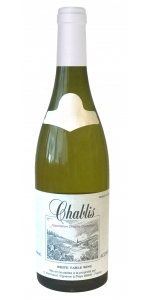
Corinne Perchaud Chablis is 100 percent Chardonnay.
A classic Chablis with aromas of ripe white fruits and a taste of rich minerals.
The Vineyards The plots are in Chablis located predominantly on the village of Fleys, but also on the common Chichée and Fontenay, their total area is 13 hectares. They are mostly north and north-west oriented. The ground floor is Kimmeridgian marl consisting clay and limestone. The oldest of of the vines is 35 years. Winemaking After a slight settling, the juice is put in stainless tanks to achieve its fermentation both alcoholic and malolactic. Ther is a long aging on lees to refine the flavors and develop complex flavors. If necessary, we make a collage of Bentonite to remove proteins and a passing cold which eliminates tartar crystals. Then we perform a tangential filtration method friendly to the wine. The wine is bottles between 14 and 21 months after the harvest.
Pairs well with Oysters or shellfish and Sole Meunière.
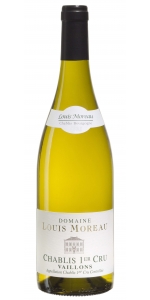
Domaine Louis Moreau Chablis Vaillons Premier Cru is made from 100 percent Chardonnay.
Chablis achieves its highly distinctive mineral character due to its cool northerly climate and its highly calcareous soil. The Domaine Louis Moreau Chablis Vaillons Premier Cru is a generous, fleshy and lively wine that displays a beautiful balance of minerality, fruitiness and elegance.
Chablis, with its steely character and fresh citrus flavor, pairs well with white fish and shellfish and its naturally high acidity can counterbalance cream-based sauces. Unoaked Chablis lends itself well to vegetables, starches, Comté, or fresh goat cheese.
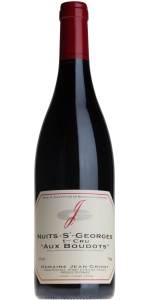
Domaine Jean Grivot Nuits-Saint-Georges Premier Cru Aux Boudots is made from 100 percent Pinot Noir.
Domaine Jean Grivot is among the great names in Burgundian wine. Étienne Grivot and his wife Marielle took over from Étienne’s father Jean Grivot in 1987. The vineyards are densely planted and farmed organically “sans certification” while the aim in the cellar is for balance and clear expression of terroir.
Jean Grivot’s 38.3 acres spread across 22 appellations with vineyards in the communes of Vosne-Romanée, Vougeot, Chambolle-Musigny, and Nuits-Saint-Georges. Besides the three grand crus, there are 8 premier crus including the much lauded Les Beaux Monts and Suchots in Vosne-Romanée. The grapes are completely de-stemmed and fermentation is spontaneous.
Nuits-Saint-Georges Aux Boudots 1er cru lies in the “Zone Vosnoise” or northern end of Nuits-Saint-Georges just below Les Damodes. It borders Vosne-Romanée Aux Malconsorts 1er just to its north. Its position slightly lower on the slope with deep soil full of pebbles results in a richer and fuller wine.
The grapes are destemmed and maceration à froid usually lasts just a day or two. The alcoholic fermentation is spontaneous and malolactic fermentation occurs in barrel. Depending on the vintage, the proportion of new oak is around 30-60% for the premier crus.
The wine shows aromas and flavors of red berries, herbs, and purple flowers. The palate is rich with ripe fruit and medium weight with bright acidity and fine tannins. Aging in 30-60% new Burgundian pièce brings notes of vanilla, toast, and baking spices.
Red Burgundy might be the world’s most flexible food wine. The wine’s high acidity, medium body, medium alcohol, and low tannins make it very food-friendly. Red Burgundy, with its earthy and sometimes gamey character, is a classic partner to roasted game birds, grilled duck breast, and dishes that feature mushrooms, black truffles, or are rich in umami.
Reviews:
‘The 2020 Nuits Saint-Georges Aux Boudots Ter Cru has the best aromatics among Grivat Nuits Saint-Georges with very well defined red berry fruit, briary and lignt sous-bois aromas. The palate is medium-badied with fine-grain tannins, slightly savory on the entry, fresh and saline on the finish. This has real verve and class, though it will benefit from time in bottle
-Vinous 93-95 Points
A wine with the substance and structure to support the generous lashings of new oak used for maturation, and the overall effect is elegant and classic in style. Aux Boudots, where Grivot has 0.85ha, is at the northern edge of Nuits, just over the border from Vosne-Romanée Malconsorts. They began to pick on the 3rd of September – Etienne specified that they are very particular that the tannins are ripe and do what they can to prolong the vegetative cycle. Still, the grapes were picked with an entirely correct pH of around 3.4.
-Decanter 94 Points
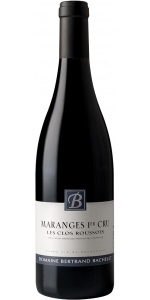
Bertrand Bachelet Maranges Rouge 1er Cru Les Clos Roussots is made from 100 percent Pinot Noir.
The Maranges appellation is the youngest of the Côte de Beaune family, making its debut in May 1989. It spans three villages: Dezize-lès-Maranges, Cheilly-les-Maranges and Sampigny-les-Maranges. Several hills and slopes make up the appellation; they face south/south-east, at an altitude of between 200 and 400 meters. This appellation produces mainly red wines comprising 95% of total production.
The Maranges 1ers Crus are spread over seven distinct terroirs: "Les Clos Roussots", which represents the second largest terroir of the appellation, spans the Cheilly-les-Maranges and Sampigny-les-Maranges areas.
The wine boasts a beautiful bright red color. The nose provides subtle harmony between red and black fruits, spices and vanilla. On the palate, this wine is both solid and fresh, harmonious and bold.
Enjoy with a veal roast and sweet potatoes or matured cheeses.
Perchaud Chablis 1er Cru Fourchaume is made from 100 percent Chardonnay
Elegant citrus aromas. Concentrated and finessed, combining flavors of dried fruit with slight hints of woody notes. Perfect balance between body and acidity, long and persistent finish. This one is drinking great now, but as with all exceptional Chablis, it is possible to pay it down for years to come.
Made from 35 year old vines. The owners take great care to produce exceptional Chablis wine by keeping the lively Chardonnay fruit and the unique mineral quality imparted by the Kimmeridgian soil, the fruity acidity and bouquet in perfect balance. The grapes are harvested by hand and gently pressed in a horizontal pressoir to ensure the fullest extraction and range of flavors and aromas.
Pair with Scallops Jacques cream, roast veal with oyster mushrooms.
The Corinne Perchaud Estate
Corinne Perchaud and her husband Jean-Pierre Grossot began working in the Domaine in 1980, but the estate was originally founded in 1920. They are the third generation of winemakers at this family estate, located in the village of Fleys, in the heart of the Chablis appellation.
"A very good to excellent Chablis producer making some wines in tank and others in barrel; the former are outstanding" - Anthony Dias Blue's pocket guide to wine 2006
The Corinne Perchaud Vineyard
They farm 18 hectares (44.5 acres) of vines: 13 A.O.C. Chablis and 5 hectares Premier Cru. The wines are only tank fermented, except the Fourneaux that gets 25% barrel fermented wine added into the final blend. The owners take great care to produce exceptional Chablis wine by keeping the lively Chardonnay fruit and the unique mineral quality imparted by the Kimmeridgian soil, the fruity acidity and bouquet in perfect balance. The grapes are harvested by hand and gently pressed in a horizontal pressoir to ensure the fullest extraction and range of flavors and aromas.
Domaine Louis Moreau Chablis Vaillons Premier Cru is made from 100 percent Chardonnay.
Chablis achieves its highly distinctive mineral character due to its cool northerly climate and its highly calcareous soil. The Domaine Louis Moreau Chablis Vaillons Premier Cru is a generous, fleshy and lively wine that displays a beautiful balance of minerality, fruitiness and elegance.
Chablis, with its steely character and fresh citrus flavor, pairs well with white fish and shellfish and its naturally high acidity can counterbalance cream-based sauces. Unoaked Chablis lends itself well to vegetables, starches, Comté, or fresh goat cheese.
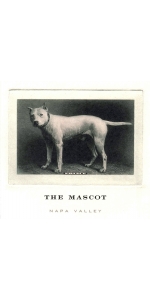
Mascot is a small-production label founded by Will Harlan in Napa Valley. The wines under this label are made from the younger vines of Harlan Estate, BOND, and Promontory, but The Mascot bottles share an exclusive preview at the development of their estates. Founded as an initial experiment to see what the young vines were capable of producing, the wines were initially only shared with close friends and family. By 2008, Will officially released the first vintage to the public since production had increased significantly. They create just one wine made from Cabernet Sauvignon, and the bottle is aged for five years before release. Assembled into a single, youthful expression, this wine shares a glimpse into the evolution and pedigree of its parent estates.
Tasting Notes:
Following a vintage full of changing conditions and demanding decision points, the steady and pleasant progress of the 2018 vintage left our team, at times, in limbo. Contradictory as it may seem, the dramas that sometimes punctuate the definitive months for the growing season help to frame the winegrowing team’s course of action; yet the tranquil succession of weeks that emerged between spring and fall in 2018 left almost entirely open the question of when to harvest. Healthy rainfall in March and April preceded a benevolent summer, whose mildness was interrupted only briefly by a few warming periods. The fruit of the young vines maintained a measured balance that gave the team little indication that harvest was imminent. Fog and temperate days followed in September, when—relying more on instinct than empirical cues—we began to pick. This judgment—as well as the gentle nature of the season—is confirmed in the subtle, ethereal power of the vintage, which reveals itself first in the deep, brooding aromas of dark fruit, black tea, and herbal notes. The texture expands around a lifted structure, as powdery tannins gently resolve. This diffused, enigmatic softness is anchored on the mid-palate by a gratifying density, which prepares the senses for a flourish of hidden energy and vivid detail that illuminates the finish.
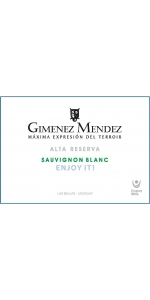
Gimenez Mendez Alta Reserva Sauvignon Blanc is made from 100 percent Sauvignon Blanc.
Gimenez Mendez Sauvignon Blanc shows a very pale hue, almost crystal clear in color. Intense and herbal bouquet in harmony with fruity notes of guava and green apple, mango and maracuja. The wine is full and ample on the palate with a very firm structure. Dry, crisp and lively in the mouth.
Sauvignon blanc grapes are hand harvested very early during some mornings of February. Banches are destemmed and delicately crushed. With a quick press, fresh and very aromatic juice are obtained. Juice is fermented in stainless steel tanks during 15 days at controlled low temperatures, between 14 to 16 °C .Once fermentation is finished lees are kept and stirred for 1 month to get a creamy texture. Then a carefully clarification is necessary. The wine is filtered and stabilized without cold, and finally bottled to keep the freshness. No oak.
Ideal to serve with very spicy seafood, sushi or salads, as well as white meats with sweet-sour sauces, paté. Serve chilled.
Review:
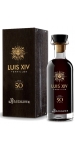
Luis XIV Fondillon Oro 50 years NV is made from 100 percent 100% Monastrell (Mourvedre). Only 24 9 liter cases produced.
The wine is produced in the village of Cañada, in the subarea of Alto Vinalopó in the province of Alicante. Made from 100% Monastrell planted on traditional dry land as bush vines, at 550-580 meters above sea leval and enjoying a Mediterranean climate with great marine influence due to the easterly winds.
Fondillon 50 years is mahogany in color with orange tile rim, medium layer and great density. On the nose, it has a very deep aroma of old wood, black tea and carob. In the mouth, it has a sweet entry balanced by a rich high acidity. Its aromas are long, almost eternal and very intense. It tastes like old mahogany, a very old barrel and bygone times.
Bottled in December 2019.
AGEING:
CASK NAME: Saboners.
AGEING: Aged more than 50 years (single barrel).
TYPE OF WOOD: 19th-century American oak barrels
CASK SIZE: 70 “cántaros valencianos” (805 litros).
ANALYSIS:
GLUCOSE AND FRUCTOSE: 34 gr/litre.
VOLATILE ACIDITY: 1.35 gr/l.
ALCOHOL: 16.2º (NO ADDED ALCOHOL).
FREE SULFITES: less than 10 mg/litre.
TOTAL SULFITES: 76 mg/litre.
Review:
Dark mahogany color, candied fruit aromas, fruit liqueur notes, spicy, varnish, acetaldehyde, bakery, complex. Fine solera notes, bitter flavors."
- Penin 2022, 99 pts
"The NV Fondillón Luis XIV has the subtitle Edad Superior a 50 años (over 50 years old), and it's a dark mahogany, bottled from a single barrel that has the specific profile of a very old wine greatly concentrated by age, which tends to make it similar to other very old and concentrated wines, be it a Mediterranean rancio or a very old Moscatel. It has notes of bitter chocolate, coconut and iodine, carob beans (algarroba) and some bittersweet sensations. It's dense and concentrated, and the palate is pungent, with very intense flavors and a bitter twist in the finish. This has 16.3% alcohol, 6.45 grams of acidity and 34 grams of sugar, but it comes through as very dry. The wine is long and extraordinary, but it just doesn't have any Fondillón character after decades of concentration by evaporation. The price is ludicrous. Only 435 half-liter bottles were filled in December 2019. - Luis GUTIERREZ
- Wine Advocate (September 2020), 95 pts
"Fondillón is an extraordinary treasure of Alicante, a rare product, made from late harvest, non-botrytised grapes, unfortified, but with a final alcohol of no less than 16%. Intense, aged, but not sweet (deliciously not more than 45g/l). Fab with cheese or dark chocolate. The wines have to be a minimum of 10 years; this release is more than 25 years. The project is a revival by David Carbonell of Vins del Comtat and two local families. Very limited quantities. - Sarah Jane Evans MW"
- Decanter (December 2021, My top 10 Spanish fine wines of 2021), 95 pts
Siegel San Elias Merlot is 100 percent Merlot
Soft, rich and concentrated with juicy plum and blackberry fruits, soft tannins and a velvety texture.
Try with hearty stews, pasta and roast red meats.