
" We don't sell the wine without touching the vine "

| Country: | France |
| Regions: | Burgundy Chablis |
| Winery: | Corinne Perchaud |
| Grape Type: | Chardonnay |
| Vintage: | 2012 |
| Bottle Size: | 750 ml |
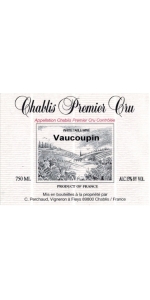
Corinne Perchaud Chablis Premier Cru Vaucoupin is 100 percent Chardonnay.
The vineyard The plots are on the Vaucoupin Chichée village. They are very steep and facing south, their average age is 40 years. The total area is 1.45 hectares. The vines are planted on soil Kimmeridgian marl consisting clay and limestone with dominant clay. Winemaking After a slight settling, the juice is put in to achieve its fermentation tank alcoholic and malolactic. It follows a long aging on lees to bring a maximum of complexity of aromas and flavors. If necessary, we make a collage to bentonite to remove proteins and a passing cold which eliminates tartar crystals. Then we perform a tangential filtration is the filtration method most friendly to wine.
The wine will be bottled 16 months after harvest. The relatively high temperatures at the end of winter allowed an early bud vines in early March. With a hot, dry spring flower took place in good conditions. In July, a hailstorm located did some damage to our Fourchaume plot. July and early August, rainy and stormy brought the water needed for the vineyards. The dry and sunny weather of the second half of August brought the grapes to maturity. The harvest began on September 2 under clement skies.
Pairs well with seafood, shellfish.
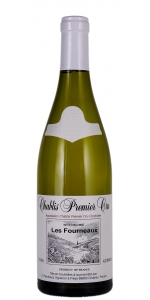
Corinne Perchaud Chablis Premier Cru Fourneaux is made from 100 percent Chardonnay.
This is the south facing portion of the slope and very hot, heavy "Fourneaux" or "oven" effect.
The wine is expressive and vivacious with beautiful aromas.
Well-balanced, round and fruity wine with a fine minerality on the finish.
1er Cru Fourneaux is located on the Fleys village and faces the field. the plots are very steep and exposed full south on soil type Kimmeridgian consists of marl clay-limestone with shallow ground and a very stony ground. After a slight settling, the juice starts its fermentation in tank, then ¼ of juice is racked in barrels. Both wines perform their alcoholic fermentation and malolactic and their aging on the lees, separately. The two cuvées are blended six months after harvesting. The wine is then filtered and is bottled 15 months after harvesting. 2013 Conditions and Harvest The relatively high temperatures at the end of winter allowed an early bud vines in early March. With a hot, dry spring flower took place in good conditions. In July, a hailstorm located did some damage to our Fourchaume plot. July and early August, rainy and stormy brought the water needed by the vineyards. The dry and sunny weather of the second half of August brought the grapes to maturity. The harvest began on September 2 under cloudy skies.
Coquille St. Jacques (scallops) with leeks and cream.
Perchaud Chablis Premier Cru Fourneaux is made from 100 percent Chardonnay.
This is the south facing portion of the slope and very hot, heavy "Fourneaux" or "oven" effect.
The wine is expressive and vivacious with beautiful aromas.
Well-balanced, round and fruity wine with a fine minerality on the finish.
1er Cru Fourneaux is located on the Fleys village and faces the field. the plots are very steep and exposed full south on soil type Kimmeridgian consists of marl clay-limestone with shallow ground and a very stony ground. After a slight settling, the juice starts its fermentation in tank, then ¼ of juice is racked in barrels. Both wines perform their alcoholic fermentation and malolactic and their aging on the lees, separately. The two cuvées are blended six months after harvesting. The wine is then filtered and is bottled 15 months after harvesting. 2013 Conditions and Harvest The relatively high temperatures at the end of winter allowed an early bud vines in early March. With a hot, dry spring flower took place in good conditions. In July, a hailstorm located did some damage to our Fourchaume plot. July and early August, rainy and stormy brought the water needed by the vineyards. The dry and sunny weather of the second half of August brought the grapes to maturity. The harvest began on September 2 under cloudy skies.
Coquille St. Jacques (scallops) with leeks and cream.
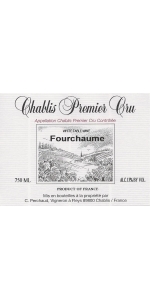
Corinne Perchaud Chablis 1er Cru Fourchaume is made from 100 percent Chardonnay
Elegant citrus aromas. Concentrated and finessed, combining flavors of dried fruit with slight hints of woody notes. Perfect balance between body and acidity, long and persistent finish. This one is drinking great now, but as with all exceptional Chablis, it is possible to pay it down for years to come.
Made from 35 year old vines. The owners take great care to produce exceptional Chablis wine by keeping the lively Chardonnay fruit and the unique mineral quality imparted by the Kimmeridgian soil, the fruity acidity and bouquet in perfect balance. The grapes are harvested by hand and gently pressed in a horizontal pressoir to ensure the fullest extraction and range of flavors and aromas.
Pair with Scallops Jacques cream, roast veal with oyster mushrooms.
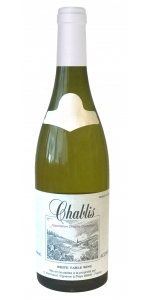
Corinne Perchaud Chablis is 100 percent Chardonnay.
A classic Chablis with aromas of ripe white fruits and a taste of rich minerals.
The Vineyards The plots are in Chablis located predominantly on the village of Fleys, but also on the common Chichée and Fontenay, their total area is 13 hectares. They are mostly north and north-west oriented. The ground floor is Kimmeridgian marl consisting clay and limestone. The oldest of of the vines is 35 years. Winemaking After a slight settling, the juice is put in stainless tanks to achieve its fermentation both alcoholic and malolactic. Ther is a long aging on lees to refine the flavors and develop complex flavors. If necessary, we make a collage of Bentonite to remove proteins and a passing cold which eliminates tartar crystals. Then we perform a tangential filtration method friendly to the wine. The wine is bottles between 14 and 21 months after the harvest.
Pairs well with Oysters or shellfish and Sole Meunière.
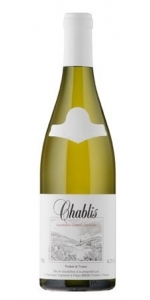
Corinne Perchaud Chablis (half-bottle) is 100 percent Chardonnay.
A classic Chablis with aromas of ripe white fruits and a taste of rich minerals.
The Vineyards The plots are in Chablis located predominantly on the village of Fleys, but also on the common Chichée and Fontenay, their total area is 13 hectares. They are mostly north and north-west oriented. The ground floor is Kimmeridgian marl consisting clay and limestone. The oldest of of the vines is 35 years. Winemaking After a slight settling, the juice is put in stainless tanks to achieve its fermentation both alcoholic and malolactic. There is a long aging on lees to refine the flavors and develop complex flavors. If necessary, we make a collage of Bentonite to remove proteins and a passing cold which eliminates tartar crystals. Then we perform a tangential filtration method friendly to the wine. The wine is bottles between 14 and 21 months after the harvest. 2011 Vintage The relatively high temperatures at the end of winter allowed an early bud vines in early March. With a hot, dry spring flower took place in good conditions. In July, a hailstorm located did some damage to our Fourchaume plot. July and early August, rainy and stormy brought the water needed vineyards. The dry and sunny weather of the second half of August brought the grape good maturity. The harvest began on September 2 under clement skies.
Corrine Perchaud Chablis Premier Cru Vaucoupin 2012 is 100 percent Chardonnay.
The 2011 vintage wines are expressive and vivacious. It is very aromatic and round giving very balanced wines.
A rich and generous wine with a lovely mineral structure.
Best thru 2021.
The vineyard The plots are on the Vaucoupin Chichée village. They are very steep and facing south, their average age is 40 years. The total area is 1.45 hectares. The vines are planted on soil Kimmeridgian marl consisting clay and limestone with dominant clay. Winemaking After a slight settling, the juice is put in to achieve its fermentation tank alcoholic and malolactic. It follows a long aging on lees to bring a maximum of complexity of aromas and flavors. If necessary, we make a collage to bentonite to remove proteins and a passing cold which eliminates tartar crystals. Then we perform a tangential filtration is the filtration method most friendly to wine. The wine will be bottles 16 months after harvest. 2011 Vintage The relatively high temperatures at the end of winter allowed an early bud vines in early March. With a hot, dry spring flower took place in good conditions. In July, a hailstorm located did some damage to our Fourchaume plot. July and early August, rainy and stormy brought the water needed for the vineyards. The dry and sunny weather of the second half of August brought the grapes to maturity. The harvest began on September 2 under clement skies.
The Corinne Perchaud Estate
Corinne Perchaud and her husband Jean-Pierre Grossot began working in the Domaine in 1980, but the estate was originally founded in 1920. They are the third generation of winemakers at this family estate, located in the village of Fleys, in the heart of the Chablis appellation.
"A very good to excellent Chablis producer making some wines in tank and others in barrel; the former are outstanding" - Anthony Dias Blue's pocket guide to wine 2006
The Corinne Perchaud Vineyard
They farm 18 hectares (44.5 acres) of vines: 13 A.O.C. Chablis and 5 hectares Premier Cru. The wines are only tank fermented, except the Fourneaux that gets 25% barrel fermented wine added into the final blend. The owners take great care to produce exceptional Chablis wine by keeping the lively Chardonnay fruit and the unique mineral quality imparted by the Kimmeridgian soil, the fruity acidity and bouquet in perfect balance. The grapes are harvested by hand and gently pressed in a horizontal pressoir to ensure the fullest extraction and range of flavors and aromas.
Copain Edmeades Pinot Noir is made from 100 percent Pinot Noir.
This wine embodies everything you love about Anderson Valley Pinot; flavors of strawberry, Rainier cherries with hints of spice.
VINTAGE NOTES:
The 2017 vintage began with significant rainfall prior to bloom, refilling the state’s reservoirs and ending California’s five-year drought. We saw a sudden spike in temperatures just prior to harvest, leading fruit to ripen quicker than anticipated. This sped up our harvest schedule, but due to our team’s vigilance, the fruit was still able to be picked at optimal ripeness. Temperatures then cooled back down by mid-September, allowing the remaining vineyards to complete ripening at an ideal pace. The rest of harvest was finished as planned, with yields coming in at their typical levels.
The historical Edmeades Vineyard sits along the western side of the small town of Philo in what’s known as the “deep-end” of Anderson Valley. Flanked by the Navarro River, there is a diversity of sandstone soils throughout the vineyard. The Edmeades vineyard is planted with vines facing southwest, allowing this vineyard to receive warmer afternoon weather. This helps to balance the prolonged cool fog influence this vineyard sees throughout the growing season.
Aromas: Raspberry, dried cherries, pennyroyal, orange zest.
Palate: Medium weight palate with soft tannins. Notes of cherry, pomegranate, and clove with light delicate cola notes on the finish.
Review:
The first vintage for this cuvée from Ryan, the 2017 Pinot Noir Edmeades Vineyard comes from mid-valley and was brought up in 27% new French oak. It's a beautiful wine with blueberry and wild strawberry fruits as well as complex spice, dried flowers, and some loamy soil notes. Medium-bodied, seamless, and silky on the palate, it's a lovely, layered wine that shines for its texture and balanced.
'Belle Côte', French for “Beautiful Slope”, was named by Sir Peter after the famous ski run in Courchevel, France. The oldest of the four Knights Valley Estate Chardonnay vineyards, ‘Belle Côte’ consistently exemplifies the potential of crafting exceptionally high-quality Chardonnay from our mountain vineyards. Planted at 1,700 to 1,800 feet (518 to 549 meters), Belle Côte has a southeastern exposure and a western border of native trees, which shelter the vines from the hot afternoon sun. These unique attributes create a naturally cool microclimate that provides an extended growing period and slow-ripening fruit, resulting in a later picking schedule that often continues into October (two to three weeks longer than most Chardonnay vineyards in Napa and Sonoma Counties).
The combination of a wet winter with significant rains in December through March and cool weather delayed budbreak nearly a month. Flowering and fruit set were also pushed back and the weather during the later flowering was favorable resulting in decent fruit set and slightly above average yields for the Chardonnay vineyards—a marked improvement over the record-low yielding 2022 vintage. The growing season was temperate without major heat spikes allowing the berries to hold onto their acidity which carried through into the wines. Harvest was almost a month later than normal with the last Belle Côte block coming in on November 2nd.
As the oldest of the four Peter Michael Winery estate Chardonnay blocks, 'Belle Côte' exemplifies the consistent quality of Chardonnay these mountain vineyards produce. Due to the naturally cool climate of the site’s high elevation, and mitigated exposure to the hot afternoon sun by its southeastern exposure and a stand of trees on its western border, the vines are allowed to slowly ripen. The growing season for Belle Côte typically extends into October, two to three weeks longer than most Chardonnay vineyards in Napa and Sonoma Counties.
With highly expressive aromatics of orange blossom, jasmine, candied orange peel, and rose petal, the 2023 'Belle Côte' showcases its unique terroir and thirty-three-year-old vines with a rich, creamy entry, dense, broad, juicy mid-palate and a lengthy, refined finish. There is a seamless quality to this wine that matches power, gras, and intensity with structure and weightlessness. The 2023 'Belle Côte' can be enjoyed in its youth or after many years of cellaring.
Review:
This extraordinary estate-grown wine from a great vintage is super vibrant, energized and tangy, with vital acidity supporting luscious ripe pear and apple flavors on a silky texture. Can't think of anything it lacks. Seamless, layered, yet structured and fresh, boding well for longer-term aging. It has a melts-in-the-mouth quality and an extra long finish. Drinkable now and best from 2030.
-James Suckling 100 Points



