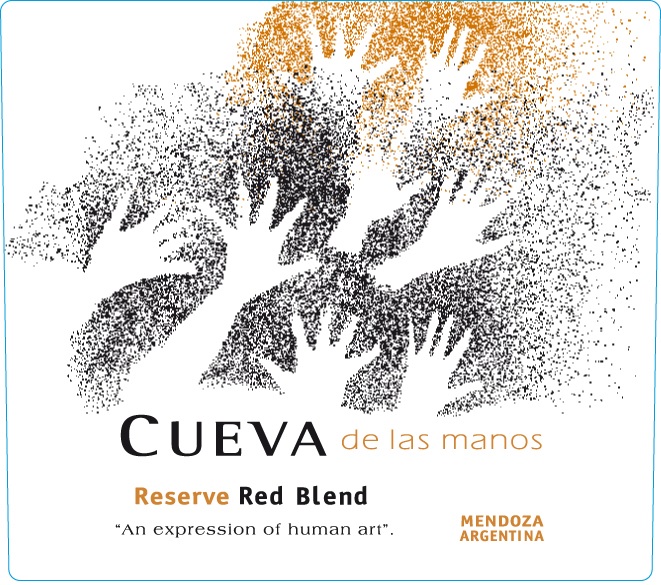
" We don't sell the wine without touching the vine "
| Country: | Argentina |
| Region: | Mendoza |
| Winery: | Cueva de las Manos |
| Grape Types: | Bonarda Cabernet Franc Malbec |
| Vintage: | 2015 |
| Bottle Size: | 750 ml |
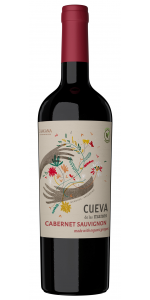
Cueva de las Manos Cabernet Sauvignon Organic is made from 100 percent Malbec.
Cueva de las Manos translates to "Cave of Hands". There are a series of caves in Patagonia containing stenciled paintings of hands, dating back over 9,000 years ago. The caves have been named a World Heritage Site, and they are the inspiration for the label on these wines.
The wine offers an intense bouquet on the nose, with notes of green pepper. On the palate it is smooth and well-textured with a long and elegant finish.
Pair with game meats and pasta with heavy sauce.
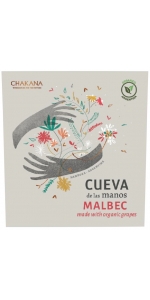
Cueva de las Manos Malbec Organic is made from 100 percent Malbec.
Cueva de las Manos translates to "Cave of Hands". There are a series of caves in Patagonia containing stenciled paintings of hands, dating back over 9,000 years ago. The caves have been named a World Heritage Site, and they are the inspiration for the label on these wines.
Cueva de las Manos Malbec is deep purple in color. Fruity intensity on the nose with floral notes. A juicy texture, mild tannins and good structure balanced by a well-integrated freshness. Clean and pure finish.
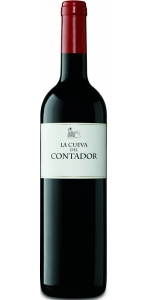
Benjamin Romeo La Cueva del Contador is made from 91% Tempranillo, 9% Garnacha.
Named after the centuries-old caves or “cuevas” carved out of the hillside below the castle of San Vicente in Sonsierra north of the Ebro, this wine is composed of 91 percent Tempranillo and 9 percent Garnacha. The fruit is sourced from eight different plots that yield about 1.2 kg per vine. Fermentation begins after a three-day cold maceration and the wine is aged for nineteen months in 100 percent new French oak and bottled without fining or filtration.
The palate offers flavors of blackberry coulis, Damson plums, Rosemary and well-integrated tannins; this wine is well balanced and youthful with a long powerful finish. Both red and black fruit are pronounced in the nose, but there are also mineral and herbal notes of gravel and lavender.
Review:
I found cleaner aromas and a fresher quality and finer tannins in the 2019 La Cueva del Contador, a quite complete wine with elegance and finesse combined with power and concentration. The oak is still noticeable after 18 months in new barriques, and I'd wait a little longer before pulling the cork. It has the perfume of La Cueva in the background. It should resurface with a little more time in bottle. 10,000 bottles produced.
-Wine Advocate 95 Points
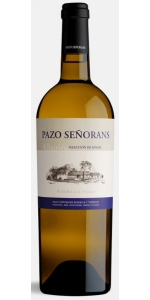
Pazo de Senorans Seleccion de Anada Albarino is made from 100 percent Albarino.
Straw yellow with greenish tints, vivid and brilliant. High intensity and very expressive. Profusion of aromas with traces of mineral. Great volume and ample body leaving a lasting impression from beginning to end.
Reviews:
The 2015 Albariño Selección de Añada is nothing short of phenomenal. For some reason, I hadn't tasted the young 2015 Albariño at the time it was released. It comes from the Los Bancales vineyard planted some 50 years ago and fermented with indigenous yeasts but without malolactic fermentation. It has a bright, almost fluorescent color and a complex, subtle and nuanced, elegant and expressive nose, with notes of sea shells and sea breeze, grass and white flowers. It's very clean, and the palate shows great balance and even feels a bit young. It has remarkable acidity and freshness (seven grams of tartaric acid) with good ripeness and 13% alcohol. This matured in tank with lees for over 30 months and was bottled in June 2024. It feels more serious and less exotic than earlier vintages. 18,000 bottles produced. This is the finest vintage that I can remember. Bravo!
-Wine Advocate 97 Points
Tech:
The Prisoner Wine Company The Prisoner Red Blend is made from a blend of Zinfandel, Cabernet Sauvignon, Petite Sirah, Syrah, and Charbono.
Bright aromas of ripe raspberry, vanilla, and coconut give way to flavors of fresh and dried blackberry, pomegranate, and vanilla, which linger harmoniously for a smooth and luscious finish.The Prisoner Red Blend was inspired by the wines first made by the Italian immigrants who originally settled in Napa Valley. The Prisoner is now the most recognized red blend, leading the resurgence of interesting blends by incorporating Zinfandel with the unlikely mix of Cabernet Sauvignon, Petite Sirah, Syrah, and Charbono.
On the nose, dried blackberry, dried açai berries, and hints of cedar and tobacco leaf are accented by sweet spices of clove, cinnamon, and nutmeg. Flavors of ripe dark cherry, blackberry coulis, and hints of anise linger harmoniously for a soft, vibrant finish balanced by ripe tannins.
Chef Brett recommends pairing The Prisoner Red Blend with Kalbi Short Ribs or Chicken Mole Tostada.
Vineyards: When you outgrow winemaking tradition, you must forge your own path. And we did. The Prisoner exists because of the collaboration with our growers, many of which have been with us since the very beginning—from the Solari Family Vineyard in Calistoga, where old school sensibilities meet new techniques, to the Korte Ranch in St. Helena, a vineyard whose diligence outlasted the Prohibition and has sustained four generations.
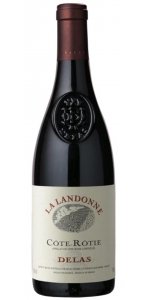
Delas Freres Cote Rotie La Landonne Rouge is made from 100 percent Syrah.
This very ancient region dates back to the Roman Era and is located on the right bank of the Rhône. It is said that during the Middle Ages, “The Seigneur de Maugiron” gave a hillside to each of his two daughters - one was brunette and the other fair - thus, were born the names of “Côte Brune” and “Côte Blonde.” Wines from the Côte Blonde tend to be more delicate and lighter in character than the fuller wines of the Côte Brune. Together, they make a wine of style and substance. This cuvée is a vineyard plot selection. The grapes come exclusively from a plot within the named slope of “La Landonne.”
This cuvée‘s first vintage was 1997. The wine is only made in the very best years. Its highly limited production never exceeds 2,500 bottles per year.
The steep, terraced hillsides along the river produce wines that are among the "biggest" reds of France. The Delas Côte-Rôtie is primarily Syrah with an addition of up to 10 to 20% of Viognier grapes in the crop. The soils of the northern part of the Côte Brune vineyard consists of extremely steep, terraced slopes of ferruginous mica schists which are covered with schist sand (arzel). The Côte Blonde has a varied geology with gneiss and granite predominating at the most southern side of the appellation. The area has dry, hot summers with regular rainfalls during other seasons. The grapes for the “La Landonne” cuvée are picked by hand at maximum maturity. Fermentation takes place in traditional open-topped concrete tanks, following three days of pre-fermentation cold maceration. Before fermentation, the maceration process continues under controlled temperatures of 82°F to 86°F. Daily cap pushing down and pumping over are carried out for about 10 days with total vatting time of up to 20 days. The wine is aged for 14 to 16 months in new or one year old oak casks. The barrels are topped up regularly.
Food Pairing: This wine pairs wonderfully with fine meats, roasted beef, water games, truffles and spicy stews. The bottle should be opened 1 to 3 hours before drinking. This wine needs at least 3 years cellaring before it can open up its complexity. In such case it is strongly recommended to decant before serving.
Tasting Notes: The wine‘s deep color is underscored by plummy hues. A complex nose shows deep, fruity aromas with hints of licorice and roasted coffee. Endowed with a dense and silky tannic structure, this is a full, fleshy wine that provides an ample and generous palate. Its lasting finish speaks of considerable ageing potential.
Reviews:
This is dark and still a bit reticent, with a cast iron cloak around the core of dark currant, plum and blackberry paste flavors, showing lots of sweet bay leaf, anise and singed apple wood notes in the background. There's serious grip through the finish. For the cellar.
-Wine Spectator 96 Points
Very open, spicy and fresh on the nose, you could almost open this now. Struck flint notes assist in teasing out notes of leaf tea, tobacco, rosemary and rose. Very full-bodied, generous but powerful on the palate, tense and mineral. Mouthcoating ripe, sweet tannin and robust amounts of sweet baking spices, along with more tobacco and black fruit on the palate. Has depth, length, power and impressive balance despite the high alcohol. Drink from now into 2022, or from 2031 to 2040. Lieu-dit La Landonne, from the Brune side (mica schist bedrock). Matured in new and one-year-old barrels for 14 months.
-Decanter 96 Points
The 2019 Côte Rôtie La Landonne comes from one of the greatest sites for Syrah in the world, the La Landonne lieu-dit located close to the center of the appellation, on the Côte Brune side. It reveals a deeper purple hue (it's slightly more opaque than the Seigneur de Maugiron) and offers a brilliant nose of ripe cassis, black raspberries, scorched earth, smoked herbs, and seared meat. Full-bodied and powerful on the palate, this is a deep, spicy, concentrated Côte Rôtie with a plush, layered mouthfeel, sweet tannins, beautiful balance, and a great, great finish. This puppy brings the fruit, opulence, and texture of the vintage yet still has a classic Côte Rôtie character.
-Jeb Dunnuck 96 Points
Fresh aromatic layers of mint sit atop crushed red cherries and wild strawberries, with light clove and thyme on the nose. The palate is rich and enticing with black cherries, plums, rhubarb, pomegranate seeds, black olives and freshly picked rosemary leaves. Tremendous texture, structure, and refreshing acidity carry this wine to a robust finish of orange zest and black tea leaves. Maisons Marques & Domaines USA.
- Wine Enthusiast 96 Points
This very ancient region dates back to the Roman Era and is located on the right bank of the Rhône. It is said that during the Middle Ages, “The Seigneur de Maugiron” gave a hillside to each of his two daughters - one was brunette and the other fair - thus, were born the names of “Côte Brune” and “Côte Blonde.” Wines from the Côte Blonde tend to be more delicate and lighter in character than the fuller wines of the Côte Brune. Together, they make a wine of style and substance. This cuvée is a vineyard plot selection. The grapes come exclusively from a plot within the named slope of “La Landonne.”
This cuvée‘s first vintage was 1997. The wine is only made in the very best years. Its highly limited production never exceeds 2,500 bottles per year.
The steep, terraced hillsides along the river produce wines that are among the "biggest" reds of France. The Delas Côte-Rôtie is primarily Syrah with an addition of up to 10 to 20% of Viognier grapes in the crop. The soils of the northern part of the Côte Brune vineyard consists of extremely steep, terraced slopes of ferruginous mica schists which are covered with schist sand (arzel). The Côte Blonde has a varied geology with gneiss and granite predominating at the most southern side of the appellation. The area has dry, hot summers with regular rainfalls during other seasons. The grapes for the “La Landonne” cuvée are picked by hand at maximum maturity. Fermentation takes place in traditional open-topped concrete tanks, following three days of pre-fermentation cold maceration. Before fermentation, the maceration process continues under controlled temperatures of 82°F to 86°F. Daily cap pushing down and pumping over are carried out for about 10 days with total vatting time of up to 20 days. The wine is aged for 14 to 16 months in new or one year old oak casks. The barrels are topped up regularly.
Tasting Notes
The wine‘s deep color is underscored by plummy hues. A complex nose shows deep, fruity aromas with hints of licorice and roasted coffee. Endowed with a dense and silky tannic structure, this is a full, fleshy wine that provides an ample and generous palate. Its lasting finish speaks of considerable ageing potential.
Food Pairing
This wine pairs wonderfully with fine meats, roasted beef, water games, truffles and spicy stews. The bottle should be opened 1 to 3 hours before drinking. This wine needs at least 3 years cellaring before it can open up its complexity. In such case it is strongly recommended to decant before serving.
Cueva de las Manos Red Blend is made from 70% Malbec, 29% Bonarda, 1% Cabernet Franc
Opaque in color, this saturated Malbec-led blend exhibits coconut and cola aromas along with fully ripe blackberry notes. This is massive in the mouth, with a solid foundation. Maximum berry expression and a jammy, deep-fruited finish give this power and content beyond its price point.
The Cueva de las Manos Estate
Looking for Chakana's other labels?
Click below:
Cueva de las Manos is produced in a state-of-the-art winery, Chakana, built with the purpose of achieving outstanding quality.
Chakana winery was founded by Juan Pelizzatti on May 2nd, 2002. Juan was driven to enter the wine industry first and foremost by his passion for wine, and also by the desire to invest his time and money on a product of agriculture. Although Juan did not know it at the time, the company was founded on the same day the Chakana was celebrated on the Andes highlands: on that same day, the Southern Cross (the Chakana for the Inca people) becomes vertical in the night Andean sky.
Juan's mission is to create an integral experience to introduce world consumers to the taste and culture of the Andes. His vision is to become one of the top 20 exporters of wine from Argentina, by consistently offering outstanding value for money.
Wine is currently produced in four different levels at Chakana, by winemaker Gabriel Bloise:
Entry Level: Maipe
Reserve Level: Maipe Reserve, Cueva de las Manos, Nuna
Estate Selection
Ayni
The winemaking process is focused on treating the grapes with great care and with strict control of every step of the production.
Wines are designed under the responsibility of the renowned international wine consultant Alberto Antonini.
The winery is located on a 150 ha. estate, 34 km South of the city of Mendoza, in Agrelo, Lujan de Cuyo.
The grapes grown are 35 year-old Malbec, Bonarda and Cabernet Sauvignon.
Deep and textured soils facilitate plant development and confer great body and structure to the wines.
The year-long sunny and dry conditions allow almost organic viticulture practices. The outstanding feature includes a great daily thermal amplitude, with mild days and cold nights, permitting a particular richness of polifenols that improves the wines flavors and color.
A drip irrigation system has been set up to achieve a precise control of the vegetative cycle and a rational use of water. Waters are processed and used in the vineyards.
The Cueva de las Manos Vineyards
Chakana sources grapes from their own four estates:
Agrelo
Acreage: 150 ha, 120 ha with vineyards
70 ha entry level
40 ha reserve level
10 ha estate & ayni
Acreage by varietal at Agrelo Estate:
Malbec: 50 ha
Cabernet Sauvignon: 30 ha
Syrah: 10 ha
Bonarda: 10 ha
Tannat: 2,5 ha
Petit Verdot: 2.5 ha
Cabernet Franc: 1.5 ha
Aspirant Bouchet: 2.5 ha
Ancellotta: 2 ha
Sauvignon Blanc: 4 ha
Viognier: 2.5 ha
Chardonnay: 2.5 ha
Wine Profile: Medium bodied, elegant, fresher fruit. Round tannin on gravels.
Terroir: Very heterogeneous – deep clay to sandy clay gravels; cool climate
Altamira I
Acreage: 15 ha, Malbec high density. Planted in 2010, not in production
Wine Profile: Full bodied, impressive tannic structure and roundness, spicy and complex.
Terroir: Sandy clay gravel, limestone; cooler climate
Altamira II
Acreage: 36 ha, 26 ha with vineyards
20 ha malbec, estate and ayni level
4 ha chardonnay, entry level and reserve
2 ha pinot noir (used for sparkling wine)
Wine Profile: Medium bodied, elegant, fresher fruit. Round tannin on gravels.
Terroir: Very heterogeneous – deep clay to sandy clay gravels; cool climate
Terrada
Acreage: 21 ha, all in vines
100% malbec, old vines, high density
Reserve – Estate Selection
Wine Profile: Complex, ripe fruit, medium bodied, elegant.
Terroir: Sandy clay gravels, 70cm. soil depth, Some limestone; warmer climate.
They also source wines from contract suppliers in Ugarteche and Medrano, for entry level wines, and in Vista Flores, for Estate Selection & Ayni levels.
Alejandro Bulgheroni Lithology Beckstoffer Las Piedras Cabernet Sauvignon is made from 100 percent Cabernet Sauvignon.
From a St. Helena vineyard planted by early Napa settler Edward Bale more than 150 years ago, and later serving as the estate vineyard for the area’s first winery built by Henry Pellet in 1860, the Las Piedras site always gives us our prettiest wine. When placed next to Dr. Crane and To-Kalon wines, the Las Piedras show a certain elegance, with a very graceful entry and finely detailed complexity. We produce it with at least 75% new French oak, so there is a floral, spicy, and vanilla accent to the intense red and black fruits, cassis, and black cherry liqueur. What distinguishes this bottling is the beautifully fine tannins, delicate texture, and stunning purity. (Less than 100 cases made.)
Fermentation 70% Oak, 24% Concrete, 6% Puncheon
Review:
"The 2018 Cabernet Sauvignon Lithology Beckstoffer Las Piedras Vineyard comes from a world-class site outside of St. Helena and is all Cabernet that spent 20 months in 80% new oak. It offers a touch more red fruit as well ample cassis, spring flowers, loamy earth, and spice-like aromas and flavors. It has a wonderful sense of minerality, ultra-fine tannins, a dense, layered texture, and incredibly purity of fruit. It’s another just about off the charts release from this estate."
- Jeb Dunnuck 98 Points
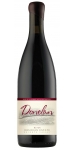
Obsidian Vineyard Syrah is bathed in terroir. The vines experience severe stress, pushing the roots ever deeper through rock in search of water, producing miniature clusters of intense power. Given the wine’s natural propensity for tannin, we take extreme care in the cellar to chisel/whittle its rough edges and leave room for richness to flatter its distinctive scaffold. The mid-palate supports flavors of roasted coffee beans, sarsaparilla, and dark chocolate. The finish marches on long after most wines have tired.
Our estate vineyard — the six-acre Obsidian Vineyard in the Knights Valley AVA — has an incredibly complex soil structure. It takes its name from a layer of volcanic obsidian rock that was discovered when we drilled for water.
Chocolate ganache, black currants, fig, graphite, and an expansive mouthfeel.
Review:
"Joe Donelan believes his Obsidian Vineyard is one of the world’s greatest sites for Syrah. I’ve visited the site twice, and can say candidly it certainly sits among the most striking vineyards I've ever laid eyes on within the U.S. It sits like a rock on a promontory—two switchbacks to reach the top—and the stones under the top soil, quite literally, never stop emerging from the ground. The place has an ancient, almost sacred, temple-like feel. It is consistently swept by afternoon breezes. The vineyard was replanted in 2017 after fires ravaged it. Winemaker David Milner laid out the site at denser spacing than before, at 2,000 vines per acre to keep yields per vine low while still achieving sensible tonnage, averaging around three tonnes per acre. Viognier was planted for co-fermentations, alongside some Cabernet Sauvignon, for a single vineyard bottling of that grape. ‘God put on his viticultural hat when he designed this site,’ says Milner. The vineyard is planted with ENTA 174, 877, and Alban 1 clones, along with Donelan Heritage selections certified virus-free. The wine, the 2023 vintage release (the first from the new vines), was aged for 21 months in 36% new oak and co-fermented with 1.8% Viognier, using 32% whole clusters. And it is positively gorgeous: composed of nine different blocks, each fermented separately, then assembled through sequential blending, with no racking until bottling. From just five-year-old vines, this wine is utterly extraordinary—something oddly achievable from young vines on rare occasion. I tasted this wine from the same bottle over three days. While the high-toned espresso-bean and cedar accents are present at first pull of the cork, they mellow out a day later, and the fruit profile is so vibrant. This is the sign of an excellent wine. I first tasted wines from the Donelan’s Obsidian Vineyard years ago at Tasting Panel Magazine in the late, great Anthony Dias Blue’s office. Cushing Donelan showed the wines, and to this day, I recall the first moment I put my nose into a glass of Obsidian Syrah. In early January of 2026, as I nosed this brand new release of Obsidian Syrah, I was transported straight back to that tasting twelve years ago. What’s remarkable is that the aromatics are unmistakably the same, yet from these new, more densely planted vines, the aromas are more refined—precision-farmed wines from young vines delivering a level of detail and poise that feels beyond their years. So what’s in the glass? Pure red, black, and blue fruit nuances layered with tobacco, white truffle character, violet pastille, and an intoxicating perfume. White pepper notes emerge on the medium- to full-bodied palate, framed by velvety tannins. Iron-like and crushed slate minerality underpins dazzling black cherry and blackberry fruit, brown spices, and blood orange richness. There’s a velvety, iron-fist quality here that exudes polish, complexity, and undeniable quality. You want to drink it now—and you absolutely can—but it will also reward time in the cellar. Either way, you’ll be utterly wowed. And when you realise the price is under £100, the achievement becomes even more staggering. As these vines mature, what will become of them in subsequent vintages? I suspect that as the vines mature, they'll go in and out of phases, but so long as Mother Nature cooperates, I expect this wine to continue to dazzle each vintage. - Jonathan CRISTALDI"
Decanter (January 5th 2026), 100 points
This is the first vintage of the Obsidian Syrah after wildfires torched the vineyard in 2017, leading to significant redevelopment. Throughout all those years, the Donelans have exhibited remarkable patience and a clear sense of purpose. This is their reward: a truly magnificent, towering wine of the highest level.
Knights Valley is one of the most magical grape-growing districts in the United States, but it is not very well known because only a few estate wineries are located there.
The 2023 Syria Obsidian Estate is one of the most profound, moving wines I have tasted in Sonoma County. Blackberry, gravel, incense, chocolate, lavender, and dried herbs race out of the glass. Delicate yet powerful, the 2023 is spectacular. It is also very fairly priced in today’s market.
Vinous 100 Points