
" We don't sell the wine without touching the vine "
| Country: | United States |
| Regions: | Washington Washington (Red Mountain) |
| Winery: | Force Majeure |
| Grape Type: | Cabernet Sauvignon |
| Vintage: | 2018 |
| Bottle Size: | 750 ml |

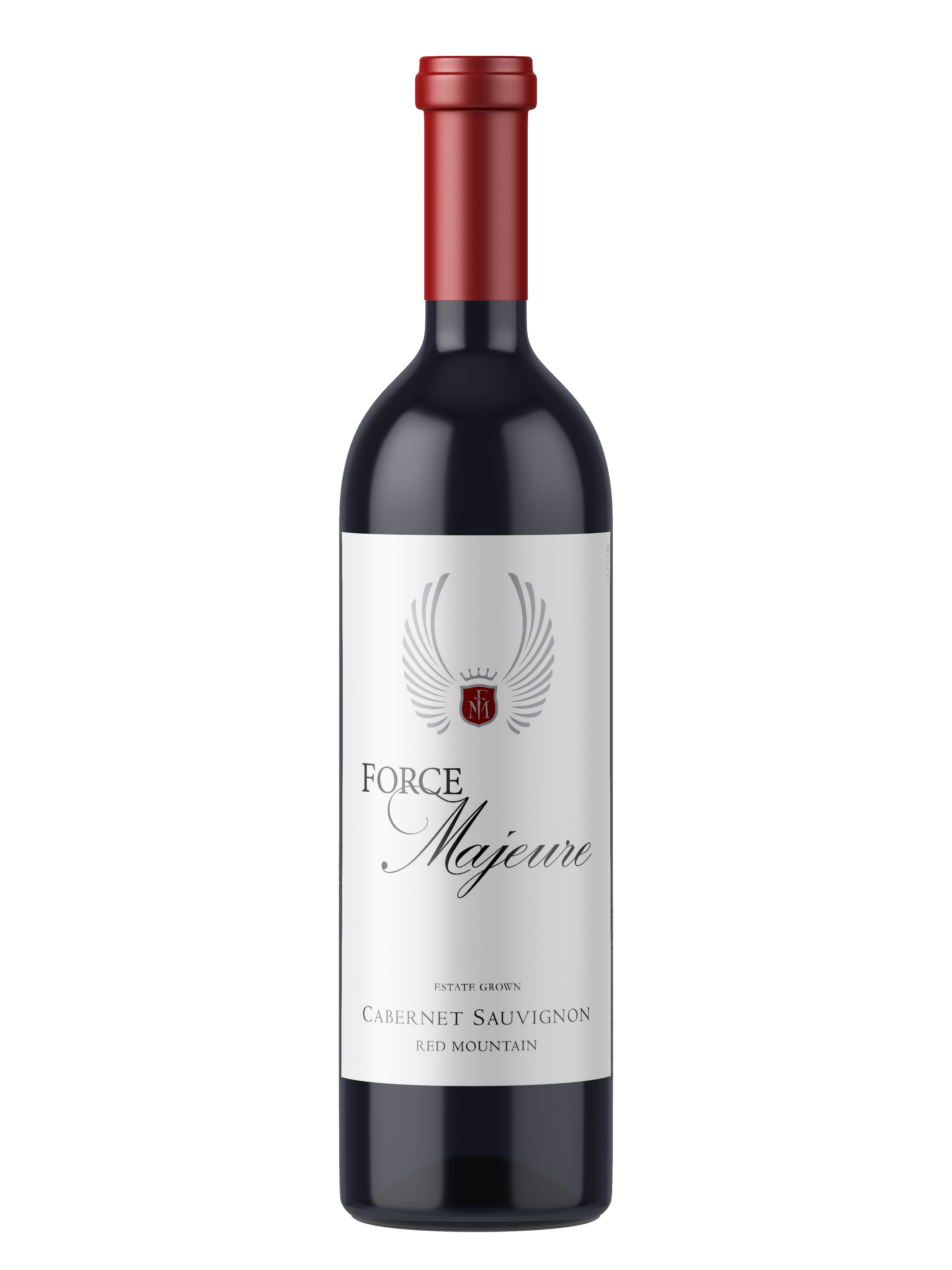
Force Majeure Cabernet Sauvignon Red Mountain is made from 100 percent Cabernet Sauvignon.
The estate Cabernet Sauvignon is grown primarily along the southwest ridge of the vineyard. The vines produce small berries with bountiful flavor, concentration and intensity, but also a good degree of finesse, excellent structure and layers of complexity that will continue to develop during extended bottle aging for those who want to cellar and age their wines. The wine is powerful, elegant, full-bodied.
Bottled unfined and unfiltered.100% free run
Pumpovers and punch-downs, up to 45 day macerations
Native yeast, 5 day cold soaks
22 months in 75% new French oak barrels
Fermented in concrete and stainless closed top tanks.
Review:
Another gem is the 2019 Cabernet Sauvignon Red Mountain Estate, a deep, concentrated, powerful Red Mountain Cabernet Sauvignon that I suspect will be up there with the legendary wines from this terroir. Beautiful cassis, graphite, lead pencil shavings, and damp earth notes give way to a full-bodied effort that has a liqueur of rocks-like minerality, flawless balance, building yet polished tannins, and a great finish. Hide bottles for 4-5 years, and it will evolve for 25-30 years if properly stored. Best After 2026.
-Jeb Dunnuck 98+ Points
"Blackberry, crushed rock, black cherry and spice aromas lead to ripe, intense, seamless, balanced dark-fruit flavors. The tannins give a firm grip. An extended finish caps it off. It's glorious. - SEAN P. SULLIVAN" - Wine Enthusiast (November 2022), 95 pts "A gutsy red that retains a sense of style and polish, with expressive blackberry, espresso and toasty spice flavors that build structure toward broad-shouldered tannins. Drink now through 2030. —Tim FISH." - Wine Spectator (Insider, January 4th 2023), 94 ptsReview:
-Jeb Dunnuck 98 Points
-Owen Bargreen (Vinous) 97 Points
-Wine Enthusiast 95 Points

Force Majeure Epinette is made from 79% Merlot, 8% Cabernet Sauvignon, 8% Cabernet Franc, and 5% Petit Verdot .
Epinette is Force Majeure's Right-bank Bordeaux-inspired blend, and was named after an avenue in Libourne (France) that leads to Pomerol and Saint-Émilion, the home of Merlot and Cabernet Franc. Epinette is also the name of a musical instrument akin to a piano, as well as a word for pine tree, which is a fitting nod to their home in Washington state.
The wine itself is a blend of primarily Merlot and Cabernet Franc, with smaller amounts of Cabernet Sauvignon and Petit Verdot, proportions of which change depending on the vintage. The Merlot and Cabernet Franc are grown in lower areas of the vineyard with deep, well-drained soils, much less rocky than the soils of our Rhone varietals.
Review:
-Jeb Dunnuck 97 Points
The estate Cabernet Sauvignon is grown primarily along the southwest ridge of the vineyard. The vines produce small berries with bountiful flavor, concentration and intensity, but also a good degree of finesse, excellent structure and layers of complexity that will continue to develop during extended bottle aging for those who want to cellar and age their wines. The wine is powerful, elegant, full-bodied.
Bottled unfined and unfiltered.100% free run
Pumpovers and punch-downs, up to 45 day macerations
Native yeast, 5 day cold soaks
22 months in 75% new French oak barrels
Fermented in concrete and stainless closed top tanks.
Review:
-Jeb Dunnuck 95 Points
-Anthony Mueller (Robert Parker) 95 Points
-Wine Spectator's Insider 93 Points
-Stephen Tanzer (Vinous) 92 Points
Force Majeure Epinette is made from 46% Merlot, 35% Cabernet Franc, 16% Cabernet Sauvignon, 3% Petit Verdot.
Epinette is Force Majeure's Right-bank Bordeaux-inspired blend, and was named after an avenue in Libourne (France) that leads to Pomerol and Saint-Émilion, the home of Merlot and Cabernet Franc. Epinette is also the name of a musical instrument akin to a piano, as well as a word for pine tree, which is a fitting nod to their home in Washington state.
The wine itself is a blend of primarily Merlot and Cabernet Franc, with smaller amounts of Cabernet Sauvignon and Petit Verdot, proportions of which change depending on the vintage. The Merlot and Cabernet Franc are grown in lower areas of the vineyard with deep, well-drained soils, much less rocky than the soils of our Rhone varietals.
Review:
-Jeb Dunnuck 95 Points
-Anthony Mueller (Robert Parker) 94 Points
Force Majeure Epinette is made from 46% Merlot, 35% Cabernet Franc, 16% Cabernet Sauvignon, 3% Petit Verdot.
Epinette is Force Majeure's Right-bank Bordeaux-inspired blend, and was named after an avenue in Libourne (France) that leads to Pomerol and Saint-Émilion, the home of Merlot and Cabernet Franc. Epinette is also the name of a musical instrument akin to a piano, as well as a word for pine tree, which is a fitting nod to their home in Washington state.
The wine itself is a blend of primarily Merlot and Cabernet Franc, with smaller amounts of Cabernet Sauvignon and Petit Verdot, proportions of which change depending on the vintage. The Merlot and Cabernet Franc are grown in lower areas of the vineyard with deep, well-drained soils, much less rocky than the soils of our Rhone varietals.
Review:
-Jeb Dunnuck 96 Points
-Antonio Galloni's Vinous 94 Points
-Stephen Tanzer (Vinous) 94 Points

Force Majeure estate Syrah is made from 100 percent Syrah.
The Force Majeure estate Syrah is cultivated in a combination of the 8 soil types that exist in the vineyard, with most of it being planted in very steep, very rocky locations, but some also planted in deeper, loamier soils.
The estate Syrah typically exhibits a broad spectrum of black, blue and red fruits, dried herbs and jasmine, fennel, smoked meats and crushed rock along with very fine tannins, great length, balance and complexity.
Appellation Red Mountain Varietal(s) 100% Syrah
Soil type Very steep, rocky locations, but some also planted in deeper, loamier soils
Vinification 22% whole cluster, remainder destemmed. Fermented in concrete, open top and closed top stainless. ~25% new French oak for 18 months, mostly larger format (300L to 500L) Native yeast, cold soak up front Macerations up to 30 days; pumpovers and punch-downs 100% free run. The wine is bottled unfined and unfiltered.
Production 500 (9-liter cases)
Review:
-Jeb Dunnuck 97 Points
-Eric Guido (Vinous) 95 Points
-Anthony Mueller (Robert Parker) 94 Points
Force Majeure Cabernet Sauvignon Red Mountain is made from 100 percent Cabernet Sauvignon.
The estate Cabernet Sauvignon is grown primarily along the southwest ridge of the vineyard. The vines produce small berries with bountiful flavor, concentration and intensity, but also a good degree of finesse, excellent structure and layers of complexity that will continue to develop during extended bottle aging for those who want to cellar and age their wines. The wine is powerful, elegant, full-bodied.
Bottled unfined and unfiltered.100% free run
Pumpovers and punch-downs, up to 45 day macerations
Native yeast, 5 day cold soaks
22 months in 75% new French oak barrels
Fermented in concrete and stainless closed top tanks.
Review:
"One of the wines of the vintage. Comprised of 95% Cabernet Sauvignon, with small parts Merlot and Petit Verdot, this saw 80% new French oak prior to bottling. The nose is downright intoxicating with crème de cassis, anise, blueberry compote and sandalwood tones that all meld in the glass. The palate is rich and seductive, with not only beautiful concentration but a seamless texture and downright brilliant length. Rich crème de violette, sagebrush, blackberry cordial and mocha flavours provide plenty of exotic appeal."
- Decanter (April 2021), 99 pts
Force Majeure is an ultra-premium winery located in the Walla Walla Valley, specializing in estate-grown, single-vineyard Bordeaux and Rhône-inspired wines. Our wines are meticulously crafted by former Bryant Family Vineyard Winemaker, Todd Alexander. From its inception, Force Majeure has been defined by unwavering commitment to outstanding viticulture and exemplary winemaking. Our original estate vineyard is located in the famous Red Mountain AVA and we have added two new vineyard sites over the past couple of years in the Walla Walla Valley. Our estate vineyards are painstakingly farmed by a stellar team.
“Force Majeure” describes the relentless, powerful elements of Nature that form the terroir of our vineyard. It also identifies the “unstoppable force” initiated when the highest level of viticulture is combined with the highest level of winemaking talent.
Our wines are produced in small quantities and are available via mailing list, as well as through a few select retailers and finer restaurants. We invite you to add your name to our mailing list to receive upcoming wine allocation offers. Wines are typically released two to three times per year.
RED MOUNTAIN AVA
Drawing inspiration from the great vineyards of Bordeaux, the Northern and Southern Rhône valleys, as well as parts of Spain, and with a desire to challenge existing viticultural practices in Washington state, we embarked on an ambitious plan to pioneer the very first vineyard on the steep, rocky upper slopes of Red Mountain, from where we knew we could create wines that were profound and powerful yet balanced and finessed, distinct and world-class. Most importantly, we knew the site would be unique and singular.
The effort to develop our Red Mountain estate site involved the careful matching of varietal and clonal selections, trellising and irrigation to the eight distinct soil types in our vineyard that were formed by the ancient Missoula floods, winds and volcanic activity. The outcome is a vineyard articulated into many small “micro-blocks,” maximizing the potential of this unique and dynamic site. This steep vineyard ranges in elevation from 960 to 1,230 feet and is, of course, completely farmed by hand. The rocky upper-slope with shallow soil is well suited to the cultivation of varietals such as Syrah and Grenache, while the lower blocks of the vineyard are comprised of deep, well-drained Warden soils, where varietals such as Cabernet Sauvignon, Merlot and Cabernet Franc excel.
The overall exposure of the site is west/southwest, and the Syrah planted on the hill is tightly spaced to provide some shade on the fruit. The soils have a volcanic foundation, being composed of fractured basalt, concreted ash and wind-blown loess with a high calcium carbonate content and granite erratics from the Missoula floods. The site was purchased in 2004 and development began in 2006.
ROCKS DISTRICT OF MILTON-FREEWATER AVA
We have recently acquired a small vineyard in the Walla Walla Valley, one-hour drive from Red Mountain. The property is partially within the boundaries of the The Rocks District of Milton-Freewater AVA, on the Oregon side of the border, and is located adjacent to the site of our new winery. The portion of the vineyard outside The Rocks District is within the borders of the Walla Walla Valley AVA. The Rocks District is an alluvial fan, and the cobbles that define the area are a result of deposits left by the Walla Walla River. This vineyard was planted between 1992 and 1994, and has a diverse soil profile that sets it apart from other vineyards in the area, and certainly from our Red Mountain site. The amount of soil covering the cobble stones is highest at the north end of the property and most shallow at the southern end. This gives us a lot of diversity within a small area, and the grapes will have different characteristics depending on the soil composition where they are grown. This vineyard is in an area proven to have very distinct terroir, and we know we can push the site further by bringing it under our care and attention.
THE NORTH FORK OF THE WALLA WALLA RIVER
Over the past couple of years, we have been in search of additional land to develop vineyards that differ from our Red Mountain estate, yet are capable of matching or exceeding the quality we achieve from that site. This search resulted in the acquisition of The Rocks District site mentioned previously, as well as the discovery of a new and exiting region about 15 minutes away from there.
As you move east from The Rocks District and our new winery, in about 15 minutes drive the topography changes dramatically – from flat lands with cobblestone soils to deep canyons with tall, steep hills as you approach the Blue Mountains that line the eastern ridge of the Walla Walla Valley. The area is wild and untamed, with only a couple of small vineyards located nearby. This area does not yet have a name, but the locals refer to it the as “The North Fork” because the North Fork of the Walla Walla River runs along the bottom of the canyon.
We have recently acquired a large piece of land in this area. It is a spectacularly beautiful site, and its elevation rises to almost 2100 feet. As it is so close to the Blue Mountains, it receives significantly more rainfall than many other parts of the Walla Walla Valley and Red Mountain. The high temperatures in the summer are more moderate, and the cold temperatures in the winter are less extreme than on the valley floor. The growing season at this site will be longer than either site in The Rocks District or Red Mountain.
This is a huge and exciting step into new and mostly unexplored territory, but promises to feed our passion for hillside sites and the wines made from them. We believe this site is capable of nurturing some of the best wine grapes, not just in the Pacific Northwest, but in North America. The combination of climatic characteristics, exposure and aspects as well as soil composition should make this land one of the most exciting new viticultural areas in the United States. In the future, this region is sure to be a new, single AVA. The size of that future AVA may be as small as 500 acres.
_________________________________
The unique topography and geological variants in these vineyards provide us with a versatility that allows us to cultivate a variety of compelling fruit characterized by stunning intensity, depth, concentration and complex flavors. The sites are all distinct and singular – yet taken together, they provide a fascinating exposition of the terroir in this region of the world.

Wachau Riesling is dry and often defined by high levels of dry extract (due to a lengthy ripening period) and a pleasing freshness (due to dramatic temperature swings between day and night). Sedimentary soils of sand and stone give Kirchweg Riesling a dense mineral texture and fine fruity flavors.
Review:
-James Suckling 96 Points
The estate Cabernet Sauvignon is grown primarily along the southwest ridge of the vineyard. The vines produce small berries with bountiful flavor, concentration and intensity, but also a good degree of finesse, excellent structure and layers of complexity that will continue to develop during extended bottle aging for those who want to cellar and age their wines. The wine is powerful, elegant, full-bodied.
Bottled unfined and unfiltered.100% free run
Pumpovers and punch-downs, up to 45 day macerations
Native yeast, 5 day cold soaks
22 months in 75% new French oak barrels
Fermented in concrete and stainless closed top tanks.
Review:
-Jeb Dunnuck 95 Points
-Anthony Mueller (Robert Parker) 95 Points
-Wine Spectator's Insider 93 Points
-Stephen Tanzer (Vinous) 92 Points

Klipsun Cabernet Sauvignon Red Mountain is made from 84% Cabernet Sauvignon, 4% Merlot, 4% Malbec and 8% Syrah.
The 2017 vintage started out with a cool, wet winter, with significantly above average snowfall in eastern Washington. Red Mountain had a 24% increase in rainfall in 2017 over the 10 year average. Going into spring, the cool trend continued. As a result, bud break at Klipsun was behind the historical average and significantly behind the most recent warm vintages of 2013 2016. Bloom was also slightly delayed. Because of the cool weather, set was lighter than usual which translated into significantly less fruit in 2017.
The early part of the summer saw average temperatures followed by above average temperatures in July and August. As a result, he at accumulation was a bit above average for the season, despite the cool start. And because of the smaller than normal yield, harvest began right on schedule, perhaps even a bit early for some of the whites. In the second half of September, when Klipsun traditionally harvests all the reds, the temperatures cooled considerably, which delayed ripening. This allowed for luxurious amounts of hang time without the threat of increased sugar accumulation, stretching harvest into the first week of October. A s a result, all fruit going into the 2017 Klipsun Cabernet Sauvignon could be picked at perfect sugars levels with great fruit maturity and flavors. Overall, the quality of t he 2017 harvest is as high as the 2016. However, the style is slightly different. The 2017 wine has a firmer structure, more spice & mocha in the nose and will take a few mo re years than the 2016 to reach a perfect balance between fruit and tannin.
Review:
The 2017 Cabernet Sauvignon Red Mountain is composed of 84% Cabernet Sauvignon, 4% Merlot, 4% Malbec and 8% Syrah, which immediately emanates with aromas of dark roasted espresso bean, toasted oak, dried tobacco and dusty black fruit tones of cassis, currant and blackberries covered in dark cocoa powder. Full-bodied, generous in complexity and still tight in the mouth, the wine unpacks layers of cedar and vanilla tones with dusty purple flowers and bitter dark chocolate across the mid-palate, giving way to fine-grained tannins that will loosen with time. As the wine sits on the palate, the 100% French oak regimen is on full display for all to see. The wine lingering long and continues to evolve in the mouth, ending with a drying finish that highlights the oak and terroir. It’s still a baby, and I would keep it in the cellar for another few years before popping the cork—this will effortlessly coast for more than a decade. The 2017 vintage marks the second release of this wine, with 6,300 bottles produced. It comes from its namesake vineyard, first planted in 1984 on Red Mountain. I’m keeping my eye on this producer. I’m impressed, and even though the oak may be a bit much at the moment, it's still delicious. - Wine Advocate 94+ Points

Heritage School Missiaens Hillside Cabernet Sauvignon is made from 100 percent Cabernet Sauvignon.
A steep, rocky site with red volcanic soils results in our most structured and concentrated wine. Planted in 1998 using 110R rootstock and clone 337 Cabernet Sauvignon our Hillside Vineyard produces wines as breathtaking as the views from its slopes. These tiny, dark blue berries ripen near the end of September thanks to cool afternoon temperatures allowing for increased hang time and developed flavors.
Reviews:
"The 2014 Cabernet Sauvignon Missiaen's Hillside Vineyard is the darkest and richest of these wines, but it also has enough structural breadth to handle all of that intensity. Superripe plum, bittersweet chocolate, tobacco and licorice all flesh out over time. This is an especially rich, seamless style, yet all the elements are in the right place. - Antonio Galloni"
- Antonio Galloni's Vinous (December 2016), 92 pts
Review:
-Antonio Galloni (Vinous) 93 Points

Crown Point Estate Selection is made from 75% Cabernet Sauvignon, 10% Merlot, 6% Petit Verdot, 6% Cabernet Franc, 3% Malbec.
The 2016 Crown Point Estate Selection exhibits a heady aromatic array of baking spices, ripe red and black fruits, with deep intonations of earth and minerals. The palate is elegant and bright, with appealing acids and nuanced notes of savory mocha and dried herbs. Polished and seamless, the tannins finish with a comet-like trail of textural opulence highlighted by glossy flavors of baked berry pie and warm toast. Recommended drinking window: now through 2030s.The 2016 Estate Selection is representative of all five red Bordeaux varieties. The selection process starts in the vineyard and continues on through the winemaking process: only the best lots make the final blend. All blocks were harvested & fermented separately. The individual components were blended after 12 months in barrel. Total time in 225 liter French oak barrels was 26 months.
Review:
-Wine Enthusiast 97 Points
-Jeb Dunnuck 97 Points

Dominique Piron Morgon Cote du Py is made from 100 percent Gamay.
The Morgon Cru is based in the heart of Northern Beaujolais. Côte du Py is the heart of Morgon, a little hill of very old blue stone rocks - the oldest soils of Beaujolais (around 430 millions years old), with a typical blue color.
Côte du Py has been known for centuries for being the best terroir of the village, producing long lived wines with strong structure and flavors.
Wines of the Côte du Py are very dark, profound and dense. Classic aromas of red berries, cherry, kirsh. Fruity, structured and mineral in the mouth with graphite flavors and spicy notes of black and white pepper. Wine can age up to 10 years.
Hand picked grapes are sorted manually and destemmed for 50 to 70%. Fermentation starts in concrete tanks and lasts for 18-25 days with remontages and pigeages. Then after pressurage starts the aging, for 2/3 in concrete tanks, and 1/3 in recent French oak barrels with batonages on fine lies only. After 10 month we do the blending, keeping only the best cuvees and best barrels, and do the bottling.
Pairs well with red meat like beef, duck and game (Hare, Dear, Wild Pork,…), cheses.
Review:
-James Suckling 91 Points

Alain de la Treille Vouvray 2025 is made from Chenin Blanc.
This Vouvray is stunning in its elegance and freshness, which carry through to a ripe, fruity palate marrying hints of honey and apricot.
Average age of the vines is 15 years. Part of this cuvee is made with 12 hours of skin maceration and another part from directly pressed grapes. The wine was lightly filtered before bottling to keep it stable.
An amazing Chenin Blanc that is great with BBQ pork spareribs or a gourmet apple pie.



