
" We don't sell the wine without touching the vine "
| BUY MORE! SAVE MORE! | ||||||||||||||||||||
|
| Country: | United States |
| Regions: | Washington Washington (Red Mountain) |
| Winery: | Force Majeure |
| Grape Type: | Merlot |
| Vintage: | 2018 |
| Bottle Size: | 750 ml |
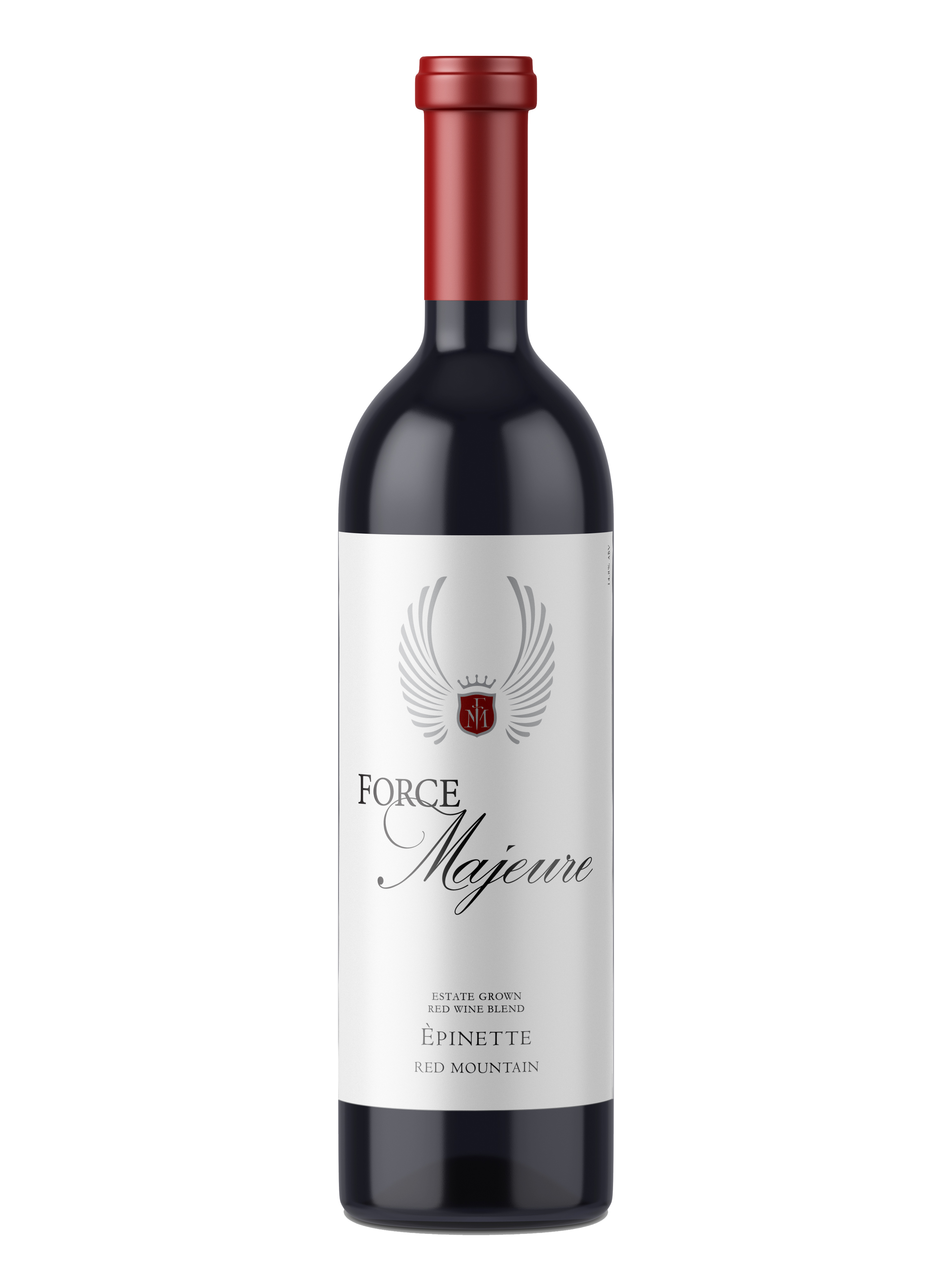
Force Majeure Epinette is made from 79% Merlot, 8% Cabernet Sauvignon, 8% Cabernet Franc, and 5% Petit Verdot .
Epinette is Force Majeure's Right-bank Bordeaux-inspired blend, and was named after an avenue in Libourne (France) that leads to Pomerol and Saint-Émilion, the home of Merlot and Cabernet Franc. Epinette is also the name of a musical instrument akin to a piano, as well as a word for pine tree, which is a fitting nod to their home in Washington state.
The wine itself is a blend of primarily Merlot and Cabernet Franc, with smaller amounts of Cabernet Sauvignon and Petit Verdot, proportions of which change depending on the vintage. The Merlot and Cabernet Franc are grown in lower areas of the vineyard with deep, well-drained soils, much less rocky than the soils of our Rhone varietals.
Review:
The 2018 Epinette is the Merlot-dominated release from this team, and it's 79% Merlot, 8% Cabernet Sauvignon, 8% Cabernet Franc, and 5% Petit Verdot, all from the estate vineyard on Red Mountain. Lots of smoky black cherry and darker currant fruits as well as notes of chocolate, graphite, lead pencil, and chalky minerality emerge from the glass, and this full-bodied beauty is beautifully textured, with a stacked mid-palate, velvety tannins, and a blockbuster finish. It's up with the finest Merlots in the New World and will drink brilliantly for at least a decade, if not longer.
Previously known as Grand Reve, Force Majeure has skyrocketed to the top of the pyramid in Washington State, in no small part due to their talented winemaker, Todd Alexander, who moved from Bryant Family in Napa to Washington State to focus on this estate. While the focus is on their Red Mountain Vineyard, they make a bevy of world-class wines from throughout the Columbia Valley. Anyone doubting the quality coming from Washington State these days owes it to themselves to try these wines.
-Jeb Dunnuck 97 Points
Force Majeure is an ultra-premium winery located in the Walla Walla Valley, specializing in estate-grown, single-vineyard Bordeaux and Rhône-inspired wines. Our wines are meticulously crafted by former Bryant Family Vineyard Winemaker, Todd Alexander. From its inception, Force Majeure has been defined by unwavering commitment to outstanding viticulture and exemplary winemaking. Our original estate vineyard is located in the famous Red Mountain AVA and we have added two new vineyard sites over the past couple of years in the Walla Walla Valley. Our estate vineyards are painstakingly farmed by a stellar team.
“Force Majeure” describes the relentless, powerful elements of Nature that form the terroir of our vineyard. It also identifies the “unstoppable force” initiated when the highest level of viticulture is combined with the highest level of winemaking talent.
Our wines are produced in small quantities and are available via mailing list, as well as through a few select retailers and finer restaurants. We invite you to add your name to our mailing list to receive upcoming wine allocation offers. Wines are typically released two to three times per year.
RED MOUNTAIN AVA
Drawing inspiration from the great vineyards of Bordeaux, the Northern and Southern Rhône valleys, as well as parts of Spain, and with a desire to challenge existing viticultural practices in Washington state, we embarked on an ambitious plan to pioneer the very first vineyard on the steep, rocky upper slopes of Red Mountain, from where we knew we could create wines that were profound and powerful yet balanced and finessed, distinct and world-class. Most importantly, we knew the site would be unique and singular.
The effort to develop our Red Mountain estate site involved the careful matching of varietal and clonal selections, trellising and irrigation to the eight distinct soil types in our vineyard that were formed by the ancient Missoula floods, winds and volcanic activity. The outcome is a vineyard articulated into many small “micro-blocks,” maximizing the potential of this unique and dynamic site. This steep vineyard ranges in elevation from 960 to 1,230 feet and is, of course, completely farmed by hand. The rocky upper-slope with shallow soil is well suited to the cultivation of varietals such as Syrah and Grenache, while the lower blocks of the vineyard are comprised of deep, well-drained Warden soils, where varietals such as Cabernet Sauvignon, Merlot and Cabernet Franc excel.
The overall exposure of the site is west/southwest, and the Syrah planted on the hill is tightly spaced to provide some shade on the fruit. The soils have a volcanic foundation, being composed of fractured basalt, concreted ash and wind-blown loess with a high calcium carbonate content and granite erratics from the Missoula floods. The site was purchased in 2004 and development began in 2006.
ROCKS DISTRICT OF MILTON-FREEWATER AVA
We have recently acquired a small vineyard in the Walla Walla Valley, one-hour drive from Red Mountain. The property is partially within the boundaries of the The Rocks District of Milton-Freewater AVA, on the Oregon side of the border, and is located adjacent to the site of our new winery. The portion of the vineyard outside The Rocks District is within the borders of the Walla Walla Valley AVA. The Rocks District is an alluvial fan, and the cobbles that define the area are a result of deposits left by the Walla Walla River. This vineyard was planted between 1992 and 1994, and has a diverse soil profile that sets it apart from other vineyards in the area, and certainly from our Red Mountain site. The amount of soil covering the cobble stones is highest at the north end of the property and most shallow at the southern end. This gives us a lot of diversity within a small area, and the grapes will have different characteristics depending on the soil composition where they are grown. This vineyard is in an area proven to have very distinct terroir, and we know we can push the site further by bringing it under our care and attention.
THE NORTH FORK OF THE WALLA WALLA RIVER
Over the past couple of years, we have been in search of additional land to develop vineyards that differ from our Red Mountain estate, yet are capable of matching or exceeding the quality we achieve from that site. This search resulted in the acquisition of The Rocks District site mentioned previously, as well as the discovery of a new and exiting region about 15 minutes away from there.
As you move east from The Rocks District and our new winery, in about 15 minutes drive the topography changes dramatically – from flat lands with cobblestone soils to deep canyons with tall, steep hills as you approach the Blue Mountains that line the eastern ridge of the Walla Walla Valley. The area is wild and untamed, with only a couple of small vineyards located nearby. This area does not yet have a name, but the locals refer to it the as “The North Fork” because the North Fork of the Walla Walla River runs along the bottom of the canyon.
We have recently acquired a large piece of land in this area. It is a spectacularly beautiful site, and its elevation rises to almost 2100 feet. As it is so close to the Blue Mountains, it receives significantly more rainfall than many other parts of the Walla Walla Valley and Red Mountain. The high temperatures in the summer are more moderate, and the cold temperatures in the winter are less extreme than on the valley floor. The growing season at this site will be longer than either site in The Rocks District or Red Mountain.
This is a huge and exciting step into new and mostly unexplored territory, but promises to feed our passion for hillside sites and the wines made from them. We believe this site is capable of nurturing some of the best wine grapes, not just in the Pacific Northwest, but in North America. The combination of climatic characteristics, exposure and aspects as well as soil composition should make this land one of the most exciting new viticultural areas in the United States. In the future, this region is sure to be a new, single AVA. The size of that future AVA may be as small as 500 acres.
_________________________________
The unique topography and geological variants in these vineyards provide us with a versatility that allows us to cultivate a variety of compelling fruit characterized by stunning intensity, depth, concentration and complex flavors. The sites are all distinct and singular – yet taken together, they provide a fascinating exposition of the terroir in this region of the world.

Certified organic, ungrafted vines over 130 years old; a "grand cru" site of Paso Robles. Transcendent. Lovely sweet red fruits, loads of spice and pepper, violets, chalk, even a hint of pineapple grass on the nose. White stones and wild strawberries in a lovely pas de deux on the palate, with vibrant energy and finesse. What a knockout.
Review:
Broad-shouldered and powerfully structured yet detailed and stylish, with deep flavors of blackberry and cherry accented by bittersweet chocolate, orange peel and fruitcake spices that gather tension and richness on the slightly firm finish.
-Wine Spectator 95 Points

Paul Hobbs Edward James Estate Chardonnay Russian River Valley is made from 100 percent Chardonnay.
This small five-acre estate named after Paul's great-grandfather, Edward James, rewards us with a chardonnay that is pale straw in color with inviting aromas of lemon zest, red apple skin, gardenia, and honeysuckle. A creamy mouthfeel on the palate evolves into poached pear, ginger spice, and brioche that come together with a crunchy acidity and lively finish.
Review:
The 2022 Chardonnay Edward James Estate was named after Paul’s grandparents on his father’s side and originates in a vineyard planted entirely to Hyde Wente clone of Chardonnay. It was raised in French oak for 18 months on the lees. In the glass, it’s highly expressive and layered with aromas of toasted spice, incense, honeysuckle, quince, and preserved citrus. Medium to full-bodied, it has a fantastic, long, supple texture with a linear, crystalline feel, great, evenly fresh acidity, and a salty, mouthwatering finish. This is my favorite of the white wines at this tasting. Drink 2025-2037.
-Jeb Dunnuck 97 Points

Maggy Hawk Unforgettable Pinot Noir is made from 100 percent Pinot Noir.
HARVEST NOTES
All plants require water to grow, and grapevines are no exception. The 2021 growing season was our driest yet. The Maggy Hawk vineyard relies on rainfall in the winter and spring to fill our vineyard ponds to irrigate our vines during the summer months. These ponds ran dry a few weeks before harvest began. Fortunately, the grapes made it across the finish line without being affected by the drought. We typically harvest over 2-3 weeks. In 2021, everything was ready at once, and we harvested in just one and a half weeks. The clusters had a shorter ripening period and were harvested on the earlier side, which produced wines with intense hues, great acidity, and concentrated aromas and flavors.
WINEMAKING
Our 2021 Unforgettable Pinot Noir is crafted from a unique selection of five blocks and three clones from all corners of the Maggy Hawk vineyard. Upon arriving at the winery, we separate the individual blocks and allow the grapes to cold soak for 5 days before raising the temperature and beginning fermentation. The fruit is then pressed very gently, and the free run is kept separate from the harder pressing and racked down to barrels. The wine is allowed to go through malolactic fermentation on its own before being left to age in 30% new French oak barrels for 17 months. Finished unfined and unfitered.
Freshness, power and persistence. Unforgettable delivers a pronounced mix of fresh black cherry and red plum balanced by hints of dried lavender, bay leaf, anise and potting soil notes. A perfect balance of structured and juicy with smooth, rounded edges on the palate due to integrated tannin.
Review:
This wine is opulent, with aromas of Black cherry, red currant compote, cinnamon spice, and fresh florals on the nose. The flavors on the palate are Bing cherry, blackcurrant confiture, vanilla lime cream interwoven with dried herbs, bittersweet chocolate, earth and a long silky finish. Hold or Drink until 2032 Pair with Lamb Shoulder — Tonya Pitts
-Wine Enthusiast 94 Points
The 2021 Pinot Noir Unforgettable boasts a deeper red/ruby color and was aged in 38% new French oak. There’s more 667 clone in this blend, which reveals a darker profile in the glass, with red and black-fruited notes of black raspberries, brambly herbs, forest floor, and cedar. Medium-bodied, it has a broader shouldered feel, with lovely structure throughout and a lovely, ripe finish. It’s going to drink well over the coming 10 years.
-Jeb Dunnuck 94 Points

Domaine du Colombier Hermitage Rouge is made from 100 percent Syrah.
Perfect with beef ribs, grilled meats and cheese.
Manually harvested with destemmed grapes and fermented for about 2 to 3 weeks in temperature controlled vats, with an ageing period of 12 months, 65% in oak barrels and 35% in concrete tanks.
Review:
Brought up in 30% new demi-muids, with the balance in used barrels, the 2017 Hermitage is beautifully pure and layered, with smoking good notes of crème de cassis, white flowers, crushed rocks, and violets. Deep, full-bodied, and concentrated on the palate, it has plenty of tannins and is going to need 5-7 years of bottle age. This is a sensational Hermitage from Colombier that will drink well for 25+ years.
These wines are made by the talented Florent Viale and shine for their purity as well as character. While the winemaking here is traditional, with the wines destemmed and brought up mostly in used demi-muids, the purity of fruit can give the impression that wines are more modern styled than they are. They will all benefit from short-term cellaring.
-Jeb Dunnuck 96+ Points

Far Niente Napa Valley Cabernet Sauvignon is made from 92.3% Cabernet Sauvignon, 6% Malbec, 2% Cabernet Franc, 1.7% Petit Sirah, 1% Petite Verdot.
Beautiful aromas of dark plum, red cherry, licorice and warm baking spices open onto a plush and silky palate layered with plum, spiced cherry and cassis. A classic Napa Valley Cabernet, fine-grained tannins and lively acidity support the wine throughout, while the finish is refined and polished.
Review:
Made with grapes sourced from Rutherford, Calistoga, St. Helena, and the winery's home in Oakville that aged 17 months in French oak, this impeccably balanced and complex red is as elegant as it is emotive. Blackberry and clove-spiced cedar line the mouth, erupting with graphite and espresso. Finely grained tannins adhere to dusty plum and lavender.
-Tasting Panel 97 Points
Refined and pure aromas of dark cherries, blackcurrants, violets and cedar. The palate is full-bodied with seamlessly integrated tannins and focused acidity, giving notes of Damson plums, graphite, mocha, dried herbs and potpourri. Very well balanced and polished.
-James Suckling 96 Points

Peju Winery Legacy Collection Cabernet Sauvignon is made from 88% Cabernet Sauvignon, 6% Petit Verdot, 6% Merlot.
This stunning wine boasts an expressive nose that immediately captivates the senses. On the palate, the wine opens up with complex layers of dried red fruit and hints of cigar box. A subtle hint of wet stone adds a unique touch to the overall experience. The wine's medium to full body creates a beautiful balance between the fruit and tannin structure. The finish is simply divine, with a touch of cocoa dust that lingers on the palate long after the last sip.
Review:
The 2022 Peju Legacy Collection Cabernet Sauvignon is a blend of 88% Cabernet Sauvignon, 6% Petit Verdot, 5% Merlot, and 1% Cabernet Franc, aged for 19 months in 40% new French and American oak, crafted by winemaker Sara Fowler. Fragrant notes of spiced plums, leather, fine cedar, and violets lift from the glass. Full-bodied, it features a framework of elongated, supple tannins, creamy black cherry fruits, dark plum jam, mocha, and a cool wet slate character on the lengthy finish.
-Decanter 94 Points

Force Majeure Epinette is made from 46% Merlot, 35% Cabernet Franc, 16% Cabernet Sauvignon, 3% Petit Verdot.
Epinette is Force Majeure's Right-bank Bordeaux-inspired blend, and was named after an avenue in Libourne (France) that leads to Pomerol and Saint-Émilion, the home of Merlot and Cabernet Franc. Epinette is also the name of a musical instrument akin to a piano, as well as a word for pine tree, which is a fitting nod to their home in Washington state.
The wine itself is a blend of primarily Merlot and Cabernet Franc, with smaller amounts of Cabernet Sauvignon and Petit Verdot, proportions of which change depending on the vintage. The Merlot and Cabernet Franc are grown in lower areas of the vineyard with deep, well-drained soils, much less rocky than the soils of our Rhone varietals.
Review:
"The 2018 Epinette is the Merlot-dominated release from this team, and it's 79% Merlot, 8% Cabernet Sauvignon, 8% Cabernet Franc, and 5% Petit Verdot, all from the estate vineyard on Red Mountain. Lots of smoky black cherry and darker currant fruits as well as notes of chocolate, graphite, lead pencil, and chalky minerality emerge from the glass, and this full-bodied beauty is beautifully textured, with a stacked mid-palate, velvety tannins, and a blockbuster finish. It's up with the finest Merlots in the New World and will drink brilliantly for at least a decade, if not longer."
- Jeb Dunnuck (May 2021), 97 pts
Force Majeure Epinette is made from 46% Merlot, 35% Cabernet Franc, 16% Cabernet Sauvignon, 3% Petit Verdot.
Epinette is Force Majeure's Right-bank Bordeaux-inspired blend, and was named after an avenue in Libourne (France) that leads to Pomerol and Saint-Émilion, the home of Merlot and Cabernet Franc. Epinette is also the name of a musical instrument akin to a piano, as well as a word for pine tree, which is a fitting nod to their home in Washington state.
The wine itself is a blend of primarily Merlot and Cabernet Franc, with smaller amounts of Cabernet Sauvignon and Petit Verdot, proportions of which change depending on the vintage. The Merlot and Cabernet Franc are grown in lower areas of the vineyard with deep, well-drained soils, much less rocky than the soils of our Rhone varietals.
Review:
"I loved the 2016 Epinette from barrel, and it certainly doesn't disappoint from bottle. Sporting a deep purple color as well as a huge bouquet of blackcurrants, black cherries, smoked earth, chocolate, and cedary spice, this flamboyant, powerful beauty hits the palate with loads of fruit, has sweet tannins, no hard edges, building tannins, and a huge finish. It's one seriously pleasure-bent effort that has another 10-15 years of prime drinking." - Jeb Dunnuck (April 2019), 96+ pts

Force Majeure Parvata is made from 69% Mourvedre, 21% Syrah, 10% Grenache (2016) / 43% Mourvedre, 25% Grenache, 23% Syrah, 4% Cinsault, 5% Counoise
Parvata means “mountain” in sanskrit, and is the name for this southern Rhône-inspired blend, grown mostly in the sandy, loamy soils of the lower section of the Red Mountain vineyard, which bring to the wine a good degree of finesse and high-toned aromatic notes, white pepper, dried herbs and grapefruit peel.
Review:
"Based on 57% Mourvèdre, 25% Syrah, and the rest Grenache, the 2018 Parvata has a wonderfully earthy, complex, classic Mourvèdre nose of ripe red and blue fruits, gamey meat, cracked pepper, violets, and tree bark. This carries to a plush, up-front, incredibly sexy 2018 with notable purity, full-bodied richness, integrated tannins, and a great, great finish. It's slightly more up-front and supple than I expected from barrel, but this incredible wine just begs to be drunk. Nevertheless, I still think a year of bottle age is warranted and it should drink well for 10-15."
- Jeb Dunnuck (May 2021), 96 pts

Force Majeure Cabernet Sauvignon Red Mountain is made from 100 percent Cabernet Sauvignon.
The estate Cabernet Sauvignon is grown primarily along the southwest ridge of the vineyard. The vines produce small berries with bountiful flavor, concentration and intensity, but also a good degree of finesse, excellent structure and layers of complexity that will continue to develop during extended bottle aging for those who want to cellar and age their wines. The wine is powerful, elegant, full-bodied.
Bottled unfined and unfiltered.100% free run
Pumpovers and punch-downs, up to 45 day macerations
Native yeast, 5 day cold soaks
22 months in 75% new French oak barrels
Fermented in concrete and stainless closed top tanks.
Review:
Another gem is the 2019 Cabernet Sauvignon Red Mountain Estate, a deep, concentrated, powerful Red Mountain Cabernet Sauvignon that I suspect will be up there with the legendary wines from this terroir. Beautiful cassis, graphite, lead pencil shavings, and damp earth notes give way to a full-bodied effort that has a liqueur of rocks-like minerality, flawless balance, building yet polished tannins, and a great finish. Hide bottles for 4-5 years, and it will evolve for 25-30 years if properly stored. Best After 2026.
-Jeb Dunnuck 98+ Points

Force Majeure estate Syrah is made from 100 percent Syrah.
The Force Majeure estate Syrah is cultivated in a combination of the 8 soil types that exist in the vineyard, with most of it being planted in very steep, very rocky locations, but some also planted in deeper, loamier soils.
The estate Syrah typically exhibits a broad spectrum of black, blue and red fruits, dried herbs and jasmine, fennel, smoked meats and crushed rock along with very fine tannins, great length, balance and complexity.
Appellation Red Mountain Varietal(s) 100% Syrah
Soil type Very steep, rocky locations, but some also planted in deeper, loamier soils
Vinification 22% whole cluster, remainder destemmed. Fermented in concrete, open top and closed top stainless. ~25% new French oak for 18 months, mostly larger format (300L to 500L) Native yeast, cold soak up front Macerations up to 30 days; pumpovers and punch-downs 100% free run. The wine is bottled unfined and unfiltered.
Production 500 (9-liter cases)
Review:
The 2020 Syrah Red Mountain Estate has a splash of Viognier as well as 22% whole clusters. with the aging occurring in 25% new barrels. Impressive red and blue fruits, as well as graphite and chalky minerality all emerge from the glass, and it's full-bodied, balanced, and concentrated, while staying light on its feet and balanced. It has serious tannins and will demand bottle age.
-Jeb Dunnuck 93-96 Points
The estate Cabernet Sauvignon is grown primarily along the southwest ridge of the vineyard. The vines produce small berries with bountiful flavor, concentration and intensity, but also a good degree of finesse, excellent structure and layers of complexity that will continue to develop during extended bottle aging for those who want to cellar and age their wines. The wine is powerful, elegant, full-bodied.
Bottled unfined and unfiltered.100% free run
Pumpovers and punch-downs, up to 45 day macerations
Native yeast, 5 day cold soaks
22 months in 75% new French oak barrels
Fermented in concrete and stainless closed top tanks.
Review:
"The 2017 Cabernet Sauvignon Red Mountain Estate is another powerful wine from this team. Opulent notes of blackcurrants, graphite, chocolate, crushed rocks, wild herbs, and espresso all give way to a full-bodied Cabernet Sauvignon that has loads of fruit, a superstar of a mid-palate, ripe tannins, and a great finish. It’s another 2017 that’s going to benefit from at least 2-4 years of bottle age and have 20 years or more of longevity."
- Jeb Dunnuck (April 2020), 95+ pts

G.D. Vajra Barolo Ravera is made from 100 percent Nebbiolo.
The Barolo Ravera shows a striking balance of all tones. Red and dark fruits on the nose are interlaced with mineral hints and the iron tones which are such a signature of Ravera. The wine has brilliant drinkability, with a layered, ample mid palate and a racy finish.
Review:
Seamlessly stitched together, the G.D. Vajra 2018 Barolo Ravera reveals tight layering and smooth texture. Fruit comes from an amphitheater of vines with Tortoniana epoch sandstone clay that is typical of parts of Barolo and Novello. What stands out here is the mineral character of the wine. It frames a dark core of plum, dark cherry and soft spice.
- Robert Parker's Wine Advocate 94 Points

Freemark Abbey 'Sycamore' Cabernet Sauvignon is made from 95% Cabernet Sauvignon, 4% Petit Verdot, 1% Cabernet Franc.
Located on the southern end of the Rutherford Bench, Sycamore Vineyard’s proximity to the Mayacamas Mountains provides the perfect climate for growing a rich, textured Cabernet. The wine is intense in aromatic complexity, reminiscent of blackberry, pomegranate syrup, black tea, and forest floor. The palate is rich and textured with flavors of forest fruits, dark chocolate, bay leaf, and warm oak spices. The ‘Rutherford dust’ is evident in the tannin structure, giving it textures that are bold but integrated, making it lovely to drink now with the capability to age in the cellar for decades.
Primary Vineyard: Sycamore Vineyard—Rutherford (100%): Small 24-acre vineyard located about 1.2 miles south of Bosche, right up against the Mayacamas Range, this vineyard has a rich clay loam. Sycamore Vineyard produces small berries reminiscent of mountain fruit berries, with intense extract of color and flavor. The color is very dark early in the fermentation, with flavors of black currant and black berry with a forest floor complexity.
Review:
Even better, the 2019 Cabernet Sauvignon Sycamore Vineyard is jaw-dropping stuff and does everything right. More structured and tannic compared to the Bosche, it has loads of red and black fruits as well as sandalwood, camphor, bay leaf, and bouquet garni-like aromas and flavors. Full-bodied, deep, layered, and concentrated, yet still with this wonderful sense of elegance, it needs 3-5 years of bottle age and will evolve for 20-25 years as well.
-Jeb Dunnuck 97 Points



