
" We don't sell the wine without touching the vine "
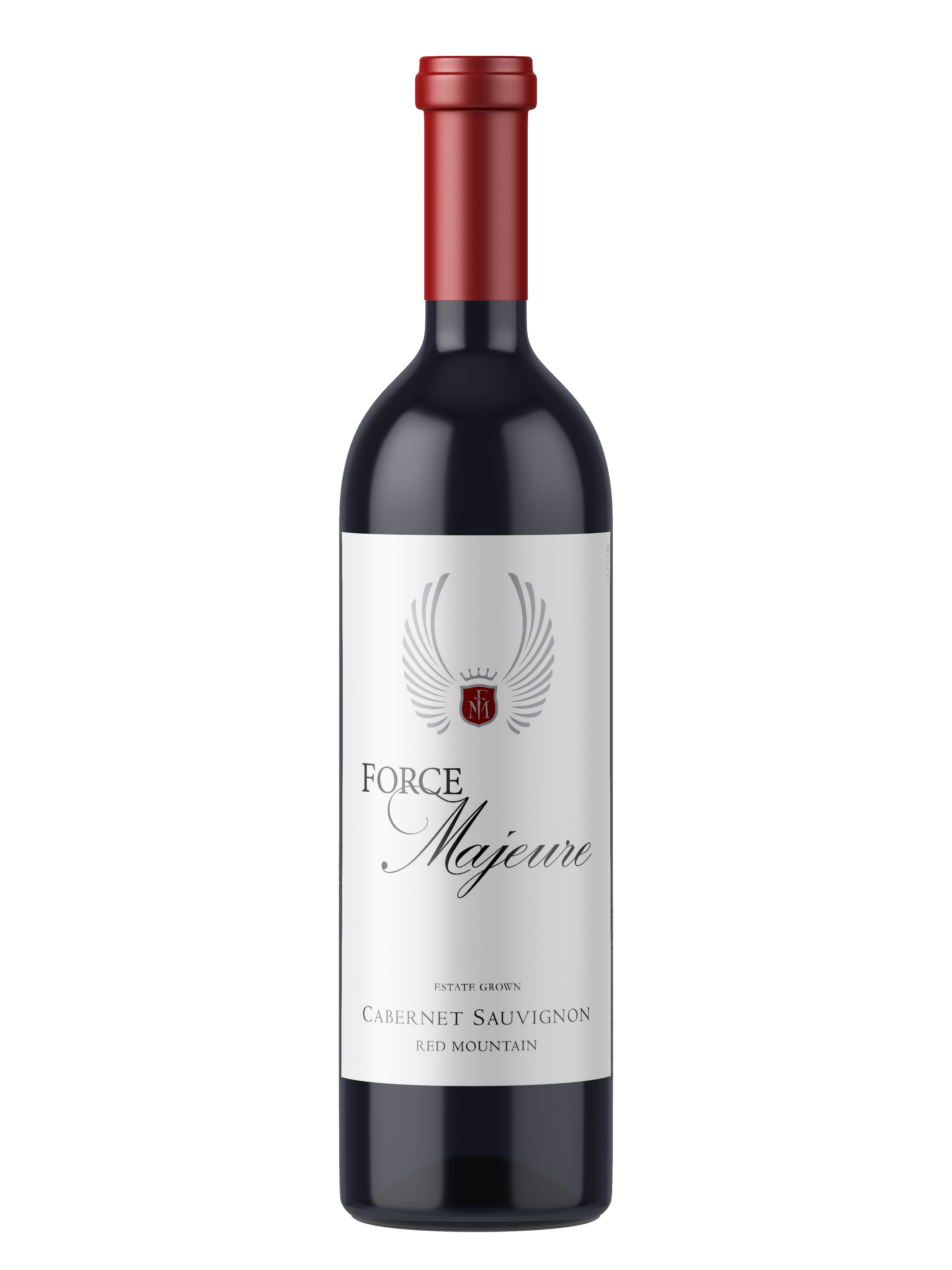
| Country: | United States |
| Regions: | Washington Washington (Red Mountain) |
| Winery: | Force Majeure |
| Grape Type: | Cabernet Sauvignon |
| Vintage: | 2016 |
| Bottle Size: | 750 ml |

The estate Cabernet Sauvignon is grown primarily along the southwest ridge of the vineyard. The vines produce small berries with bountiful flavor, concentration and intensity, but also a good degree of finesse, excellent structure and layers of complexity that will continue to develop during extended bottle aging for those who want to cellar and age their wines. The wine is powerful, elegant, full-bodied.
Bottled unfined and unfiltered.100% free run
Pumpovers and punch-downs, up to 45 day macerations
Native yeast, 5 day cold soaks
22 months in 75% new French oak barrels
Fermented in concrete and stainless closed top tanks.
Review:
-Jeb Dunnuck 95 Points
-Anthony Mueller (Robert Parker) 95 Points
-Wine Spectator's Insider 93 Points
-Stephen Tanzer (Vinous) 92 Points

Force Majeure estate Syrah is made from 100 percent Syrah.
The Force Majeure estate Syrah is cultivated in a combination of the 8 soil types that exist in the vineyard, with most of it being planted in very steep, very rocky locations, but some also planted in deeper, loamier soils.
The estate Syrah typically exhibits a broad spectrum of black, blue and red fruits, dried herbs and jasmine, fennel, smoked meats and crushed rock along with very fine tannins, great length, balance and complexity.
Appellation Red Mountain Varietal(s) 100% Syrah
Soil type Very steep, rocky locations, but some also planted in deeper, loamier soils
Vinification 22% whole cluster, remainder destemmed. Fermented in concrete, open top and closed top stainless. ~25% new French oak for 18 months, mostly larger format (300L to 500L) Native yeast, cold soak up front Macerations up to 30 days; pumpovers and punch-downs 100% free run. The wine is bottled unfined and unfiltered.
Production 500 (9-liter cases)
Review:
-Jeb Dunnuck 97 Points
-Eric Guido (Vinous) 95 Points
-Anthony Mueller (Robert Parker) 94 Points
Force Majeure Cabernet Sauvignon Red Mountain is made from 100 percent Cabernet Sauvignon.
The estate Cabernet Sauvignon is grown primarily along the southwest ridge of the vineyard. The vines produce small berries with bountiful flavor, concentration and intensity, but also a good degree of finesse, excellent structure and layers of complexity that will continue to develop during extended bottle aging for those who want to cellar and age their wines. The wine is powerful, elegant, full-bodied.
Bottled unfined and unfiltered.100% free run
Pumpovers and punch-downs, up to 45 day macerations
Native yeast, 5 day cold soaks
22 months in 75% new French oak barrels
Fermented in concrete and stainless closed top tanks.
Review:
Another gem is the 2019 Cabernet Sauvignon Red Mountain Estate, a deep, concentrated, powerful Red Mountain Cabernet Sauvignon that I suspect will be up there with the legendary wines from this terroir. Beautiful cassis, graphite, lead pencil shavings, and damp earth notes give way to a full-bodied effort that has a liqueur of rocks-like minerality, flawless balance, building yet polished tannins, and a great finish. Hide bottles for 4-5 years, and it will evolve for 25-30 years if properly stored. Best After 2026.
-Jeb Dunnuck 98+ Points
"Blackberry, crushed rock, black cherry and spice aromas lead to ripe, intense, seamless, balanced dark-fruit flavors. The tannins give a firm grip. An extended finish caps it off. It's glorious. - SEAN P. SULLIVAN" - Wine Enthusiast (November 2022), 95 pts "A gutsy red that retains a sense of style and polish, with expressive blackberry, espresso and toasty spice flavors that build structure toward broad-shouldered tannins. Drink now through 2030. —Tim FISH." - Wine Spectator (Insider, January 4th 2023), 94 pts-Owen Bargreen (Vinous) 97 Points
-Wine Enthusiast 95 Points

Force Majeure Epinette is made from 46% Merlot, 35% Cabernet Franc, 16% Cabernet Sauvignon, 3% Petit Verdot.
Epinette is Force Majeure's Right-bank Bordeaux-inspired blend, and was named after an avenue in Libourne (France) that leads to Pomerol and Saint-Émilion, the home of Merlot and Cabernet Franc. Epinette is also the name of a musical instrument akin to a piano, as well as a word for pine tree, which is a fitting nod to their home in Washington state.
The wine itself is a blend of primarily Merlot and Cabernet Franc, with smaller amounts of Cabernet Sauvignon and Petit Verdot, proportions of which change depending on the vintage. The Merlot and Cabernet Franc are grown in lower areas of the vineyard with deep, well-drained soils, much less rocky than the soils of our Rhone varietals.
Review:
-Jeb Dunnuck 96 Points
-Antonio Galloni's Vinous 94 Points
-Stephen Tanzer (Vinous) 94 Points
Force Majeure Epinette is made from 46% Merlot, 35% Cabernet Franc, 16% Cabernet Sauvignon, 3% Petit Verdot.
Epinette is Force Majeure's Right-bank Bordeaux-inspired blend, and was named after an avenue in Libourne (France) that leads to Pomerol and Saint-Émilion, the home of Merlot and Cabernet Franc. Epinette is also the name of a musical instrument akin to a piano, as well as a word for pine tree, which is a fitting nod to their home in Washington state.
The wine itself is a blend of primarily Merlot and Cabernet Franc, with smaller amounts of Cabernet Sauvignon and Petit Verdot, proportions of which change depending on the vintage. The Merlot and Cabernet Franc are grown in lower areas of the vineyard with deep, well-drained soils, much less rocky than the soils of our Rhone varietals.
Review:
-Jeb Dunnuck 95 Points
-Anthony Mueller (Robert Parker) 94 Points
Force Majeure Epinette is made from 79% Merlot, 8% Cabernet Sauvignon, 8% Cabernet Franc, and 5% Petit Verdot .
Epinette is Force Majeure's Right-bank Bordeaux-inspired blend, and was named after an avenue in Libourne (France) that leads to Pomerol and Saint-Émilion, the home of Merlot and Cabernet Franc. Epinette is also the name of a musical instrument akin to a piano, as well as a word for pine tree, which is a fitting nod to their home in Washington state.
The wine itself is a blend of primarily Merlot and Cabernet Franc, with smaller amounts of Cabernet Sauvignon and Petit Verdot, proportions of which change depending on the vintage. The Merlot and Cabernet Franc are grown in lower areas of the vineyard with deep, well-drained soils, much less rocky than the soils of our Rhone varietals.
Review:
-Jeb Dunnuck 97 Points
The estate Cabernet Sauvignon is grown primarily along the southwest ridge of the vineyard. The vines produce small berries with bountiful flavor, concentration and intensity, but also a good degree of finesse, excellent structure and layers of complexity that will continue to develop during extended bottle aging for those who want to cellar and age their wines. The wine is powerful, elegant, full-bodied.
Bottled unfined and unfiltered.100% free run
Pumpovers and punch-downs, up to 45 day macerations
Native yeast, 5 day cold soaks
22 months in 75% new French oak barrels
Fermented in concrete and stainless closed top tanks.
Review:
-Jeb Dunnuck 99 Points
Force Majeure is an ultra-premium winery located in the Walla Walla Valley, specializing in estate-grown, single-vineyard Bordeaux and Rhône-inspired wines. Our wines are meticulously crafted by former Bryant Family Vineyard Winemaker, Todd Alexander. From its inception, Force Majeure has been defined by unwavering commitment to outstanding viticulture and exemplary winemaking. Our original estate vineyard is located in the famous Red Mountain AVA and we have added two new vineyard sites over the past couple of years in the Walla Walla Valley. Our estate vineyards are painstakingly farmed by a stellar team.
“Force Majeure” describes the relentless, powerful elements of Nature that form the terroir of our vineyard. It also identifies the “unstoppable force” initiated when the highest level of viticulture is combined with the highest level of winemaking talent.
Our wines are produced in small quantities and are available via mailing list, as well as through a few select retailers and finer restaurants. We invite you to add your name to our mailing list to receive upcoming wine allocation offers. Wines are typically released two to three times per year.
RED MOUNTAIN AVA
Drawing inspiration from the great vineyards of Bordeaux, the Northern and Southern Rhône valleys, as well as parts of Spain, and with a desire to challenge existing viticultural practices in Washington state, we embarked on an ambitious plan to pioneer the very first vineyard on the steep, rocky upper slopes of Red Mountain, from where we knew we could create wines that were profound and powerful yet balanced and finessed, distinct and world-class. Most importantly, we knew the site would be unique and singular.
The effort to develop our Red Mountain estate site involved the careful matching of varietal and clonal selections, trellising and irrigation to the eight distinct soil types in our vineyard that were formed by the ancient Missoula floods, winds and volcanic activity. The outcome is a vineyard articulated into many small “micro-blocks,” maximizing the potential of this unique and dynamic site. This steep vineyard ranges in elevation from 960 to 1,230 feet and is, of course, completely farmed by hand. The rocky upper-slope with shallow soil is well suited to the cultivation of varietals such as Syrah and Grenache, while the lower blocks of the vineyard are comprised of deep, well-drained Warden soils, where varietals such as Cabernet Sauvignon, Merlot and Cabernet Franc excel.
The overall exposure of the site is west/southwest, and the Syrah planted on the hill is tightly spaced to provide some shade on the fruit. The soils have a volcanic foundation, being composed of fractured basalt, concreted ash and wind-blown loess with a high calcium carbonate content and granite erratics from the Missoula floods. The site was purchased in 2004 and development began in 2006.
ROCKS DISTRICT OF MILTON-FREEWATER AVA
We have recently acquired a small vineyard in the Walla Walla Valley, one-hour drive from Red Mountain. The property is partially within the boundaries of the The Rocks District of Milton-Freewater AVA, on the Oregon side of the border, and is located adjacent to the site of our new winery. The portion of the vineyard outside The Rocks District is within the borders of the Walla Walla Valley AVA. The Rocks District is an alluvial fan, and the cobbles that define the area are a result of deposits left by the Walla Walla River. This vineyard was planted between 1992 and 1994, and has a diverse soil profile that sets it apart from other vineyards in the area, and certainly from our Red Mountain site. The amount of soil covering the cobble stones is highest at the north end of the property and most shallow at the southern end. This gives us a lot of diversity within a small area, and the grapes will have different characteristics depending on the soil composition where they are grown. This vineyard is in an area proven to have very distinct terroir, and we know we can push the site further by bringing it under our care and attention.
THE NORTH FORK OF THE WALLA WALLA RIVER
Over the past couple of years, we have been in search of additional land to develop vineyards that differ from our Red Mountain estate, yet are capable of matching or exceeding the quality we achieve from that site. This search resulted in the acquisition of The Rocks District site mentioned previously, as well as the discovery of a new and exiting region about 15 minutes away from there.
As you move east from The Rocks District and our new winery, in about 15 minutes drive the topography changes dramatically – from flat lands with cobblestone soils to deep canyons with tall, steep hills as you approach the Blue Mountains that line the eastern ridge of the Walla Walla Valley. The area is wild and untamed, with only a couple of small vineyards located nearby. This area does not yet have a name, but the locals refer to it the as “The North Fork” because the North Fork of the Walla Walla River runs along the bottom of the canyon.
We have recently acquired a large piece of land in this area. It is a spectacularly beautiful site, and its elevation rises to almost 2100 feet. As it is so close to the Blue Mountains, it receives significantly more rainfall than many other parts of the Walla Walla Valley and Red Mountain. The high temperatures in the summer are more moderate, and the cold temperatures in the winter are less extreme than on the valley floor. The growing season at this site will be longer than either site in The Rocks District or Red Mountain.
This is a huge and exciting step into new and mostly unexplored territory, but promises to feed our passion for hillside sites and the wines made from them. We believe this site is capable of nurturing some of the best wine grapes, not just in the Pacific Northwest, but in North America. The combination of climatic characteristics, exposure and aspects as well as soil composition should make this land one of the most exciting new viticultural areas in the United States. In the future, this region is sure to be a new, single AVA. The size of that future AVA may be as small as 500 acres.
_________________________________
The unique topography and geological variants in these vineyards provide us with a versatility that allows us to cultivate a variety of compelling fruit characterized by stunning intensity, depth, concentration and complex flavors. The sites are all distinct and singular – yet taken together, they provide a fascinating exposition of the terroir in this region of the world.

Kinsella Estates Heirloom Cabernet Sauvignon is made from 100% Cabernet Sauvignon
20 months in French Oak (75% New)
Organic made.
Intense was the first word that came to mind. Purely focused tannin weaves its way through the core of this wine. Has a savory characteristic that we have found in past vintages (2014 to be specific) with a slight licorice note on the exceptionally long finish. While this vineyard has been described as “feminine” in the past, that is certainly not the case for this bigger, bolder vintage!

The Grade Napa Cabernet Sauvignon Winfield Vineyard is made from Napa Valley Cabernet Sauvignon.
“2016 produced wines that are very giving, round, coating and streamlined. Year after this year, this bottling aims to highlight the best attributes of the Winfield Vineyard, and also creates a wine that possesses qualities that allow it to age well in the cellar and evolve over many years.
“This wine expresses a focused balancing act of dark, rich black fruit, and a fine tannin structure, illuminated through the core with a laser-like acidity. The wine displays a deep purple-red hue with a cranberry halo. Aromas of cassis, cinnamon, citrus oil, roasted meat, and lilac swell from the glass.
“The palate is marked by a wave of jet-black brambly fruit up front, followed by an exotic spice mid-palate and a long, complex finish that lasts and lasts expressing notes of flowering jasmine, and oolong tea. The silky tannins hold everything together and will certainly allow this wine to evolve in the cellar for at least 7-10 years.” - Thomas River Brown
Review:
-Jeb Dunnuck 94 Points

Roland Champion Champagne Brut Rose Grand Cru NV is the blend of 33% Chardonnay, 33% Pinot Meunier and 33% Pinot Noir.
The Champagne rose shows an orange salmon color coming from the red wine base. The pinot meunier brings red fruit aromas of strawberry and raspberry with hints of spices. The palate is juicy and harmonious with good depth and minerality. A delicate balance between Chardonnay, Pinot Meunier and Pinot Noir.
It is a blend of 93% White juice (made from 33% Chardonnay, 33% Pinot Meunier and 33% Pinot Noir) and 7% Pinot Noir red wine. The grapes used to produce the Coteaux Champenois red wine are coming from their vineyards near the Village of Verneuil.

Roland Champion Champagne Blanc de Blancs NV is aged for minimum 30 months (the minimum for NV is 15 months). This cuvee is made from 100% Chardonnay and is produced from the free run juice only. The current release is the result of the blend of the 2005, the 2006 and the 2007 vintage.
Fresh and delicate, its fine bubbles and wide range of aromas will be perfect as an aperitif. This Champagne will also match very well with seafood and shellfish.
dosage : 8 grams per liter
ageing : 30 months on laths
Even if it doesn't say on the label, 100% of the production is RD (Recently Disgorged)
Total Production for this Cuvée : 1,500 cases (9 liter equivalent) per year
Reviews:
"Golden yellow color. Lively, fruity, toasty leesy aromas of honeyed brioche and apple tart with a satiny, tangy, dry-yet-fruity medium body and a sleek, interesting, snappy lemon curd, nougat, and chalk finish with silky, soft, fruit tannins. A classic example of blanc de blanc champagne, delicious."
- Beverage Testing institute , 93 pts
"Spiced with ground anise and ginger accents, this offers notes of poached pear, lemon meringue pie, hazelnut and stony mineral. Very elegant and well-meshed throughout, with a silky finish. Tasted twice, with consistent notes. 1,500 cases made. –AN"
- Wine Spectator 92 pts
"This cuvée made from 100% Chardonnay offers a fresh aromatic nose of light toast, dried yellow fruit and nuances of yeast. On the palate it has a creamy mouth feel of toasted nuts and rich autolytic notes. This is a beautiful wine, rich and complex."
International Wine review 92+ pts
"Small grower. Autumn fruits dominate the aromas of this wine, which is blatantly more like a wine than we normally expect a champagne to be. Some may find that unexpected and even off-putting, while others will find it intriguingly delicious."
- Washington Post - EXCELLENT
"Roland Champion is a small family-owned producer, now with the fourth generation, in the village of Chouilly (”shoo-ee”), which has only Grand Cru vineyards. Made from 100 percent chardonnay grapes, this Champagne offers ethereal grace and poise and harmony; if I were fighting a duel tonight, I would ask for this Champagne as my last beverage. The nose here is about the richness of warm biscuits and hazelnuts, dried fruit and spice, like a Platonic, ineffably light fruitcake; in the mouth, however, it’s about a structure that encompasses an incredible marriage of power and elegance, like the delicacy and strength of the finest bone china. And there’s something porcelain-like about this Champagne, in its notable crisp, lively character, its transparency and its slightly chalky, shale-like mineral elements. Forget the Champagnes that come on with heavy toasty, caramel qualities; here, instead, is a wealth of subtlety and nuance touched with a racy, dynamic edge. Exceptional."
Biggerthanyourhead.net

Pahlmeyer Jayson Red Napa Valley is made from 51% Merlot, 27% Cabernet Sauvignon, 11% Malbec, 7% Petit Verdot, 4% Cabernet Franc.
Voluptuousness meets vibrance in this classic Bordeaux-inspired blend. Ripe Merlot-dominant aromas of juicy macerated raspberry unfurl with hints of pencil lead, clove, cedar, and fresh sage. The compact fruit core, flanked by fine, polished tannin, surges open on a full, silky palate, giving way to complex underpinnings of earth and spice. A beam of bright acidity keeps the fruit fresh and focused through a soft, lingering finish of dusty plum and cocoa.
It’s best to serve this rich, layered wine at a temperature between 60°F and 65°F. Open and opulent in its youth, this wine is ready to match with a range of flavorful summer dishes such as Carolina-style pulled pork, bánh mì sandwiches, or bacon cheddar burgers.
Review:
This is a very polished wine in 2022, well-built with neatly knit tannins that form a solid foundation for the dark currant and blackberry fruit that floods the mid-palate. Good depth of concentration and driving energy create a sense of tension and vibrancy. Indeed not a shy wine, yet more approachable, with tannins almost melting away on the finish—very characteristic of the warm vintage. Grape sources include William Hill and Broken Rock in Napa, Stagecoach, Waters, and Round Pond in Rutherford, along with Cabernet Franc and Cabernet Sauvignon from the iconic Monte Rosso Vineyard in Sonoma. Grapes are sorted by hand, fermented in stainless steel with a small percentage in oak tanks, and then aged for 15 months in 80% new French oak. (JC)
-Decanter 94 Points

Antonio Camillo Vermentino 2025 is made from Vermentino. It is the sea-breeze white from Antonio Camillo, best known for his Ciliegiolo but equally at home with the Maremma's signature coastal white grape. The estate sits near Capalbio in southern Tuscany, where Camillo has farmed his own old vines with a low-intervention hand since 2006.
Fermented in steel to keep it fresh and precise, this Vermentino is crisp and saline, with citrus, green apple and white flowers over a stony, almost briny finish. Pour it cold alongside seafood, fried vegetables or a sunny afternoon.



