
" We don't sell the wine without touching the vine "
| BUY MORE! SAVE MORE! | ||||||||||||||||||||
|
| Country: | France |
| Region: | Champagne |
| Winery: | Gosset |
| Grape Type: | Chardonnay |
| Organic: | Yes |
| Vintage: | NV |
| Bottle Size: | 750 ml |
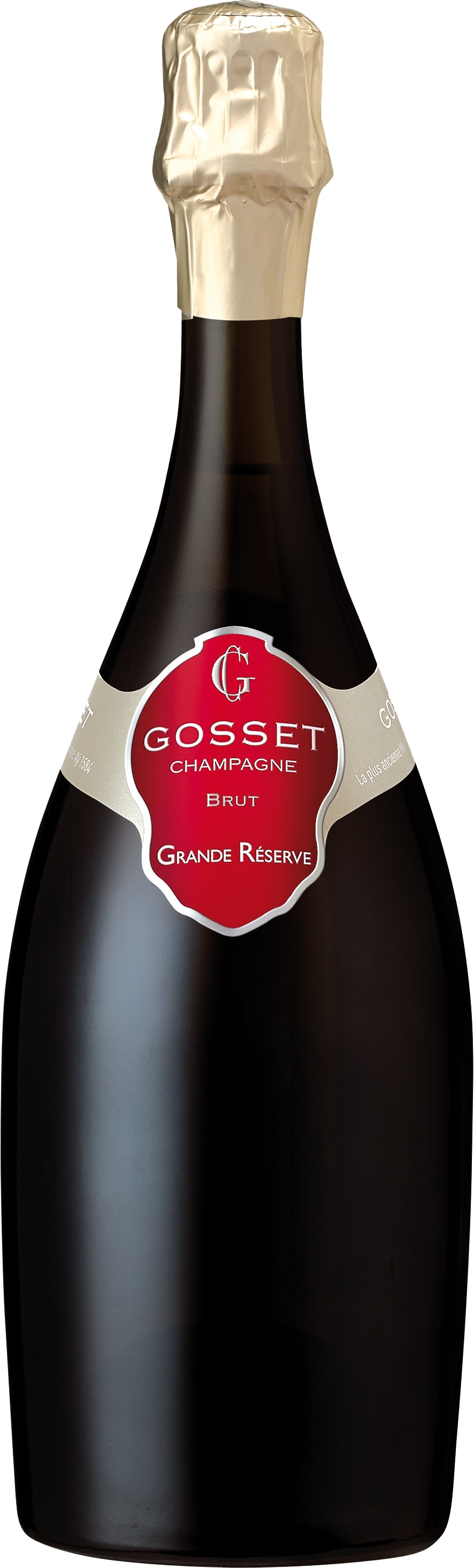
Gosset Grande Reserve Brut is made from 45% Chardonnay, 45% Pinot Noir, 10% Pinot Meunier.
The color is bright and golden, the nose open and expressive, and the palate is dominated by a refreshing mineral tension.
Gosset Grande Reserve is a truly faithful expression of the Gosset style. To achieve a cuvee of this quality, the cellar-master has blended the best of the various champagne crus at the grape- harvest with wines specially chosen from our reserve stocks for their richness and maturity.
This champagne is the perfect accompaniment to mild and subtly spiced dishes with cooked fruit, sweet/savory dishes or tajines. A blend of three vintages, the Grande Réserve Brut is adaptable by nature — from apéritif to dessert.
Review:
-Decanter 94 Points
Founded in Aÿ in 1584 by Pierre Gosset, Champagne Gosset is the oldest wine house in Champagne. For more than four centuries, the preservation of style, elegance and family traditions in the making of Gosset champagne has been paramount. Champagne Gosset’s reputation for high-quality starts in the vineyard, where they source grapes almost entirely from premier cru and grand cru vineyards. Unlike most champagne producers, Gosset carefully avoids malolactic fermentation and uses extended lees aging to expose the terroir and produce dynamic, age-worthy cuvées. Gosset champagnes are made with extreme care and kept in dark cellars for four to five years for non-vintage wines — and up to seven for vintage champagnes and 10 for the CELEBRIS cuvées — before release.
Founded in Aÿ in 1584 by Pierre Gosset, Champagne Gosset is the oldest wine house in Champagne. Over the next four centuries, generations of the Gosset family would go on to win fame not only as alderman, mayors and magistrates in Aÿ, but also in growing and trading wines of Champagne. Whatever the period, the men and women of the Gosset family had a single ambition — to improve their terroir.
In 1993, after more than 400 years of family ownership, Champagne Gosset was purchased by the Renaud-Cointreau family, who also owns and manages the highly regarded Cognac Frapin. The Renaud-Cointreaus insist on a continuity of the old-style champagne appropriate to its historic birthplace in Aÿ. While other Champagne houses are handing over the reins to large corporations, the Renaud-Cointreau family understands the importance of preserving the heritage in winemaking that has, over 430 years, made Champagne Gosset the ultimate name in champagne.
In 2009, Champagne Gosset announced the acquisition of a new property in the heart of Epernay, which doubles the cellar space and serves as an extension to its production facilities in Aÿ.
Champagne Gosset’s reputation for quality starts in the vineyard, where it sources grapes almost entirely from premier cru and grand cru vineyards in the Côte des Blancs, Grand Vallée de la Marne and Montagne de Reims. These vineyards rate an average of 95 percent on the “échelle des crus,” or “ladder of growths,” — the classification system of the villages in the Champagne region. The top-rated villages are given a score of 100 percent and are called grand crus; currently there are 17 such villages. The next tier has scores ranging from 90 to 99 percent; these are the premier cru villages, of which there are 44. The remaining 296 crus have scores between 80 and 89 percent.
Champagne Gosset has long-term relationships with growers that date back several generations, allowing the winemaking team to direct activity in the vineyards.
Champagne Gosset’s style is based on a philosophy that aims to utilize all the grapes and terroir have to offer and to minimize other inputs. For example, unlike most champagne producers, Gosset carefully avoids malolactic fermentation, thus preserving the malic acid present in the grapes.
Champagne Gosset keeps all grower lots separate until it is time to blend the cuvées and vinification temperatures are managed carefully to preserve delicate aromatics.
During assemblage, all the lots are tasted blind – there are no recipes with Champagne Gosset. Similarly, dosage for each lot is selected during blind trials. Gosset champagnes are made with extreme care and kept in dark cellars for at least three years — and up to seven for vintage champagnes and 10 for the CELEBRIS cuvées — before release. Extended lees aging is another hallmark of Champagne Gosset.
Gosset’s inimitable style — pure, precise, elegant and textured, with remarkable longevity — has changed little over the centuries. Once a favorite of the kings and queens of France, Champagne Gosset remains one of the most illustrious and prestigious producers, considered by many collectors and connoisseurs as the world’s preeminent luxury champagne.

Laurent-Perrier Grand Siecle No. 27 is a blend of 60% Chardonnay, 40% Pinot Noir.
Grand Siècle was born from the vision of Bernard de Nonancourt: to recreate the perfect year, one that nature alone could never deliver. Iteration N°27 embodies this idea, crafted from a masterful blend of three outstanding years – 2015, 2013, and 2012 – with a predominance of Chardonnay complemented by Pinot Noir, sourced from eight Grand Cru vineyards.
After at least 10 years of aging on the lees, the result is a wine of rare aromatic complexity, combining freshness, energy, and timeless elegance. Grand Siècle is never tied to a single vintage but represents a higher concept: the pursuit of absolute balance between intensity, finesse and harmony. Since 1959, it has been revealed only 27 times in bottle and 24 times in magnum, affirming its place among the most exclusive and refined champagnes.
Vintage in Champagne is usually synonymous with excellence for Prestige Cuvées. Contrarily, Laurent‑Perrier believes that only the art of assemblage can offer what nature can never provide, that is, the perfect year.
The expression of the perfect year is that of a great champagne wine that has long ageing potential and over time develops depth, intensity and aromatic complexity yet retains its freshness and vibrancy.
Since 1959, Grand Siècle has been revealed only 26 times in bottle format and 23 times in magnum.
The « Grand Siècle » (Great Century) is the name given to one of the most prosperous periods (17th century) in the history of France known for the capacity of man, through his works, to create what nature cannot. Louis XIVth, known as the « Sun King », by creating the « Château de Versailles » and its gardens, was the architect of this model of harmony, balance and perfection.
The symmetry and perspective of the « Jardins à la française », the capacity to grow Mediterranean fruits (especially Oranges inside the « Orangerie ») in such a Northern climate, creating the Grand Canal, the fountains and ponds with no nearby rivers are many illustrations of this ability of man to sublimate natural elements. The name of Grand Siècle was chosen for Laurent‑Perrier’s Prestige Cuvée based on this common vision to reach a perfection that Nature, on its own, cannot provide.
Review:
Impressively aromatic, showing honeysuckle, violets and lavender with bread dough and just a hint of light caramel as well as dried apples, cooked pears and tarte tatin. Reductive with graphite, stone and iodine. Some chalk too. Full-bodied but not at all heavy, turning almost weightless. Nine years on the lees and 7 g/L dosage give energy, length and form. Goes on for minutes. This will age beautifully but is already fascinating, evolving in the glass. Drink or hold.
James Suckling 99 Points

Henriot Brut Millesime 2014 is made from 50% Chardonnay, 50% Pinot Noir.
If the expression is intense and heady, it is nevertheless of an extraordinary finesse and elegance. A strength of character emerges, powerful, virile yet restrained and humble. The register is fresh, floral, vanilla, greedy. In the mouth the structure is solid, constructive, rectangular. The tannins take place and last after tasting. The freshness is present throughout the tasting, ending with a delicate bitter touch.
Review:
-James Suckling 93 Points

2013 Henriot Cuvee Hemera Brut is made from 50% Chardonnay, 50% Pinot Noir.
The year 2013 offered a substance rich in freshness, tension and acidity. These elements have given Cuvée Hemera 2013 a profile of precision, detail and lace. On the nose, fresh and candied citrus fruits, lemony notes, a frank minerality, and an almost heady smokiness come through. On opening, subtle notes of toast and dried fruit accompany the nose. On the palate, it is a continuity, with a salivating tension, a frank and straightforward structure, accompanied by a finish sprinkled with tannins that give it a fine length.
Review:
A wonderfully expressive nose of sourdough, acacia, citrus peel, apricots and honeycomb. Some pineapple and grapefruit. It’s explosive on the palate, with mouthwatering acidity and so much tension. Tight bubbles. Drives forward with energy. Chardonnay and pinot noir from the six founding crus of the house: Avize, Chouilly, Le Mesnil-sur-Oger, Mailly-Champagne, Verzenay and Verzy. 3.5g/L dosage. Disgorged June 2023. Drink or hold.
James Suckling 96 Points

Piper-Heidsieck Rare Brut Champagne is made from 70% Chardonnay, 30% Pinot Noir.
The effervescence of Rare Millésime 2013 is tinged with an intensely bright, light golden color. The nose, at first subtle and clean, emerges in two stages combining tonicity and elegance. It all begins with the delicacy of white flowers, a hint of black tea and touches of citrus, kiwi and kumquat. Then, notes of lime blossom, green tea and fern give way to aromas of white fruits such as greengage plums. Touches of chestnut honey, sweet spices, vanilla and marzipan round off the wine's rich bouquet. The two facets of Rare Millésime 2013 are confirmed in the mouth: smooth and vibrant, indulgent and dynamic. After hints of meringue, whipped cream and marzipan, kumquat, blood orange and kiwi then provide a refreshing tonicity. On the finish, the comforting texture of Rare Millésime 2013 appears as an aromatic and smoky indulgence punctuated by a freshness and a subtle bitterness. Rare Champagne's iconic signature of tropic minerality is expressed differently in Rare Millésime 2013, extended by a plump and prolonged aftertaste.
Reviews:
Originally a part of the legendary Piper-Heidsieck Champagne house, Rare is moving their Champagne Millésime to a new brand and want it to stand alone. (Think Delamotte and Salon.) The 13th vintage for this cuvée, the 2013 Champagne Millésime is a blend is 70% Chardonnay with the rest Pinot Noir, with the majority of the blend coming from the Montagne de Reims Grand Cru and Premier Cru. A bright yellow hue, its aromatics are exquisite and well-balanced, with fresh notes of key lime, candied apple, fresh croissant dough, fresh pineapple, and honeysuckle. Medium to full-bodied, it fills the palate with a rounded and supple texture and a pillowy mousse. It’s long on the palate and has a silky personality as well as a long, pristine finish. It has fantastic balance of decadence and freshness, and I could drink this all day. It’s going to have a long drinking window. Drink 2024-2044 and beyond. Disgorged December 2022.
-Jeb Dunnuck 97 Points
Like a stallion out of the gate, this shows an initial explosion of power, in the form of mouthwatering flavors and fine texture, before quickly settling into an elegant gait. The racy acidity is seamlessly knit, buoying the lacy mousse and flavors of cassis, toasted brioche and tangerine, with accents of candied ginger, hazelnut and fleur de sel lingering on the long, creamy finish.
-Wine Spectator 97 Points
Review:
-Audrey Frick 98 Points

Lovely salmon pink color. A very delicate nose of strawberry and redcurrant fruit with floral undertones. There is a silky richness on the palate full of red berries balanced with a subtle bready texture. Very accessible. Will also develop nicely over time.
Colmant Brut Rose NV is made from 75% Pinot Noir and 25% Chardonnay
This wine spends a minimum of 24 months on the lees at a consistent temperature of 14C before degorgement.15% of the base wine has been barrel fermented.
Pinot Noir 75%, Chardonnay 25% (Franschhoek, Robertson and Elgin).
15% of the blend is made of reserve wine from the previous vintages and 15% of the base wine is barrel fermented.
This wine spends a minimum of 24 months on the lees at a consistent temperature of 14°C before degorgement.
Perfect as a summer sundowner. A delicious complement to white meat, strawberry dessert and decadent dark chocolate.
Review:
-Vinous 91 Points

Georges Cartier Champagne Brut Tradition NV is made from 65% Pinot Meunier, 25% Pinot Noir, and 10% Chardonnay.
This champagne was made to reflect the potential of each grape growing areas of the Champagne region.
The grapes for Georges Cartier Brut Tradition have been carefully selected from the 3 emblematic areas of Champagne. Chardonnay is sourced from the Côte des Blancs, Pinot Noir from Montagne de Reims and Pinot Meunier from the Marne Valley.
Each grape variety brings its own character and specific quality to the wine: Pinot Meunier brings fruit and roundness, Pinot Noir brings character, power, structure and balance, while Chardonnay contributes to the finesse, minerality and elegance of the result wine.
The blend in 2022 will be 70% 2018 vintage and 30% of reserve wines (consisting of 2014, 2015 and 2016 vintages).
It will be RD (meaning "Recently Disgorged") to keep freshness, fruitiness, minerality and elegance.
Review:
-The Tasting Panel 93 Points

The wine has a white gold color with a fine sparkle. The nose displays minerality and hints of citrus. On the palate the wine is balanced and sustained with a finish that is fresh with notes of lemon.
The Blanc de Blancs is a true wine for gastronomy pairing well with the finest fish: sea bass with salt crust, scallops, grilled marinated squid with lemon, thyme, olive oil as well white meats such as veal tartare with ginger and lemon.
Review:
-James Suckling 95 Points

This 100% Chardonnay blend is made from Tête de Cuvée, or first pressing of the grapes, considered superior in quality, with a high percentage of reserve wines for extra complexity, depth and richness, and a low added dosage to preserve purity and freshness.

Trouillard Elexium Brut NV is a blend of 50% Chardonnay, 30% Pinot Noir and 20% Pinot Meunier
Aged 2 years on the lees.
This “cuvee” combines pinot noir’s power, pinot meunier ‘s suppleness and chardonnay’s elegance to give to Elexium all its radiance and its lightness. Its ageing provides beautiful citrus fruits notes, whites fruits and a lightly gold color.
Color: Green pale gold, beautiful intensive and persistent sparkle.
Nose: Notes of citrus fruits, white fruits and white flowers.
Mouth: Sophisticated, light, fresh, silky, elegant with a good persistence. Airy character almost feminine.
Terroirs: AOC Champagne - France, 20 selected vineyards located mainly in Petite and Grande Montagne de Reims, in Grande and Haute Vallée and in Côte des blancs.
This cuvee can be served from the aperitif to the dessert. We recommend that you enjoy with poultry, smoked salmon, whites fruits or sorbet.

Reynvaan Foothills Reserve Estate Syrah 2021 is made from 100% Syrah.
Reynvaan Family Vineyards was founded in 2004 by Mike and Gale Reynvaan in Washington’s Walla Walla Valley, with son Matt Reynvaan as winemaker, and has become one of the most sought-after names in the state for its Rhône-inspired, estate-grown reds. The Foothills Reserve is a barrel selection from the family’s high-elevation Foothills in the Sun Vineyard, planted in 2008 on loess soils over deep basalt in the foothills of the Blue Mountains.
Walla Walla Valley Syrah is prized for two very different terroirs: the basalt-cobblestone Rocks District, known for savory, meaty, olive-and-mineral character, and the wind-swept loess hillsides that lend structure, freshness and lift. The Foothills site sits among the latter, giving a Syrah of both power and energy.
Review:
A total masterclass, the 2021 ‘Foothills Reserve’ is a barrel selection wine that comes from the Reynvaan’s high elevation estate Foothills In The Sun Vineyard. The site is set on Loess soils with deep basalt deposits and I have been writing about the potential of this site for more than a decade. Today, wines from this high-elevation location are every bit as good as those from their Rocks District vineyard. Hoisin sauce, beef drippings, menthol, and shades of wild blackberry all combine on the nose. The palate is utterly seamless with serious tension, weight and mouth-watering acidity. It offers La Landonne levels of flavor complexity, yielding blood orange zest notes alongside red cherry candy, cigar ash, wet stone and pipe tobacco that all brilliantly meld together on the palate. Showing seriously good flavor and aromatic range, enjoy this simply stunning Syrah now and over the next ten plus years to come. Drink 2023-2037.
Owen Bargreen, 99 points
Review:
-Jeb Dunnuck 98 Points
-Wine Enthusiast 97 Points
-Eric Guido (Vinous) 96 Points
-James Suckling 95 Points

Lokoya Spring Mountain Cabernet Sauvignon is made from Napa Valley Cabernet Sauvignon.
Review:
-Jeb Dunnuck 98 Points
-Robert Parker's Wine Advocate 97 Points
-Antonio Galloni 97 Points

Ridge's Geyserville is one of California's iconic field-blend reds, drawn from century-old vines in Sonoma's Alexander Valley. Zinfandel-led, with Carignane and Petite Sirah, it is made in Ridge's signature natural-yeast, American-oak style — vivid, spicy and built to age.
Review:
Tasted from tank just prior to bottling, the 2024 Geyserville is one of the very best Geyservilles I've ever tasted. It's weightless and elegant but supremely concentrated and packed to the gills with intense flavor. Rich blue fruit, incense, crushed rocks and deeply pitched spice tones march with gravitas from open to close. What a sensational edition of this wine.
Vinous (Billy Norris) 97 Points



