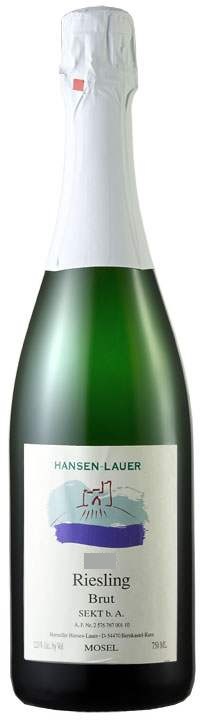
" We don't sell the wine without touching the vine "

Hansen Lauer Sekt Riesling Brut is made from 100 percent Riesling grown on Devonian slate.
A very fine bubbles along with a very nice fruit (apple, pear, citrus) and minerality coming from the stony (slate) vineyards.
Production techniques: the Sekt is bottle fermented, stayed on the lees for 12 months, thus giving it very fine bubbles along with a very nice fruit and minerality.
The vineyard sites are Bernkasteler Graben, Bernkasteler Badstube, Bernkasteler Bratenhöfchen, Graacher Himmelreich. The vineyards are situated at the beginning of a long stretch of approx. 2 million vines.
Enjoy on its own as an aperitif or with delicate food, such as pike, lobster and scalops.

Hansen Lauer Bernkasteler Badstube Riesling is a nice Mosel-Riesling with a lot of minerality and a hint of stewed apple, cantalope and dried orange flavors. The finish is long and clean, which make it very easy to drink.
This is coming from grapes grown on 100% Devonian slate soils. After harvest, the grapes are sorted in order to keep only the best quality. It is then aged on the lees for more than 6 months, giving the wine richness and depth.
The Hansen Lauer Bernkasteler Badstube Riesling goes well with turkey and seafood

Salmon hue with bright red tints. Fine and energetic bubbles. A ripe, complex and youthful bouquet of slightly tangy red fruit (redcurrants, blackcurrants), ripe citrus (blood orange) and roasted cocoa beans. After some time in the glass, the wine reveals sappier, floral and sweet notes with a saline, almost briny, core. The first impression of the wine is of a generosity, softness and concentration. One has the sensation of biting into juicy, ripe fruit and blood orange, it is a fabulous aromatic explosion with luscious and slightly tangy overtones. The concentrated and dense body takes over and reinforces the impression of substance, of concentrated liqueur on the mid-palate. The finish stretches out, perfectly-honed, gradually revealing umami notes thanks to the precise and crisp mineral freshness.
Reviews:
The 2015 Brut Vintage Rosé is generous and demonstrative, bursting with aromas of peach, orange and pear mingled with hints of red berries, fresh bread and ginger. Full-bodied, layered and vinous, it's rich and enveloping, its textural attack segueing into an ample, fleshy core that's girdled by bright acids and enlivened by a pillowy mousse. Long and expansive, it's more generous and gourmand than its racier 2014 predecessor, but just as good.
-Wine Advocate 94 Points
This shows lots of cotton candy and peach, together with strawberries and cream. But not overpowering. Some cranberry, too. It’s medium-to full-bodied with fine bubbles and a lively finish. Dosage 8g/L. Drink now or hold.
-James Suckling 94 Points

Inspired by the historical winemaking techniques of Erni Loosen’s great-grandfather, the Appassionata Riesling GG is made in the same way as the Dr. Loosen Grosses Gewächs (“Great Growth”) Rieslings he produces in Germany. The GG designation indicates a dry-style wine from a vineyard of special distinction — in this case, the old-vine Medici vineyard, planted in 1976. We farm this exceptional site, which is just a few miles east on the Chehalem Mountain ridge.
The fruit for this wine was harvested from old Rieslng vines (planted in 1976) in the Medici Vineyard, which is also in the Chehalem Mountains AVA, just a few miles from the winery. We lease this vineyard and have been farming it organically since 2015. The wine was fermented in a 3,000-liter German oak cask, and rests on the full lees for 12 months before bottling. The extended lees contact allows the wine to clarify and find its own harmonious balance naturally.
Production notes:
Whole-cluster pressing; natural fermentation in a neutral 3,000-liter oak cask; matured on the full lees for 12 months; no bâtonnage.
Review:
If you prefer a thinking person's wine you'll run out of superlatives to describe this Riesling from Dr Loosen's Oregon project with J Christopher Wines. From a personal favourite, the old vines of the Medici Vineyard, the winemaking shows serious patience and determination. Fermented in a 3,000-liter, neutral oak German Fuder cask. It rests on the full lees for two years and is then held in bottle for three to five years before release. Aged, savoury and delicious. Aromas are savoury and saline. Lanolin, dandelion, seafoam, and beeswax with hints of fresh herbs and dried lemon peel. The palate is brilliant, savoury and bright and complex. Energetic flavours of wet slate, savoury bee pollen, white tea and lanolin notes. The finish offers crushed stone vibrancy.
-Decanter 93 Points

Inspired by the historical winemaking techniques of Erni Loosen’s great-grandfather, the Appassionata Riesling GG is made in the same way as the Dr. Loosen Grosses Gewächs (“Great Growth”) Rieslings he produces in Germany. The GG designation indicates a dry-style wine from a vineyard of special distinction — in this case, the old-vine Medici vineyard, planted in 1976. We farm this exceptional site, which is just a few miles east on the Chehalem Mountain ridge.
The fruit for this wine was harvested from old Rieslng vines (planted in 1976) in the Medici Vineyard, which is also in the Chehalem Mountains AVA, just a few miles from the winery. We lease this vineyard and have been farming it organically since 2015. The wine was fermented in a 3,000-liter German oak cask, and rests on the full lees for 12 months before bottling. The extended lees contact allows the wine to clarify and find its own harmonious balance naturally.
Production notes:
Whole-cluster pressing; natural fermentation in a neutral 3,000-liter oak cask; matured on the full lees for 12 months; no bâtonnage.

Georges Cartier Champagne Brut Tradition NV is made from 65% Pinot Meunier, 25% Pinot Noir, and 10% Chardonnay.
This champagne was made to reflect the potential of each grape growing areas of the Champagne region.
The grapes for Georges Cartier Brut Tradition have been carefully selected from the 3 emblematic areas of Champagne. Chardonnay is sourced from the Côte des Blancs, Pinot Noir from Montagne de Reims and Pinot Meunier from the Marne Valley.
Each grape variety brings its own character and specific quality to the wine: Pinot Meunier brings fruit and roundness, Pinot Noir brings character, power, structure and balance, while Chardonnay contributes to the finesse, minerality and elegance of the result wine.
The blend in 2022 will be 70% 2018 vintage and 30% of reserve wines (consisting of 2014, 2015 and 2016 vintages).
It will be RD (meaning "Recently Disgorged") to keep freshness, fruitiness, minerality and elegance.
Review:
"A blend of Pinot Noir, Pinot Meunier, and Chardonnay. Lemon drop and buttercup combine with lime sorbet. Bubbles burst with ease and the wine’s mineral tone keeps the palate cleansed."
- The Tasting Panel (May/June 20022), 93 pts
A very fine bubbles along with a very nice fruit (apple, pear, citrus) and minerality coming from the stony (slate) vineyards.
Production techniques: the Sekt is bottle fermented, stayed on the lees for 12 months, thus giving it very fine bubbles along with a very nice fruit and minerality. The vineyard sites are Bernkasteler Graben, Bernkasteler Badstube, Bernkasteler Bratenhöfchen, Graacher Himmelreich. The vineyards are situated at the beginning of a long stretch of approx. 2 million vines.
Review:
"Delicate lemon and dusty mineral tones introduce this lovely traditional-method Riesling sekt. Juicy, intensely primary lemon, green-apple and grapefruit flavors are tinged with slate on the midpalate. It's a vibrant, cutting wine with persistent tiny bubbles.. - Anna Lee C. Iijima"
- Wine Enthusiast (April 2019), 90 pts
The Hahn Estate
The Hahn family has been in the wine business since 1650 and moved to Kobern, the present location, in 1892 to start a small winery. Konrad Hahn took over the operation in 1991, when his father retired, and works now with his Colorado-born wife Laurel Kerns-Hahn. The winery is recognized as one of the top estates in the region. The high quality of the wines is continuously confirmed by awards and medals received in regional and national as well as international competitions.
The Hahn Vineyard
The vineyards are located in Michelsberg, which is near the town of Piesport (Mosel Valley). In this most northern part, the Mosel valley is very narrow and the vineyards very steep. The warm micro climate and the use of terraces along the south facing slopes allows the vines to grow to full ripeness despite the northern location. The use of machinery is impossible and all work including harvesting is done by hand. The grapes for this wine were grown in slate soil, which is typical for the Mosel area and provides a unique minerality. The harmonious climate, warm summers and mild winters promote a long growing season providing fine fruit with balancing acidity and low alcohol.
A warm, but by far not as hot summer as 2003, continued into a beautiful sunny autumn. This allowed a perfect ripening of the grapes in 2005 vintage. Especially the always late ripening Riesling grapes achieved exceptional quality with must-weights similar to 2003 but with higher acidity levels and mineral concentration similar to 2004.
We view the 2005 vintage as the best vintage in our estate in years even though it is following several great vintages such as 2001, 2002 and 2003. We are very excited about this great vintage

W & J Graham's Vintage Port is made from 35% Touriga Nacional, 47% Touriga Franca and various others.
It is with great pleasure that Graham's announces the declaration of the 2000 Vintage, a wine that has been deemed to meet our very exacting standards, and one that shows every promise of living up to the reputation of the very best Vintage ports that the Twentieth Century provided.
This is a landmark wine for Graham's, not only being the first Vintage of a new millennium, but being the first Vintage wine to enjoy the extraordinary results achieved by the new robotic 'lagares' at Malvedos in the inaugural year of our remodelled winery. Significant also has been the decision to include a rather larger proportion of mature Touriga Francesa and Touriga Nacional from Vila Velha, a classic riverside Quinta a short distance downstream from Malvedos, and some spectacular old vine lots from Vale de Malhadas in the Upper Douro. These wines each from family-owned Quintas have been used to reinforce the predominant component from Malvedos and the traditional excellence of the Rio Torto lots from Lages, to produce a rounded and even blend in the hallmark rich Graham style.
Picking began at Malvedos on September 22nd and the last lagar was run off on October 10th, an unusually short and compact Vintage. Fruit arrived in good condition although yields were less than three quarters of a kilogram per vine, and the juice to skin ratio well below normal. 2000 was a year noted for a very low average yield across the Douro, and with the grapes unusually lacking in liquid, the extra amount of treading work required made it an ideal time to employ our new, tireless, mechanical treaders alongside the two original 1890 stone lagares still worked by human feet. It was evident early on in the Vintage from the colour and aroma of the fermenting musts that we were looking at a spectacular year, and after the usual waiting period of sixteen months or so to see how the lots would develop, we have now made our final selection and assembled the final blend.
The blend displays many of the typical Graham aromas of ripe plum and 'esteva' (gum cistus) and is pleasantly smooth on the palate despite its youth. It is full and rich in the mouth with fresh blackberry and red plum notes. Despite the hallmark Graham sweetness in the mouth the finish is long and clean.
As with all Graham Vintages, this is a wine made to last for years and the patience of laying down the wine for fifteen to twenty years will certainly be rewarded.

Matthews Cabernet Sauvignon Columbia Valley is made from 76% Cabernet Sauvignon, 15%Merlot, 6% Cabernet Franc, 2% Petit Verdot, 1% Malbec.
The 2021 Columbia Valley Cabernet Sauvignon is deep ruby in the glass with purple hues. The rich bouquet of spiced black plum and cocoa nib are balanced with aromas of fresh earth and crushed flint. Intense and opulent flavors of ripe blackberry, cedar, mocha, and black currant coat the broad and balanced palate and the ripe tannin creates a perfect frame for the lush fruit expression. Cherry cordial and cola linger on the long, quenching finish.
Review:
Precise and expressive, with handsome flavors of blackberry, bay leaf and espresso that build richness and structure toward refined tannins.
-Wine Spectator 93 Points
The 2021 Cabernet Sauvignon Columbia Valley is spicy, showing off a gentle peppery tinge and dusty rose tones that give way to dried black cherries. This is wonderfully crisp and refined, with silky textures and depths of dark red fruit propelled by juicy acidity. It tapers off long and structured, yet the tannins are quite sweet. The 2021 finishes with a pleasant crunch and a lingering licorice tinge.
-Vinous 93 Points
The 2021 Cabernet Sauvignon is based on 76% Cabernet Sauvignon, 15% Merlot, 6% Cabernet Franc, 2% Petit Verdot, and 1% Malbec. A rocking wine offering ample red and black plum-like fruit, chocolate, tobacco, and subtle violet-like aromas and flavors, I t's full-bodied and has a terrific mid-palate, velvety tannins, and a great finish.
-Jeb Dunnuck 93 Points


.jpg)