
" We don't sell the wine without touching the vine "
| Country: | United States |
| Regions: | California California (Napa) |
| Winery: | Heitz |
| Grape Type: | Cabernet Sauvignon |
| Organic: | Yes |
| Vintage: | 2017 |
| Bottle Size: | 750 ml |

Paradigm Cabernet Sauvignon is made from 90% Cabernet Sauvignon, 8% Merlot, 1% Petit Verdot, 1% Cabernet Franc
20 months in French oak (only about a third of that is new oak) and for 20 more months in bottle before release
Our winemaking "style" is solely determined by this place or terrior we call "Paradigm." Winemaking is agriculture when you own your vineyards and are able to farm them to promote the very best Earth will give you. All of our selections of wines are made from five varietals on the estate. Every wine is 100% farmed and grown by us.
Complexity in our wines supported by luscious fruit and acidity is our hallmark. Our efforts during harvest and barrel cellaring concentrate on maintaining the freshness from the first day we handpicked each vineyard block. Simple winemaking protocols are employed while crucial “timing” oriented winemaking decisions rule each day.
Review:
-Wine Enthusiast 94 Points
-Joe Czerwinski (Robert Parker) 92 Points

Avennia Sestina Cabernet Sauvignon is made from 77% Cabernet Sauvignon, 17% Merlot, 6% Cabernet Franc.
The story of this wine - The Sestina is an ancient form of poetry from Medieval France. Just as a modern poet can fill this form with new expressions, Avennia uses the traditional Bordeaux blend to express Washington. Sestina is their vision for an old vine, complex blend where all of the components complement each other. This wine is designed for the cellar, so the emphasis is on structure, balance, and complexity.
Winemaker Tasting Notes - “Good deep ruby/garnet color, with aromas of black cherry, fresh black currant, dark mocha, cigar box, and graphite. The palate is lively and dense with mountain berries, mocha, vanilla honey, damp earth, and wildflowers. The finish shows a distinct chalky minerality and beautiful tension. This is a classically balanced and ageworthy Sestina. Drink 2025-2040.” - Chris Peterson, Winemaker
Review:
-Jeb Dunnuck 95 Points
-Anthony Mueller (Robert Parker) 94 Points
-Stephen Tanzer (Vinous) 93 Points

Klipsun Cabernet Sauvignon Red Mountain is made from 84% Cabernet Sauvignon, 4% Merlot, 4% Malbec and 8% Syrah.
The 2017 vintage started out with a cool, wet winter, with significantly above average snowfall in eastern Washington. Red Mountain had a 24% increase in rainfall in 2017 over the 10 year average. Going into spring, the cool trend continued. As a result, bud break at Klipsun was behind the historical average and significantly behind the most recent warm vintages of 2013 2016. Bloom was also slightly delayed. Because of the cool weather, set was lighter than usual which translated into significantly less fruit in 2017.
The early part of the summer saw average temperatures followed by above average temperatures in July and August. As a result, he at accumulation was a bit above average for the season, despite the cool start. And because of the smaller than normal yield, harvest began right on schedule, perhaps even a bit early for some of the whites. In the second half of September, when Klipsun traditionally harvests all the reds, the temperatures cooled considerably, which delayed ripening. This allowed for luxurious amounts of hang time without the threat of increased sugar accumulation, stretching harvest into the first week of October. A s a result, all fruit going into the 2017 Klipsun Cabernet Sauvignon could be picked at perfect sugars levels with great fruit maturity and flavors. Overall, the quality of t he 2017 harvest is as high as the 2016. However, the style is slightly different. The 2017 wine has a firmer structure, more spice & mocha in the nose and will take a few mo re years than the 2016 to reach a perfect balance between fruit and tannin.
Review:
The 2017 Cabernet Sauvignon Red Mountain is composed of 84% Cabernet Sauvignon, 4% Merlot, 4% Malbec and 8% Syrah, which immediately emanates with aromas of dark roasted espresso bean, toasted oak, dried tobacco and dusty black fruit tones of cassis, currant and blackberries covered in dark cocoa powder. Full-bodied, generous in complexity and still tight in the mouth, the wine unpacks layers of cedar and vanilla tones with dusty purple flowers and bitter dark chocolate across the mid-palate, giving way to fine-grained tannins that will loosen with time. As the wine sits on the palate, the 100% French oak regimen is on full display for all to see. The wine lingering long and continues to evolve in the mouth, ending with a drying finish that highlights the oak and terroir. It’s still a baby, and I would keep it in the cellar for another few years before popping the cork—this will effortlessly coast for more than a decade. The 2017 vintage marks the second release of this wine, with 6,300 bottles produced. It comes from its namesake vineyard, first planted in 1984 on Red Mountain. I’m keeping my eye on this producer. I’m impressed, and even though the oak may be a bit much at the moment, it's still delicious. - Wine Advocate 94+ Points
-Jeb Dunnuck 94 Points

The estate Cabernet Sauvignon is grown primarily along the southwest ridge of the vineyard. The vines produce small berries with bountiful flavor, concentration and intensity, but also a good degree of finesse, excellent structure and layers of complexity that will continue to develop during extended bottle aging for those who want to cellar and age their wines. The wine is powerful, elegant, full-bodied.
Bottled unfined and unfiltered.100% free run
Pumpovers and punch-downs, up to 45 day macerations
Native yeast, 5 day cold soaks
22 months in 75% new French oak barrels
Fermented in concrete and stainless closed top tanks.
Review:
-Jeb Dunnuck 95 Points
-Anthony Mueller (Robert Parker) 95 Points
-Wine Spectator's Insider 93 Points
-Stephen Tanzer (Vinous) 92 Points

Morlet Family Vineyards Mon Chevalier Cabernet Sauvignon is made from 94% Cabernet Sauvignon 6% Cabernet Franc .
Located on the hillsides of Knights Valley, near Calistoga, this vineyard benefits from its proximity to Mount St. Helena, whose warm and windy climate is ideal for the long ripening of the Bordeaux red varietals. Handcrafted by using classical winemaking techniques, this special wine is dedicated to our son, Paul Morlet.
Dark red with a hue of purple. Intense and complex bouquet of red, black and blue berries intermixed with notes of blueberries, minerals (graphite, wet river rocks) licorice, fresh blond tobacco and a hint of lavender. Full bodied, the palate is reminiscent of the nose, with a richly tannic yet round frame and a great intensity. The hillside tannins and the classical aromatic complexity create a harmonious ensemble, leading to a very long and elegant finish. Built to age for decades, this collectible wine opens up after a few years of cellaring and is particularly representative of this special vineyard from the hillside of Knights Valley. Mon Chevalier features the interaction of the loamy, well drained and rocky volcanic soil, the typical sunny mountain climate and the low-interventionistic Morlet winemaking approach.
Propietary Name Mon Chevalier
Name Meaning My Knight Named after our son, Paul Morlet
Type of wine Vineyard designated
Appellation Knights Valley
Vineyard singularity Morlet Family Estate Hillside 1100-1200 feet elevation Rhyolitic, loam & volcanic ash
Typical harvest date End of October
Picking Manual, small lugs, refer truck
Sorting Cluster by cluster, berry per berry
Fermentation Through native yeast Tank and Puncheons
Upbringing 16 months French oak from artisan coopers
Bottling Unfiltered
Cellaring time Decades
Serving Room temperature
Decanting recommended
Review:
-Vinous 96 Points
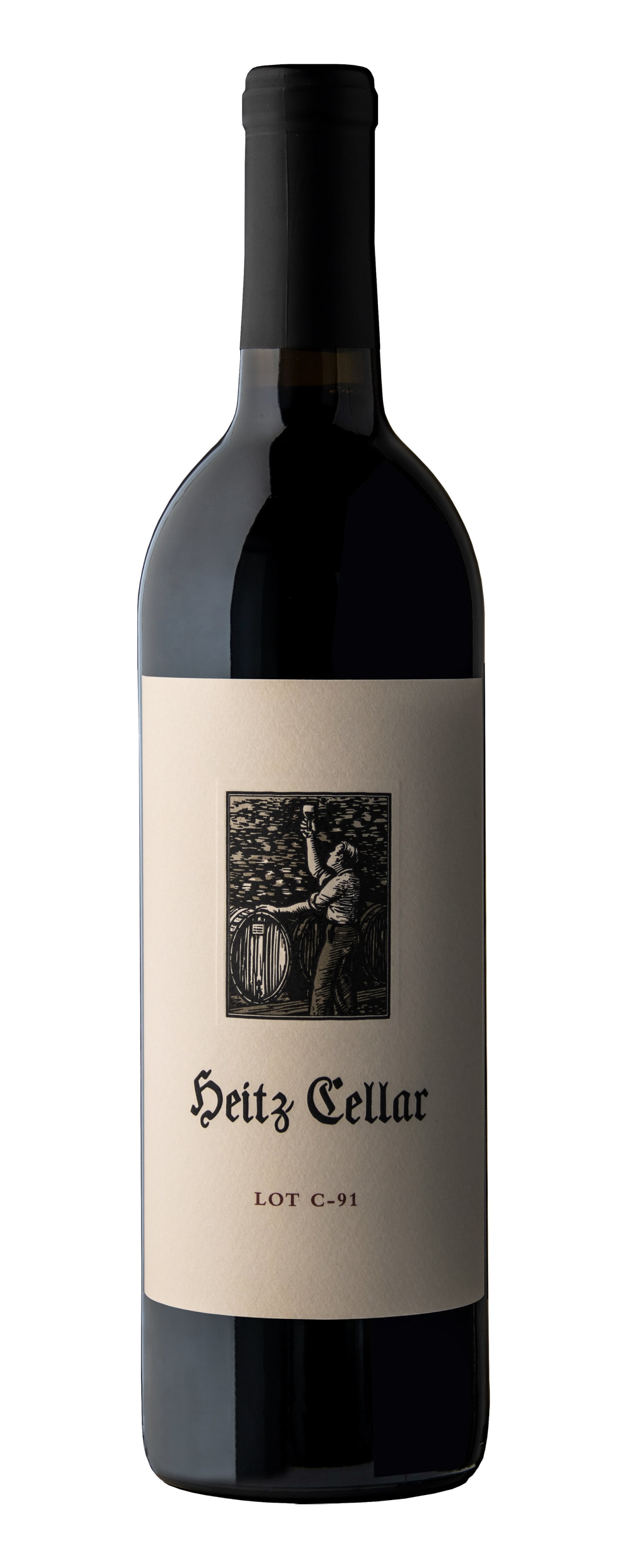
The origin of Lot C-91 began in the fall of 1969 when Joe Heitz created this one-off cuvée, which was very normal in those days, as a more premium version of his already iconic Napa Valley Cabernet Sauvignon bottling. Joe envisioned Lot C-91 as a greater step up in quality from the Napa Valley Cabernet Sauvignon, with a higher quality of fruit sourcing, coming exclusively from the sought-after single vineyards of Heitz Cellar.
Lot C-91 is the culmination of 50 years of tireless effort, trial and error, and the continual desire to make a unique expression of the heralded vineyards of Heitz Cellar.
Review:
Wow. Such a racy and exciting nose! This is quite agile and nimble, full of red and blue berries in the forefront, then complemented by spiced orange, earl grey, red plums, potpourri, savory plums and chocolate. Tense and elegant on the palate, which is all about succulent red berries, nuance and texture. Nothing redundant here. A great Napa cabernet sauvignon that has real definition. A beauty by all accounts!
-James Suckling 96 Points
In 1969, Heitz produced a one-off cuvée called Lot C-91. It was thought of as an elevated version of the Napa Valley Cabernet – a 'best of the best' blend from sites throughout Napa. After a bottle of the '69 turned up and turned heads at a Heitz wine dinner, the winemaking team decided to produce a modern iteration. It's comprised of vineyards in four AVAs: Rutherford (34%), Oakville (34%), Howell Mountain (17%) and St Helena (15%). The dazzling nose instantly shows off the component from Martha's Vineyard and on the palate it walks the line between succulent, powerful, herbal and floral, showing none of the heat of the 2017 vintage. As of June 2020, this was still a barrel sample, while many Napa 2017s are already on the market.
-Decanter 96 Points
Family owned since its founding in 1961, Heitz Cellar’s legacy runs as deep as the roots throughout the Napa Valley; a winery legend that has helped shape the history of Napa Valley winemaking. In the late 1950s, pioneering vintner Joe Heitz ushered in Napa’s modern era with his iconic, globally celebrated wines, including Napa Valley’s first vineyard-designated Cabernet Sauvignon, the renowned Heitz Cellar Martha’s Vineyard. Fifty-eight years of the Heitz family’s dedication to viticulture, stewardship, and classic winemaking maintained the winery’s notoriety as a benchmark amongst its peers in California and Europe.
In April 2018, Heitz Cellar entered an exciting new chapter as this rich legacy was passed into the hands of the Lawrence family, whose deep roots in agriculture and commitment to the same core values of fine winemaking made it a perfect match. The wines are made with an unwavering commitment to quality from organically farmed, 100% Napa Valley fruit, and a commitment to the sustainability of Napa Valley.
Our prized estate vineyards are planted in six of Napa Valley’s sub-appellations: Oakville, Rutherford, St. Helena, Howell Mountain, Oak Knoll District, and Calistoga, giving us an incredible breadth of diversity in terroir, allowing us to craft wines that are a pure representation of place. Their roots keep us grounded to the entirety of Napa Valley and at the same time, keep us mindful of our responsibility to maintain a sustainable environment. We are proud to be a leader in agricultural stewardship as 100% of our vineyards are grown certified CCOF organic, with a move towards biodynamic farming in the near future.
We at Heitz Cellar cherish our history and legacy, with a full commitment to our vision and goals to maintain the winery’s heritage.

Kinsella Estates Heirloom Cabernet Sauvignon is made from 100% Cabernet Sauvignon
20 months in French Oak (75% New)
Organic made.
Intense was the first word that came to mind. Purely focused tannin weaves its way through the core of this wine. Has a savory characteristic that we have found in past vintages (2014 to be specific) with a slight licorice note on the exceptionally long finish. While this vineyard has been described as “feminine” in the past, that is certainly not the case for this bigger, bolder vintage!

The Grade Napa Cabernet Sauvignon Winfield Vineyard is made from Napa Valley Cabernet Sauvignon.
“2016 produced wines that are very giving, round, coating and streamlined. Year after this year, this bottling aims to highlight the best attributes of the Winfield Vineyard, and also creates a wine that possesses qualities that allow it to age well in the cellar and evolve over many years.
“This wine expresses a focused balancing act of dark, rich black fruit, and a fine tannin structure, illuminated through the core with a laser-like acidity. The wine displays a deep purple-red hue with a cranberry halo. Aromas of cassis, cinnamon, citrus oil, roasted meat, and lilac swell from the glass.
“The palate is marked by a wave of jet-black brambly fruit up front, followed by an exotic spice mid-palate and a long, complex finish that lasts and lasts expressing notes of flowering jasmine, and oolong tea. The silky tannins hold everything together and will certainly allow this wine to evolve in the cellar for at least 7-10 years.” - Thomas River Brown
Review:
-Jeb Dunnuck 94 Points

Hickinbotham Brooks Road Shiraz is made from 100 percent Shiraz.
After the hand-picked Shiraz clusters were delivered from high country (210-230 meters) by Viticulturer Michael Lane, the winemaker destemmed and sorted the whole berries into open fermenters. The cold soak was four days, the skins plunged three times daily, and the minimum time on skins was eighteen days. The wine was then basket pressed; its free run and pressings kept separate. To minimize filtration at bottling, three rack-and-returns were conducted over fifteen months as the wine seasoned in a mixture of Burgundy-coopered barrels.
This Shiraz shows the characters this vineyard has displayed since the start, but perhaps in a more elegant, harmonious and balanced form. Its consistency is comforting and reassuring, buttressed by blue and black fruit notes throughout. It is readily enjoyable but has all the structure, acid and tannin to offer decades of rewards from cellaring.
Review:
-Wine Spectator 95 Points

Booker Vineyard Oublie Red is made from 33% Syrah, 30% Grenache, 28% Mourvèdre, 5% Tannat, 4% Petite Sirah
Oublié's blend is always Grenache, Syrah and Mourvèdre – the California version of a Châteauneuf du Pape. The namesake is a play on the French term for "forgotten." Rhône varietals grow beautifully on the estate and Booker believes that they are far-too-often forgotten when you think of a California wine. Deep ruby/purple in color, this hearty expression of a Paso GSM boasts confident notes of boysenberry, licorice and cedar on the nose. On the palate, the taster is rewarded with lively flavors of raspberry coulis mingled with blonde roast coffee and chocolate ganache. For lovers of Mourvèdre, this vintage of Oublié will show off. It drinks bolder than prior vintages, mostly because the Mourvèdre was so special in '19.
Oublié is traditionally one of Booker's most food-friendly wines and should pair well with most dishes.
Review:
-Wine Advocate 97 Points

Dense purple hues, with evocative aromas of black cherries, ripe plums, nectarines, boysenberry, wild bramble and exotic oak spice. The juicy and sweet-fruited palate entry, combined with crunchy tannins, lures one into a sense of overtness, yet the wine is sublimely elegant and poised. The complex layers of fruit is in perfect harmony with the oak, all bound together by a lively seam of acidity. The finish is pleasantly dry and savory, with lingering notes of Christmas cake and vanilla pod.
Pair with barbequed meats, especially venison and beef / bobotie / lamb curry / seared tuna / spicy Asian-styled cuisine / aromatic curries / duck with sweet plum sauce / beef or lamb burgers / pizza
Review:
-Decanter WWA 2021 96 Points
-Wine Enthusiast 92 Points
-Tim Atkin 94 Points

Inglenook Rutherford Cabernet Sauvignon is made from 96% Cabernet Sauvignon, 4% Cabernet Franc.
Stunningly deep ruby in color, the 2019 Cabernet Sauvignon opens with heady aromas of brambly black cherry, vanilla, warm brioche, and crème de cassis. As the wine warms on the palate, notes of red cherry, graphite and fennel emerge, as very polished, refined tannins carry the wine into a long, fragrant finish. Layered flavors, good tension, and a perfect integration of wine and oak interact to create this classic expression of Inglenook Cabernet Sauvignon.
Review:
This shows notes of ripe blackberries and blackcurrants with hints of licorice, cloves, walnuts and chocolate. It has full body and a velvety tannin structure. Juicy and vibrant fruit on the palate with a touch of earthiness. Smooth and delicious. Long, fruity finish. Very pure fruit. Try after 2024.
-James Suckling 95 points

Holocene Memorialis Pinot Noir is made from 100 percent Pinot Noir.
Holocene Pinot Noir Memorialis is a blend of 777, Pommard and 115 clones from MonksGate vineyard in the Yamhill-Carlton AVA, and it saw about 20% new French oak for 16 months prior to bottling. It is always the lighter and more feminine of the two Holocene wines, with red fruits, white flowers, dried herbs, mushroom and forest floor aromatics, bright acidity and a lithe texture, long finish.
By now, everyone knows that the Willamette Valley is an amazing place to grow Pinot Noir. When I relocated from Napa Valley to partner up with Force Majeure Vineyards, I knew I also wanted to start a project where I could focus attention on a varietal and growing region that I loved. Part of the excitement of being in the Pacific Northwest is the ability to have access to so many amazing vineyards and so much diversity, along with the opportunity to push boundaries and try new things – something that is becoming increasingly difficult in other growing regions.
We partner up with a few very small, diverse and amazing vineyards in the Willamette Valley, sourcing fruit from these dry-farmed sites that emphasize low yields, sustainable practices and produce outstanding fruit.
The wines are crafted in the same way I have been making wine since I was carrying it out at Bryant Family Vineyard in the Napa Valley — utilizing very low-impact, non-industrial techniques, native yeasts, little extraction and little new oak, and never filtering or fining. This allows a real sense of place to show through in the wines that is often dimmed when too much manipulation is undertaken.
Our first vintage was 2015, and was released in early 2017. As production is currently extremely small, the best way to get the wines into your hands is to join our mailing list at the “Mailing List” link above to receive an allocation when we have a release. We release wines once per year, and they will be sold on a first come, first served basis, shipped straight to your door.
Review:
-Jeb Dunnuck 95 Points

Chappellet Pritchard Hill Estate Vineyard Cabernet Sauvignon is made from Cabernet Sauvignon.
Chappellet's Pritchard Hill Cabernet Sauvignon has been, since the beginning of their winemaking career, the most sought after wine of their portfolio. The wine is truly a love letter to the winegrowing potential of Pritchard Hill. The wine was inspired by Bordeaux, and like most left bank Bordeaux, the wine is a blend of predominately Cabernet Sauvignon with remaining amounts other classic Bordeaux blend varieties. The vines grow upon rocky, mountainside vineyards. After harvest and fermentation, the wine was aged for 22 months in 100% new French oak barrels.
Chappellet planted on Pritchard Hill in 1967, among the first to prove this rugged, high-elevation bench on Napa Valley's eastern ridge could grow world-class Cabernet. The volcanic, iron-rich soils sit above the fog line, where poor ground and long, even ripening yield naturally concentrated fruit and the wine's celebrated capacity to age.
Review:
The flagship release here, the 2023 Cabernet Sauvignon Pritchard Hill sports a saturated purple hue and absolutely heavenly aromatics of crème de cassis, liquid violets, graphite, crushed stone, and a Pauillac-like character that builds with time in the glass. Based on 95% Cabernet Sauvignon and 5% Petit Verdot, it's full-bodied, has a deep, concentrated mouthfeel, ultra-fine tannins, and a great, great finish. This is magical stuff that offers pleasure even today given its purity, balance, and finesse, but I'd be shocked if it didn't keep for 50 years or more. Drink 2025-2075.
Jeb Dunnuck, 100 points
-Jane Anson (Jane Anson - Inside Bordeaux) 100 Points
-Joe Czerwinski (Robert Parker) 100 Points
-Decanter 99 Points



