" We don't sell the wine without touching the vine "
| Country: | France |
| Region: | Bordeaux |
| Winery: | Chateau des Landes |
| Grape Types: | Cabernet Sauvignon Merlot |
| Organic: | Yes |
| Vintage: | 2019 |
| Bottle Size: | 750 ml |
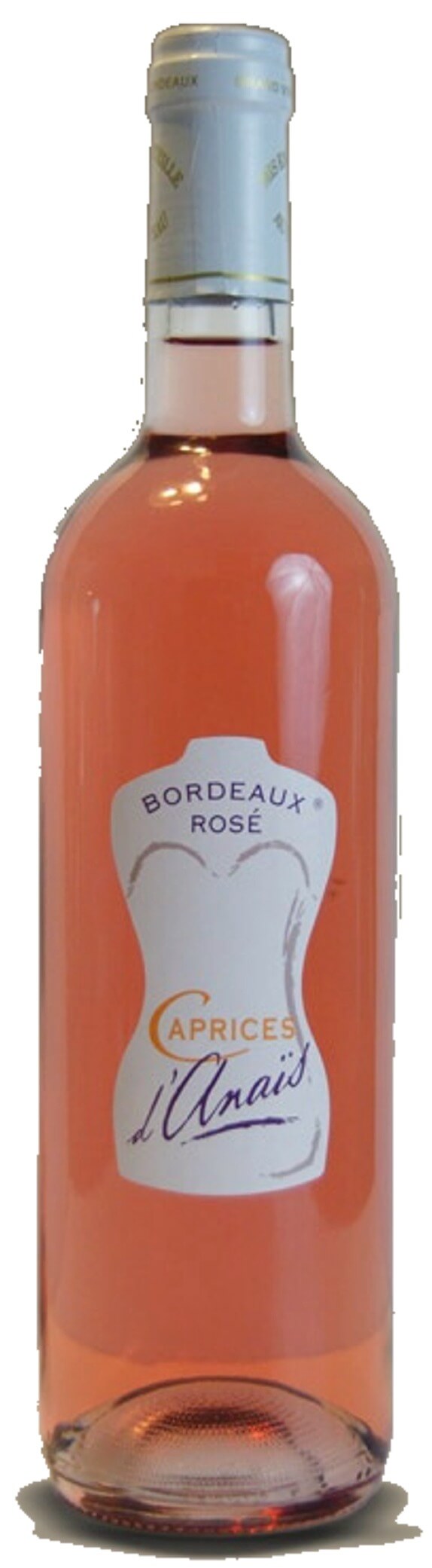
Landes Caprices d'Anais Rose is made from 50% Merlot + 50% Cabernet Sauvignon
This cuvée was created in 2005 to honor Nicolas's first daughter Anais. Caprice d'Anais means "Anais' Whim".
Color: Pale pink with salmon hues.
Aromas: quite aromatic nose dominated with floral (linden and elderberry) and fruity (cherry, strawberry and raspberry) notes.
Flavors: Quite similar to the aromas, with red fruit and floral flavors. The wine is easy to drink with a good fresh and zesty finish.
Great on its own during summer time, it will also pair very well with grilled salmon, salads, roasted chicken or any white meat dish.
Rileys Rows Rose of Syrah is made from 100 percent Syrah.
When I think about my rosé one word comes to mind: intentional. Made from 100% syrah and pressed off skins in the Provencal style this wine is not just an afterthought. Typically picked in mid-October from a cool climate site the fruit comes in with both chemical and flavor ripeness. The result is a low alcohol, fresh wine with a complete flavor profile
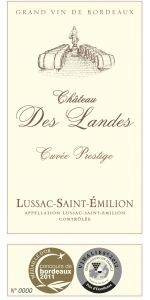
Landes Cuvee Prestige Lussac Saint Emilion is made from 80% Merlot, 15% Cabernet Sauvignon and 5% Cabernet Franc
Color: deep dark ruby intense color
Aroma: racy and aromatic nose with aromas of ripe red fruit, floral notes, wood and spice with a touch of vanilla.
Taste: this wine has a good structure and some powerful aromas of raspberries, blackcurrant, vanilla and it is powerful with a complex finish. The oak is present but not dominant. The tannins are quite well integrated already.
Average age of the Vines: 60 years Yield : 50 hectoliters / hectare. Grape picking: harvest by machine. Vats: Stainless steel thermoregulated and computerized. Fermentation: 45 to 50 days with a final 35°C warm steeping. Winemaking: Malolactic fermentation in new oak barrel. Ageing: 16 months in new French Oak barrels from Allier and Limousin. Annual production: 10,000 bottles. (833 cases)
Review:
"This shows aromas of ripe blackcurrants and blackberries with walnuts, spices and cocoa. Medium-bodied with firm tannins and a bright, succulent character. Racy finish. Drink or hold."
- James Suckling (December 2022), 92 pts
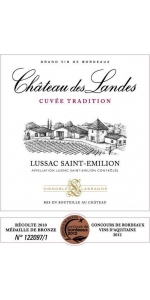
Landes Cuvee Tradition Lussac Saint Emilion is made from 80% Merlot, 15% Cabernet Sauvignon and 5% Cabernet Franc
Color: deep ruby intense color.
Aroma: racy and aromatic nose with aromas of ripe red fruit.
Taste: this wine is silky, round and smooth first taste, with aromas of raspberries, and blackcurrant, powerful and complex finish.
Landes Cuvee Tradition Lussac Saint Emilion is made from 80% Merlot, 15% Cabernet Sauvignon and 5% Cabernet Franc
Color: deep ruby intense color.
Aroma: racy and aromatic nose with aromas of ripe red fruit.
Taste: this wine is silky, round and smooth first taste, with aromas of raspberries, and blackcurrant, powerful and complex finish.
Landes Cuvee Tradition Lussac Saint Emilion is made from 80% Merlot, 15% Cabernet Sauvignon and 5% Cabernet Franc
Color: deep ruby intense color.
Aroma: racy and aromatic nose with aromas of ripe red fruit.
Taste: this wine is silky, round and smooth first taste, with aromas of raspberries, and blackcurrant, powerful and complex finish.
Landes Caprices d'Anais Rose is made from 50% Merlot + 50% Cabernet Sauvignon
This cuvée was created in 2005 to honor Nicolas's first daughter Anais. Caprice d'Anais means "Anais' Whim".
Color: Pale pink with salmon hues.
Aromas: quite aromatic nose dominated with floral (linden and elderberry) and fruity (cherry, strawberry and raspberry) notes.
Flavors: Quite similar to the aromas, with red fruit and floral flavors. The wine is easy to drink with a good fresh and zesty finish.
Great on its own during summer time, it will also pair very well with grilled salmon, salads, roasted chicken or any white meat dish.
Chateau des Lande Estate
Château des Landes was created in 1952 by Paul Lassagne, Nicolas' grandfather. He started with only 2 hectares and grew to 7 hectares in 1979.
His son, Daniel, came along and bought more vineyards surrounding the cellar and he managed to grow to 27 hectares in almost 20 years.
In 2001, Nicolas, came aboard and decided to continue on the family tradition bringing his expertise and his knowledge.
Nicolas is now in charge of the Estate and he manage 27.2 hecatres of vineyards (68 hectares).
27.2 hectares (68 acres) of vineyard with a density of 5,500 vineplants per hecatres ( 2,217 vineplants per acre).
The average age of the vine is 30 years.
The soil is mostly a mix of Clay and limestone, while the subsoil is white clay.
The Grade Cellar Kingly Project Cabernet Sauvignon is made from Napa Valley Cabernet Sauvignon.
"This is a noble expression of Cabernet Sauvignon" in full regalia, with decadent aromas and a mouthfeel viscous and sleek. "This vintage of the Kingly Project Cabernet Sauvignon enters the scene" -- Thomas Rivers Brown
Review:
The 2019 Cabernet Sauvignon Kingly Project is fabulous. A wine of vertical power and thrust, the 2019 soars out of the glass, showing magnificent intensity from start to finish. Black cherry, scorched earth, licorice, plum and chocolate give this substantial Cabernet tons of complexity. I would cellar the 2019 for at least a few years to allow the tannins to soften. -
- Antonio Galloni 97 Points

Clear, golden straw, with a slight greenish tinge. The nose is intense with yellow apple, Calamansi lime, apricot, quince, white flowers, flinty minerals, and brioche. The palate is light and quaffable.
Alcohol: 12.5%
Acid TA: 6.34g/L
pH: 3.22