" We don't sell the wine without touching the vine "
| BUY MORE! SAVE MORE! | ||||||||||||||||||||
|
| Country: | France |
| Region: | Bordeaux |
| Winery: | Chateau des Landes |
| Grape Types: | Cabernet Franc Cabernet Sauvignon Merlot |
| Organic: | Yes |
| Vintage: | 2023 |
| Bottle Size: | 750 ml |
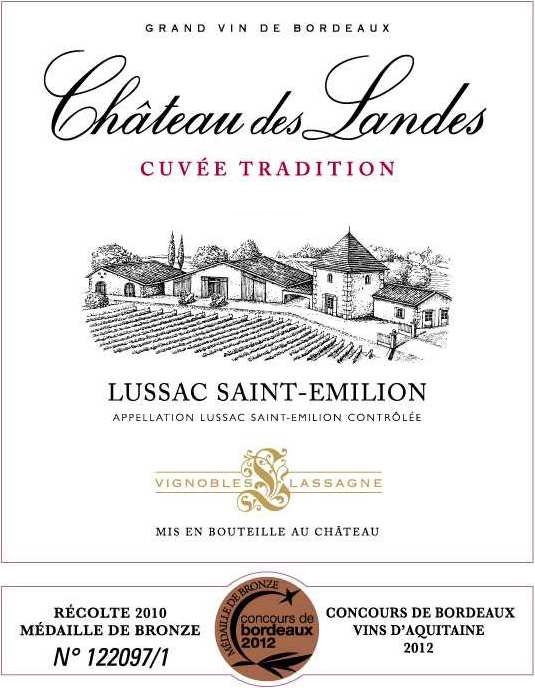
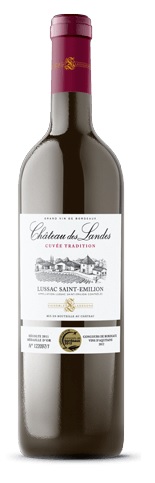
Landes Cuvee Tradition Lussac Saint Emilion is made from 80% Merlot, 15% Cabernet Sauvignon and 5% Cabernet Franc
Color: deep ruby intense color.
Aroma: racy and aromatic nose with aromas of ripe red fruit.
Taste: this wine is silky, round and smooth first taste, with aromas of raspberries, and blackcurrant, powerful and complex finish.
Chateau des Lande Estate
Château des Landes was created in 1952 by Paul Lassagne, Nicolas' grandfather. He started with only 2 hectares and grew to 7 hectares in 1979.
His son, Daniel, came along and bought more vineyards surrounding the cellar and he managed to grow to 27 hectares in almost 20 years.
In 2001, Nicolas, came aboard and decided to continue on the family tradition bringing his expertise and his knowledge.
Nicolas is now in charge of the Estate and he manage 27.2 hecatres of vineyards (68 hectares).
27.2 hectares (68 acres) of vineyard with a density of 5,500 vineplants per hecatres ( 2,217 vineplants per acre).
The average age of the vine is 30 years.
The soil is mostly a mix of Clay and limestone, while the subsoil is white clay.

Landes Cuvee Tradition Lussac Saint Emilion is made from 80% Merlot, 15% Cabernet Sauvignon and 5% Cabernet Franc
Color: deep ruby intense color.
Aroma: racy and aromatic nose with aromas of ripe red fruit.
Taste: this wine is silky, round and smooth first taste, with aromas of raspberries, and blackcurrant, powerful and complex finish.
Landes Cuvee Tradition Lussac Saint Emilion is made from 80% Merlot, 15% Cabernet Sauvignon and 5% Cabernet Franc
Color: deep ruby intense color.
Aroma: racy and aromatic nose with aromas of ripe red fruit.
Taste: this wine is silky, round and smooth first taste, with aromas of raspberries, and blackcurrant, powerful and complex finish.
Landes Cuvee Tradition Lussac Saint Emilion is made from 80% Merlot, 15% Cabernet Sauvignon and 5% Cabernet Franc
Color: deep ruby intense color.
Aroma: racy and aromatic nose with aromas of ripe red fruit.
Taste: this wine is silky, round and smooth first taste, with aromas of raspberries, and blackcurrant, powerful and complex finish.
Landes Cuvee Tradition Lussac Saint Emilion (half-bottle)is made from 80% Merlot, 15% Cabernet Sauvignon and 5% Cabernet Franc
Color: deep ruby intense color.
Aroma: racy and aromatic nose with aromas of ripe red fruit.
Taste: this wine is silky, round and smooth first taste, with aromas of raspberries, and blackcurrant, powerful and complex finish.

Landes Cuvee Prestige Lussac Saint Emilion is made from 80% Merlot, 15% Cabernet Sauvignon and 5% Cabernet Franc
Color: deep dark ruby intense color
Aroma: racy and aromatic nose with aromas of ripe red fruit, floral notes, wood and spice with a touch of vanilla.
Taste: this wine has a good structure and some powerful aromas of raspberries, blackcurrant, vanilla and it is powerful with a complex finish. The oak is present but not dominant. The tannins are quite well integrated already.
Average age of the Vines: 60 years Yield : 50 hectoliters / hectare. Grape picking: harvest by machine. Vats: Stainless steel thermoregulated and computerized. Fermentation: 45 to 50 days with a final 35°C warm steeping. Winemaking: Malolactic fermentation in new oak barrel. Ageing: 16 months in new French Oak barrels from Allier and Limousin. Annual production: 10,000 bottles. (833 cases)
Review:
"This shows aromas of ripe blackcurrants and blackberries with walnuts, spices and cocoa. Medium-bodied with firm tannins and a bright, succulent character. Racy finish. Drink or hold."
- James Suckling (December 2022), 92 pts

Landes Grand Heritage Lussac Saint Emilion is made from 100 percent Merlot.
First vintage of this wine was 2010 to pay tribute to the founding father of Chateau des Landes - Paul Lassagne. He gave the family a great legacy of terroir, passion and know-how to craft this great cuvee produced from a selection of the finest grapes that are vinified and aged in 600 liter French oak foudres, just like it was done in the old days. The resulting wine is complex and aromatic offering bold aromas and flavors of dark berries, floral tones, spice, oak and vanilla. The palate is onctuous and powerful, well structured with ripe tannins. Well balanced and a complex finish.
Average age of the Vines: 60 years Yield : 50 hectoliters / hectare. Grape picking: harvest by machine. Vats: Stainless steel thermoregulated and computerized. Fermentation: 45 to 50 days with a final 35°C warm steeping. Winemaking: Malolactic fermentation in new oak barrel. Ageing: 16 months in new French Oak barrels from Allier and Limousin. Annual production: 10,000 bottles. (833 cases)

Franz Prager, co-founder of the Vinea Wachau, had already earned a reputation for his wines when Toni Bodenstein married into the family. Bodenstein’s passion for biodiversity and old terraces, coupled with brilliant winemaking, places Prager in the highest echelon of Austrian producers.
Smaragd is a designation of ripeness for dry wines used exclusively by members of the Vinea Wachau. The wines must have minimum alcohol of 12.5%. The grapes are hand-harvested, typically in October and November, and are sent directly to press where they spontaneously ferment in stainless-steel tanks.
Klaus sits adjacent to Achleiten and is one of the Wachau’s most famous vineyards for Riesling. The vineyard is incredibly steep with a gradient of 77% at its steepest point. The southeast-facing terraced vineyard of dark migmatite-amphibolite and paragneiss produces a tightly wound and powerful wine. The parcel belonging to Toni Bodenstein was planted in 1952.
Tasting Notes:
Austrian Riesling is often defined by elevated levels of dry extract thanks to a lengthy ripening period and freshness due to dramatic temperature swings between day and night. “Klaus is not a charming Riesling,” says Toni Bodenstein with a wink. Klaus is Prager’s most assertive and robust Riesling.
Food Pairing
Riesling’s high acidity makes it one of the most versatile wines at the table. Riesling can be used to cut the fattiness of foods such as pork or sausages and can tame some saltiness. Conversely, it can highlight foods such as fish or vegetables in the same way a squeeze of lemon or a vinaigrette might.
Review:
Superbly cool, restrained and refined, this austere, beautiful dry riesling is a slow-burn masterpiece that's only just beginning to reveal its complex white-peach, white-tea, wild-herb and dark-berry character. Super-long and mineral finish. Drink or hold.
-James Suckling 97 Points

Bachelet Bertrand Santenay Blanc is made from 100 percent Chardonnay.
The Santenay Blanc comes from a parcel that is 1.2 hectares in size (3 acres) in the village called 'En Charron', at around 300 meters above sea level, with excellent sunshine and thin limestone soil, guaranteeing great aromatic finesse.
The wine shows a beautiful golden color, a fresh and slightly roasted nose combining lemon and lime aromas with a hint of vanilla. On the palate, almond and toasted hazelnut flavors, along with notes of white flowers and vanilla nuances.