
" We don't sell the wine without touching the vine "
| Country: | France |
| Region: | Burgundy |
| Winery: | Louis Jadot |
| Grape Type: | Pinot Noir |
| Vintage: | 2020 |

Louis Jadot Montrachet Grand Cru is made from 100 percent Chardonnay.
Le Montrachet is situated to the south of the Côte de Beaune, on both villages of Puligny Montrachet and Chassagne Montrachet (like the Batard Montrachet Grand Cru).
The terroir is extremely chalky with a lot of stones, perfectly drained and easy to overheat with south-south-eastern exposition.
The Montrachet is produced with Chardonnay
Grapes are harvested by hand and put in small cases in order not to damage the fruits. Grapes are pressed softly, they ferment in oak barrels produced by our cooperage. 1/3 are new barrels. Aging usually lasts 15 months on fine lies before bottling.
Review:
Aromas of buttered toast, honeyed peaches, white flowers and mint introduce the 2019 Montrachet Grand Cru (Maison Louis Jadot), a full-bodied, layered and enveloping wine that's satiny and sumptuous, with lively acids and fine depth at the core. While I'd give the nod to the stunning Demoiselles as Jadot's best white wine this year, this Montrachet—purchased from the Chassagne-Montrachet side, from the house's usual source—is undeniably promising.
-Wine Advocate 94-96 Points

Domaine Louis Moreau Chablis Vaillons Premier Cru is made from 100 percent Chardonnay.
Chablis achieves its highly distinctive mineral character due to its cool northerly climate and its highly calcareous soil. The Domaine Louis Moreau Chablis Vaillons Premier Cru is a generous, fleshy and lively wine that displays a beautiful balance of minerality, fruitiness and elegance.
Chablis, with its steely character and fresh citrus flavor, pairs well with white fish and shellfish and its naturally high acidity can counterbalance cream-based sauces. Unoaked Chablis lends itself well to vegetables, starches, Comté, or fresh goat cheese.

Domaine Jean Grivot Clos de Vougeot Grand Cru is made from 100 percent Pinot Noir.
Domaine Jean Grivot is among the great names in Burgundian wine. Étienne Grivot and his wife Marielle took over from Étienne’s father Jean Grivot in 1987. The vineyards are densely planted and farmed organically “sans certification” while the aim in the cellar is for balance and clear expression of terroir.
Jean Grivot’s 38.3 acres spread across 22 appellations with vineyards in the communes of Vosne-Romanée, Vougeot, Chambolle-Musigny, and Nuits-Saint-Georges. Besides the three grand crus, there are 8 premier crus including the much lauded Les Beaux Monts and Suchots in Vosne-Romanée. The grapes are completely de-stemmed and fermentation is spontaneous.
About the Vineyard:
Clos de Vougeot grand cru was acquired by Étienne’s grandfather, Gaston Grivot, in 1919. The total holding is 4.6 acres from the middle of the vineyard to the lower wall and the average vine age is 40 years old. A good Clos de Vougeot should be a complete wine without any one feature standing out. It is a perfect balance of power, aroma, and flavor.
Wine Production:
The grapes are destemmed and maceration à froid usually lasts just a day or two. The alcoholic fermentation is spontaneous and malolactic fermentation occurs in barrel. Depending on the vintage, the proportion of new oak is around 40-70% percent for the grands crus.
Tasting Notes:
The wine shows aromas and flavors of red berries, herbs, and purple flowers. The palate is rich with ripe fruit and medium weight with bright acidity and fine tannins. Aging in 40-70% new Burgundian pièce brings notes of vanilla, toast, and baking spices.
Food Pairing:
Red Burgundy might be the world’s most flexible food wine. The wine’s high acidity, medium body, medium alcohol, and low tannins make it very food-friendly. Red Burgundy, with its earthy and sometimes gamey character, is a classic partner to roasted game birds, grilled duck breast, and dishes that feature mushrooms, black truffles, or are rich in umami.
Review:
This round version is packed with ripe black cherry, violet, graphite and tobacco flavors. The silky texture and vibrant acidity work in tandem, while refined tannins provide support without getting in the way. There are a few edges to be worked out, yet this is long and concentrated.
-Wine Spectator 95 Points

Domaine Jean Grivot Echezeaux Grand Cru is made from 100 percent Pinot Noir.
Domaine Jean Grivot is among the great names in Burgundian wine. Étienne Grivot and his wife Marielle took over from Étienne’s father Jean Grivot in 1987. The vineyards are densely planted and farmed organically “sans certification” while the aim in the cellar is for balance and clear expression of terroir.
Jean Grivot’s 15.5 hectares spread across 22 appellations with vineyards in the communes of Vosne-Romanée, Vougeot, Chambolle-Musigny, and Nuits-Saint-Georges. Besides the three grand crus, there are 8 premier crus including the much lauded Les Beaux Monts and Suchots in Vosne-Romanée. The grapes are completely de-stemmed and fermentation is spontaneous.
About the Vineyard:
Echézeaux grand cru is a large vineyard of 38 hectares divided into 11 individual climats. Grivot’s parcel is in the climat of Les Cruots and lies at the southern end of Echézeaux near the premier cru of Les Suchots. A good Echézeaux should have rich fruit, considerable earthiness, and be very complete on the palate.
Tasting Notes:
The wine shows aromas and flavors of red berries, herbs, and purple flowers. The palate is rich with ripe fruit and medium weight with bright acidity and fine tannins. Aging in 40-70% new Burgundian pièce brings notes of vanilla, toast, and baking spices.
Food Pairing:
Red Burgundy might be the world’s most flexible food wine. The wine’s high acidity, medium body, medium alcohol, and low tannins make it very food-friendly. Red Burgundy, with its earthy and sometimes gamey character, is a classic partner to roasted game birds, grilled duck breast, and dishes that feature mushrooms, black truffles, or are rich in umami.
Review:
A very elegant expression of Echezeaux, with a velvety black plum and rose petal fruit. There is a lovely freshness and so much finesse that the tannin and structure might surprise you at the end. This has the substance to age for decades. Produced from a 0.84ha parcel in Cruots next to Comte Liger-Belair. The vines were planted in 1954 and the destemmed fruit was gently fermented.
This is pure, racy and enticing, hosting aromas and flavors of black currant, blackberry, violet and iron. This is about finesse, grace and precision balance, with saturated fruit flavors persisting on the superlong aftertaste. Needs a decade in the cellar.
-Wine Spectator 97 Points

Joseph Drouhin Batard-Montrachet Grand Cru is made from 100 percent Chardonnay.
Producing communes: Puligny-Montrachet and Chassagne-Montrachet.
Site: Bâtard-Montrachet straddles Puligny and Chassagne. It lies right below the famous Montrachet vineyard. Bâtard is one of the greatest white wines of the Côte de Beaune.
History & tradition: according to the often told story, the lord of Puligny in the Middle Ages divided his estate between his children: the eldest was the « chevalier » (knight), the daughters were the « pucelles » (young virgins) and the son born out of wedlock was the « bâtard ».
Soil: located on a mild slope, the soil is a brownish limestone mixed with gravel. The secret of this exceptional terroir comes from the unique interaction between the deep layers of limestone and the roots of the vines.
Tasting a wine of this stature is always cause for emotion. The golden colour has bright reflections. After some aeration, the aromas reveal their rich intensity: grilled bread, almond, honey, exotic wood...What is striking is the structure of the wine, its « monumental » grandeur. There is even a touch of tannin that provides an added dimension. A voluptuous finale, seemingly without end, with precious notes of preserved and ripe fruit..
Supply: this wine comes from grapes harvested on some parcels of the Drouhin Family Properties as well as from grapes and musts purchased from supply partners according to rigorous specifications.
Harvest: grapes harvested by hands in open-work crates. If necessary, a careful sorting is proceeded.
Vinification: slow pressing in a pneumatic press. The juice of the last press is separated from the free run-juice. The juice is transferred into wine barrel after a little settling.
Ageing: the alcoholic fermentation as the malolactic and the ageing are being processed in oak barrels. The proportion of new barrels is around 30%.
The ageing lasts between 18 to 21 months.
Origin of the wood: oak grown in French high forest.
Throughout the ageing process, decisions are taken only after careful tasting evaluation. The data obtained is completed through technical analysis. As with every other Joseph Drouhin wine, absolute priority is given to the true expression of terroir and character of the vintage.

Grand Veneur Chateauneuf du Pape Rouge Le Miocene is made from 70% Grenache, 20% Syrah, 10% Mourvèdre .
An intense dark-ruby color. The nose develop aromas of ripe black fruit (such as blackberry), cherry and spice box. The palate reveals the presence of tannins, in high quantity and elegant. The finish is long and luxurious. This is the Châteauneuf du Pape expression, displaying all the characteristics of the terroir.
Soil type: Plots are located northern part of Châteauneuf du Pape and the vines are grown under organic process.The soil is marked by the violence wrought by the Rhone river. It consists of a layer of marine molasses of the Miocene period covered by alpine alluvium. The presence of a great number of rounded stones known as "galets" in the earth is evidence of the time when the Rhone, then a torrent, tore fragments of rock from the Alps and deposited them on the plain. The GRAND VENEUR cuvee will express year after year a great power and aromatic complexity.
Winemaking & ageing: Harvest is sorted by hand, destemmed and crushed. Fermentation temperature is controlled at 30°C. Vatting period of 18 to 20 days. Matured in vats and oak casks.
Review:
A classic nose of deep red and black cherries is embraced by captivating violet perfume and saffron-cardamom spice. The palate is concentrated, supported by youthful tannins and a generous wave of acidity that refreshes the palate and provides lift to its intense dark-fruit finish. This expression will be exciting to revisit even after a few years of cellaring.
- Wine Enthusiast (December 2023, Best of Year issue), 94 pts
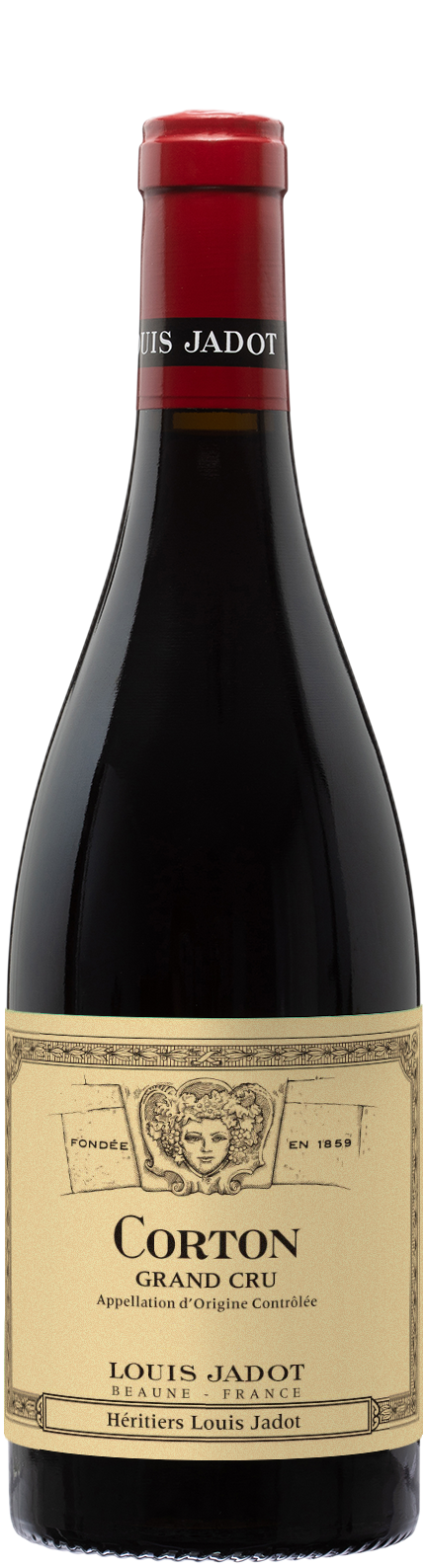
Louis Jadot Corton Grand Cru is made from 100 percent Pinot Noir.
Corton is distinct from the individual Grand Cru vineyard Le Corton.The Grand Cru appellation of Corton covers different vineyards among Aloxe-Corton, Ladoix and Pernand.
Frédéric Barnier joined Maison Louis Jadot in 2010 as Technical Director, working under the guidance of Jacques Lardière. For 42 years, the legendary Lardière was responsible for the winemaking and bottling of all Maison Louis Jadot wines, and he is considered to be one of Burgundy’s finest winemakers. He briefly retired, then came out of retirement to launch Resonance Wines, Jadot’s new brand from Oregon. Frédéric now leads the winemaking team with the Maison Louis Jadot philosophy: no compromise on quality.
Maison Louis Jadot was founded in 1859 by the man whose name it bears, Louis Henry Denis Jadot. The first of his family arrived in Beaune from Belgium in 1794 and soon began purchasing Premier and Grand Cru vineyards. With grape growing a part of his heritage, Louis Henry set about gaining experience first in the cellars, in the evaluation of wines, and then in the vineyards, in the study of viticulture.
Jadot invests in Burgundy, only purchasing grapes from the highest quality producers where they have a relationship and vinifying the wine on-site rather than buying ready-made wines.
For its Beaujolais and Mâconnais wines, Jadot practices a further, though expensive, practice called réplis, in which wines of a higher appellation are incorporated into a wine bearing the appellation below them. Thus, for example, Jadot’s Beaujolais-Villages will customarily contain a percentage of wines from Beaujolais crus.
Maison Louis Jadot’s principles of vinification balance tradition and technology, and focus on the purest expression of each wine’s terroir, taking the lightest possible hand in winemaking and a restrained use of oak maturation. For its village level Côte d’Or wines, Jadot practices a further, though expensive, practice called réplis, in which wines of a higher appellation are incorporated into a wine bearing the appellation below them.
Jadot’s cellar practices, including long macerations, the choice of wild yeast when possible for fermentation, fermentation temperature and other winemaking methods are also designed to preserve the character of the fruit in the wines. For both red and white wines, Maison Louis Jadot places great importance on the restrained use of new oak in the aging process. Time in cask and percentage of new oak is dictated differently by each vintage. In keeping with its non-interventionist philosophy, Jadot considers that very great vintages, complete and harmonious by themselves, require minimum contact with new oak.
In 1970, aware that Maison Louis Jadot’s future growth lay in its increasing role as owner-producer, Gagey engaged Jacques Lardière, a brilliant young enologist, as his assistant and eventual technical director. Lardière, now retired, is today acknowledged as one of Burgundy’s finest winemakers, an artist with the reins of nature in one hand and those of technology in the other. In 1984, André Gagey’s son, Pierre-Henry Gagey, joined the firm. He had a strong background in business administration and management, and an inherited knowledge of wines. In February of 1985, the négociant firm of Maison Louis Jadot was purchased by the owners of Kobrand Corporation, sole United States importer of Jadot Burgundies since 1945. In 1991, Pierre-Henry Gagey assumed the position of President, and in 2012 upon Lardière’s retirement, promoted Frederic Barnier to succeed him.
As Louis Henry traveled he acquired a faithful clientele, and in 1859 purchased the respected négociant firm of Lemaire-Fouleux and gave the firm his name. After his death, his son, Louis Baptiste Jadot, enthusiastically carried on the work his father had begun. He expanded his export markets as well as his clientele in France, reinvesting his profits in the acquisition of vineyards in some of the finest and most famous Grands Crus and Premiers Crus of the Côte d’Or.
In 1939, Louis Baptiste Jadot died and left control of the firm to his eldest son, Louis Auguste Jadot, who had assisted in the direction of the business under his father since 1931. He opened and greatly developed the new export market of the United States, as well as those of Great Britain, Holland, South America and New Zealand.
In 1954, André Gagey joined Maison Louis Jadot as assistant to Louis Auguste Jadot. When Louis Auguste Jadot died in 1962, survived only by his wife, André Gagey was appointed managing director of the firm. He had full responsibility for its operations, under Mme. Jadot’s ownership and direction. As managing director, Gagey was for nearly three decades responsible for the final decisions over selection and purchase of all grapes and wines bottled under the Jadot label, as well as the care and maintenance of the vineyards within the Jadot estate.

Laurent-Perrier Grand Siecle No. 26 is a blend of 58% Chardonnay, 42% Pinot Noir
white gold in color with delicate and persistent bubbles, Grand Siecle No. 26 offers a very complex nose which mixes honeysuckle, lemon, clementine and fresh butter aromas, followed by notes of hazelnut and a touch of honey. The feel in the mouth is very delicate and fresh with candied lemon and fresh hazelnut aromas. The palate is silky and mineral with notes of honeysuckle, flaked almonds and clementine.
It pairs with high quality produce and refined dishes, including shellfish, noble fish and white meats such as Thai style langoustine tartare and fine roasted poultry.
Vintage in Champagne is usually synonymous with excellence for Prestige Cuvées. Contrarily, Laurent‑Perrier believes that only the art of assemblage can offer what nature can never provide, that is, the perfect year.
The expression of the perfect year is that of a great champagne wine that has long ageing potential and over time develops depth, intensity and aromatic complexity yet retains its freshness and vibrancy.
Since 1959, Grand Siècle has been revealed only 26 times in bottle format and 23 times in magnum.
The « Grand Siècle » (Great Century) is the name given to one of the most prosperous periods (17th century) in the history of France known for the capacity of man, through his works, to create what nature cannot. Louis XIVth, known as the « Sun King », by creating the « Château de Versailles » and its gardens, was the architect of this model of harmony, balance and perfection.
The symmetry and perspective of the « Jardins à la française », the capacity to grow Mediterranean fruits (especially Oranges inside the « Orangerie ») in such a Northern climate, creating the Grand Canal, the fountains and ponds with no nearby rivers are many illustrations of this ability of man to sublimate natural elements. The name of Grand Siècle was chosen for Laurent‑Perrier’s Prestige Cuvée based on this common vision to reach a perfection that Nature, on its own, cannot provide.
Review:
This is really something. Electric on the palate. The aromas are so complex with sliced fresh and dried ginger, subtle pie crust, tarte tatin and hints of nutmeg with some salted caramel. Toasted bread, too. Always subtle. The palate is full- to medium-bodied yet hemmed-in with a freshness and balance that draws you back. Savory and vibrant. It's full of energy. Spectacular. Fascinating. Symphonic blend of 2012, 2008 and 2007. 65% of the 2012, 25% of the 2008 and 10% of the 2007. Eight grand cru. Chardonnay 58% and 42% pinot noir. Disgorged February 2023. 10 years on the lees. 7g/L dosage.
-James Suckling 100 Points

Heritage School Missiaens Hillside Cabernet Sauvignon is made from 100 percent Cabernet Sauvignon.
A steep, rocky site with red volcanic soils results in our most structured and concentrated wine. Planted in 1998 using 110R rootstock and clone 337 Cabernet Sauvignon our Hillside Vineyard produces wines as breathtaking as the views from its slopes. These tiny, dark blue berries ripen near the end of September thanks to cool afternoon temperatures allowing for increased hang time and developed flavors.
Reviews:
"The 2014 Cabernet Sauvignon Missiaen's Hillside Vineyard is the darkest and richest of these wines, but it also has enough structural breadth to handle all of that intensity. Superripe plum, bittersweet chocolate, tobacco and licorice all flesh out over time. This is an especially rich, seamless style, yet all the elements are in the right place. - Antonio Galloni"
- Antonio Galloni's Vinous (December 2016), 92 pts

Le Poste’s cool microclimate and limestone soil make it one of Saint Cosme’s most structured, aromatic, and mineral intense wines of the estate. This wine always walks a knife's edge of power and finesse thanks to its deep fruit and precise structure. The wine features aromas and flavors of iodine, violet, pepper, and ash.
Grenache is the pale-colored, red-fruited, and potpourri-scented red grape variety of the southern Rhône and can be paired with both rustic and sophisticated dishes. Full-bodied Grenache-based wines are ideal with stews, braises, and grilled meats, while lighter versions can work well with dark fish and tomato-based dishes such as ratatouille.
Review:
Deep magenta. Expansive, spice- and mineral-tinged black raspberry, kirsch and boysenberry aromas are complicated by suggestions of incense, lavender and smoky minerals. Alluringly sweet and focused in the mouth, offering densely packed red and blue fruit preserve, floral pastille and exotic spice flavors that smoothly balance weight and finesse. This wine shows superb finishing clarity and mineral lift on the penetrating and impressively long finish, which features polished tannins and resonating fruit, floral and mineral notes.
-Vinous 95-97 Points

K Vintners Syrah Royal City us made from 100 percent Syrah.
Royal City for REAL. Perfume of great complexity. Camphor, black cherry and forest floor. All spice building on the palate. Suave and full of finesse with cured olive and wet earth. This is where elegance reigns supreme. – Winemaker, Charles Smith
Review:
The 2019 Syrah Royal City is earthy, almost meaty in the glass, as notes of sage and dill accentuate green olive, then evolves to show musky black currants and crushed rocks. This is texturally thrilling, deep and creamy in feel, yet somehow energetic as well, with masses of mineral-tinged black fruits complemented by sweet herbs and tobacco. The 2019 melts away from the palate like molten chocolate, with exotic spices and tangerine to balance. Wow, I can't wait to see what another four to five years of cellaring might reveal here.
Vinous Rating: 97+ Points

Johann Michel Cornas Cuvee Mere Michel is made from 100 percent Syrah.
Cuvee Mère Michel was first introduced in 2016 and is not produced every year. This wine is a tribute to Johann Michel' wife, Emmanuelle, and a nod to the French song, La Mere Michel. This wines comes from Selection Massale (replanting new vineyards with cuttings from exceptional old vines from the same property) cuttings of Serine off the 1947 Yves Cuilleron vineyard at Chavanay. The vineyards are located in the lieu-dit "Les Cotes" at an altitude of 230 meters and benefiting from a southern sun exposure.
Review:
The tiny production 2022 Cornas Mère Michel is 100% Serine that was not destemmed and was aged 14 months in French oak. Tighter and more focused, this beautiful wine reveals ripe red and blue fruits that give way to more spice, leather, graphite, and mineral notes. More medium to full-bodied, with a firm spine of tannins, it's impressive but will need time.
-Jeb Dunnuck 94 Points
K Vintners Syrah Royal City us made from 100 percent Syrah.
Royal City for REAL. Perfume of great complexity. Camphor, black cherry and forest floor. All spice building on the palate. Suave and full of finesse with cured olive and wet earth. This is where elegance reigns supreme. – Winemaker, Charles Smith
Review:
Lots of lavender, cured meats, loamy earthy, and pepper as well as both red and darker fruits emerge from the 2018 Syrah Royal City, easily one of the richest, most powerful Syrahs in the lineup. Full-bodied and concentrated, with loads of meaty, gamey, spicy nuances, this rock star of a Syrah offers loads of pleasure today yet is going to benefit from 2-4 years of bottle age and cruise for another 10-15 years in cold cellars. It's a ripe, sexy, yet again, incredibly savory and meaty Syrah that could come from nowhere else!
-James Suckling 98 Points
Lots of lavender, cured meats, loamy earthy, and pepper as well as both red and darker fruits emerge from the 2018 Syrah Royal City, easily one of the richest, most powerful Syrahs in the lineup. Full-bodied and concentrated, with loads of meaty, gamey, spicy nuances, this rock star of a Syrah offers loads of pleasure today yet is going to benefit from 2-4 years of bottle age and cruise for another 10-15 years in cold cellars. It's a ripe, sexy, yet again, incredibly savory and meaty Syrah that could come from nowhere else!
-Jeb Dunnuck 98 Points

Redigaffi has an intense color that arouses enthusiasm and satisfy the sight, it highlights great complexity characterized by the fruity attack in the mouth leaving then “room” to tobacco and liquorice notes. Good concentration given by the pre-harvesting activity, three passages and perfect maturation reached by our grapes.
Outstanding complexity. Floral notes typical of our “Macchia Mediterranea” are intense and persistent. The elegance of tannins is enhanced by the great structure and balance. Considerable extraction and good acidity.
Review:
Wow. The aromas are really something else with red fruits, black olives, spices like cardamon and nutmeg, as well as hints of tar and meat. It’s full-bodied yet in check and focus with fine, fine tannins that roll over the palate and create beautiful motion. Chewy yet silky and endless. A great young merlot and one of the best for a number of years.
- James Suckling 99 Points

Hansen Lauer Sekt Riesling Brut is made from 100 percent Riesling grown on Devonian slate.
A very fine bubbles along with a very nice fruit (apple, pear, citrus) and minerality coming from the stony (slate) vineyards.
Production techniques: the Sekt is bottle fermented, stayed on the lees for 12 months, thus giving it very fine bubbles along with a very nice fruit and minerality.
The vineyard sites are Bernkasteler Graben, Bernkasteler Badstube, Bernkasteler Bratenhöfchen, Graacher Himmelreich. The vineyards are situated at the beginning of a long stretch of approx. 2 million vines.
Enjoy on its own as an aperitif or with delicate food, such as pike, lobster and scalops.



