
" We don't sell the wine without touching the vine "
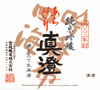
| Country: | Japan |
| Region: | Nagano |
| Winery: | Myasaka Brewing Company |
| Grape Type: | Miyamanishiki (kojimai) (Sake) |
| Vintage: | NV |
| Bottle Size: | 720 ml |
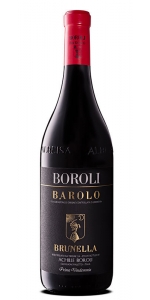
Boroli Barolo Brunella is made from 100 percent Nebbiolo.
A clear ruby red color, with very light orange reflections. A net aroma in which liquorice stands out at first, immediately followed by a fruity scent; the aroma makes you scent it again and again to discover different and pleasant facets. The fruity aroma magnificently prevails after a few minutes in the glass. A very enveloping, fresh and harmonious taste, with a delicate and tasty presence of wood. A long lasting taste that invites to sip it slowly again and again.
Tasting Notes
Brunella is distinguished by a careful selection of grapes, perfect destemming, long macerations with submerged cap. The barrels for Brunella are specifically chosen by the winemaker.
Wine Production
Brunella is one of the most historic single vineyard sites of all of Castiglione Falletto, however it hasn’t ever been bottled singularly under the Menzione Geografica Aggiuntiva BRUNELLA until 2013. The Brunella vineyard occupies the western crest of the Villero hillside and complete surrounds the Boroli winery. The vineyard is a monopole—owned entirely by Boroli and is the most prestigious wine in the lineup. As it occupies the best exposed section of the Villero hillside, La Brunella expresses power, drive, complexity, and extraordinary length and ageability.
About the Vineyard
The Boroli family is a family of entrepreneurs, with roots in Piedmont dating back to 1831. The family started their winemaking business in1997, when Silvano and Elena Boroli felt an ardent desire to step away from the pressures of their publishing business and reconnect to nature. Silvano and Elena grew the company until their son, Achille, stepped in to run the wine-growing and production business in 2012.
With the 2012 grape harvest Achille decided to radically change the methods used in vineyards and wineries, aiming for the highest quality in Barolo and its crus. He cut production levels, updated the winemaking technology, and focused on low intervention methods to raise the quality of the Boroli wines be on par with the finest Barolo wines.
Review:
Ripe red cherries and blood oranges, as well as herbs and roses on the nose, leading to a juicy and flavorful palate that has a swathe of bright, juicy red-fruit flavor. Drinking well now.
-James Suckling 93 Points
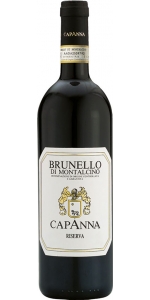
Capanna Brunello di Montalcino Riserva is made from 100 percent Sangiovese.
TYPE: DOCG
BLEND: 100% Sangiovese carefully selected in the oldest vineyards and only of the best harvests.
VINIFICATION:
Alcoholic fermentation with maceration of the skins (30-35 days) at a controlled temperature and spontaneous malolactic fermentation, both in truncated cone-shaped Slavonian oak vats.
AGEING:
In Slavonian oak casks of 10 to 25 hl for over 40 months; followed by ageing in bottles for at least 15 months.
NOTES:
Colour: deep ruby red, strong, lively.
Bouquet: very intense and complex, fruity and spicy, with red fruit, jam and liquorice shades; great prospects of future development.
Taste: great structure in the acid-tannin components, well supported by the soft ones; extremely persistent.
Food pairings: roast red meats, game and very aged cheeses.
Review:
Bright ruby in the glass. First impact is low key, with red cherry, leather, tobacco, fresh violet and balsamic notes. The attack is velvety, with a full body, lifted acidity and dense, ripe tannins. Character emerges from the glass, meaty and bloody. Thick, dry finish that’s fierce. Drink or hold
-James Suckling 95 Points
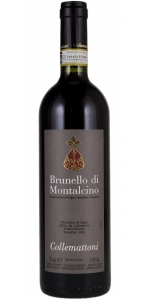
Collemattoni Brunello di Montalcino is made from 100 percent Sangiovese.
Color: brilliant red with burgundy reflects; Bouquet: penetrating with memories of wild black fruits, black cherry and noble wood; Taste: warm, dry and persistent
Coming from a parcel with 10-15 year old vines planted in sandy clay and marl soils.
Harvest is 100% destemmed with a soft pressing, fermentation in stainless steel tanks at controlled temperature of 28-30°C, pumping over for the first week of maceration followed by skin-contact maceration for 20-25 days with rack and return technique (delestage).
Malolactic fermentation completed.
Wine is slightly filtered before bottling.
Review:
This is a really balanced and pretty young Brunello with dark-cherry and citrus character on both the nose and palate. It’s medium-bodied with integrated tannins and a beautiful, succulent finish. Nicely done. Drinkable now, but better in two or three years.
-James Suckling 95 Points
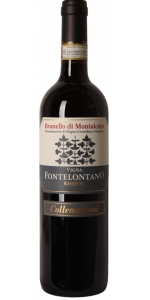
Collemattoni Brunello di Montalcino Riserva is made from 100 percent Sangiovese.
Intense ruby red with brilliant burgundy reflects in color. Reminiscent of wild black fruits, vanilla and spices on the nose and dry, warm, slightly austere but velvety in the palate.
This wine comes from the oldest vineyard of Collemattoni: Fontelontano. Less than half hectare. It's one of the few Single Vineyard Brunello di Montalcino riserva.
Coming from a parcel with 15-18 year old vines planted in sandy clay and marl soils.
Harvest is 100% destemmed with a soft pressing, fermentation in stainless steel tanks at controlled temperature of 28-30°C, pumping over for the first week of maceration following by skin-contact maceration for 20-25 days with rack and return technique (delestage).
Malolactic fermentation completed. The delestage and the pumping over are then spaced out along the process.
Wine is slightly filtered before bottling.
Review:
This is intense with aromas of dried cherries, sweet licorice, cloves, crushed walnuts and hints of chocolate and undergrowth. Full-bodied, deep and structured with taut, tightly packed tannins. Long and persistent. Drink or hold.
-James Suckling 94 Points
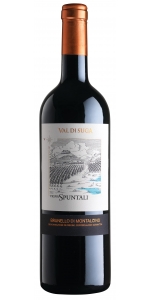
This is a 6 pack with 2 bottles each from vintages from 2013, 2015, and 2016.
***Tenimenti Angelini Val di Suga Vigna Spuntali Brunello di Montalcino 2016:
The 2016 Vigna Spuntali Brunello di Montalcino is the most brooding of the lineup from Val di Suga and is sourced from the southwest of the region on sandy soils. There are aromatics of black raspberry, licorice, menthol, sage, cinnamon, and iron-rich earth. Its Mediterranean influence is felt on the palate with ripe black cherry, dried herbs, and sun-baked earth. This is the fullest bodied and most savory of the Val di Suga lineup, with more roundness and grip. Its structure will benefit from cellaring for several years and will be great drinking over the next 20 years or more. 2026-2040.
-Jeb Dunnuck 96 Points
***Tenimenti Angelini Val di Suga Vigna Spuntali Brunello di Montalcino 2015:
The 2015 Vigna Spuntali Brunello di Montalcino is more introverted on first opening, with notes of black plum, licorice, dried Mediterranean herb, and sun-baked earth. On the palate, it offers a tart dried fruit character, with a building tannin structure that finishes with tomato leaf, and bitter herbs. The most rustic and burly of the wines in the lineup of the 2015 Val di Suga vintage, it will benefit from allowing some time in cellar to see how this matures and its tarriness develops. Drink 2026-2036
-Jeb Dunnuck 94 Points
***Tenimenti Angelini Val di Suga Vigna Spuntali Brunello di Montalcino 2013:
Plenty of spices and fresh herbs on the nose, such as dried rosemary and nutmeg, to match the underlying dried redcurrants and cranberries. Full-bodied with plenty of concentration, but still shows a very sturdy, tannin backbone and punchy acidity, to drive this through to a long finish. Drink in 2021.
-James Suckling 94 Points
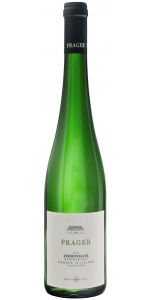
Franz Prager, co-founder of the Vinea Wachau, had already earned a reputation for his wines when Toni Bodenstein married into the family. Bodenstein’s passion for biodiversity and old terraces, coupled with brilliant winemaking, places Prager in the highest echelon of Austrian producers.
Smaragd is a designation of ripeness for dry wines used exclusively by members of the Vinea Wachau. The wines must have minimum alcohol of 12.5%. The grapes are hand-harvested, typically in October and November, and are sent directly to press where they spontaneously ferment in stainless-steel tanks.
Zwerithaler is a sub-site of Buschenberg and sits to the east of Weißenkirchen. The name Zwerithaler, meaning "nestled between the valleys," is a near monopole of Weingut Prager. It has a complex soil of paragneiss with alternating layers of dark and calcareous rock. Zwerithaler Kammergut is a 0.34-hectare parcel planted before WWI. The wine from these ungrafted, 100-year-old vines was bottled separately by Prager for the first time in 2015.
Light greenish yellow, silver reflections. Fine savory, delicate nuances of anise, tobacco notes, delicate yellow fruit, a touch of mango and honey blossom. Full-bodied, juicy white apple fruit, well-integrated, silky acidity structure, finesse and long persistence, saline finish, lingers for minutes, Veltliner at its best.
-Falstaff 99 Points
"The aromas of this old-vine gruner veltliner leap out and shake you to the core. Full-bodied and full of weighty and balanced layers of papayas, mangoes, nectarines, chives, white tea and oranges. Fantastic concentration, giving so much pleasure already, but it will keep blossoming if you give it time. From vines planted in 1907. Sustainable. Drink or hold."
-James Suckling 98 Points
Masumi Arabashiri First Run (720ml)
Masumi's spring release combines the yeasty punch of fresh-from-the-vat sake with the rich, fruity flavor typical of ginjo labels. It finishes gracefully: an unusual connoisseur's experience not to be missed.
Practically exploding with flavor, Arabashiri pairs well with robust foods - even Cuban and Brazilian fare. Important: Arabashiri is nama, or unpasteurized. Keep refrigerated at all times and serve chilled.
Rice Variety: Hitogokochi, Miyamanishiki
Polishing Ratio: 55%
Alcohol Percentage: 17.0%-18.0%
Sake Meter Value: -1.5
Acidity: 1.8
Yeast Type: Alps
Myasaka Brewing Company
Masumi is one of the great names of the sake world, admired throughout Japan for its satisfying taste and unshakeable, down-to-earth reliability. The brewery where it is made was founded in 1662 in the town of Suwa, where a tradition of precision craftsmanship had led to the development of the silk spinning trade. Attention to detail remains at the heart of the Masumi brewing philosophy to this day.
In 1920, the brewery's president, Masaru Miyasaka, appointed a 28-year-old sake prodigy named Chisato Kubota to the position of brewmaster. The two travelled throughout Japan in the manner of Zen monks, "knocking on the door of the master and seeking knowledge." This keen desire to elevate the quality of Masumi sake, combined with a shared openness of mind, was rewarded in 1936 when Miyasaka Brewing Company won the first of many top honors at the Japan National Sake Appraisal.
Masumi achieved even greater prominence in 1946 when brewmaster Kubota, discovering a lovely aroma emanating from one of the brewery's fermentation tanks, requested that an expert from the National Research Institute of Brewing be called in for consultation. Samples were taken and it was soon confirmed that a new yeast variety, Association No. 7, had been discovered.
In the sake world, discovering a new yeast is like receiving the Nobel Prize, and only a handful of breweries enjoy this distinction. With its gentle, pleasing aroma and ease of use, No. 7 soon spread beyond Nagano Prefecture, and today continues to be used by over half of the breweries in Japan. In 2002, Masumi released a redolent, old-style sake with an insouciant 21st-century attitude called "Nanago" (No. 7) in tribute to the famous microorganism to whom the sake world owes so much.
Kosta Browne Sonoma Coast Pinot Noir is made from 100 percent Pinot Noir.
Dark cherry, raspberry, and elderberry intertwine with intriguing hints of fresh basil, and pomegranate. Decadent fruit flavors unfold, showcasing remarkable acidity with dynamic structure and an enduring finish.
Our Appellation Series wines embody our unwavering commitment to exploration and the artistry of crafting soulful, thought-provoking wines that pay homage to the world’s extraordinary terroirs.
The Sonoma Coast is the largest appellation in Sonoma County, strongly influenced by its proximity to the ocean and heavy rainfall—producing more than twice the annual amount of its inland neighbors.
Our Sonoma Coast vineyards span the northern true coastal zone and the southern edge of the appellation. This distinctive blend is made from 11 different clones, fermented in predominantly stainless steel, and aged for 16 months in 38% new oak. The resulting wine has an energetic acidity with cascading layers of black cherry and elderberry, followed by a lasting finish.
Fact of Note: This Sonoma Coast blend was the longest to ferment in stainless steel from our Appellation Series.
Importer Sale!
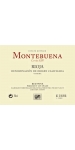
Produced from 100% Tempranillo grapes, which are hand harvested from the Montebuena vineyard.
Brilliant deep ruby red color, fruity aromas .
Montebuena Red has a spicy vanilla bouquet and is smooth and fruity in the mouth with some well-integrated secondary nuances, full-flavored and a persistent pleasant finish. Pairs well with beef & lamb dishes, stews & cheeses.



