
" We don't sell the wine without touching the vine "
| BUY MORE! SAVE MORE! | ||||||||||||||||||||
|
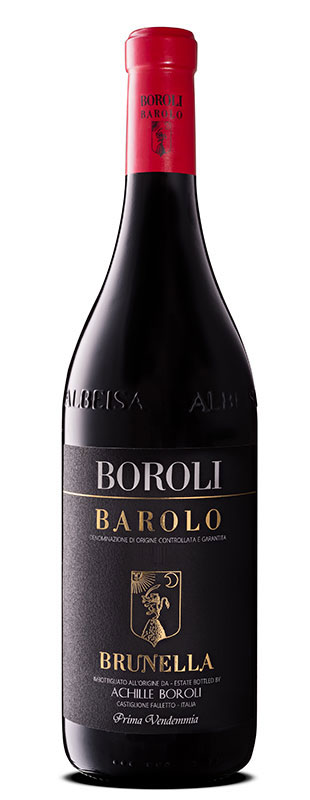
Boroli Barolo Brunella is made from 100 percent Nebbiolo.
A clear ruby red color, with very light orange reflections. A net aroma in which liquorice stands out at first, immediately followed by a fruity scent; the aroma makes you scent it again and again to discover different and pleasant facets. The fruity aroma magnificently prevails after a few minutes in the glass. A very enveloping, fresh and harmonious taste, with a delicate and tasty presence of wood. A long lasting taste that invites to sip it slowly again and again.
Tasting Notes
Brunella is distinguished by a careful selection of grapes, perfect destemming, long macerations with submerged cap. The barrels for Brunella are specifically chosen by the winemaker.
Wine Production
Brunella is one of the most historic single vineyard sites of all of Castiglione Falletto, however it hasn’t ever been bottled singularly under the Menzione Geografica Aggiuntiva BRUNELLA until 2013. The Brunella vineyard occupies the western crest of the Villero hillside and complete surrounds the Boroli winery. The vineyard is a monopole—owned entirely by Boroli and is the most prestigious wine in the lineup. As it occupies the best exposed section of the Villero hillside, La Brunella expresses power, drive, complexity, and extraordinary length and ageability.
About the Vineyard
The Boroli family is a family of entrepreneurs, with roots in Piedmont dating back to 1831. The family started their winemaking business in1997, when Silvano and Elena Boroli felt an ardent desire to step away from the pressures of their publishing business and reconnect to nature. Silvano and Elena grew the company until their son, Achille, stepped in to run the wine-growing and production business in 2012.
With the 2012 grape harvest Achille decided to radically change the methods used in vineyards and wineries, aiming for the highest quality in Barolo and its crus. He cut production levels, updated the winemaking technology, and focused on low intervention methods to raise the quality of the Boroli wines be on par with the finest Barolo wines.
Review:
-James Suckling 93 Points
A Piedmontese family of entrepreneurs since 1831. Firstly in the textile industry, then in publishing and now also in wine-growing.
In the 90’s, Silvano and Elena Boroli felt the need to start a new project that could bring them back to nature, far from the crazy rhythms of today.
The choice was almost obligatory for a Piedmontese: Langa wines. A passion that has converted into a job. What could be better?
A very difficult and demanding job, whose results are never achieved by chance, but, precisely for this reason, with great satisfaction.
In 2000, Achille, the third of four children, joined the company.
However, the family origins lie in the mists of time. Many family documents have survived thanks to the conservation and classification work of Don Carlo Pollina (1744-1799), the guardian of little Carlo Antonio Boroli, Silvano’s Great Great Great Grandfather.
Among them, the coat of arms tells us about great merits in the crusades, as shown by the Crescent and the scimitar brandished by the lion rampant, a symbol of perspicacity and bravery. On its part, the shining sun tells us about the resources of the family, blessed by Divine Providence.
Silvano married Elena Verri in 1968; they have 4 sons (Carlo, Guido, Achille and Filippo) who work in different fields, and now 7 grandchildren.
Silvano worked in the graphics-publishing industry until the ’90s and decided to change his life by devoting himself to an old passion of his: the land, which for a Piedmontese can only mean Langa wines.
Achille, after graduating in business administration, decided to take care of the wine-growing and producing business and deal with food-and-wine connoisseurship. After gaining the Michelin Star with the Locanda del Pilone, with the 2012 grape harvest he decided to radically change the methods used in vineyards and vineries, aiming at total quality for Barolo and its crus.

Domaine de la Janasse Chateauneuf-du-Pape Cuvee Vieilles Vignes is made from 65% Grenache, 20% Mourvèdre, 10% Syrah, 5% divers.
In contrast to Chaupin, which is made from old-vine Grenache on sandy soils, the cuvée Vieilles Vignes is from old vines of Grenache, Mourvedre, Syrah along with smaller percentages of other permitted varieties that are grown in these old vineyards. The wine is sourced from 4 terroirs: pebbly clay, sand, gravelly red clay and sandy limestone. Vieilles Vignes is always the most powerful and concentrated Châteauneuf-du-Pape cuvée made at Domaine de la Janasse.
Review:
-Wine Advocate 96 Points

Aalto P.S. Pagos Seleccionados Tinto is made from 100 percent Tempranillo.
Climatic conditions
The farming year began with a mild autumn and little precipitation. A very dry winter started with -9ºC reaching at the end higher temperatures than normal for that time of the year. Spring and summer characterized by little rain, only some rain showers in July and late August avoided the hydric stress of the vines. The vegetative cycle of the vine developed with big variations of temperatures, alternating warm and atypical low temperatures of 4ºC for mid-June. The ripening of the grapes happened under very good conditions and the harvest started on 24th September 2019.
100% Tinto Fino (Tempranillo) primarily from very old vines – 60 to 90 years old – from selected plots in La Horra and La Aguilera. The harvest was done by hand, in small boxes of 15 kilos that are thoroughly inspected, bunch by bunch, on the selection table.
Tasting notes
Review:
Color: dark cherry, Aroma: toasty, spicy, fine cocoa, black fruit, Mouth: tasty, toasty, fine bitterness, ripe tannins
Guia Penin 94 Points
"A red made exclusively from Tempranillo, from vineyards 60 to 90 years old, grown in the pagos of La Horra and La Aguilera, with 21 months of aging in new French oak barrels. Captivating in aroma and flavor, it shows ripe red and black fruit alongside floral, herbal and sweet-spice notes, which carry onto the palate, where its good acidity and firm, very fine-grained tannins lend support to the oak and balance to the whole. It has a full, very long finish, with reductive, earthy touches of cassis, blackberry, violet and licorice. It follows the house's powerful style, yet shows itself more fluid, tense and vertical. A fine example that concentration, opulence, precision and finesse can go hand in hand. Be patient with it in the glass or in the bottle, as it is still young and has everything it needs to get even better over the next 20 years. Alcohol 15%."
-Revista Adega 95 Points

Wolfberger Alsace Grand Cru Riesling Rangen de Thann is made from 100 percent Riesling.
Mineral, spicy, minty with some eucalyptus notes, tropical fruits, grapefruit. Balanced and exotic in the finish, with long lasting flavors.
The Rangen Grand Cru is located in Thann, deep in the south of Alsace. Its particular soil is made of volcano-clastic rocks that drink up the heat of the day and send it back out again at night. The composition of the soil allows the roots of the vines to drink deeply from the mineral-rich sub-soil. Its southern exposure has the advantage of refreshing, drying winds in case of dampness. The high slopes are quite steep, reaching 68% in some places, requiring that the harvest be done by abseiling or roping down. Perfect for aging, these wines will reveal even more qualities after several years in the cellar.
Pair with Serve with fish, seafood, sushi, sashimi, goat cheese, vegetarian food.
Review:
-Wine & Spirits Magazine 93 Points

#32 Wine Spectator Top 100 of 2023
Delicate red in color. The incredibly expressive bouquet offers notes of sandalwood, herbs de Provence, and Red Delicious apples. On the palate, freshly picked red huckleberries provide tart and lasting succulence with a hint of baking spice. The sandy soils of the Chehalem Mountains offer salinity and minerality on the finish that is complemented with dark cherry and rhubarb.
Review:
-Wine Spectator 95 Points
-Wine & Spirits 95 Points
-Decanter World Wine Awards 96 Points

Boizel Grand Vintage Brut is made from 50% Chardonnay, 50% Pinot Noir.
BACKGROUND
In 1834 the Boizel House was established in Épernay, the heart of Champagne, by a family passionate about the wines of its region. Intimate knowledge of the Champagne region, passed on through the generations, and access to grapes from the finest cru sites, are the essential elements behind the Boizels’ elegant portfolio. Working with Chardonnay and Pinot Noir sourced only from Champagne’s most coveted Grands and Premiers Crus blended with the best crus of Pinot Meunier, Boizel’s intimate knowledge of each village and hillside coupled with longstanding grower relationships allows them the ability to select the finest quality grapes for their Champagnes.
TERROIR & VINTAGE NOTES
Pinot Noir and Chardonnay grapes for the production of the Grand Vintage wines are sourced from Grands and Premiers Cru vineyards within the villages of La Montagne de Reims (Pinot Noir) and the Côte des Blancs (Chardonnay). Pinot Meunier is sourced from the best sites within the Vallée de la Marne.
All wines are aged sur lie in Boizel’s historic chalk cellars beneath the Avenue de Champagne for a minimum of 3 years, climbing to 15 years and above for the best vintages.
WINEMAKING & AGEING
A unique expression of the vintage, the Grand Vintage is only produced in the best years. This cuvée is a blend of 50% Chardonnay from the Côte des Blancs (Mesnil sur Oger, Oger, Avize, Vertus) and 50% Pinot Noir from the Montagne de Reims (Mailly, Bisseuil, Chigny les Roses).
The wine was aged 8 months in stainless steel vats. Post second fermentation, the wine was aged for 8 years on its lees.
TASTING NOTES
Due to the long lees aging, almond, frangipane, candied orange and brioche aromas are rich and balanced. The palate is complex and mature, with the silky perlage supplying acidity and lift. Elegant pastry notes rounds out the finish.
Review:
Disgorged in October 2014, this smooth, now mature, wine has flavors of yeasty toastiness and a tight, mineral structure. Sliced apple and lemon zest still give freshness. Behind the fruit, crisp texture and a steely edge await. It is beautifully balanced, rich while dry and ready to drink. ROGER VOSS
-Wine Enthusiast 94 Points

Chateau Vermont L'Ame Grand Vin de Bordeaux is made from 40% Merlot, 30% Cabernet Franc and 30% Petit Verdot.
L'AME de Vermont represents the culmination of 10 years of dedicated work, derived from select grapes of Chateau Vermont's best parcels, chiseled to be the ultimate extraction of their terroir and Spirit. This cuvée is the Winemaker's soul. It is a reflection of the requirements, precise work and desire to achieve perfection.
A rare and confidential wine, vinified and matured in new oak barrels. Fine wine, elegant and well-balanced, with vanilla notes coming from the oak aging and subtle scents of ripe black and red fruits. A beautiful structure and great aging potential.
Review:
-Wine Enthusiast 91 Points

Villero is undoubtedly one of the most important vineyards in Castiglione Falletto in terms of quality and exposure.
The soil is clayey and calcareous, with a south and southwest exposure. The combination of exposure and soil give us a structured and powerful Barolo, with a deep aromatic profile. The tannins are smooth and soft, thanks to long maceration.
Barolo Villero is a long-lasting wine, capable of reaching its full potential even many years after the harvest.
Wine Production
Villero is distinguished by a careful selection of grapes, perfect destemming, long macerations with submerged cap.
Tasting Notes
Clear bright ruby colour with very light garnet red reflections; intense and persistent aroma of red fruit with notes of plum and cherry. A pleasant aroma of wood is noticeable after the fruity aroma, anticipating the full taste of a great wine suitable for long lasting life. A succulent, rich, full-bodied and pleasant taste emerges after the woody one, with the presence of slightly ripe red fruit
Food Pairing
Thanks to its viscosity and body, Barolo is the ideal wine to combine with elaborate dishes such as truffle dishes, meat dishes, pasta with porcini mushrooms, game, and aged cheeses. Villero is also perfect with dry pastries or chocolate.
Review:
-James Suckling 95 Points

Filippino Elio Barolo Riserva is made from 100 percent Nebbiolo.
This 100% Nebbiolo offers a fruity, floral and spicy bouquet of red roses, raspberry, cinnamon and cocoa. It is generous, enveloping and elegant in the mouth, yet intense and full-bodied.
The grapes undergo a soft crushing and destemming leading to a clear must. This must ferments in steel tanks at a controlled temperature of 26°C and macerates for 20-25 days. After racking, the wine undergoes a lengthy maturation in oak barrels, which is continued with a lengthy bottle-ageing. Bottle-ageing confers the wine’s final character, at which time the wine is sent to market and from there to consumer tables.
Review:
-Jeb Dunnuck 92 Points

“1752” is the name of the Damilano Barolo Cannubi Riserva, in honor of the year in which the historic bottle was first marked “Cannubi”. It still exists today perfectly conserved by the Manzone family in Bra, close to Barolo. The bottle is clearly marked as being of “1752” vintage, indicating that Cannubi historically precedes Barolo.
About the Vineyard:
The Cannubi Cru is in found within one of the 6 core zones which comprise a UNESCO heritage site in Italy. A mixture of Tortonian and Helvetian calcareous marl gives the grapes intense aromas of cherry, plum and tobacco, rose and violet in sequence. Its low potassium and high calcium/magnesium content offer the wine a fine and polished touch. The vineyard is located at about 270 m. a.s.l. and has a south-east sun exposure. Barolo Riserva Cannubi 1752 It is a small plot of about 2 hectares of Nebbiolo vines, currently between 30 and 50 years of age.
Tasting Notes:
Garnet ruby red in color, the bouquet is intense and balanced, with notes of violet, red fruit, cherry and plum, spices, liquorice, cocoa, leather and tobacco. Dry, robust, full-bodied, very persistent, rich and velvety
Food Pairing:
This wine is excellent with typical piedmontes pasta (tajarin, ravioli); perfect with red meat, braised and roast meat, game and absolutely ideal with all types of cheeses.
Review:
“Incredible, reserved ripeness and depth already evident on the nose after one whiff, offering plum, cedar, rose hip, sandalwood, and licorice. Full-bodied with superb depth of fruit and an abundance of polished tannins that give the wine poise and grace, even though it’s long and powerful. The quality of the tannins are exceptional. Sheer and refined. This comes from the center of Cannubi.”
-James Suckling 99 Points

Lodovico Barolo Cannubi is made from 100% Nebbiolo.
With a ruby-red color, the Barolo Cannubi has a rich bouquet which gradually recalls the scents of roses flowers, truffles and wood spice. The palate is at first elegant and refined, then is begins to gain in complexity with a little breathing or decanting.
Vine: Nebbiolo, sub-variety Lampia and Michet
Grapes provenance: Cannubi Boschis vineyard in the village of Barolo
Soil: composed mainly of large clayey limestone marls and sands
Vineyards: South-est facing with Guyot pruning (6-8 buds / vine)
N° Vines / hectare: 5000
Yield / hectare: 50-55 q / Ha
Plant year: 1970
Size of the vineyard: 1.3 hectare (3.21 acres) in the family since 1996 out of 40 hectares (98.8 acres) total for Cannubi.
Average height: 250-260 mt
Nebbiolo is a native black grape variety of Piedmont that gives birth also Barolo and Barbaresco. The name ‘Nebbiolo’ derives from the word ‘fog’ and there could be two reasons. The first hypothesis traces the name of Nebbiolo back to the obscured, almost clouded appearance of the grape, covered with abundant bloom. The second hypothesis, more suggestive, is linked to the very late ripening of the grapes: the Nebbiolo grape harvest often takes place in late October, when the vineyards are enveloped in morning mists.
Pairs with aged cheeses, red meat, rich/earthy dishes, truffle risotto, pasta with sausages and mushrooms. Braised or roasted meats.

Cavalier Dario Barolo Riserva 2016 is made from Nebbiolo.
This is the flagship of the Cavalier Dario house — a Barolo held back for the extended aging a Riserva demands and released only once it has begun to soften and open. In the glass it shows the deep garnet Nebbiolo takes on with time, with an aromatic profile the estate calls fresh, complex and austere, and a palate that is warm and supple with the balance that separates a serious Barolo from a merely powerful one. A wine for the table: braised beef, game, aged Piedmontese cheeses and slow Sunday cooking.

The Cordero di Montezemolo Barolo Enrico VI is a deep red garnet in color. Delicately spiced bouquet with notes of eucalyptus, licorice and menthol, and mature fruit on the palate invoking liqueur soaked cherries, blackberries and prunes with hints of violets and medicinal herbs. Powerful on the palate with a lasting finish.
Review:
The rose flower, violet, dark berry and cedar aromas are impressive on the nose. Full-bodied with chewy tannins that are powerful and muscular. Excellent length. Classic Barolo that needs at least four or five years to soften. From organically grown grapes. Try after 2027.
-James Suckling 96 Points

Long Shadows Pirouette Meritage is made from 68% Cabernet Sauvignon 15% Merlot 8% Petit Verdot 6% Cabernet Franc 3% Malbec
Philippe Melka, named one of the top nine winemakers in the world by Robert Parker, used small lots from Washington State's finest vineyards to craft this enticing red blend.
Like the last several growing seasons, 2016 was another hot year that required extra care in the vineyards. Building on the success of our canopy managment program over the last few vintages, we worked with growers throughout the season to encourage growth of the canes and outside foliage to protect against the sun while opening up the fruit zone for even maturation. Warm temperatures in the fall hastened ripening, but the Columbia Valley's cool autumn nights protected the grapes' acidity, yielding bright, vibrant wines that will drink well in their youth but also promise to bring enjoyement to those who cellar.
A variety of fermentation methods were used to enhance complexity and richness in this classic Bordeaux blend. Hand-harvested Cabernet was fermented in 400L French oak barrels that were gently rolled throughout fermentation to integrate the oak with refined, dark fruit flavors and give the wine its silky mouthfeel. All other varieties were fermented in traditional stainless steel tanks, with select lots enjoying longer skin contact to enhance the wine's dark color and mid-palate. The finished wine was aged 22 months in French oak barrels (75% new) before bottling unfiltered and unfined.
Review:
-Jeb Dunnuck 97 Points

From the Adrianna Vineyard — Catena Zapata’s crown jewel, planted at nearly 5,000 feet in Gualtallary, high in the Tupungato district of Mendoza’s Uco Valley, and one of the highest-altitude vineyards in all of Argentina. Nicolás Catena named it for his youngest daughter, and the wine world has come to call it the Grand Cru of South America.
White Stones is a single parcel within Adrianna — a Vino de Parcela, a wine of one plot — named for the round, white calcareous river stones that litter its alluvial soil. Those stones, the thin mountain air and the cold Andean nights give this Chardonnay its signature: taut, saline and mineral-driven, with laser acidity and a long, chalky, almost Chablis-like finish. It is a wine of place before it is anything else.
Region
Mendoza is the heart of Argentine wine, a high desert in the rain shadow of the Andes where the vines live on Andean snowmelt and ripen under intense sunlight and wide day-to-night temperature swings. The Uco Valley is its coolest, highest and most exciting frontier, and Gualtallary — a rocky, limestone-rich zone above Tupungato — sits near its upper edge. The combination of altitude, poor stony soils and cold nights preserves a freshness and tension that lower, warmer sites simply cannot match.
Winery Info
Founded in 1902, Bodega Catena Zapata is one of Argentina’s founding wine families. It was Nicolás Catena Zapata who, through the 1980s and ’90s, bet that world-class wine could be grown at extreme altitude in the Andean foothills — a conviction that reshaped Mendoza and restored Malbec as a fine-wine grape. Today his daughter, Laura Catena — a physician who founded the Catena Institute of Wine — leads the family’s relentless research into high-altitude terroir. The Adrianna Vineyard is the fullest expression of that life’s work.
Review:
-James Suckling 99 Points



