" We don't sell the wine without touching the vine "
| Country: | United States |
| Regions: | Oregon Oregon (Willamette) |
| Winery: | Maysara Winery |
| Grape Type: | Pinot Noir |
| Organic: | Yes |
| Vintage: | 2016 |
| Bottle Size: | 750 ml |

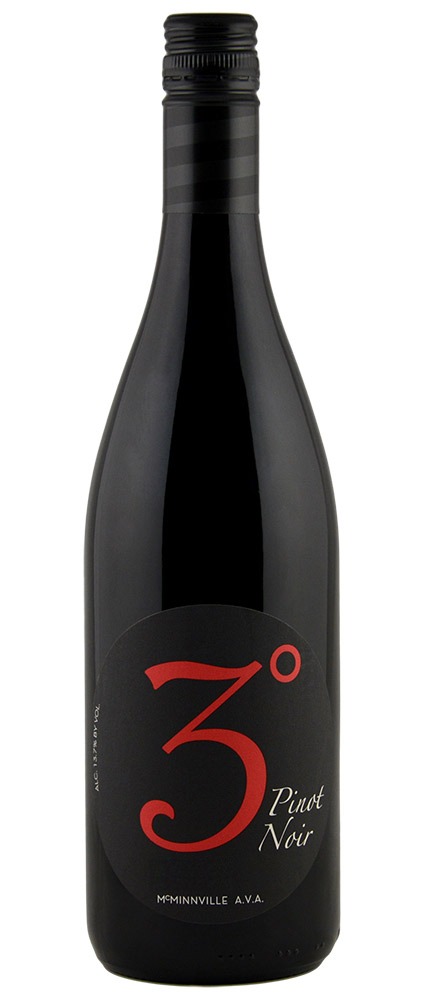
Maysara 3 Degrees Pinot Noir is 100 percent Pinot Noir
Aged 11 months in neutral French oak barrels
3° (Three Degrees) Pinot Noir is handcrafted by the Momtazi sisters whose differing personalities; combined with elegance, finesse and balance, reflect the dynamic characteristics of the Momtazi Vineyard. The sisters, Tahmiene, Naseem and Hanna, set out to make a pinot that tastes great and has the highest quality fruit all while being affordable for everyone.
Intriguing notes of fresh earth, oak leaves and pepper are woven together in the initial impression. Lifted, verdant tannins give this wine a firm structure for the vintage to showcase its characteristic starry-eyed smile.
At Maysara Winery & Momtazi Vineyard, we are committed to cap-turing the complete expression of our land and conveying it to you through superior quality in every bottle. We practice only low-impact, holistic farming methods in our Demeter Certified Biodynamic Vineyard. We are confident these practices are the best way to capture the true essence of the soil in our fruit and ensure health of our vines and the unique accent of our terroir for generations. This philosophy is carried into the cellar, where Demeter Certified Biodynamic wine-making practices produce wines with intensity, sophistication and elegance while maintaining a purity of both fruit and earth.
Momtazi Vineyard.
A vibrant and snappy pinot that will shine and refresh when paired with curries, spetzatinas and rich stews.

Maysara Jamsheed Pinot Noir is made of 100 percent Pinot Noir
11 months in 10% new French oak barrels
According to ancient Persian legend, King Jamsheed was able to observe his entire realm by peering into his full wine goblet.
Beginning with a generous core of red-black fruits, the McMinnville AVA saunters over the palate with both bravado and grace. Blackberry and fresh cracked pepper entwine perfectly with matured and lengthy tannins on the finish. The depth of this unassuming bottling is always an adventure to mine. Some older prospectors hear tell of herbal notes… silver sage? rosemary?
At Maysara Winery & Momtazi Vineyard, we are committed to cap-turing the complete expression of our land and conveying it to you through superior quality in every bottle. We practice only low-impact, holistic farming methods in our Demeter Certified Biodynamic Vineyard. We are confident these practices are the best way to capture the true essence of the soil in our fruit and ensure health of our vines and the unique accent of our terroir for generations. This philosophy is carried into the cellar, where Demeter Certified Biodynamic wine-making practices produce wines with intensity, sophistication and elegance while maintaining a purity of both fruit and earth.
Always offering generous accessibility, pair Jamsheed with darker fowl, grilled meats or salmon, even caramelized veggies.

Archery Summit Estate Pinot Noir Dundee Hills is made from 100 percent Pinot Noir.
Archery Summit Dundee Hills Pinot Noir touts all the hallmarks of this storied appellation. It begins with hints of ripe plum skin, ocean air, baking spices, and cocoa powder dustiness on the nose. The palate is just as expressive, with fresh, juicy red fruit backed by graceful tannins, a complex brininess, and a mouth-watering acidity. Finishing with spiced oak and a mouth-coating basalt minerality, this wine is great now and will be for years to come.
The Dundee Hills Pinot Noir touts all the hallmarks of Archery Summit's storied appellation. It begins with brambleberry, ripe rainier cherry, blackberry blossoms, cocoa powder, and spice on the nose. The palate is just as lively, with fresh, juicy red fruit backed by graceful tannins and acid. Finishing with spiced oak and a mouth-coating minerality, this wine is a case study in the magic of the Dundee Hills.
Yet, thanks to water reserves in the soil itself and some timely viticultural movements, the vineyards persevered through the heat and water limitations. The dryer season accelerated picking times, making the fruit ripen a bit earlier than normal. September rewarded us with cool nights and the lower-than average yields set us up to make wines with abundant character, intensity and balance. The winery is so grateful for the moisture-abundant, microbially-rich and chemical-free soils that lovingly nudged the vines towards the finish line.
Review:
Expressive and sleekly built, with floral raspberry and cherry flavors laced with cinnamon and dusky spices. Finishes with medium-grained tannins. Drink now through 2032.
-Wine Spectator 92 Points

Belle Glos Clark and Telephone Vineyard Pinot Noir is made from 100 percent Pinot Noir.
Deep ruby red in color with scarlet highlights, Clark & Telephone opens with bountiful aromas of red fruits of cranberry and raspberry jam, laced with clove, cedar, and holiday baking spices. Bold and complex flavors of crushed ripe cherry, cranberry and blueberry pie linger on the palate. The texture is rich and lively, and leads into a warm and structured finish.
Review:
A dark shade in the glass, this bottling offers intense aromas of black cherry, cola, rosewater and caramelized oak on the nose. The palate is rich and powerful, pairing smoky oak with black cherry flavors to create a lavish sip.
-Wine Enthusiast 93 Points

Maysara Asha Pinot Noir is made from 100 percent Pinot Noir
22 months in 40% new French oak barrel
Asha is an ancient Persian Word describing one who has a clean conscience for good thoughts, words, and deeds with a pure demeanor and performance.
A bejeweled glassful of garnets, Asha snakes onto your palate with amarena cherries, clove and a tantalizing whisp of … what is that? A distant campfire? Elegant and slippery tannins sway to a tune played upon vanilla violins.
At Maysara Winery & Momtazi Vineyard, we are committed to cap-turing the complete expression of our land and conveying it to you through superior quality in every bottle. We practice only low-impact, holistic farming methods in our Demeter Certified Biodynamic Vineyard. We are confident these practices are the best way to capture the true essence of the soil in our fruit and ensure health of our vines and the unique accent of our terroir for generations. This philosophy is carried into the cellar, where Demeter Certified Biodynamic wine-making practices produce wines with intensity, sophistication and elegance while maintaining a purity of both fruit and earth.
Pair with dishes that utilize slow braised meats, something with complex layers of spices and caramelization, as the mid-palate is ensorcelled with lively acidity and don't forget those tannins!

Belle Glos Balade Pinot Noir is made from 100 percent Pinot Noir.
Tasting Notes
he word "Balade", French for "Wandering," is a fitting term for Belle Glos' annual exploration of single-vineyard pinot noir tracts on the west coast. As such, each vintage is very limited.
This Pinot Noir opens with aromas of blackberry, cherry, and delicate floral notes mingling with hints of cedar and baking spice. On the palate, you’ll experience layers of dark plum, juicy black raspberry, and subtle undertones of cocoa and vanilla, all wrapped in a plush, silky texture. Soft tannins and a balanced acidity contribute to a smooth, lingering finish, making it a perfect match for grilled meats, roasted vegetables, or simply as a luxurious glass to enjoy on its own.
Review:
This appellation is an ideal place to produce this brand's bold style of Pinot Noir, as elegance persists with power. In this bottling, aromas of black plum, blackberry and mahogany lead into a rich, creamy palate layered in wild mint, pepper and dark fruit. A searing acidity leads into a candied vanilla finish.
— Matt Kettmann Wine Enthusiast: 94 Points
Maysara 3 Degrees Pinot Noir is 100 percent Pinot Noir
Aged 11 months in neutral French oak barrels
3° (Three Degrees) Pinot Noir is handcrafted by the Momtazi sisters whose differing personalities; combined with elegance, finesse and balance, reflect the dynamic characteristics of the Momtazi Vineyard. The sisters, Tahmiene, Naseem and Hanna, set out to make a pinot that tastes great and has the highest quality fruit all while being affordable for everyone.
Intriguing notes of fresh earth, oak leaves and pepper are woven together in the initial impression. Lifted, verdant tannins give this wine a firm structure for the vintage to showcase its characteristic starry-eyed smile.
At Maysara Winery & Momtazi Vineyard, we are committed to cap-turing the complete expression of our land and conveying it to you through superior quality in every bottle. We practice only low-impact, holistic farming methods in our Demeter Certified Biodynamic Vineyard. We are confident these practices are the best way to capture the true essence of the soil in our fruit and ensure health of our vines and the unique accent of our terroir for generations. This philosophy is carried into the cellar, where Demeter Certified Biodynamic wine-making practices produce wines with intensity, sophistication and elegance while maintaining a purity of both fruit and earth.
Momtazi Vineyard.
A vibrant and snappy pinot that will shine and refresh when paired with curries, spetzatinas and rich stews.
Maysara winery is nestled in the foothills of the McMinnville AVA, in Oregon's Willamette Valley. The Momtazi family is dedicated to biodynamic farming practices. What makes Maysara unique is that there is over 600 feet elevation gain in the vineyards. From the property's lowest point at 120 feet to around 600 feet, the soil is clay and loam based (similar to most of the valley). From 600-780 feet, there is Jory soil (a red earth loaded with iron and mineral deposits). Quite a bit of the McMinnville AVA has this top soil. What makes this part of Maysara's vineyard special is that there's 10 feet of this earth before the base of loam and calcareous sub-soil.
Maysara Wines reflect this commitment to terroir, showing a purity of fruit and earth, that are true to the soils from which they come.
On April 1st, 1997, Moe and Flora Momtazi bought 496 (of the now 532) acres of abandoned wheat farm just south of their home in McMinnville, Oregon. Though wild and untouched, Moe’s vision for the Momtazi Estate was born looking out across the thriving hills of land that had been free of chemicals for seven years.
Though using chemicals would have been faster and more economical while building infrastructure and reclaiming the land, not a single one has or will be used throughout the estate. Instead, the ground was turned over multiple times during the summer of 1997 in order to eliminate unwanted plants and weeds while returning the soil to a usable state.
They began planting in March of 1998, with 13 acres of self-rooted pommard pinot noir vines. After months of researching the relationships between specific pinot noir clones, rootstocks and the different soil types found across the estate, over 120,000 plants were grafted in the greenhouses and planted in the vineyard by the end of the summer in 1999.
They believe that 90% of winemaking takes place in the vineyard. Because of this, they have held themselves to a strict form of land use acting as stewards of the land in order to nurture and reap the rewards naturally. Their alternative approach to chemical use is growing a variety of medicinal and dynamic flowers and herbs that they make into compost teas. By steeping into teas, they’re able to harness the beneficial properties of each flower and herb and embody a “from nature to nature” philosophy. As such, their multiple compost piles and Biodynamic preparations are extremely important for their vineyards because the resulting humus is worked into their vineyard in order to achieve long-term soil and vine health.
Their unique niche in the foothills of Oregon’s Coast Range separates them from valley weather influences providing warmer days and cooler nights with less precipitation during the harvest season. The property has highly diversified soil types consisting primarily of Nekia and Yamhill series, laced with veins of Peavine and Jory. By training their vines to produce between 1.75-2.25 tons per acre, they believe they are getting the best fruit possible from their unique terroir.
BIODYNAMICS
Biodynamics is an ultra-organic way of farming stemming from the two words; biological and dynamic. The biological aspect is practiced throughout organic farming and includes; composting, cover cropping, green manuring, cultivation, companion planting and integration of animals throughout the farm. The dynamic effects are extremely important, maybe even more-so than the biological. They include planning and planting by a calendar (i.e. near and far stars), Biodynamic composting, peppering and radionics, along with homeopathy. Therefore, both the biological & the dynamic effects are practiced and implemented.
In Biodynamics the farm is considered a living organism — having its own individuality and soul. As such the farm is believed to be sick if it imports any fertilizer from the outside; therefore being self sufficient is an important part of Biodynamic farming. Soil is considered to be the foundation of agriculture, therefore enriching the soil is an important task. A farmer is comparable to the conductor of an orchestra — bringing all the individual forces and energies into harmony by playing the right notes at the right time.
We distribute our own compost, inoculated with the Biodynamic preparations and distribute it underneath the vines as needed. We have also eliminated the use of minerals which need to be mined from the earth. Instead, we grow a variety of herbs and flowers that have been used medicinally for thousands of years (i.e. Chamomile, Dandelion, Yarrow, Valerian, Horsetail, Stinging Nettle, etc.). We make teas with them to be sprayed either on the foliage (on leaf days) or injected through the irrigation line to the root system (on root days). We apply these teas in homeopathic amounts in order to maintain the vitality and healthy immune system of the plants. Plants do not need to be shocked with penicillin like treatments if they are “brought up” with healthy immunities to pests and diseases.
In the winery, we allow the native yeast found on the grape skins to naturally initiate primary fermentation. No commercial yeast or enzyme use is allowed and we do not adjust acidity or add sugar. The secondary or malolactic fermentation also occurs on its own without any additives.
MCMINNVILLE AVA
The McMinnville American Viticultural Area is a sub-appellation of the Willamette Valley, nestled in the Coast Range foothills of Yamhill County that was created in 2005 after a successful petition that began in 2002. The soils found in the McMinnville AVA are primarily made up of both sedimentary and volcanic soils such as loams and silts with an underlying base of basalt. Beneath an average of 20-40 inches of clay and soil, lies hard stone mixed with basalt pebbles and compressed sediment that gives off minerality. It’s this unique soil diversity and the location at the mouth of the Van Duzer corridor that gives the McMinnville Pinot Noirs their dark fruit flavors and spicy earth tones, while allowing whites like Pinot Gris, Blanc and Riesling to attain a bright fruit-forwardness and vibrant acidity.

Robert Mondavi Winery Cabernet Sauvignon is made from 91% Cabernet Sauvignon, 5% Petit Verdot, 3% Cabernet Franc, 1% Malbec.
The 2022 Robert Mondavi Napa Valley Cabernet Sauvignon shows notes of plum, blackberry, licorice, chocolate, violet, and warm spice. Dark plum and black fruit carry through to the palate. Fresh and lively with plush tannins and a polished structure.
Review:
"A solid representation of Napa Valley Cabernet Sauvignon, this wine sources fruit from St. Helena down to Carneros, with the bulk of the blend coming from the Wappo Hill property in Stags Leap. All five Bordeaux varieties are included in the blend. Fermentation begins with a cold soak in stainless steel, followed by 26 days on skins, and 18 months of ageing in 31% new French oak. The wine opens with powerful Kirsch aromatics, lifted by bright Bing cherry, warm baking spices, new wood cedar, and white pepper. It is plush and layered on the palate, with black-toned fruit and robust, lingering tannins that carry through a long finish of dark red and black fruit, warming spices, and mineral tension. A balanced expression of power and fruit-forward ripeness, this vintage showcases both depth and structure, making for a bold yet polished Napa Cabernet."
- Jonathan Cristaldi, February 2025 Pts. Decanter
A very good introduction to Napa Valley cabernet for drinkers who are unfamiliar. This offers ripe, generous red and black fruit on a velvety texture of fine-grained tannins. Black cherries, dark plums and blackberries come up in the aroma and then go deeper on the palate. Contains 7% petit verdot, 8% merlot, 3% cabernet franc and 1% malbec. Aged in all French barrels, 31% new, which add accents of cinnamon and cedar. Drink now or hold.
-James Suckling 92 Points

Continuum Red Blend 2022 is made from 45% Cabernet Sauvignon, 43% Cabernet Franc, 8% Petit Verdot, 4% Merlot.
2022 tells a story of subtle drama of the seasons. Aromatically effusive, 2022 Continuum is a seductive wine with an upright and regal core. Elegantly interwoven notes of black plum, black cherry, cacao, forest floor and tobacco leaf mingle with our sage mountain garrigue and volcanic minerality. Energetic and expressive, 2022 Continuum is a harmoniously integrated wine with structural complexity wrapped in a velvet robe.
WINEGROWING- Continuum is estate grown on our Sage Mountain Vineyard. It’s location, high on Pritchard Hill along the eastern ridge above Oakville, overlooks Napa Valley and the San Francisco Bay. The rocky, volcanic soils of the site focus the vine’s energy keeping yields low yielding fruit of depth and complexity. 38 acres of mature estate vineyard, planted in 1991 and 1996, with additional plantings in 2004, 2010, together comprise 38 distinct vineyard blocks. Cabernet Sauvignon, Cabernet Franc, Petit Verdot, and Merlot are grown from 1300 to 1600 feet in elevation, on western and southern facing aspects with slight northern and eastern slopes in places. This diversity of plantings on our volcanic soils are the essence of the complexity of Continuum.
PRODUCTION- Continuum is 100% estate grown, produced and bottled. All fruit is selectively hand-harvested at night. The fruit is then sorted before and after de-stemming, and gravity fed into French oak or concrete tanks. A threeday cold soak is followed by fermentation, receiving three to four pumpovers daily, and délestage two to three times in total during the most active period. The wine remains on skins in tank for 20 to 40 days. All lots are then drained, basket pressed, and transferred with lees for malolactic fermentation and aging. Continuum spent 22 months in barrel. 63 percent of French oak barrels were new and 35 percent were once used. A single concrete amphora was also used for aging. The wine clarified slowly and settled naturally in our cold barrel room, was racked sparingly and bottled without fining or filtration. Each vineyard lot was tasted and carefully considered many times to assemble the blend.
Review:
Perfumed aromas of subtle currants, roses, lavender and sage, following through to a medium body with super-fine tannins that caress the palate and leave it fresh and inspired.
- James Suckling 99 Points