
" We don't sell the wine without touching the vine "
| Country: | France |
| Regions: | Burgundy Maconnais |
| Winery: | Michel Delorme |
| Grape Type: | Chardonnay |
| Vintage: | 2011 |
| Bottle Size: | 750 ml |
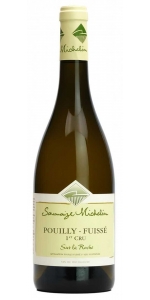
Saumaize-Michelin Pouilly-Fuisse “Clos sur la Roche” is made from 100 percent Chardonnay.
Produced from the oldest parcel of the estate dating back from 1979 and planted on the slopes of the Vergisson Rock, "Clos sur la Roche" benefits from a south sun exposure. This beautiful Chardonnay offers abundant floral and white fruit aromas, toasty and buttery notes and brioche scents. Well-balanced and concentrated on the palate with a rich structure and refreshing notes of zesty lemon and mineral purity that brings a vibrant energy to the finish.
Complex aromas of soft citrus fruits and minerals. Densely packed and fresh, with intense, complex flavors of white fruit as well as a hint of spice. The finish is very firm, long but not dry.
This site is now a Premier Cru!
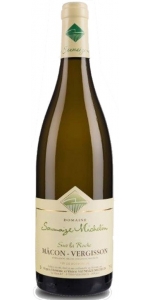
Saumaize-Michelin Macon Vergisson Cru Sur La Roche is made from 100 percent Chardonnay.
Harmonious, fresh and clean aromas of fresh apple, lemon, orange blossom, white flower. Pure, crisp, silky and fine texture. Ripe fruit flavors and good acidity.
Saumaize-Michelin Macon Vergisson Cru Sur La Roche is made from 100 percent Chardonnay.
Harmonious, fresh and clean aromas of fresh apple, lemon, orange blossom, white flower. Pure, crisp, silky and fine texture. Ripe fruit flavors and good acidity.
Saumaize Michelin Macon Vergisson Sur Roche is made from 100 percent Chardonnay.
Harmonious, fresh and clean aromas of fresh apple, lemon, orange blossom, white flower. Pure, crisp, silky and fine texture. Ripe fruit flavors and good acidity.

All older vintage wines have been purchased from a single collectors cellar. Pictures can be requested before shipment.
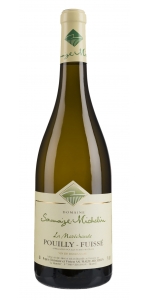
Saumaize Michelin Pouilly Fuisse Marechaude is made from 100 percent Chardonnay.
A beautiful Pouilly-Fuisse from "La Marechaude" parcel that Saumaize-Michelin acquired in 2013. Planted on clay and limestone slopes and hand harvested, this Chardonnay offers fresh and elegant notes of white flowers, crisp, citrus and exotic fruits. Powerful and mineral on the palate with a fantastic balance, finesse and freshness. The exceptional terroir brings minerality and juicy flavors of stone fruits, peach and melon supported by subtle toasty notes.
It is now a Premier Cru.
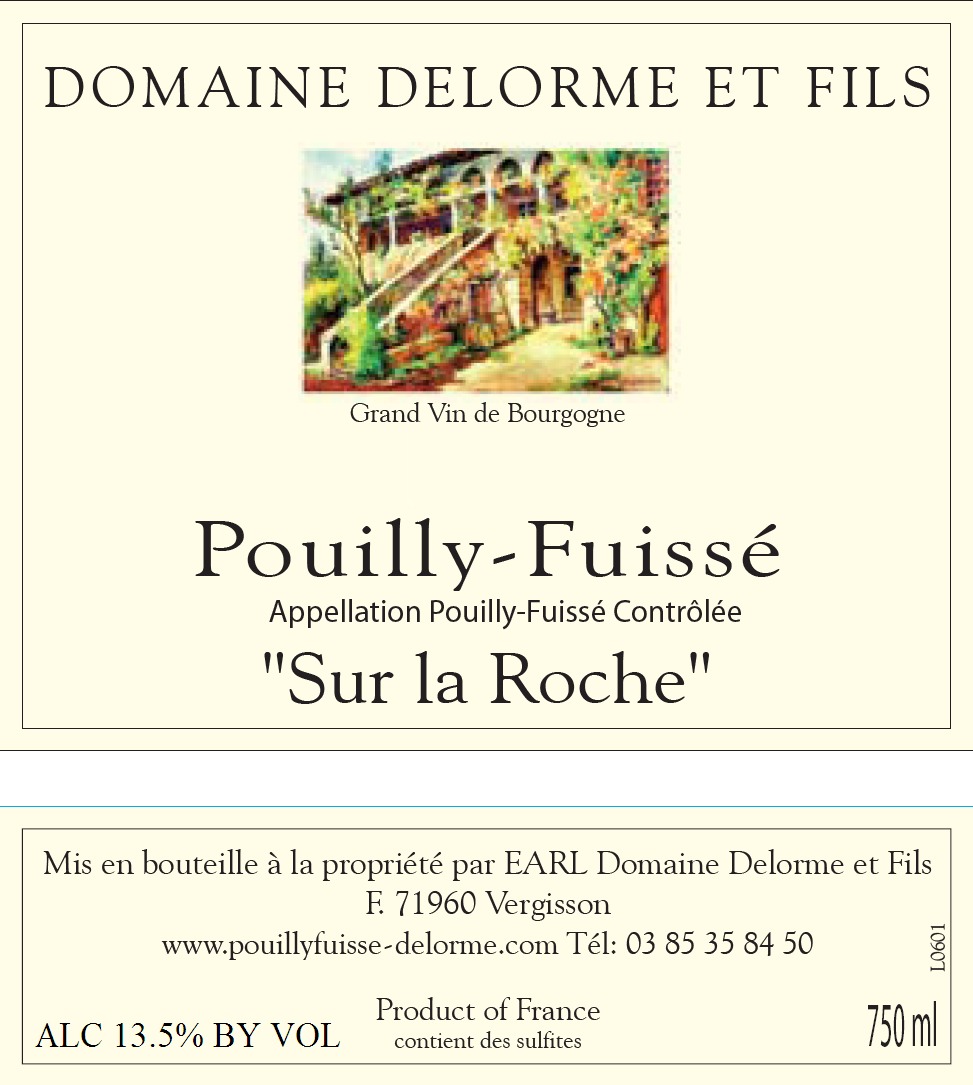
Michel Delorme Pouilly-Fuisse Sur la Roche 2011 is made from 100 percent Chardonnay.
The wine is produced from 40 year old vines ideally situated on the south east faced slope near the rock of Vergisson.
The wine is aged in stainless steel tanks with a short period in oak barrels.
Bright golden yellow color. The nose offers floral and stony mineral aromas. Rich and elegant on the palate with citrus and lemon flavors, and a nice acidity.
The Domaine Michel Delorme Estate
Domaine Michel Delorme was founded in 1820 and is located in Vergisson, a very small traditionally winegrowing village in South Burgundy, 10 km from Mâcon and famous for its “Roche” (rock). Delorme family has owned the Domaine for generations. The origin can be traced back to the 17th century.
The Domaine Michel Delorme Vineyard
The vineyard is composed of 4.3 hectares (10.6 acres) of land. The breakdown is 3.9 hectares of Pouilly-Fuisse and 0.4 hectare of Saint-Veran. Approximately 60% of his production is sold in bottle and 40% sold in bulk to negoce. Production is about 2,400 bottles of Saint-Veran (200 cases) and 16,000 bottles of Pouilly-Fuisse (1,333 cases). The vineyards are cultivated on slopes around the Rock of Vergisson, with a south-southeast exposure. Pouilly-Fuisse and Saint-Veran wines are both 100 % made from the little golden-seeded Chardonnay grape.
Exceptionally aromatic with aromas of violets, hints of blackberry, blackcurrant and black plum on the nose. There is some spice that is balanced with fresh acidity and minerality. A long finish with ripe but firm tannins.
Dow's Senhora da Ribeira can be enjoyed anytime and pairs wonderfully with chocolate desserts and soft cheeses like creamy Stilton or Roquefort.
Review:
Rich and fruity, this wine is packed with intense black-currant flavors. It is perfumed, ripe with a good tannic background. The density of the wine and the firm structure point to a long aging process. Drink this beautifully structured wine from 2026.
-Wine Enthusiast 93 Points
Winemaking:
Senhora da Ribeira has one of the most advanced specialist wineries in the Douro, combining the best of traditional winemaking practice, evolved over centuries, and the latest state-of-the-art automated systems. Three granite ‘lagares’ for foot treading are complemented by three ‘robotic’ lagares, designed by the Symington family and installed in the quinta’s winery in 2001.
It has long been recognised that traditional treading produced some of the finest Ports, but there are some drawbacks involved in traditional treading; temperature control is difficult, there is a limit to how long people are willing to tread and they need to sleep. The winemaker’s options are therefore limited, he or she cannot order treading at different times through the night, or pull people off the picking team at will. Furthermore, emptying the traditional lagar takes a long time; in the meantime the fermentation process is accelerating away. A further handicap arose over recent years, when an increasing scarcity of labour obliged producers to look for less labour-intensive vinification solutions. The Symingtons opted to devise a mechanical means of replicating the proven method of foot treading. The result was the Symington ‘robotic lagar’, an automated treading machine which exactly replicates the gentle action of the human foot and which has revolutionised winemaking in the Douro Valley. This equipment is very expensive but the results have been so good that an increasing proportion of Dow’s finest wines are now made in these automated lagares. Approximately half of the wines for Dow’s much praised 2003 Vintage were vinified in them.
The Senhora da Ribeira’s Quinta Vintage Ports have amassed a highly impressive number of awards: three Gold Medals at the International Wine Challenge, (2008, 2006 and 2001, for the 2005, 2002 and 1999 Vintages, respectively) as well as seven Silver Medals and two Gold Medals at the International Wine & Spirit Competition (London, 2008 for the 2005 Vintage and 2002 for the 1998 Vintage). In September 2006, Jancis Robinson MW wrote, “One very exciting new bottling is Dow’s Quinta da Senhora da Ribeira 2004...this single quinta bottling demonstrates superb quality with wonderful vibrancy. Great wine in any context - not that unlike some California reds! This is definitely a wine to look out for when it is released.”
Wine Profile
The very hot climate through the summer at this vineyard results in highly complex and concentrated wines but very low yields. Colours of the musts in the fermentation tanks are always purple-black due to the very high skin to juice ratio. The old vines add further to the intensity of the wine as they make up a very large percentage of the vineyard. The resulting wine can be described as being the essence of Vintage Port, with powerful wild red-fruit flavours, leading into rich black chocolate notes, the whole balanced by complex, attractive and peppery tannins.
One of the Douro’s most beautiful vineyards, Senhora da Ribeira is located 24km (15 miles) upriver from Quinta do Bomfim in the remote Douro Superior. The vineyard commands a magnificent north bank position, overlooking a broad sweep of the Douro, directly opposite another famous Symington owned vineyard: Quinta do Vesuvio. Senhora de Ribeira was built close to an ancient river crossing, guarded by two 12th century castles on either side of the river built by the Moors during their centuries long occupation of Iberia. A small chapel dedicated to the ‘Lady of the River’ (literally: Senhora da Ribeira) has stood here for centuries and gave the quinta its name. Travellers would pause here to ask for a safe river passage and onward journey.
Senhora da Ribeira’s wines are some of the finest in the Douro and they complement those from Bomfim in the composition of Dow’s classic Vintage Ports. The quinta’s high proportion of old vines (45% are over 25 years old) is of critical importance. The old vines are very low-yielding, producing on average less than 1Kg of grapes each, giving intense and concentrated musts which are ideal for classic Vintage Port. The remainder of the vineyard was replanted as follows: 21% in 2001 and 34% from 2004, the latter involving mainly Touriga Nacional vines. This grape variety - very important for Vintage Port - now represents almost exactly a third of the total planted at the quinta. The entire vineyard has the maximum ‘A’ rating.
As with Bomfim, the consistency of the climate plays a key role, although the rainfall is only half of that experienced at Bomfim: 448mm is the 10 year average. This more extreme climate, hot dry summers and cold, equally dry winters results in wines with unique depth of colour and complexity.
As with Quinta do Bomfim, the best Ports from Senhora de Ribeira are used to make Dow’s Vintage Ports in the great and rare ‘Declared’ years. In the good year’s when Dow’s does not ‘declare’ a Vintage, the best wines of ‘The Lady of the River’ are bottled as Dow’s Quinta de Senhora da Ribeira Vintage Port. They will tend to mature a little earlier than the very rare ‘Declared’ years, but can be every bit as good as some other Vintage Ports.
Scents and flavors of peach and yellow plum, citrus and mineral notes. Extremely long, white peach finish.
This wine is a 100 case Cuvee produced from the steepest part of the Paulinschofberger vineyard, 65 % slope. Vine age is 105 years old. "Grosses Gewachs" Großes Gewächs: (great growth = Grand cru), a designation used by VDP members in all regions except Mosel and Rheingau to designate top-level dry wines from selected sites (the highest level of quality). Dry means dry on the palate. The maximum yield is 50 hl/ha, from a classified vineyard. The natural minimum density of must is around 90° Oechsle. The wines are produced using exclusively traditional production methods. The wines are tested and approved by a test body before and after bottling. Hand Harvest (no machine harvest). The wine must not be released before September the year after it was made.



