
" We don't sell the wine without touching the vine "
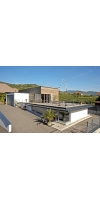
Rudi Pichler is among the elite growers of the Wachau producing wines of precision, power, and longevity. The cellar is based in the village of Wösendorf where generations of Pichlers have tended vines since 1731. Rudolph Pichler, III took over the winery in 1997 and has since expanded the vineyards and constructed a modern cellar in 2004. Grüner Veltliner and Riesling make up 95% of the production with the remaining 5% shared between Weißburgunder and Roter Veltliner. Rudi Pichler belongs to the prestigious Vinea Wachau and vinifies under the strict parameters of their codex. He was awarded Falstaff’s Vintner of the Year in 2010.
Weingut Rudi Pichler consists of 37 acres spread between Wösendorf, Joching, Weißenkirchen, and Mautern. Wösendorf and Joching lie in the heart of the Wachau Valley where south-facing terraces look down at the Danube River. Here, rieden such as Kirchweg, Hochrain, and Kollmütz are marked by occasional deposits of loess over base rock. Rudi produces crystal-clear expressions of Grüner Veltliner, Riesling, and Weißburgunder from these sites. Directly east of Joching is Weißenkirchen, home to the famous rieden of Steinriegl and Achleithen, two distinctive Riesling sites with calcareous and weathered gneiss, respectively. Rudi also maintains a small vineyard of Roter Veltliner across the river in Mautern.
“I’m a wine caretaker not a winemaker,” is Rudi’s credo, placing the intensity of work in the vineyards at the foundation of his philosophy. Rudi wants vineyard and varietal expression to be as clear as possible so yields are kept low between 30 and 35 hectoliters per hectare with harvest and botrytis carefully removed by hand. Grapes are crushed by foot and receive between three and 36 hours of maceration on the skins depending on the vintage and style. “The skin has information about the specific place where it is from,” says Rudi. Vinification is entirely in stainless-steel tanks and malolactic fermentation is avoided. The resulting wines are pure, dense, and taut with energy.
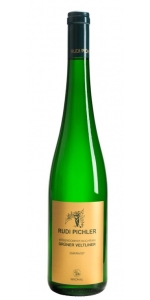
Rudi Pichler is among the elite growers of the Wachau producing wines of precision, power, and longevity. Grüner Veltliner and Riesling make up 95% of the production with the remaining 5% shared between Weißburgunder and Roter Veltliner. Rudi Pichler belongs to the prestigious Vinea Wachau and vinifies under the strict parameters of their codex.
Yields are kept low between 30 and 35 hectoliters per hectare with botrytis carefully removed by hand. Grapes are crushed by foot and receive between three and 36 hours of maceration on the skins. Vinification is entirely in stainless-steel tanks and malolactic fermentation is avoided.
Hochrain, a name meaning "high place," is a southeast-facing terraced vineyard in Wösendorf sitting between 200 and 300 meters of elevation. The vineyard consists of an unusually high content of loess, a mineral-laden soil that produces wines that are especially broad and rich.
Review:
“A stunning wine for this grape that is also rather easy to understand. The Reine Claude plum and peppery nose is complex, but already charming. As exciting as the simultaneously creamy and succulent mid-palate is, what makes this medium- to full-bodied gruner veltliner really stand out is the extremely long, crushed rock finish.”
James Suckling 96 Points
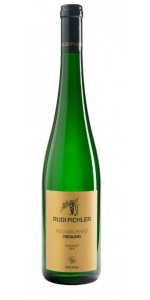
Wachau Riesling is dry and often defined by high levels of dry extract (due to a lengthy ripening period) and a pleasing freshness (due to dramatic temperature swings between day and night). Sedimentary soils of sand and stone give Kirchweg Riesling a dense mineral texture and fine fruity flavors.
Review:
Welcome to the dark side of Wachau dry riesling! Deep and delicately spicy nose that’s full of mystery. Incredible concentration and massive wet stone character on the very precise medium-bodied palate. Radical mineral energy and garden herb freshness at the enormously long and tightly-focused finish.
-James Suckling 98 Points
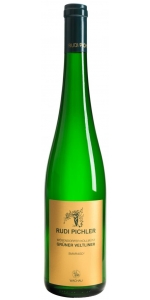
Rudi Pichler Kollmutz Smaragd Gruner Veltliner is made from 100 percent Gruner Veltliner.
Rudi Pichler is among the elite growers of the Wachau producing wines of precision, power, and longevity. Grüner Veltliner and Riesling make up 95% of the production with the remaining 5% shared between Weißburgunder and Roter Veltliner. Rudi Pichler belongs to the prestigious Vinea Wachau and vinifies under the strict parameters of their codex.
Yields are kept low between 30 and 35 hectoliters per hectare with botrytis carefully removed by hand. Grapes are crushed by foot and receive between three and 36 hours of maceration on the skins. Vinification is entirely in stainless-steel tanks and malolactic fermentation is avoided.
Kollmütz is a terraced vineyard in Wösendorf sitting between 200 and 400 meters of elevation. The soils of Kollmütz developed from an ancient landslide resulting in chaotic layers of rock and boulders. The vineyard is particularly rich in magnesium and iron. Wines from Kollmütz are typically linear, dense, and intensely mineral in character.
Grüner Veltliner is the signature grape of Austria and produces a dry white wine with savory aromas, spicy flavors, and good acidity. Grüner Veltliner Smaragd from the Wachau is a full-bodied wine and is rich in style with notes of stone fruit, lemon, radish, and arugula.
Review:
I have heard gruner veltliner dismissed for supposedly not being elegant, but this is an extremely elegant example! Very complex nose of snow peas, green beans, wild herbs and green pepper. On the medium-bodied palate, this remarkable gruner veltliner has a discreet succulence, but what makes it amazing is the way it glides so gracefully over the palate, then splash lands in a deep pool of wet stone minerality. Underplayed power and concentration!
-James Suckling 97 Points
Wachau Riesling is dry and often defined by high levels of dry extract (due to a lengthy ripening period) and a pleasing freshness (due to dramatic temperature swings between day and night). Sedimentary soils of sand and stone give Kirchweg Riesling a dense mineral texture and fine fruity flavors.
Review:
I love the deep and delicate, peachy nose of this extremely attractive Wachau dry riesling. Wonderful fresh fruit with a touch of mint and lemon balm on the ripe but rather sleek and very precise palate. The power and concentration show themselves first at the stunningly long and pristine finish.
-James Suckling 96 Points
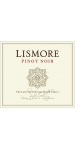
Lismore Pinot Noir is made from 100 percent Pinot Noir
Complex bouquet of crushed rose petals, wild jasmine and fresh French herbs followed by a palate full of cranberry, raspberry and a long savory finish.
The grapes were picked at optimal ripeness. 30% whole bunch fermented in large 5000 liter vats with gentle pump-overs twice a day. The process allowed for a long extraction period which lends to the fruit expression and structure of this wine. The free run wine was drained off and the fermented grapes were then pressed in a traditional wooden basket press. The wine was racked into 225, 300 and 500 liter barrels where malolactic fermentation took place and the wine was aged for 10 months. 35% new French oak was used.
Review:
"The 2018 Pinot Noir comes from Walker Bay and Kaaimansgat and includes 30% whole-bunch fruit, aged for 11 months in 25% new oak. The bouquet sports vivid red cherry and raspberry fruit that is exceptionally well defined and beautifully integrated with the oak. The palate is medium-bodied with supple tannins, well-judged acidity and a slightly fleshy texture. There is just the right amount of salinity here, and the finish is kept on a tight leash, allowing the detail and precision to be fully expressed. A slight sour edge on the finish keeps you coming back for another sip. Excellent and reassuringly classy. - Neal Martin" - Antonio Galloni's Vinous (November 2019), 92 pts
"Walker Bay and Elandskloof are the twin sources of 30% whole bunch-fermented Pinot from Sam O'Keefe. Juicy, floral and charming, it's a graceful, fruit forward style with some clove and tobacco spice and refreshing acidity. The finish is a little firmer than I remember. 2020-24"- Tim Atkin (South Africa 2020 Special Report), 92 pts
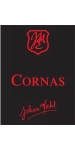
Johann Michel Cornas is 100% Syrah
This Cornas is a blend from 2 different vineyard sites:
- 60% of the final blend is from vineyards located on a hillside (16 year old vines on the "coteau"), planted on sandy soils, decomposed granite and some rocks, giving the structure, spiciness and licorice flavors to the blend.
- the other 40% of the final blend comes from the bottom of the slope (40 years old vines on the "pied de coteau"), planted on sandy soils, bringing acidity and balance to the wine.
Expressive, deep, rich, silky and juicy. Well structured and round, it displays red fruit, leather, black cherry, liquorice and black berry aromas.



